
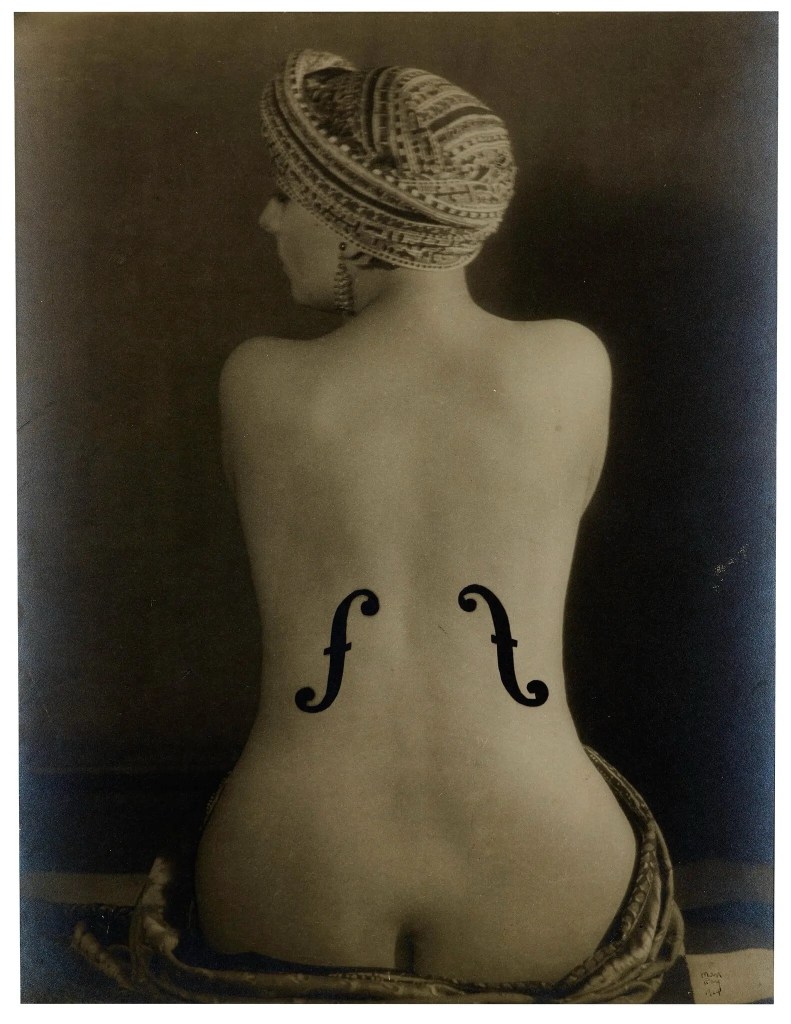
Man Ray’s “Le violon d’Ingres,” 1924. The showstopper at the Met, purchased at auction for about $12.4 million, shows Man Ray’s lover, Kiki de Montparnasse (born Alice Prin). Credit… Man Ray 2015 Trust/Artists Rights Society(ARS), NY/ADAGP, Paris 2025; via Metropolitan Museum of Art, New York. [New York Times caption and illustration]
Muddling is when you gently and lovingly release aromatic oils from fruits and herbs.
“I have finally freed myself from the sticky medium of paint, and am working directly with light itself.”
(Man Ray, 1922)
In French, the title [“Violon d’Ingres] is an idiom for a hobby, derived from the story that the great painter Jean-Auguste-Dominique Ingres prized his amateur violin playing as highly as his art.
To make his image, Man Ray photographed Kiki de Montparnasse from behind, nude to just below the waist and wearing a turban, a pose that Ingres had used in the painting known as “The Valpinçon Bather,” on view in the Louvre. On Kiki’s lower back on the print, Man Ray drew the f-holes of a violin in black ink.
Afterward, he had another idea. He enlarged the print of Kiki in the darkroom and masked it with a sheet of paper or cardboard on which he had cut two f-holes. Then he flashed the light again, so that the shapes were burned black, to make what he called “a combination of a photo and a rayograph.”
… Along with an ingenious melding of techniques, he had transposed a verbal pun into visual reality. In its beauty and absurdity, “Le Violon d’Ingres” encapsulates, arguably better than any other artwork, the insouciant wit of Surrealism…
(Arthur Lubow, “Man Ray’s Mysteries, in Glorious Bloom at the Met,” New York Times, 9-6-25)
(c) 2025 JMN — EthicalDative. All rights reserved





 EthicalDative
Rollicking Chin Wag Introduces ‘Mumble Rap’
The New York Times recorded interview with Earl Sweatshirt was a freewheeling romp by a voluble cohort of cognoscenti. High spirits prevailed. The three-way session was suffused with knowing guffaws, spicy vernacular and poignant insider allusion. For the hip-hop-curious outsider listening in, it felt like sniffing someone else’s delicious picnic and longing for a taste of the goodies.
I’ve often meditated on what role the lyrics play in pop music, fretting over my inability to understand the words of many songs. I’m talking about the vocalizations of well nigh every front man or woman of every rock group I’ve ever listened to — I don’t mean only Elton John and Robert Plant. (Paul Simon is an exception.)
I settled resignedly into the notion that the singers’ voices were simply another instrument in the combo; that what they uttered were musical noises, as notes are noises, and unencumbered with conventional denotative freight; they were not units of spoken communication at all. If the singers weren’t bothered for their noises to reach me as words, I wasn’t bothered to decode those noises other than tonally and acoustically. It was all about the melody, the moves, the beat, the “wall of sound,” baby.
In his interview, Earl dropped a remark that has turned my modus vivendi with pop garble on its head:
I definitely want to always be expanding my linguistic capabilities. If you’re in 2025 complaining about mumble rap — probably racist. If you haven’t processed that different people talk different ways, like, why are you not trying to aspire to learn new things? Like Boomhauer, his homies know what he’s talking about.
Yikes. Message received and taken under advisement. Processing like crazy here.
I’d never heard the term “mumble rap” before, but I ask myself, “Have I been bitching unfairly about ‘mumble rock’ all the while?” Maybe I need to cultivate better aural literacy in genres that eschew punctilious enunciation, in like manner as I’ve done in studying the different ways foreigners use their tongues, attuning my ear to novel sounds, unaccustomed rhythms, runaway velocities. Putting in extra effort, damn it. I’m up for it. Never stop aspiring to learn new things, I say. (Also, I need to reflect on how the author of a book on hip-hop lyrics hangs out on genius.com curating the written signature of an oral genre.)
Rap, if not pop, I surmise, wants to be experienced as language on top of music. In casual contact with the genre, I’ve encountered references to a performer’s “flow” — the stream of speech. Pains are taken to create rhyme. These two characteristics alone suggest that its lyrics be treated as disclosure and narrative rather than highly cadenced, quasi-melodic, sonic gesture. Chant comes to mind, an intriguing and time-honored analog.
(c) 2025 JMN — EthicalDative. All rights reserved