My enduring affection for Spain gets periodic boosts from ceremonies such as this.
On June 6, 2020, a group of Spaniards staged a reenactment of Velazquez’s famous “Surrender of Breda” to commemorate the event itself in the Dutch war of independence as well as the painter’s 421st birthday on June 5.
It was staged a day after the anniversaries, outside the mid-16th-century house where Velázquez was born, and which is being turned into a learning centre and museum dedicated to the artist and his life.
Masks were worn and numbers of persons kept to a minimum in respect for the coronavirus.
Enrique Bocanegra, a journalist and author, is behind a project to restore Velazquez’s birthplace after being inspired by a visit to William Shakespeare’s home in Stratford-upon-Avon.
“We’re just waiting for permission to start the restoration works and we’re hoping to begin later this month,” said Bocanegra. “We’re going to start with the roof but the problem with renovating a 16th-century house is that it’s like opening up a melon – you just never know what you’re going to find inside.”
(Sam Jones, “Veláquez painting brought to life by historical reenactment group in Seville,” theguardian.com, 6-7-20)
Violence and gore, revolting and horrific in real life, are revolting and banal in the movies. What’s horrifying is how hard it is to find good horror in entertainment. Edward Tew chainsaws cleanly through the halitosis:
A lot of genre film-makers lazily assume that violence and gore will scare people the most but it never seems to work that way. Atmosphere, dread and the power of suggestion are much more disturbing and this underseen movie deftly uses all three to palm-sweating effect. It feels grounded in reality by refusing to go over the top.
“Creep” is a 2014 film from Blumhouse with Patrick Brice and Mark Duplass. It’s on Netflix in the U.S. and UK.
(Edward Tew, “My streaming gem: why you should watch Creep,” theguardian.com, 6-8-20)
Monte Brown and his wife Christine at Brown, Owens, and Brumley Family Funeral Home and Crematory, in Fort Worth. Credit… Ilana Panich-Linsman for The New York Times.
“What everybody is talking about right now is, what happened to pneumonia?” he said. “What happened to a lot of deals, a lot of common flu deaths, why is everything being reported Covid now?… We’ve heard that hospitals are getting reimbursed more for Covid cases…”
Perhaps Mr. Brown sensed that I was skeptical. “Right now you’re located in Texas, you’re in North Texas, you’re in the Bible Belt,” he told me. “So people around here have a different philosophy than a lot of people in New York.” Mr. Brown paused for a moment, holding my eyes with a practiced earnestness. “I’m just being honest.”
(Elizabeth Bruenig, “Death and Texas,” NYTimes, 6-5-20)
We Texans often have to remind visitors of where they’re located and where they’re from. It’s a kind of forgetfulness we cure them of with our honesty.
“Because it spans a very windy gap across the Bay, the Golden Gate Bridge is now effectively a giant orange wheezing kazoo.”
Citizens have weighed in disparately:
— Can someone explain me why is this eerie sound has been going on for an hour…
— So peaceful…
— So crazy but also kinda beautiful!!…
— We can hear this in our house more than three miles away from the bridge. It’s crazy making…”
Bridge spokesperson Paolo Cosulich-Schwartz has spoken knowingly:
“The new musical tones coming from the bridge are a known and inevitable phenomenon that stem from our wind retrofit project during very high winds… We knew going into the handrail replacement that the bridge would sing during exceptionally high winds… We are pleased to see the new railing is allowing wind to flow more smoothly across the bridge.”
The Guardian has analogized interestingly:
The noise is not the first time a suspension bridge’s physical qualities have raised eyebrows. Central London’s Millennium Bridge, for example, closed days after it opened in 2000 because of dramatic swaying. It reopened a year and a half later.
And I have decided conclusively:
If my choice is to cross a musical bridge or a kinetic one, I will choose the giant wheezing kazoo every time.
(Victoria Bekiempis, “‘A giant wheezing kazoo’: Golden Gate starts to ‘sing’ after design fix,” theguardian.com, 6-6-20)
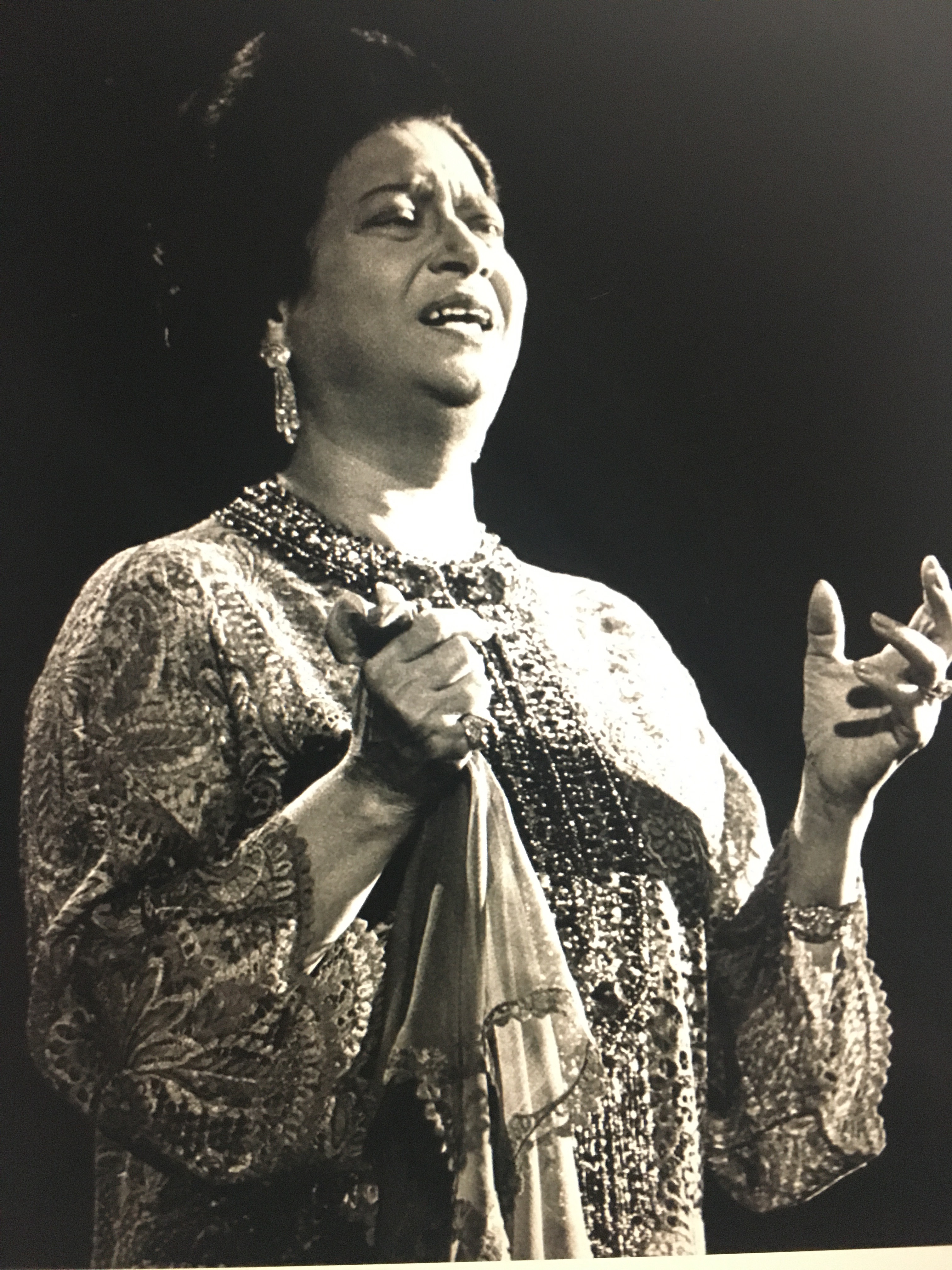
Umm Kulthum died in 1975. I had a passing acquaintance with the singing of this venerated Egyptian artist, but knew nothing of her life. I learn from this article by Tom Faber that Umm Kulthum’s singing was admired by western performers such as Maria Callas, Bob Dylan, and Robert Plant.
I also learn that her biographer Virginia Danielson, an ethnomusicologist, mentions Umm Kulthum’s “possible lesbianism,” saying that she showed little interest in men: “It is very, very likely she had relationships with women.”
Such discussions can be bumpy, and more so concerning deceased idols who span culture divides.
She is not a feminine singer, not at all. Her face lacks the prettiness appropriate to a woman’s face, and her lungs are extraordinarily large. Her breasts are massive, true; but her neck is thick as it encases her enormous throat. She draws, too, because her voice encompasses more than one sex, soaring high as the dome of the womb and falling as low as the well of the testicles. Her voice is saltiness and sweetness: an asexual voice, but a bisexual one, too. The lyrics to her songs are in a masculine voice, but one that encompasses the feminine.
The above remarks by Lebanese novelist Hoda Barakat are quoted by Iraqi writer Musa Al Shadeedi in the Jordanian LGBT magazine My.Kali referenced by Faber. The mention of Umm Kulthum’s possible lesbianism caused the Jordanian government to block the magazine’s website. Al Shadeedi’s comments reflect both temptation and reluctance to probe Umm Kulthum’s rejection of traditional gender roles.
“We don’t talk about strong or masculine women in our history… We only discuss [Umm Kulthum] as a singer… I don’t see how dragging dead people out of the closet will fix our society today… But we can ask: if she was lesbian, would that change how we see her? This might help people reconsider how they react to such taboos.”
In terms of reactions to such taboos, astonishing in its way is that of Columbia literature professor Edward Said, the Palestinian-American author of “Orientalism.”
“During her lifetime, there was talk about whether or not [Umm Kulthum] was a lesbian, but the sheer force of her performances of elevated music set to classical verse overrode such rumours.”
The remark is cited by Al Shadeedi from Said’s “Homage to a Belly-Dancer” in the London Review of Books (September 13, 1990). It is an extended tribute to Tahia Carioca. As Said warms to his subject, he makes this comment (not quoted by Al Shadeedi):
Whereas you couldn’t really enjoy looking at the portly and severe Um Kalthoum, you couldn’t do much more than enjoy looking at fine belly-dancers, whose first star was the Lebanese-born Badia Massabni, also an actress, cabaret-owner and trainer of young talent. Badia’s career as a dancer ended around World War Two, but her true heir and disciple was Tahia Carioca, who was, I think, the finest belly-dancer ever.
His remarks suggest that lesbianism and belly-dancing occupied two widely separate rungs of Professor Said’s sensibility.
(Tom Faber, “‘She exists out of time’: Umm Kulthum, Arab music’s eternal star,” theguardian.com, 2-28-20)
The police said seven bodies were found inside a home in Valhermoso Springs, near Huntsville, Ala. Credit… WAFF 48 Huntsville.
Life in these United States leads to comfort where you can find it: In this case, the theory by police that this is an isolated killing and not a spree killing.
Seven adults were found shot dead last night, June 4, 2020, in Valhermoso Springs, Alabama, near Huntsville. (“Valhermoso” means “pretty valley.”)
Four dead men and three dead women had multiple gun-shot wounds in a single-level, ranch-style residence. (Ranch-style homes became popular in the 1950s as a post-war white middle class settled into leafy suburbs around the country.)
“We believe it is an isolated, and not a spree, killing,” said a spokesman for the sheriff’s office.
“It is a horrific scene,” said the county coroner, but there is more comfort from police: It’s thought there is “no immediate threat to the public in the area.”
So: Not a spree killing — they’re of the worse kind — and no threat to the public in the area that could be deemed immediate; that tracks as good news in these United States.
(Christine Hauser, “7 People Dead in Alabama Shooting, Police Say,” NYTimes, 6-5-20)
The first published science journal, Philosophical Transactions of the Royal Society, was published in 1667 and consisted mostly of letters and brief dispatches. Credit… Album British Library, via Alamy. (Illustration from Carl Zimmer, “How You Should Read Coronavirus Studies, Or Any Science Paper,” NYTimes, 6-1-20)
The knowledge and assumptions that determine The Shed’s personal path through the pandemic are excerpted below. As the science evolves, our behavior will adapt accordingly. Godspeed and safe harbor to everyone. May we reach a common goal of the greatest possible health and wellbeing everywhere, for all, bar none.
Long Haul Ahead We will be in this pandemic era for the long haul, likely a year or more. The masks, the social distancing, the fretful hand-washing, the aching withdrawal from friends and family — those steps are still the best hope of staying well, and will be for some time to come.
Masks Beneficial Most experts now agree that if everyone wears a mask, individuals protect one another… And when combined with hand washing and other protective measures, such as social distancing, masks help reduce the transmission of disease…
Asymptomatic Spread … No one can afford to be cavalier about catching it. About 35 percent of infected people have no symptoms at all, so if they are out and about, they could unknowingly infect other people.
Herd Immunity Difficult We can’t count on herd immunity to keep us healthy… The antibodies that protect people against viruses infecting mucosal surfaces like the lining of the nose [in diseases such as influenza and whooping cough] tend to be short-lived.
Warm Weather No Guarantee We can’t count on warm weather to defeat the virus… If someone infected sits near you and coughs, or talks a lot or sings, it doesn’t really matter where you’re sitting and how nice a day it is… [The virus] has a world population with no immunity waiting to be infected. Bring on the sun; the novel coronavirus will survive…
Goal of Many Over 50 “As an older person, what I want is not to end up on a respirator…”
(All excerpts are from “Six Months of Coronavirus: Here’s Some of What We’ve Learned,” NYTimes, 6-3-20)
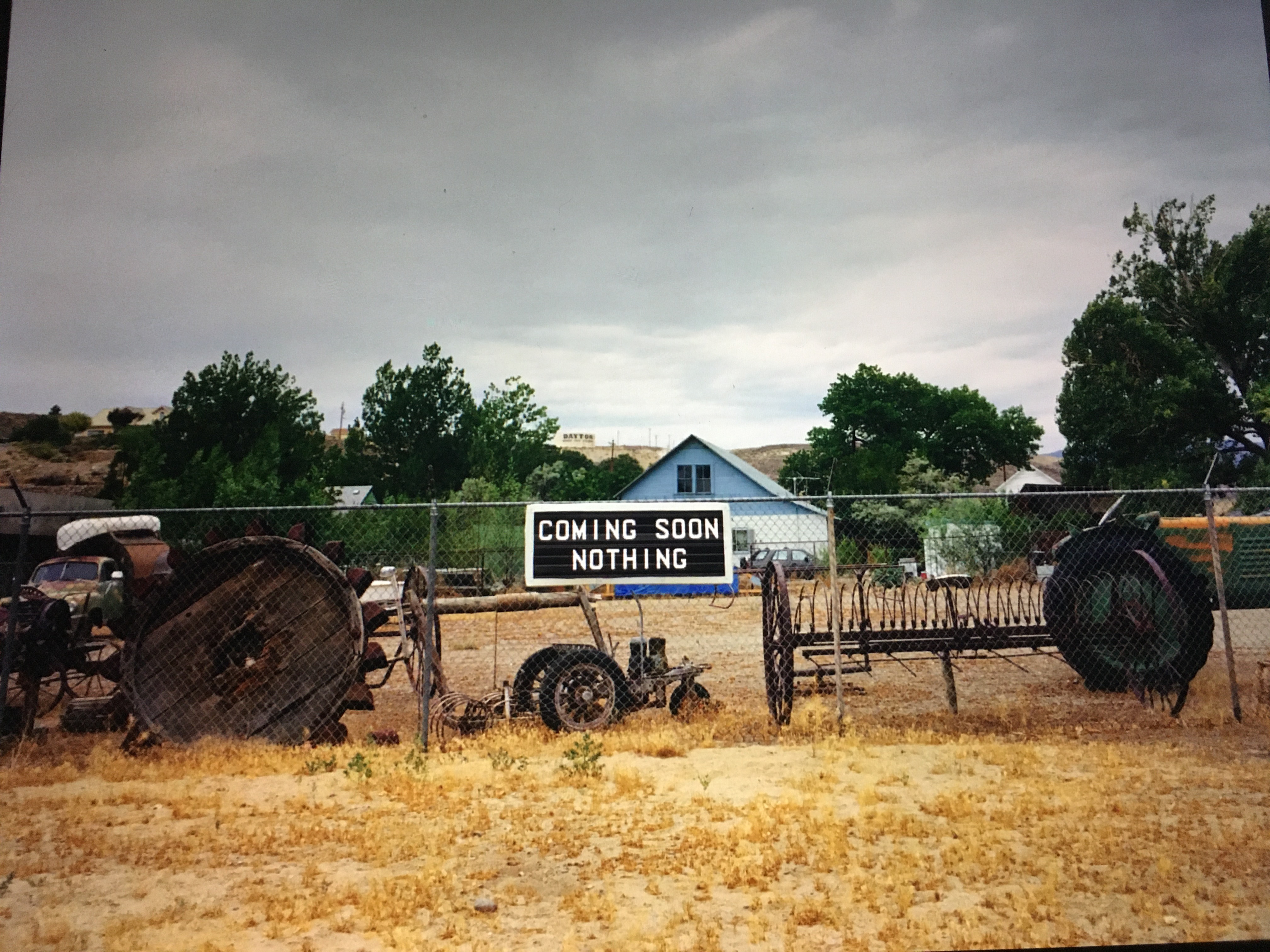
Roadside sign in Dayton, Nevada, 2002. Photograph: Jane Hilton/Courtesy of the artist and Eleven Fine Art. (Lisa O’Kelly, “The big picture: a deadpan roadside sign in Nevada,” theguardian.com, 5-31-20).
the tru-est words they says is that there are no per se
true words for it for ev-‘ry thing has a no-thing if
My dog with the candy name goes off at the drop of a hat. When the washing machine rumbles a cycle-change from the tenebrosity of its cave, I wish I could say Taffy ululates, but it would overdress the event. She does peal like popcorn at the sinister clank.
Loving waggy Taff nonsensically is my segue to the poetry of unknown words. Words to me unknown are new words; and known words used new ways have an unlikely hood to them that also stretches a body no-pain-no-gainfully.
Poets can’t be trusted to call Jane merely plain — due respect — or a thing by its first name. It’s the storied glory of the tribe, and keeps me toeing each new line in the sand they raise.
Here are sonorous fragments ripe with newness and reverence from Pascale Petit in Poetry, April 2020:
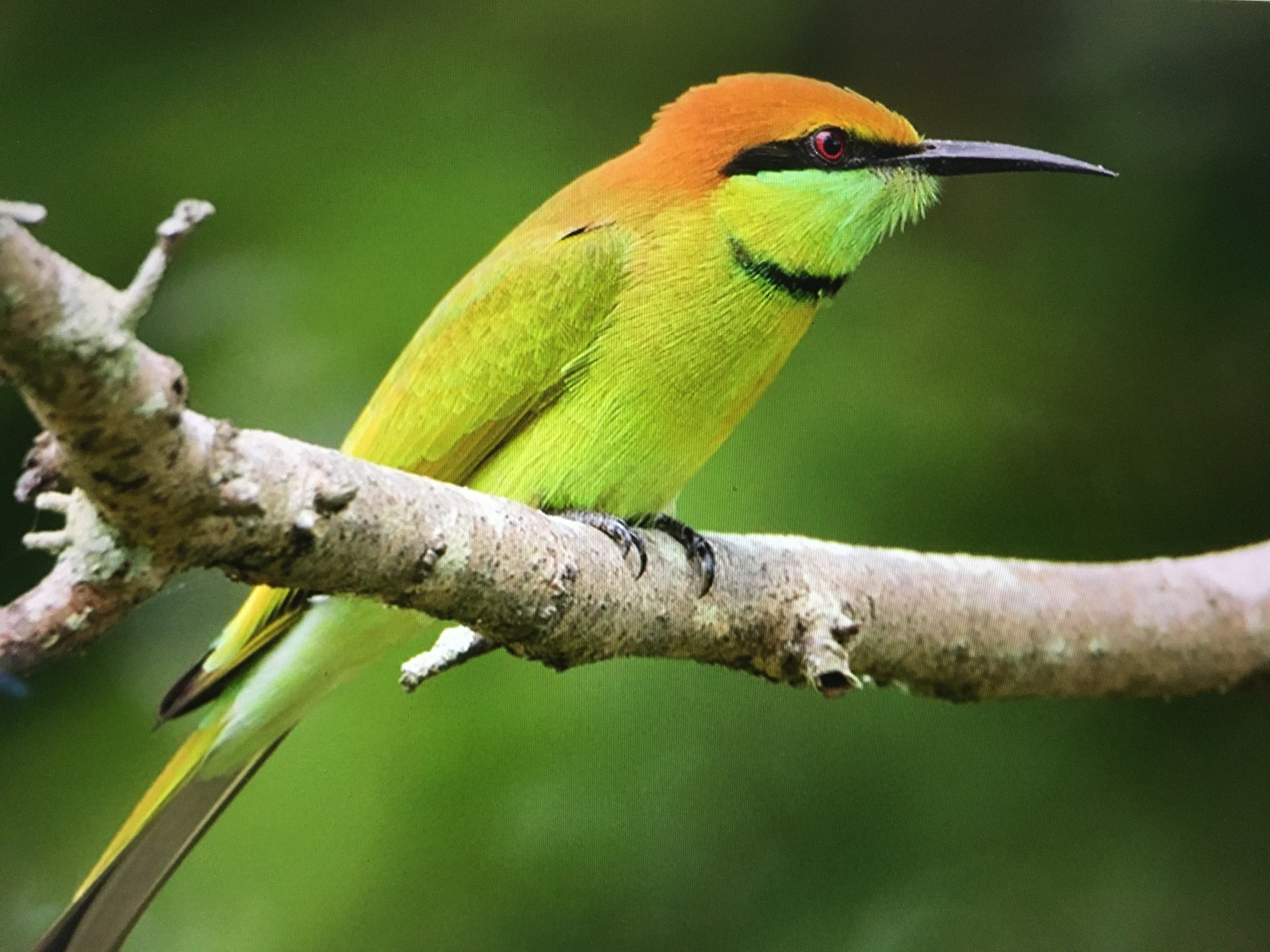
Green Bee-Eater More precious than all / the gems of Jaipur— / the green bee-eater […] with his space-black bill / and rufous cap…
Swamp Deer The barasingha bears his twenty-tined rack / like a crucified forest […] he crosses the highway / with all the birds of Kaziranga / balanced on each fork…
barasingha: swamp deer (Rucervus duvaucelii); native to India; status Vulnerable (population decreasing). green bee-eater: (Merops orientalis); a passerine (perching!) bird in the bee-eater family; status Least Concern (population increasing). Jaipur: capital of the Indian state of Rajasthan. Kaziranga: a national park in the Indian state of Assam. rufous: reddish-brown in color.







Opening Up a Melon
My enduring affection for Spain gets periodic boosts from ceremonies such as this.
On June 6, 2020, a group of Spaniards staged a reenactment of Velazquez’s famous “Surrender of Breda” to commemorate the event itself in the Dutch war of independence as well as the painter’s 421st birthday on June 5.
It was staged a day after the anniversaries, outside the mid-16th-century house where Velázquez was born, and which is being turned into a learning centre and museum dedicated to the artist and his life.
Masks were worn and numbers of persons kept to a minimum in respect for the coronavirus.
Enrique Bocanegra, a journalist and author, is behind a project to restore Velazquez’s birthplace after being inspired by a visit to William Shakespeare’s home in Stratford-upon-Avon.
“We’re just waiting for permission to start the restoration works and we’re hoping to begin later this month,” said Bocanegra. “We’re going to start with the roof but the problem with renovating a 16th-century house is that it’s like opening up a melon – you just never know what you’re going to find inside.”
(Sam Jones, “Veláquez painting brought to life by historical reenactment group in Seville,” theguardian.com, 6-7-20)
(c) 2020 JMN