
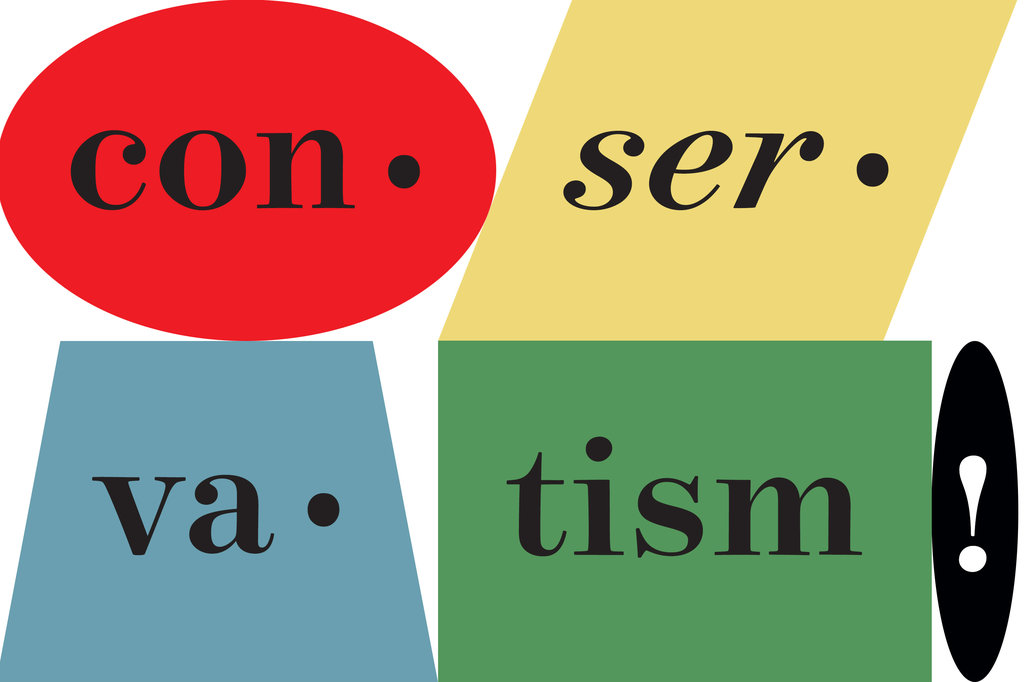
George Will reviews “American Conservatism: Reclaiming an Intellectual Tradition,” Edited by Andrew J. Bacevich. Being susceptible to typography-based graphics I was drawn in by the illustration. Will’s opening statement added enticement.
When assembling an anthology of writings representative of a political persuasion, the challenge is to acknowledge the persuasion’s varieties without producing a concoction akin to sauerkraut ice cream, a jumble of incompatible ingredients.
Two passages of Will’s critique sum it up. In the first, note the “however”; it betokens serious preceding quibbles.
The volume is, however, a nourishing cafeteria of writers, many of them justly forgotten but still interesting because they once were interesting.

The second passage credits Bacevich’s most inspired selection to be Joan Didion’s “1972 stiletto of an essay ‘The Women’s Movement,’ which begins, ‘To make an omelette you need not only those broken eggs but someone “oppressed” to break them.’”
Didion, who long ago contributed to National Review and in 1964 voted for Barry Goldwater, here exemplified an analytical acuity, stylistic verve and unenthralled mentality that conservatism, like other persuasions, rarely attains.
(George F. Will, “The Mind of Conservatism,” NYTimes, 4-1-20)
I confess to having to be reminded that there are, or have been at least, capable minds behind conservatism. The current scene belies it.
(c) 2020 JMN










Neck-Broken
A photo of Henry Adams helped draw me into a review by George F. Will of an anthology of conservative thinkers (“American Conservatism: Reclaiming an Intellectual Tradition,” Edited by Andrew J. Bacevich).
In “The Education of Henry Adams (1907),” Adams recalled “visiting ‘the great hall of dynamos’ at a 1900 exposition of modern technologies.”
There he felt “his historical neck broken by the sudden irruption of force totally new.” This illustrates Bacevich’s theory that “modern” American conservatism “emerged in reaction to modernity,” by which he means “machines, speed and radical change — taboos lifted, bonds loosened and, according to Max Weber, ‘the disenchantment of the world.’”
(George F. Will, “The Mind of Conservatism,” NYTimes, 4-1-20)
My bond with Henry Adams’s work is not with his famous “Education,” but with his “Mont Saint Michel and Chartres,” privately published in 1904. Wikipedia describes it as
a pastiche of history, travel, and poetry that celebrated the unity of medieval society, especially as represented in the great cathedrals of France. Originally meant as a diversion for his nieces and “nieces-in-wish”, it was publicly released in 1913 at the request of Ralph Adams Cram, an important American architect, and published with support of the American Institute of Architects.
It’s good to be reminded during a plague of soulless conservatism that a sensibility and tongue such as Adams’s once stood and spoke for the better kind, even in disenchantment.
(c) 2020 JMN