Art Wins, Artists Lose

cropped-wanted1.jpg

Among the biggest losers in the current system are artists themselves. With art now considered an asset class to equities and commodities, collectors are forever on the lookout for rising stars whose work can be bought at bargain prices and then resold for many multiples as their reputation soars. When the market moves on, careers are often shattered (except in the case of a few ever-in-demand stars).

And even those artists who do remain popular usually benefit only from the initial sale of their work; as its value appreciates, the profits go mainly to collectors and auction houses. 

(Michael Massing, “How the Superrich Took Over the Museum World,” NYTimes, 12-14-19)

(c) 2020 JMN

Posted in Commentary | Tagged | 1 Comment

“Pretty Ugly”

blooms library

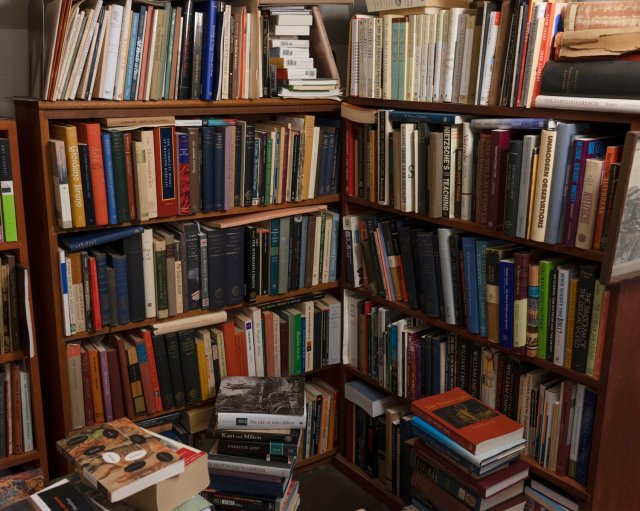
Harold Bloom’s home library, photographed in June. Credit Tanya Marcuse.

This tweet contrasts so starkly with the seriousness of the actual situation with Iran,” said Ben Rhodes, a former top national security aide to Mr. Obama. “We are in the midst of a roiling crisis with Iran that is largely of Trump’s own making, and yet he continues to view that largely through the prism of pretty ugly domestic politics.”
(Annie Karni, “A Narrative Collapses as Trump Tweets: ‘It Doesn’t Really Matter’,” NYT)

This quote triggers a reflection on the interesting use in English of “pretty” as what I would call an adverbial qualifier. The word is emptied of its adjectival sense of “comely” or “attractive” and becomes instead the equivalent of “fairly” or “to a great extent.” It seems to fall somewhere between the poles of “not much” and “extremely.” It’s especially fun when it happens to land alongside its opposite adjective “ugly.” 

Would a non-native speaker be confused by “pretty ugly,” wondering, “Which is it?” As a linguist I enjoy mulling how such expressions might be translated. 

In Spanish I would resort to “bastante,” which basically means “enough”; however, “bastante fea” becomes what I would call “pretty ugly.” 

In French also I would choose “assez,” or “enough”; “assez laide” is “pretty ugly” too.

(I’ve used the feminine adjectives “fea” and “laide” in both translations because “politics” is feminine in both languages: “la politica” and “la politique.”)

From a style standpoint, waffling adverbs can render statements flaccid, tepid, noncommittal, evasive, or deniable. See, for example, a statement by Stephanie Grisham, presidential press secretary, in defense of a photoshopped image retweeted by her boss:

 In an interview with Fox News, Ms. Grisham said the president was “making clear” that Democrats were “parroting Iranian talking points, almost [my emphasis] taking the side of terrorists.”

Correction: Making “almost” clear. 

(c) 2020 JMN

Posted in Commentary | Tagged , , , | 5 Comments

Intellectual Disarmament

diversity

Ross Douthat writes that when he was an undergraduate at Harvard University “our so-called ‘core’ curriculum promised to teach us ‘approaches to knowledge’ rather than the thing itself.” 

It was, and remains, an insane view for humanists to take, a unilateral disarmament in the contest for student hearts and minds; no other discipline promises to teach only a style of thinking and not some essential substance.
(Ross Douthat, “The Academic Apocalypse,” NYTimes, 1-11-19)

As a failed teacher I’ve found that some of the best pointers on teaching issue from the armchairs of non-teachers. It’s tempting to invert the sardonic old dig to: “Those who can’t teach it do it.”

I once taught Spanish in a humanities division. Our medley of disciplines — foreign languages, art, English, music, history, theater — competed to fulfill the humanities component of students’ degree plans. 

I finally dropped out of academia, before being thrown out, and went into advertising. My own insufficiency and creeping disengagement had defeated me. I could not give undergraduates a good reason to meet my Spanish class twice a week.

I had made one belated grasp for “substance” in an effort to make Spanish look relevant to elective shoppers: Translation! My overture to slant teaching in that direction was batted away by the senior ranks. 

As it happened, I had a profitable side-hustle as a translator for off-shoring industries. My obsession with George Steiner’s “After Babel” did not keep my bid to align my classroom and research activities from looking non-cynical to my tenured colleagues. They didn’t buy it, or me.

 (c) 2020 JMN

Posted in Commentary | Tagged | Leave a comment

Vija Celmins

celmins

New York Times.

Vija Celmins (pronounced VEE-ja SELL-mins) was born in 1938 in Riga, capital of Latvia. Fleeing the Soviet invasion of 1944, her family immigrated to the United States in 1948. She earned an undergraduate art degree in Indiana and an M.F.A from UCLA in 1965.

celmins1

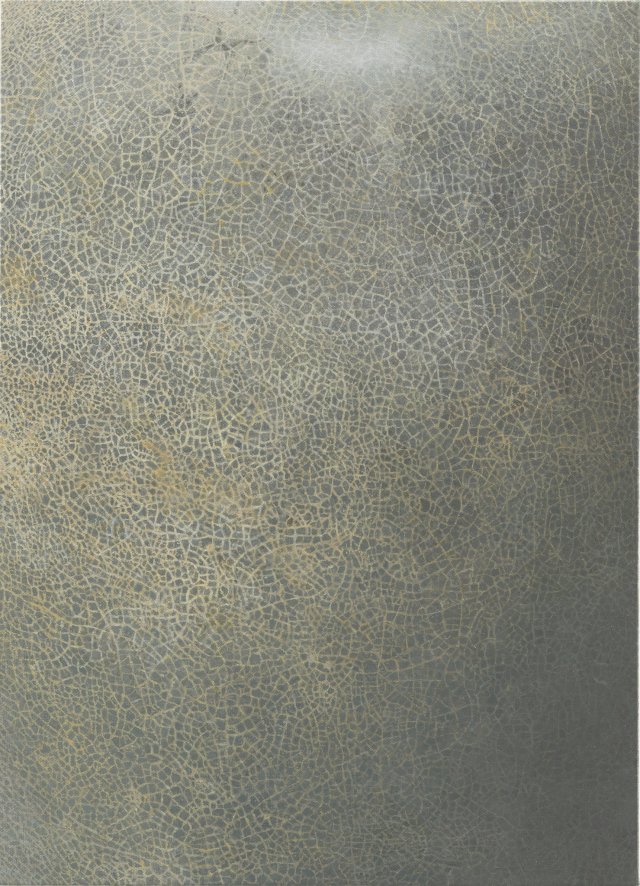
A recent painting by Vija Celmins, “Vase,” offers a close-up of the side of a Chinese porcelain vase, with its finely rendered craquelure glaze. Credit…Vija Celmins and Matthew Marks Gallery.

Within a decade, she was becoming known for precise, painstakingly wrought illusions of reality: expanses of ocean waves, star-studded night skies, clouds or the moon’s surface, rendered in graphite, charcoal or muted tones of oil paint.

celmins3

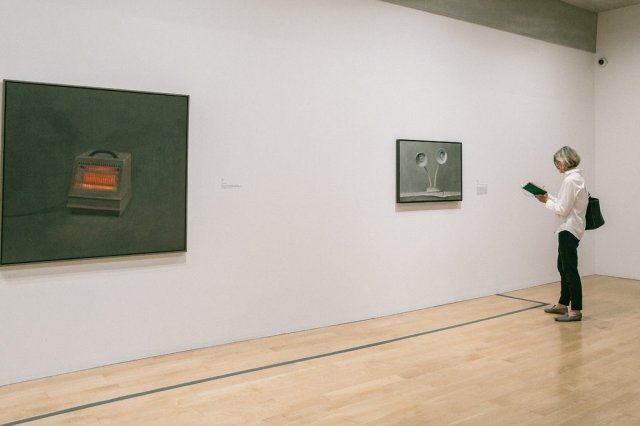
From a time when she was “looking at simple objects and painting them straight”: From left, “Heater,” 1964, and “Lamp #1,” 1964. Credit…Haruka Sakaguchi for The New York Times.

[In the period 1963-1968]… Ms. Celmins first committed to “looking at simple objects and painting them straight.” She depicts her studio companions — an electric heater, its red-hot coil at full blast; a two-headed lamp; and an electric fan — in varieties of gray. “I’m from a gray land, Latvia,” she has said. They also testify to her attraction to the lush backgrounds of Velázquez.

celmins2

From 1968, “Letter,” collage and graphite on paper. Ms. Celmins made the envelope’s five stamps separately; three tiny drawings offer aerial views of the Pearl Harbor attack. Credit…Vija Celmins and Matthew Marks Gallery.

In a smaller gallery of tiny graphite drawings there is a depiction of a letter addressed to the artist in her mother’s cursive handwriting. Ms. Celmins made the envelope’s five stamps separately; each is a tiny drawing with crenelated edges, three offer aerial views of the Pearl Harbor attack.

(Roberta Smith, “Deep Looking, With Vija Celmins,” NYTimes, 9-26-19)

(c) 2020 JMN

Posted in Commentary | Tagged , , | 1 Comment

Therianthropes

therianthrope

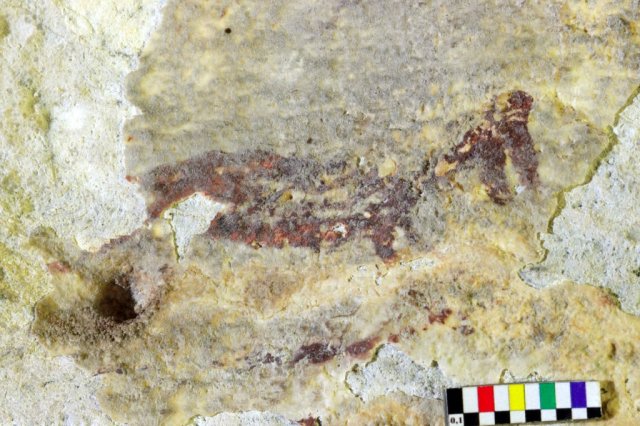
A humanoid with a bird-like head was among the eight therianthrope figures depicted in a cave painting on the island of Sulawesi. Credit…Ratno Sardi.

In December 2017, an Indonesian archaeologist discovered a cave painting on the island of Sulawesi that dates back at least 43,900 years — “the oldest pictorial record of storytelling and the earliest figurative artwork in the world.”

In the story told in the scene, eight figures approach wild pigs and anoas (dwarf buffaloes native to Sulawesi). For whoever painted these figures, they represented much more than ordinary human hunters. One appears to have a large beak while another has an appendage resembling a tail. In the language of archaeology, these are therianthropes, or characters that embody a mix of human and animal characteristics.

The author of this article writes: “… The original inspiration for the painting, as well as its significance to the humans who created it, is likely to remain a mystery.”

… These humans were storytellers whose abstract [?] paintings shed light into the origins of human cognition and spirituality… “While we can’t know if this was the case… we can point to these enigmatic images of therianthropes as the world’s earliest known evidence for our ability to conceive of the existence of supernatural beings.” … A linguist [at MIT] suggested that the painting could have implications for understanding humanity’s “unique capacity to communicate using intricate language… It also hints at high order cognitive processes such as language and elaborate artwork emerging fairly recently in evolution,” [he said].

(Becky Ferreira, “Mythical Beings May Be Earliest Imaginative Cave Art by Humans,” NYTimes, 12-11-19)

Besides introducing me to the term “therianthrope” (werewolves are therianthropes!), the article suggests how archaeology itself is a science that treats mystery with projective storytelling and disciplined leaps of imagination.

(c) 2019 JMN

Posted in Commentary | Tagged , , | Leave a comment

“The Self-Defeating Rage of the Old”

edgerton

Shonagh Rae.

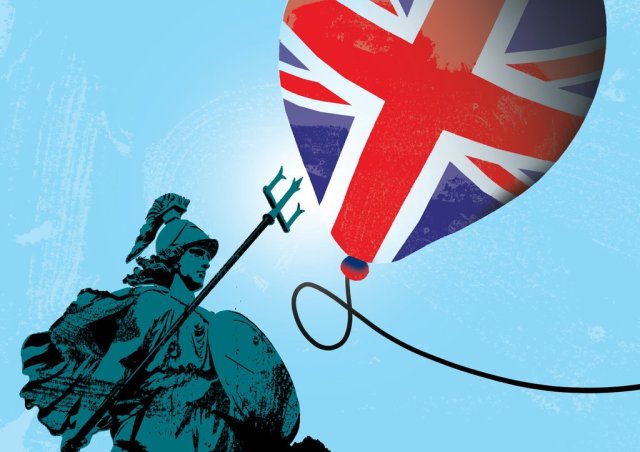
The young people of England, like those in the rest of Britain, … understand we need liberation from the practices of Westminster and Whitehall, not Brussels, and from the self-defeating rage of the old.

David Edgerton, a British historian, writes: “The ‘United Kingdom’ is neither ancient nor stable.”

After 1945, “Britain” — a national United Kingdom — was one of many post-imperial constructions that emerged from the ashes of the British Empire… This national United Kingdom was broken up economically starting in the 1970s by the closely related processes of globalization and deepening economic integration with Europe.

Edgerton argues that the U.K.’s dissolution, which may be likelier after Brexit, could ultimately be beneficial for each country — Northern Ireland, Scotland, Wales and England.

Despite its being the dominant nation in the United Kingdom, the arrangement hasn’t been good for [England]. It doesn’t have a sense of itself as a nation to be transformed and is divided between the vibrant, youthful and pro-European big cities — especially London — and the aging, stagnating and anti-European rest of the country.

(David Edgerton, “Boris Johnson Might Break Up the U.K. That’s a Good Thing,” NYTimes, 1-10-20)

This is my first encounter with a somewhat positive vision of a conceived post-U.K. future.

(c) 2020 JMN

Posted in Commentary | Tagged , | 1 Comment

Feminized Heroes

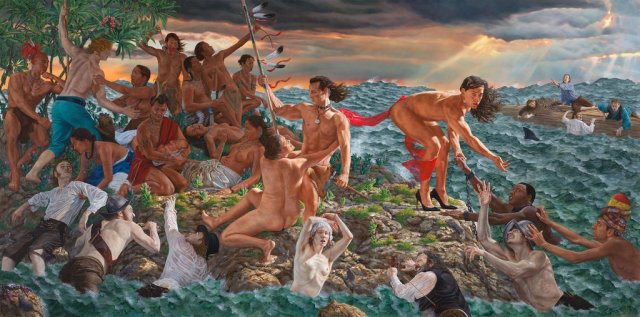
Images of historic persons have been depicted recently in novel ways by artists in Mexico and in Canada. Both cases have a gender-fluid slant; the contrast in public reaction in each country is notable.

zapata

The work is part of an exhibit about Zapata in one of Mexico City’s premiere arts venues, the Fine Arts Palace. Photograph: Eduardo Verdugo/AP.

Emiliano Zapata, betrayed and killed in 1919, was a hero of the Mexican Revolution, an advocate for landless peasants. Artist Fabián Cháirez depicts a naked Zapata astride a white horse, wearing high heels “while his lips pout beneath his distinctive curved moustache.” His sombrero is pink.

This isn’t freedom of expression, it is debauchery! It’s degrading. They can’t exhibit our history that way,” fumed Antonio Medrano, a spokesman for the protesters. “They can’t permit this kind of mockery.”

“… We are not going to allow this,” said Jorge Zapata Gonzalez. “For us as relatives, this denigrates the figure of our general – depicting him as gay.”
(David Agren, “Nude portrait of Emiliano Zapata in high heels sparks fury in Mexico,” theguardian.com, 12-11-19)

Fabián Cháirez said he had the idea for the painting after noticing that in most representations “Zapata’s masculinity is glorified. There are some people who experience discomfort from bodies that don’t obey the rules. In this case, where is the offence? They [the protesters] see an offence because Zapata is feminised,” he said.
(“Protesters storm museum over naked Zapata painting, http://www.bbc.co.uk, 12-11-19)

Meanwhile, the Metropolitan Museum of Art exhibits without incident the paintings of Canadian artist Kent Monkman, 54, “one of Canada’s best-known contemporary artists.” Monkman is of mixed Cree and Irish heritage.

monkman

In Mr. Monkman’s paintings, Indigenous people are mostly proactive figures shaping the world around them. Miss Chief Eagle Testickle, in heels, provides a rescuing hand in “Welcoming the Newcomers.” His sources include Courbet and Titian. Credit…Kent Monkman.

His paintings, done in a crisply realistic, highly detailed, somewhat cut-and-paste illustrational style, are far from grim. In many of them, humor and erotic, usually homoerotic, fantasy have an important role. So does the image of the artist himself in the guise of his alter ego, a buff, cross-dressing, gender-fluid tribal leader named Miss Chief Eagle Testickle.
(Holland Carter, “A Cree Artist Redraws HIstory,” NYTimes, 12-19-19)

It’s hard not to see some fun being had in the work of both painters, and to share in it.

(c) 2019 JMN

Posted in Commentary | Tagged , , , , | 1 Comment

Relative Generality

writing plume

When you reach a fork in the road
Pick it up like Einstein thought in nineteen-oh-seven
At his business of therefore’s that

People in free fall do not feel their own weight
Equals floating in gravity-free space
So no work force of gravity in either state and

Resting in gravity feels like one G of acceleration
And the feel of both is the same so
Both must have the same cause and therefore

Big-like-Earth things curve space and time and
Gravity, where the curve is — there! — itself arises
And — there! — acceleration feels like resting and

Light-beams acceleration bends in spaceships also
Mass bends like sun-bent starlight lends a cosmic lens on
That! — what the same thing causes.

(c) 2019 JMN

Posted in Anthology | Tagged | Leave a comment

Dream

Glass mountains

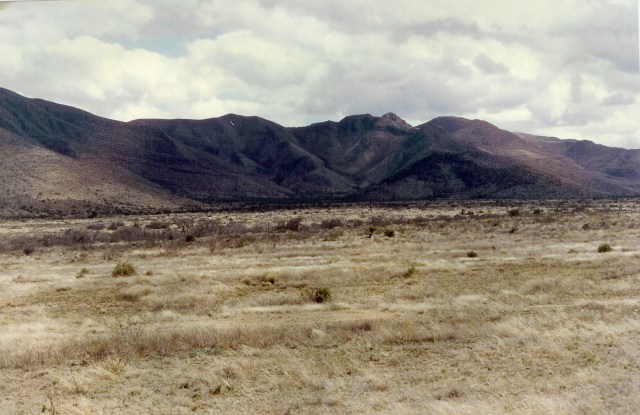
Glass Mountains, West Texas

I once said to my dad in a dream, “What did you think? That you fucked my mother and got an idiot?”

I was cooking an elaborate turkey stuffing in my mother’s kitchen to celebrate for the umpteenth time their hoary divorce. Perhaps I had opened the oven door once, twice, or thrice to check on my concoction.

He admonished me that each time I opened the oven door I was letting heat escape, which inhibited the cooking process. I wanted to tell him that even in middle age I understood escaped heat, but I needed to see how my stuffing was doing.

So I said it in a dream years after he died.

That I can conceive of talking to him like that hurts me in a sense. I wonder if it does him also? Such language would have fetched me a licking as a kid.

He’s a crock of ashes in a shallow hole in West Texas now. Can he hear me tell him I was offended? Religion only knows what the dead hear.

(c) 2019 JMN

Posted in Commentary | Tagged | Leave a comment

Hard to Handle

More Galleries | Tagged | Leave a comment