De Gustibus…

I try to envisage EthicalDative as a safe space for saying that I like certain art. Tolerating tastes, especially other people’s, doesn’t come easily to our species. Persons with cultivated eye, especially, may compare it to defending people’s right to have opinions based on alternative facts. I myself, uncredentialed and untrained in art, experienced a fugitive thrill of specious superiority once when a man retired from 30 years of teaching art in the public schools told me his favorite artist was Norman Rockwell. De gustibus non est disputandum, I reminded myself. “There’s no arguing over tastes.”

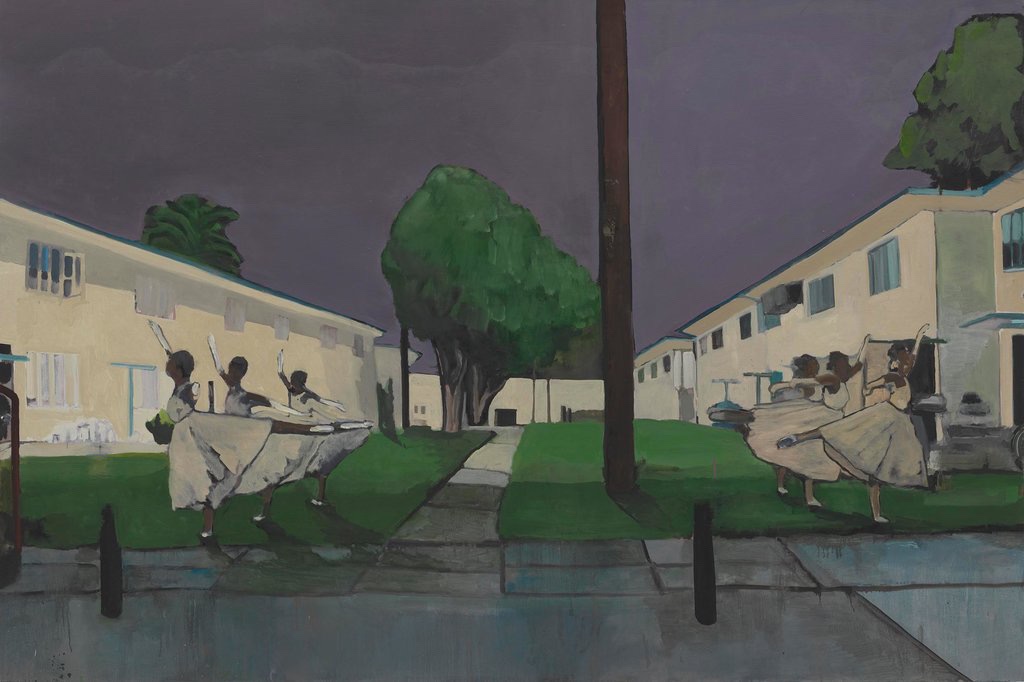
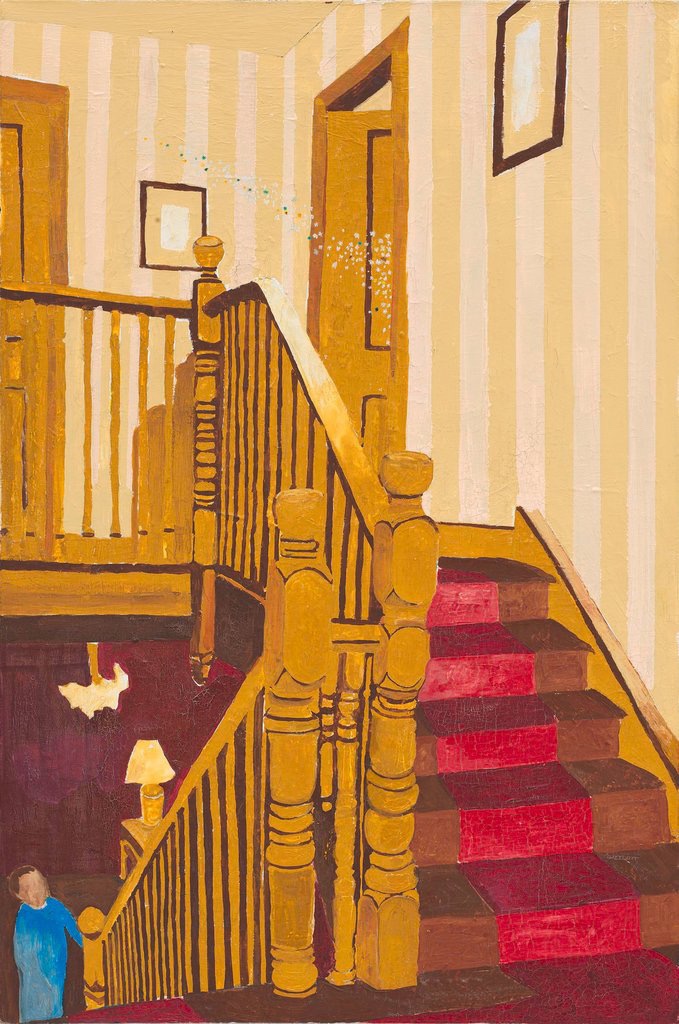
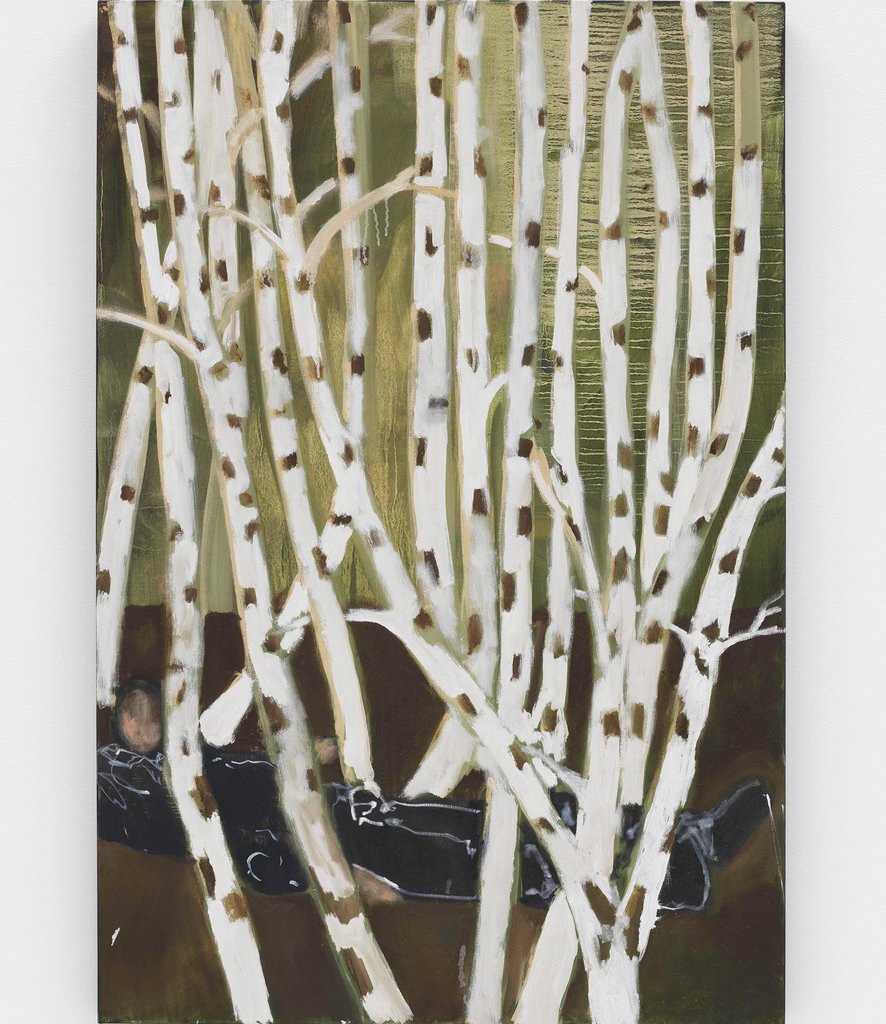
I find much to like about Noah Davis’s painting.
Also, I always find something to be intrigued by, puzzle over, and admire in Roberta Smith’s art commentary.

Davis once said he preferred to think of himself as a painter rather than an artist, and the 27 canvases here… back him up. He was immersed in the medium, its materials and its history, and although his work was ostensibly traditional, it was also subtly pushing at the envelopes of subject matter, psychological expression and painting technique.
For me the provocative notion of identifying as painter rather than artist has appeal. It makes a backhanded kind of sense; whereas adverbs almost always fog my windshield. Words such as “ostensibly” and “subtly” sap vigor from the traits and acts they qualify.

[Davis]… refused to commit to a single figurative style or to use photographic images in a formulaic way. Nearly every canvas here is different, and most have an interpretive and painterly openness. Your eyes and mind enter them easily and roam through the different layers of brushwork and narrative suggestion. There’s an unexpected optimism to all this. The paintings also dwell in silence, slow us down and hypnotize.
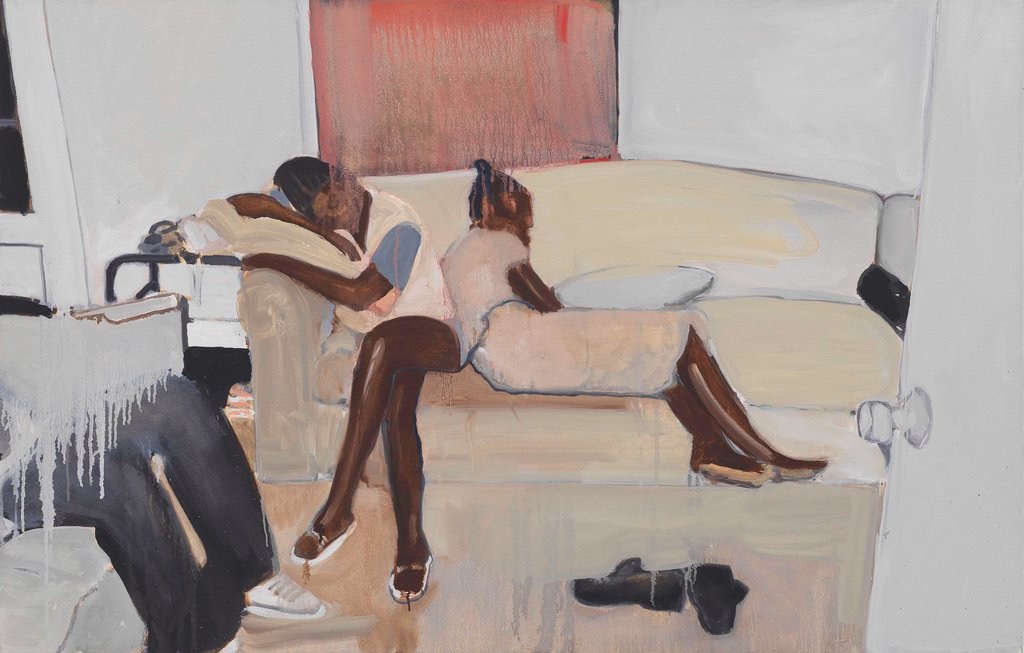
The bit about not using photographic images “in a formulaic way” gives me something to grope my way towards understanding. Also, paintings that “dwell in silence.”

(Roberta Smith, “Noah Davis Is Gone; His Paintings Continue to Hypnotize,” NYTimes, 2-6-20)

(c) 2020 JMN

Posted in Anthology | 3 Comments

Artie Shaw on Glenn Miller

I transcribed this snippet from the Ken Burns documentary about jazz. It inspires me to make mistakes at what I’m doing.

[Glenn Miller]… was sort of the Lawrence Welk of jazz. It was one of the reasons he was so big; people could identify with what he did, they perceived what he was doing. But the biggest problem: His band never made a mistake, and it’s one of the things wrong. If you never make a mistake, you aren’t trying, you’re not playing at the edge of your ability. You’re playing safely, within limits, and you know what you can do, and it sounds after a while extremely boring.

(c) 2020 JMN

Posted in Commentary, Quotations | Tagged | 2 Comments

What Stuff Is About

www.nytimes.com/2020/02/05/science/quadratic-equations-algebra.html

“Math is not about memorizing formulas without meaning, but rather about learning how to reason logically through precise statements,” Dr. Loh said.

(Kenneth Chang and Jonathan Corum, “This Professor’s ‘Amazing’ Trick Makes Quadratic Equations Easier,” NYTimes, 2-5-20)

Dr. Loh’s statement teases me, a non-adept at mathematics, in imprecise ways.

The saucy segments are: “formulas without meaning”; “reason logically”; and “through.”

There are no formulas “without meaning”; a formula “means” what it formulates. It abstracts and generalizes in a repeatable way, and it’s useful only to those who have it beyond memory. It’s the act of lazy head-stuffing that’s meant to be belittled.

To reason “logically” is the same as to drink “liquidly.” How else to do either?

“Through” is tricky. At first I read it as prepositioning the notion of advancement by means of penetrative navigation. Picture, if you will, a thicket of precise statements; then picture yourself reasoning your way “through” them. On second reading, however, I estimate Dr. Loh to imply instrumentality — “by means of.” Picture yourself engaged in a reasoning process, and doing so by making a series of precise statements — reasoning “through” them.

Much stuff is about the likes of “through,” which is why computers are better at arithmetic than at translating.

(c) 2020 JMN

Posted in Commentary, Quotations | Tagged , , | Leave a comment

George Steiner, 1929 – 2020

www.nytimes.com/2020/02/03/books/george-steiner-dead.html

My experience with George Steiner’s work is bitter-sweet. His book “After Babel: Aspects of Language and Translation” had great significance for me at a time when I struggled to establish my bona fides as an academic linguist while casting about for a basis on which to salvage a disintegrating career. Having striven with mixed success to acquire my extra languages, I envied his natively absorbed polyglot fluency. My fight to be learned is behind me. That makes it easier now to tip my hat to Steiner for having supported it.

Mr. Steiner complained… of having “scattered and, thus, wasted my strengths… As the close comes nearer, I know that my crowded solitude, that the absence of any school or movement originating in my work, and that the sum of its imperfections are, in considerable measure, of my own doing… It is the unwritten book which might have made the difference… Which might have allowed one to fail better. Or perhaps not.”

“I’d love to be remembered as a good teacher of reading,” he told The Paris Review in 1994. Characteristically, he had a specific, lofty notion of reading as a moral calling. It should, he added, “commit us to a vision, should engage our humanity, should make us less capable of passing by.”

(Christopher Lehman-Haupt and William Grimes, “George Steiner, Prodigious Literary Critic, Dies at 90,” NYTimes, 2-3-20)

(c) 2020 JMN

Posted in Commentary, Quotations | Tagged , , | Leave a comment

Advancing Retrogression

www.nytimes.com/2020/01/31/opinion/brexit-uk.html

“Put your flags away, you’re leaving, and take them with you.”
[Mairead McGuinness, vice-president of the Parliament, to Nigel Farage, who waved a miniature Union Jack in the European Parliament as he bade farewell (2020).]

“We must build a kind of United States of Europe.”
[Winston Churchill in a speech (1946).]

In the nightmare of the dark
All the dogs of Europe bark,
And the living nations wait,
Each sequestered in its hate;
Intellectual disgrace
Stares from every human face,
And the seas of pity lie
Locked and frozen in each eye.
[Lines from W.H. Auden’s poem “September 1, 1939” sent to Roger Cohen by Patrick Wintour, diplomatic editor of The Guardian.]

[Referring to the lines from Auden:] A better epitaph for the aborted story of Britain in Europe and the tragedy of a disoriented nation’s willful infliction of enduring self-harm is impossible to imagine.
(Roger Cohen, “Requiem for a Dream,” 1-31-20. All quotations above are from this opinion piece.)

I say without irony that I feel Cohen’s pain from my perch in the boonies. I’ve kept the 99-line Auden poem memorized for several years. I would add only that it concludes with mention of “the Just,” and with the self-exhortation: “May I… show an affirming flame.” Here is the last stanza of a poem that transcends its moment in an Orwellian way:

Defenceless under the night
Our world in stupor lies;
Yet, dotted everywhere,
Ironic points of light
Flash out wherever the Just
Exchange their messages:
May I, composed like them
Of Eros and of dust,
Beleaguered by the same
Negation and despair,
Show an affirming flame.

(c) 2020 JMN

Posted in Commentary, Quotations | Tagged , , , | Leave a comment

Goya on My Mind

www.theguardian.com/artanddesign/2019/dec/28/goya-paintings-many-not-work-of-spanish-master-studio-assistants

She spoke of her “trepidation” about challenging attributions as Goya’s pictures change hands for millions of pounds: “If a picture turns out to be by an assistant, of course the value collapses. “Artists in the shadow of a great master [can] illustrate [?] his imagery, his style, his handling of paint, but the work is not infused with the unique individuality and strength of the original creator.

(Dalya Alberge, “Dozens of ‘Goyas’ are not by the master’s own hand, claims art historian,” theguardian.com, 12-28-19)

(I wonder if the historian meant “imitate” instead of “illustrate”?)

I experience a moment of fatigue when the trafficking in trophy art is punctuated by an expert’s reserve over whether or not attributed paintings are “infused” with the “unique” spunk and slobber of an oldtime picture-factory boss such as Goya.

My uninformed speculation is that some of the sand kicked up occasionally over how purely authentic a work is may encourage what I theorize could be a misconception about how the old masters operated in their antique world.

Could it be that a major concern of a successful painter as he presided over his studio was to provide a steady supply of pictures to his clamoring patrons? And that delegating certain drawing and brushwork to helpers and apprentices came naturally, so that any number of pictures rolled out over his signature were touched to a greater or lesser degree by other hands? Should the value of such works necessarily “collapse”?

I don’t disparage the sleuthing that well-meaning historians perform in their researches into the validity of attributions. What’s tedious is that the astronomical sums of money in play (“millions of pounds”) tend to corrupt scientific discussion and elevate disputes into headline cheese.

(c) 2020 JMN

Posted in Commentary, Quotations | Tagged , , | Leave a comment

Roots

www.nytimes.com/2019/12/26/opinion/media-politics.html

Do you want to predict how a certain region is going to vote in the 2020 presidential race? Discover who settled the region in the 17th and 18th centuries. If the settlers were from the East Anglia section of Britain, then that region is probably going Democratic. If the settlers were from the north of Britain, that region is very likely to vote for Donald Trump.

(David Brooks, “The Media Is Broken,” 12-26-19)

(c) 2020 JMN

Posted in Quotations | Tagged | 2 Comments

What’s “Up”?

Jack ran up the hill.

Jack ran up the bill.

Why can we also say “Jack ran the bill up” but not “Jack ran the hill up”?

What does “up” add in the following:

She’ll try to climb up your leg, man!

I’m gonna clean up the mess.

Sorry I messed you up.

There used to be a place up in Toledo.

They laid off a bunch of really high up people.

(c) 2020 JMN

Posted in Commentary | Tagged | Leave a comment

Musicianshift

www.nytimes.com/2019/12/19/arts/music/terry-riley.html

“For me music is a daily practice that I try to deepen in the sense that I get to understand more about what music really is, and sometimes what I think it really is is the simplest elements — elements that are just basic to music, that when they can come forward, are the things that need to be there…..”

(Mike Rubin, “Terry Riley’s Avant-Garde Sounds Are Still Casting Spells,” NYTimes, 12-19-19)

This remark by Terry Riley stymies me in the fruitful way that musicology does.

(c) 2020 JMN

Posted in Commentary, Quotations | Tagged , | Leave a comment

One-One-Twenty-Twenty

At nine PM on New Year’s Day 2020, it’s quiet in my neighborhood.

Two earsplitting reports in quick succession rip the peace: POP-POP. A second or two of silence, then one more: POP.

I recall an old cartoon in which a man says, “False alarm, everyone! It’s just gun shots. For a moment I thought it was a car backfiring.”

I switch off my lights and window-peep into the unyielding darkness.

The incident is unresolved. The reality, however, is that what sounds like gunfire now probably is. That’s where we are where I live.

(c) 2020 JMN

Posted in Commentary | Tagged | Leave a comment