
New York Times.
Vija Celmins (pronounced VEE-ja SELL-mins) was born in 1938 in Riga, capital of Latvia. Fleeing the Soviet invasion of 1944, her family immigrated to the United States in 1948. She earned an undergraduate art degree in Indiana and an M.F.A from UCLA in 1965.
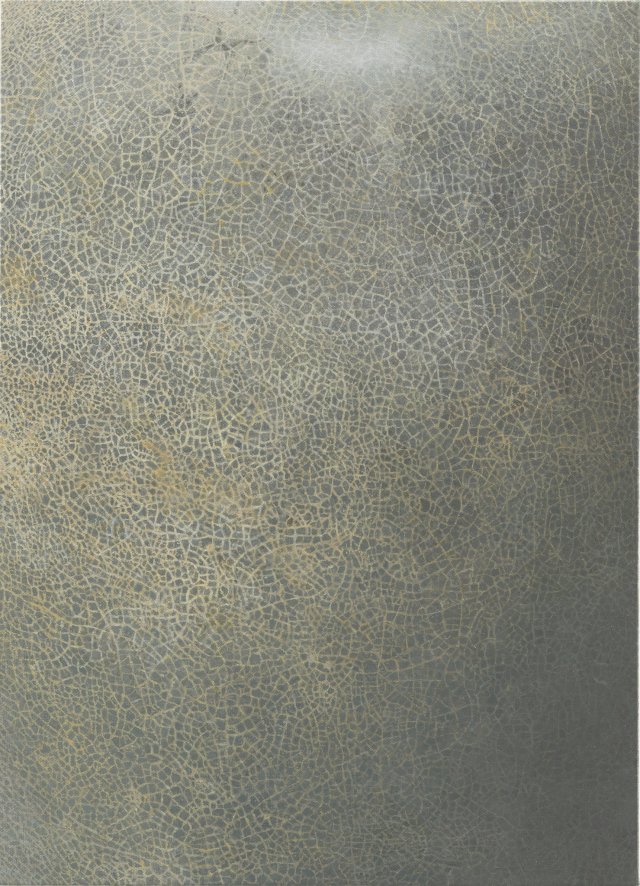
A recent painting by Vija Celmins, “Vase,” offers a close-up of the side of a Chinese porcelain vase, with its finely rendered craquelure glaze. Credit…Vija Celmins and Matthew Marks Gallery.
Within a decade, she was becoming known for precise, painstakingly wrought illusions of reality: expanses of ocean waves, star-studded night skies, clouds or the moon’s surface, rendered in graphite, charcoal or muted tones of oil paint.
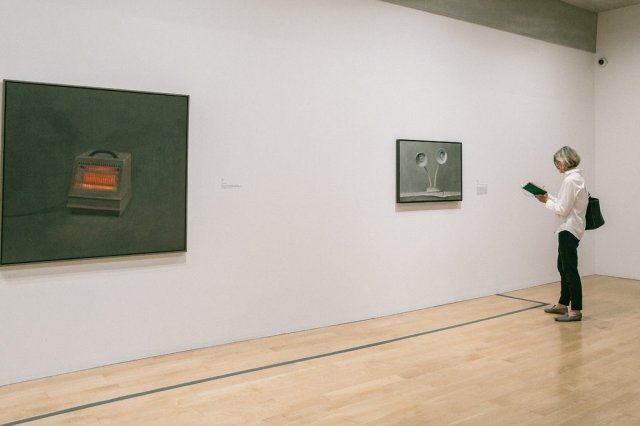
From a time when she was “looking at simple objects and painting them straight”: From left, “Heater,” 1964, and “Lamp #1,” 1964. Credit…Haruka Sakaguchi for The New York Times.
[In the period 1963-1968]… Ms. Celmins first committed to “looking at simple objects and painting them straight.” She depicts her studio companions — an electric heater, its red-hot coil at full blast; a two-headed lamp; and an electric fan — in varieties of gray. “I’m from a gray land, Latvia,” she has said. They also testify to her attraction to the lush backgrounds of Velázquez.

From 1968, “Letter,” collage and graphite on paper. Ms. Celmins made the envelope’s five stamps separately; three tiny drawings offer aerial views of the Pearl Harbor attack. Credit…Vija Celmins and Matthew Marks Gallery.
In a smaller gallery of tiny graphite drawings there is a depiction of a letter addressed to the artist in her mother’s cursive handwriting. Ms. Celmins made the envelope’s five stamps separately; each is a tiny drawing with crenelated edges, three offer aerial views of the Pearl Harbor attack.
(Roberta Smith, “Deep Looking, With Vija Celmins,” NYTimes, 9-26-19)
(c) 2020 JMN







 EthicalDative
Intellectual Disarmament
Ross Douthat writes that when he was an undergraduate at Harvard University “our so-called ‘core’ curriculum promised to teach us ‘approaches to knowledge’ rather than the thing itself.”
As a failed teacher I’ve found that some of the best pointers on teaching issue from the armchairs of non-teachers. It’s tempting to invert the sardonic old dig to: “Those who can’t teach it do it.”
I once taught Spanish in a humanities division. Our medley of disciplines — foreign languages, art, English, music, history, theater — competed to fulfill the humanities component of students’ degree plans.
I finally dropped out of academia, before being thrown out, and went into advertising. My own insufficiency and creeping disengagement had defeated me. I could not give undergraduates a good reason to meet my Spanish class twice a week.
I had made one belated grasp for “substance” in an effort to make Spanish look relevant to elective shoppers: Translation! My overture to slant teaching in that direction was batted away by the senior ranks.
As it happened, I had a profitable side-hustle as a translator for off-shoring industries. My obsession with George Steiner’s “After Babel” did not keep my bid to align my classroom and research activities from looking non-cynical to my tenured colleagues. They didn’t buy it, or me.
(c) 2020 JMN