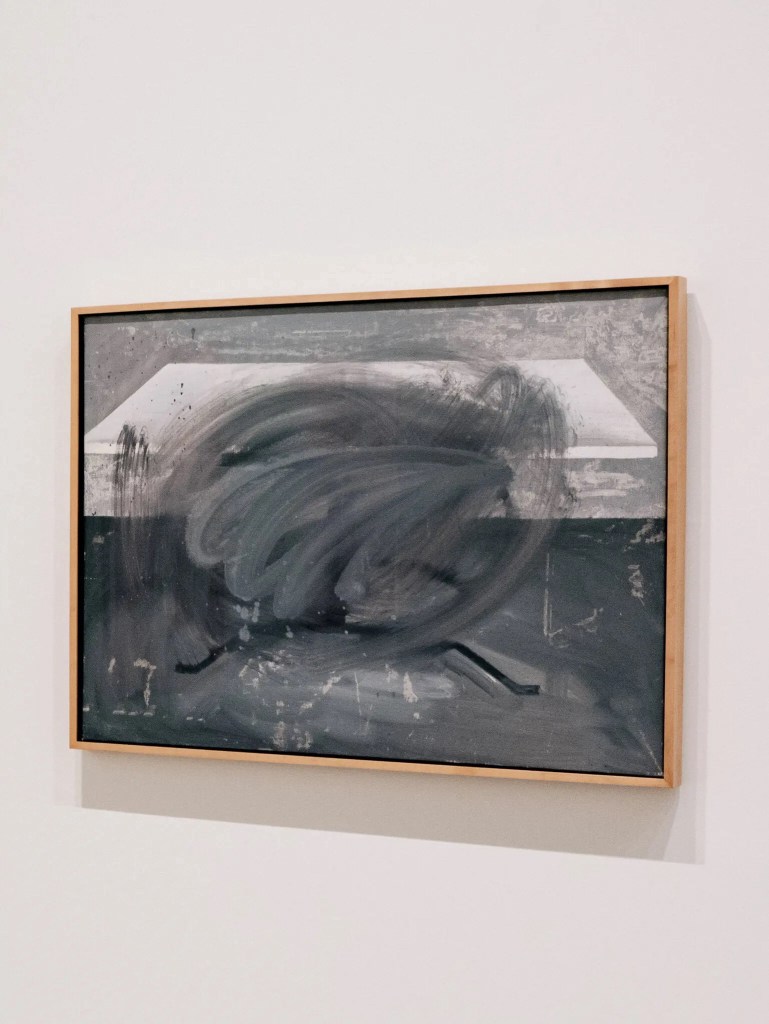
“Tisch” (1962) introduces Gerhard Richter’s trademark blur and use of found photographic imagery. [New York Times caption and illustration]
The only constants in his oeuvre, which takes in every traditional genre… are change, relentless curiosity and, perhaps most of all, an insistent question: What is an image?
[Gerhard Richter’s] painting “Tisch” (1962), has the daunting catalog position of painting No. 1. It introduces the trademark blur and use of found photographic imagery for which Richter is now well-known. Based on an image sourced from a 1950s edition of Domus, an Italian design magazine…
The scene is, however, obscured: A roiling mass of sweeping, agitated strokes hovers over the center of the image like a cataract, or an accident, or an exasperated defacement, or all of the above.
A wall text tells us that the artist originally painted the table as it was, directly from the source image; dissatisfied, he smeared the magazine photograph with solvents and then reproduced the result, in which the table has all but disappeared.
Richter remains one of the greatest living artists because of his devotion to the complexity of images, to always asking what we are looking at and how we might remake it, again and again.
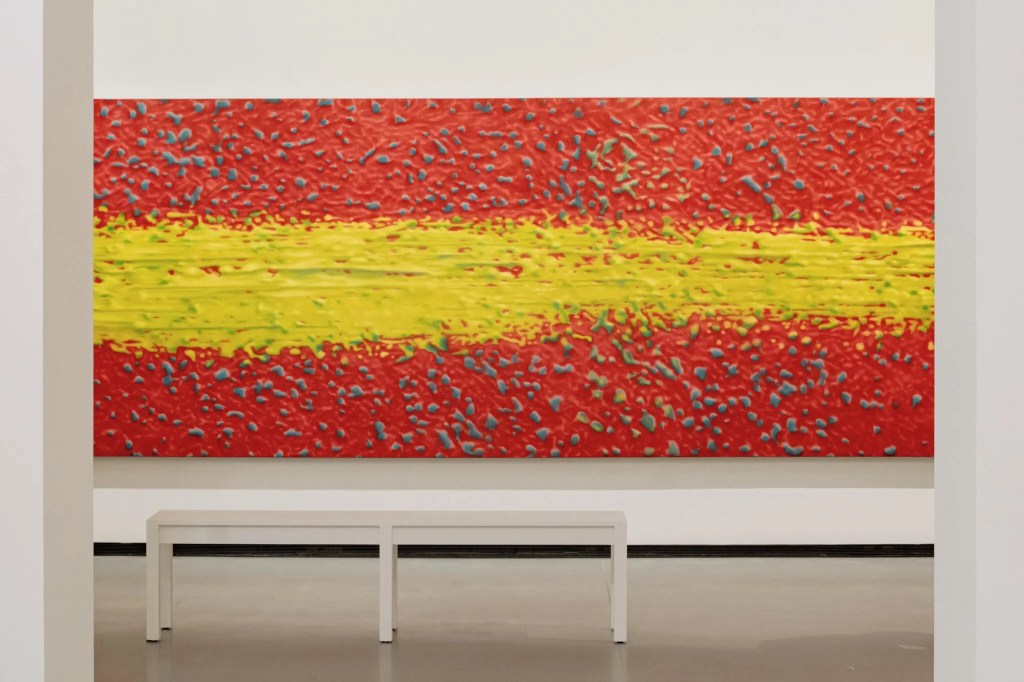
“Stroke (on Red)” (1980). [New York Times caption and illustration]
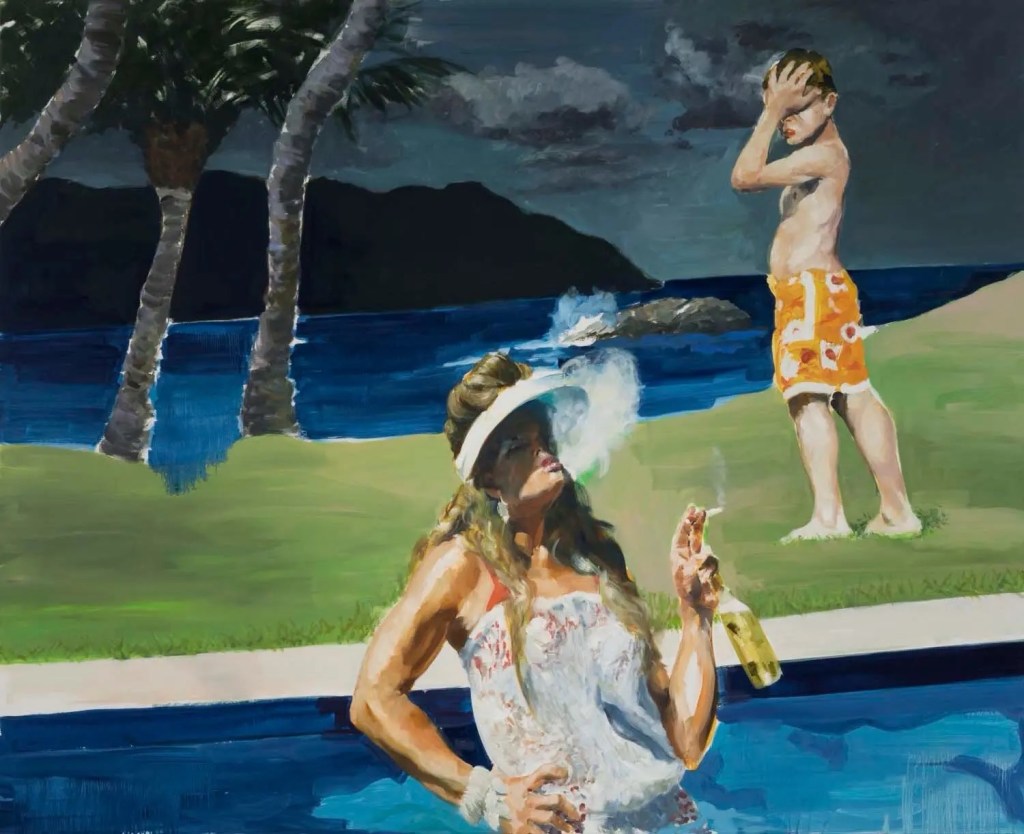
“Island of the Cyclops: The Early Years” (2018) by Eric Fischl. Credit… Eric Fischl. [New York Times caption and illustration]
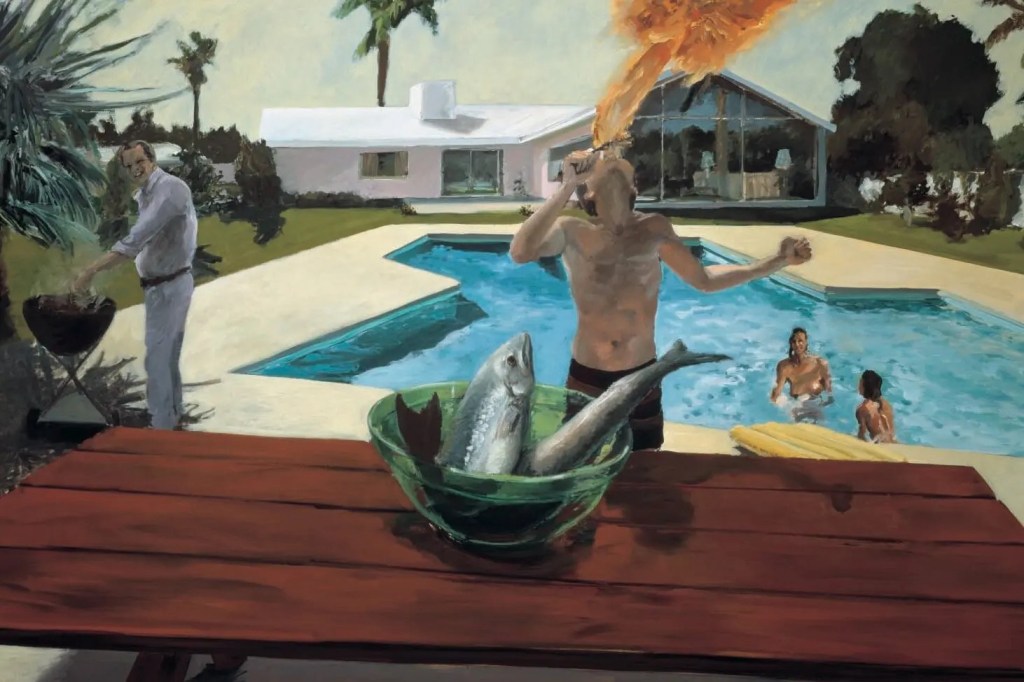
[Eric Fischl] “Eric Fischl: Stories Told” Featured here are about 40 large-scale works by the figurative painter Eric Fischl, created from the late 1970s to today. The artist largely had to teach himself traditional painting styles, studying early modern artists like Édouard Manet and Edgar Degas, because new art forms ruled during the ’70s and classic movements were out of fashion…
“Barbeque” (1982) by Eric Fischl is part of the exhibition “Eric Fischl: Stories Told” at the Phoenix Art Museum. Credit… Eric Fischl. [New York Times caption and illustration]
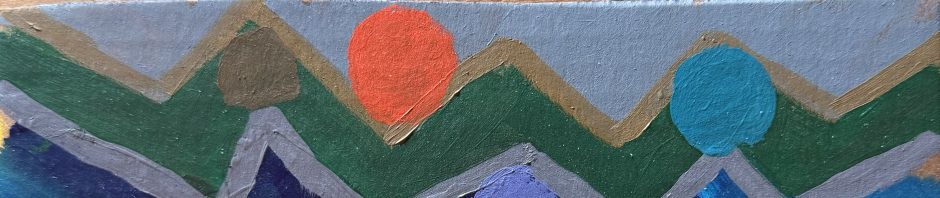
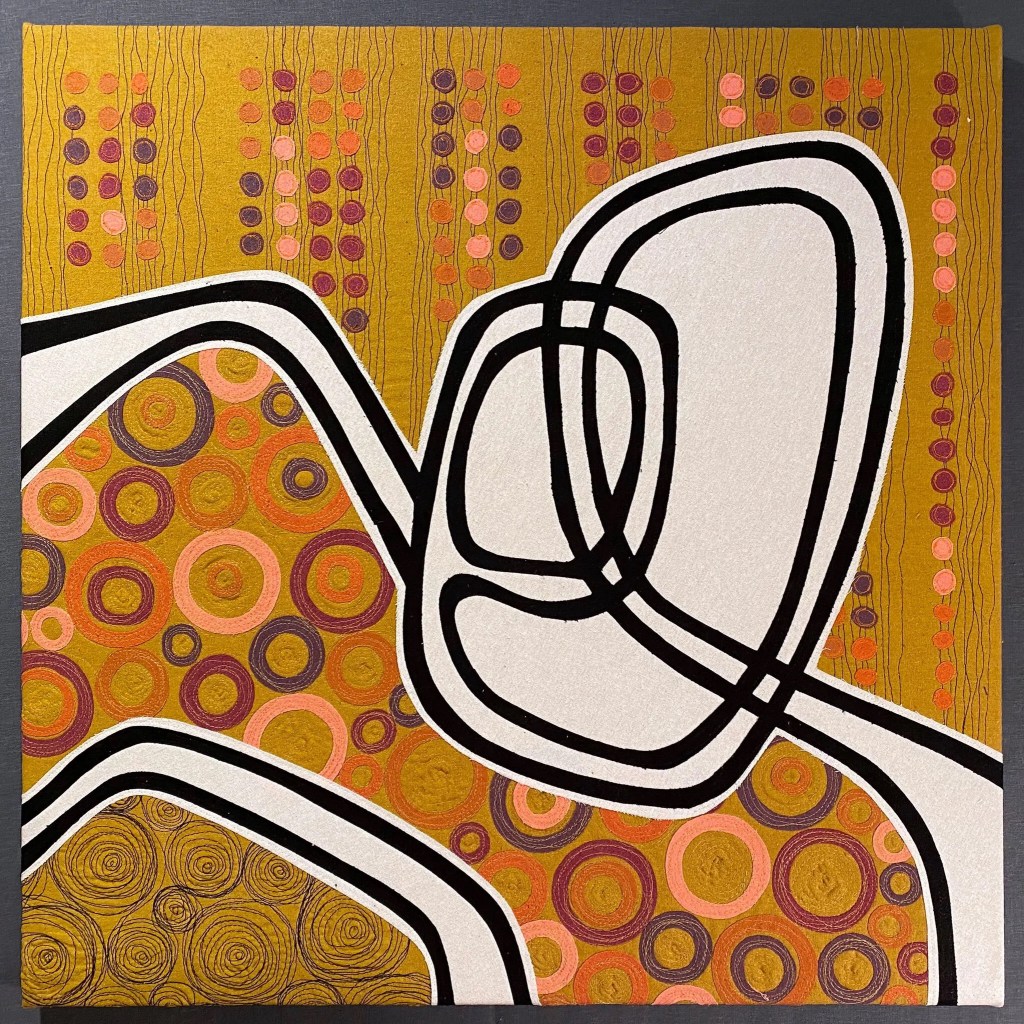
[Monica Thompson] “Threads” A selection of collages, assemblages, textiles, eco-prints and weavings created by nine Montana women who are artists, mothers and art teachers is presented here…
“The Greater the Whole” (2023) by Monica Thompson. Credit… Monica Thompson, via Yellowstone Art Museum. [New York Times caption and illustration]
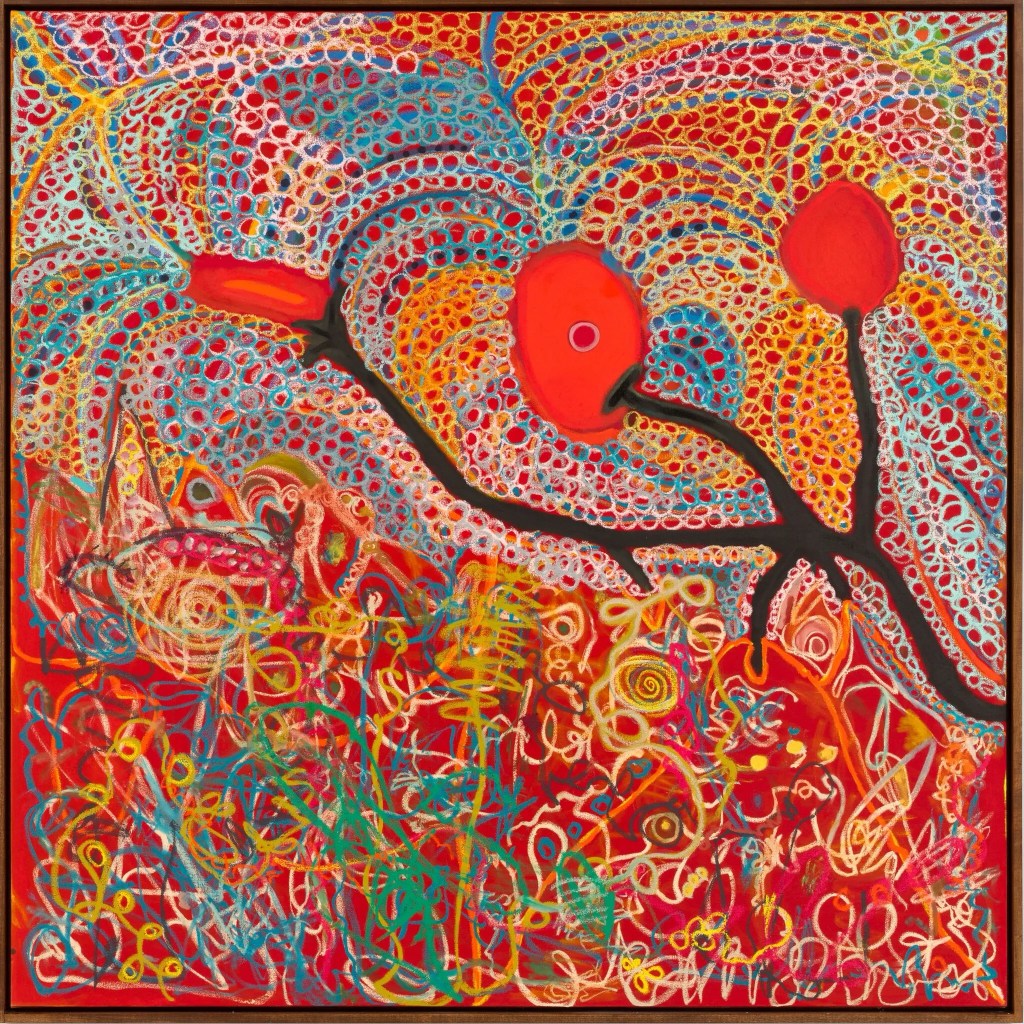
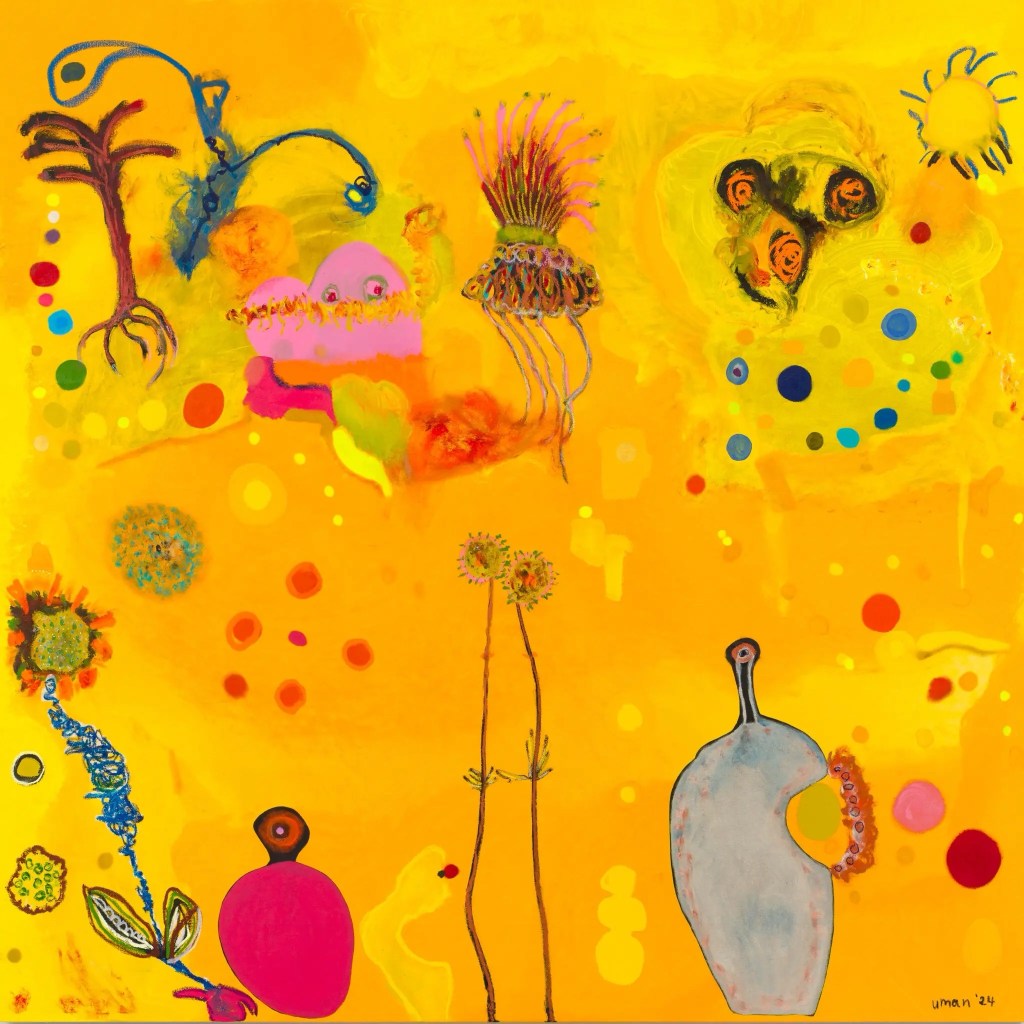
[Uman] “Uman: After all the things …” The artist Uman was born in Somalia and raised in Kenya. She spent her teenage years in Denmark and then ultimately landed in upstate New York… Her paintings, created with markings like spirals, doodles, circles and stars, evoke the fabrics worn by women in Somali bazaars, the slanted flourishes of Arabic calligraphy and the countryside of Kenya and upstate New York…
“Sumac Tree in Roseboom” (2022-23) by Uman. Credit… Lance Brewer[New York Times caption and illustration] “Eedo Kafia’s Turkana” (2024) by Uman. Credit… Lance Brewer. [New York Times caption and illustration]
All excerpts and illustrations are from Morgan Malget, “A Full Season of Art to See at Museums and Galleries Across the U.S.,” New York Times, 10-11-25.
With its loping equine cadence, amphibrachic tetrameter holds morbid fascination for the doggerel-besotted. No one knows what it is until they hear it. Then they go, “Oh yeah. There once was a girl from Nantucket.” But they’re wrong, that’s only trimeter. Keep up, people, we need four triplets.
Is there such a thing as front-rhyme? you ask. Should there be? What would it look like?
He grabs by the vitals whomever he chooses. The slabs of endeavor are redolent ruses.
There you have it: an AB front-rhymed couplet. To your untested ear is rhyme even present? Not so much, right? That’s the genius. English has long since said eff it to Nantucket. But what’s to fill the empty bucket? Say hello to head rhyme.
I grant you, the couplet is flawed. The incidental rhyming at end-of-line — chooses/ruses — is unfortunate. It has no place in the model of a new paradigm. English, like Italian, is almost impossible to versify without rhyming. Let’s try to improve the couplet…
… first, by altering line 1:
He grabs by the vitals whomever he wishes. The slabs of endeavor are redolent ruses.
Wishes and ruses are still too close to rhyming. Let’s try altering line 2:
He grabs by the vitals whomever he chooses. The slabs of endeavor are redolent mimsies.
Close enough. Do not fret over the poetic license of line 2. A “slab of endeavor” explains itself in a manner of speaking. Mimsies, plural of mimsy, may be a recherché nonce word or not. Verse allows such ambiguities. Only poetry takes them seriously.
Embrace new vistas in versifying, messieurs-dames. Where there’s a will there’s a way. Dream hard, dream big, dream on. It’s the right thing to do.
A friend I’ll nickname Stardust, avid prose reader, has remarked that relatively few people have a taste for poetry nowadays. I surmise it’s always been so, even in this or that era when <name-your-Great-Poet> flourished. The Great One would have been lionized by a coterie of fans in a populous land of nonreaders.
Poets are a few obsessives bent on strewing words just so, in a way the next person can’t, applecart-tipping and necessary. Their readers are a peculiar lot bent on stewing over those words. I like to think of doggerel, tangentially, as poetry’s running dog. Hail to thee, blithe mutt! Bird thou never wert.
The pivot point in this spiel is that Stardust is a skilled artist who can reify in line, value and hue what a poet does in words:
I did not want / the moment to end / then stopped wanting / so I could / be, not yearn,… (Lia Purpura, from “Intersection”, Poetry, September 2025)
“Did not want… then stopped wanting… be, not yearn,” Impossible to say differently that’s better. Both Stardust and Lia Purpura can turn a flash of perception into a thing that lingers, and completes itself in the psyche of another human.
If Stardust is ever pierced by a poem-moment, and there’s no special need for that to happen from where I stand, there’s hundred’s of feet of fertile loam accrued in my friend’s delta of sensibility for it to root in. Stardust will have perceived the poem as lines, akin to a sketch that works unusually well.
*** “I hate being called poet/dramatist/translator/director. Poet covers it all for me… I want to do justice to my inwardness, my tenderness, my political rage.” (Tony Harrison) ***
*** … como una mosca espía… … like a fly on the wall… [“a spy fly”!] (From “Revuelo” by Azurea20) ***
*** … Maybe instead of building a ship somewhere in your body you just let yourself feel the pain and humiliation. No need to make it beautiful for some future reader. Just say how much you wanted to hurt someone like you got hurt. And then just watch that for a while. It’s okay to feel horribly ashamed. Best not to look away. (From “Karma Affirmation Cistern Don’t Be Afraid Keep Going Toward the Horror,” by Gabrielle Calvocoressi, Poetry, October 2025) ***
*** A month and continent away your father (a painter) steps to my side
as we admire a row of lavender & someone
en plein aire complains the scene is mis-composed
(a power-line cuts through…)
your father smiles, and gestures out — art
isn’t for capturing what’s there (From “Arles, Whidbey,” by Reed Turchi, Poetry, October 2025) ***
Depending on whether I’m going or returning, not long before or after my crossings of the mighty, tea-dark Brazos near the Arredondo bridge, I pass what appears to be a Christian church whose name has kerygma in it.
For a period measurable in years now, I’ve meant to look up what kerygma means. As I spin by on the farm-to-market road, I always reflect that it has a Greek sound to it. This sets off a well-worn rut of reflection induced by the boredom of a familiar route…
The old saw about something incomprehensible: “It’s Greek to me.” My southern grandfather’s time-stamped joke about one Black schoolboy’s query to another concerning homework: “Is ya didja Greek?” The only son he was that never graduated high school because he wouldn’t pass Latin, according to his mother. The father he was to my teenage mother, jibing her for dating a “jewboy,” son of the Tobolowskys, who owned the dry goods store.
At long last I’ve Googled kerygma, and its meaning is what you’d expect: a bunch of words in English. Something about preaching.
I always end up on ekphrastic, another Hellenism that writhes in and out of my retentive faculty like a slippery fish. It reminds me of a favorite painting of mine from among those I’ve done.
The painting is narrow and tall. A female figure — girl/woman — stands holding a stunned five-year-old boy — son/brother. They fill the picture space from head to toe.
With the boy balanced on her scrawny hip, she stares skyward with the bleakest of looks, searching for God, maybe, or else the next bomb. Their skin is ashen; the coloring of their clothing filthy, ferrous, feral: mauve, olive, rust, ochre.
Much as they are the putative subject, the true subject is the rubble of which they are the human pieces. Sturm und Drang; wrack and dreck; profit and loss.
I’ve never painted anything with more devotion than the abstract wreckage, technically a background, which envelopes the walking destined-to-be-killed. It’s an inglorious, ghastly gallimaufry of improvised shapes in gamuts of grisly grays.
Rubble — inky, icky, inevitable — enduring creation of man, background of so-called civilization.
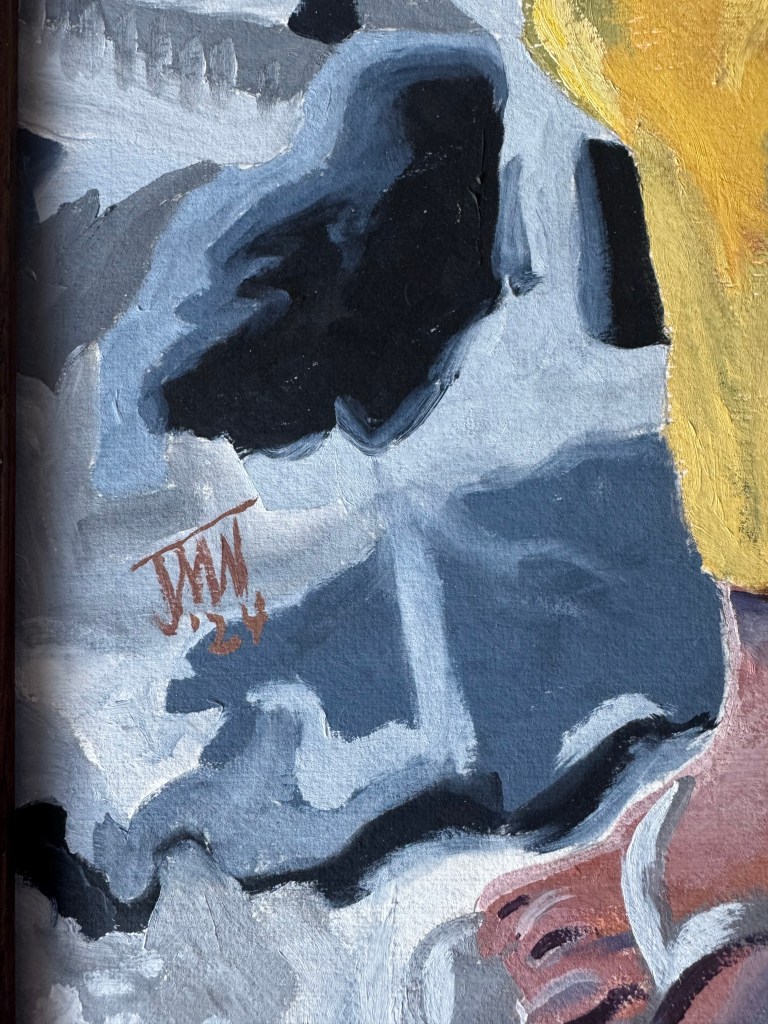
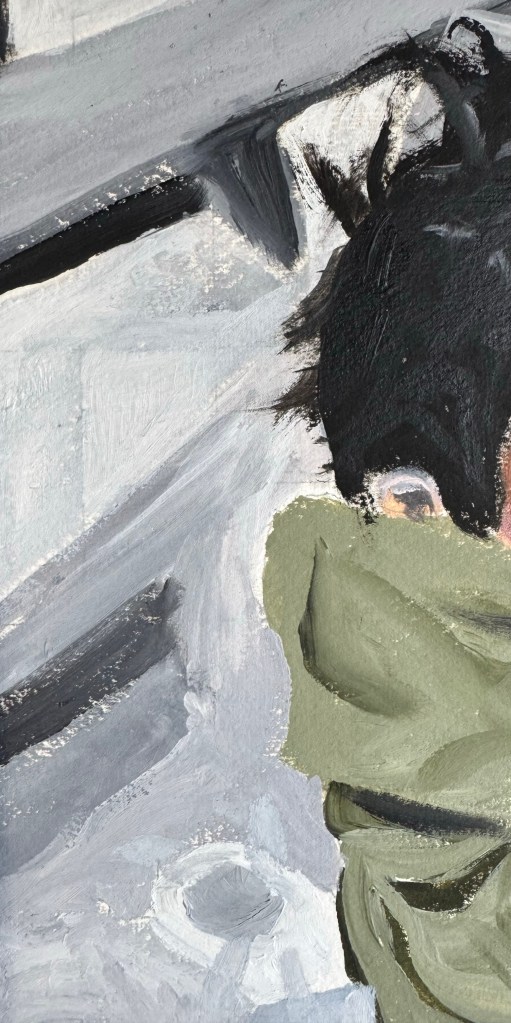
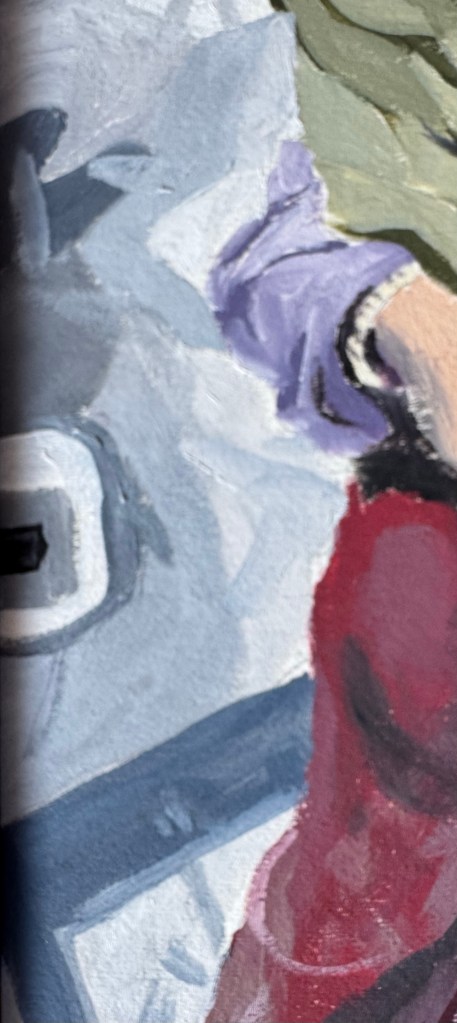
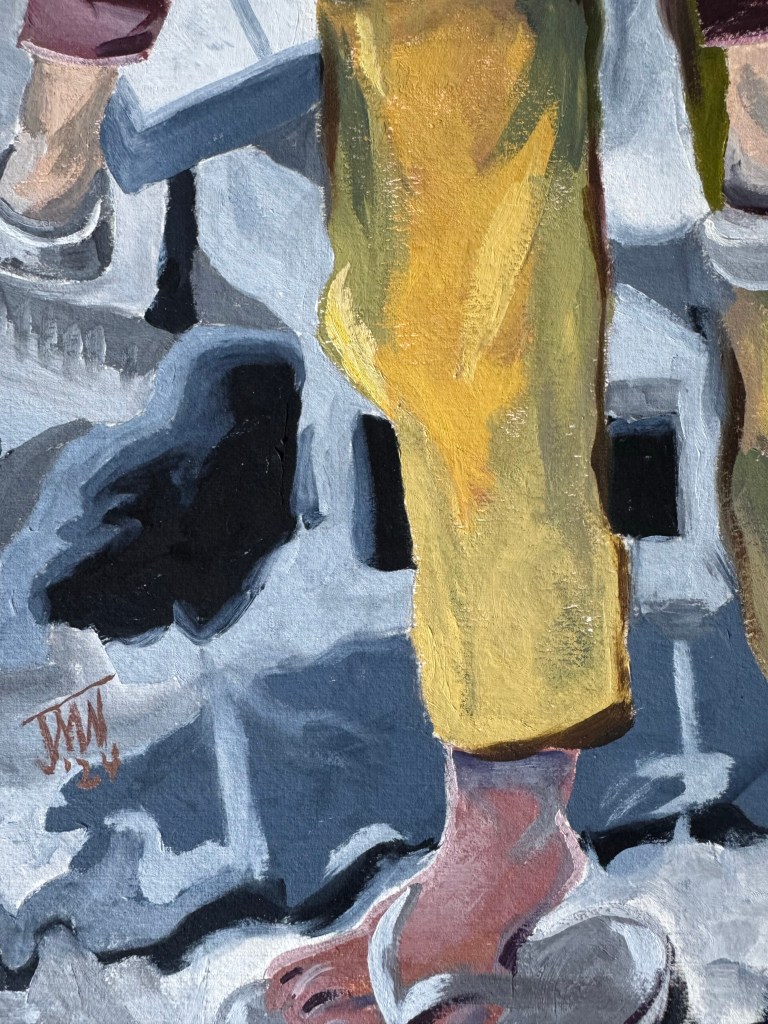
Detail, “Rubble,” oil on watercolor paper, 14×30 in. (JMN 2024)
Often as not a poem gives me a right old drubbing while stealing my lunch money, cackling in cold delight all the while. Instead of picking up my Big Chief tablet, shrugging and slinking back to class, I squeal like a ninny for it to give me a wedgie and Dutch Rub to boot.
Of all the species of eight creeping things
I burst my pink peppercorn of DNA and became a bird, like you. […]
Like me!
I adopt the guise of a messenger returning from conference with a potentate. I’m tasked with carrying report to my liege lord, the imperious brain. The trick is this: the potentate and my suzerain speak different dialects. Nominally, I straddle the void between them, a Scheherazade translator, fending off the executioner with whatever I can pretend to have heard.
What if Rick of Casablanca had said this: “Of all the gin joints in all the eight towns in all the world, she walks into mine.” Tell me there’s not a jolly problem.
There’s the affair of the peppercorn, the pink one. Everyone knows about deoxyribonucleic acid (DNA), the double helix and all that (nervous chuckle, bead of sweat on my brow). A bursting of this hide-and-seek spice symbol causes the speaker to become a bird, who tells this to another bird. That much is clear.
Moving on.
I found your flanks wattle, primaries & tail feather. […]
Among other things, I love the periods in this poem. They let me collect myself.
I think Bird of Paradise, because it sounds fable-Babelish, but it’s a plant. Better a Phoenix, mythical bird regenerated from fire. (Does the Phoenix have a wattle? Park that for now, your majesty. It’s of little moment for our purposes… heh-heh, sweat bead drops.)
Birds do hop, waddle and fly, not creep. That’s why “Bird” opens with a tone of disbelief, like Rick’s.
This “finding” that goes on (“I found your flanks…” etc.) is like the biblical “knowing,” a naughty euphemism. It could evoke a mating ritual — yes, two sexy, one-of-a-kind (!) Phoenixes. Myth makes its own weather, sire, like forest fires. Let’s not obsess on hermeneutics. Ask instead what twin firebird hankypanky could engender.
All our lesser holes-in-the-corner
opened like mantles —the sun’s orange rind flew out of the terrifying world. (“Bird.” by Sean Singer, Poetry, September 2025)
Apocalypse is what!
In the associative spasm of a million infernos, Earth’s molten core, breaching its mantle, spurts ejecta into Sun’s dissipating corona — its rind. The egg of a future beyond conceiving is fertilized in a hail Mary of cosmic ecstasy. It’s a hellish curtain call for all terrestrial life. What’s not to be terrified by, of, for, about, your highness?
(The prepositions did their work. My lord and master has succumbed to slumber. I’ll live another day.)
Sean Singer’s nettlesome lyric tells the story it tells in the words it uses. Tell me it doesn’t. I see those words at each pass. What I’ve made of them is addled whimsy, of course, but not snide, and not mockery. The poem doesn’t need me; I need it. Reading poetry teaches me: Don’t lose your head. Be bold. Read it the high way, the low way, any way but loose. Just read it, let it look for, if not find, you; otherwise, your orange rind can’t fly out.
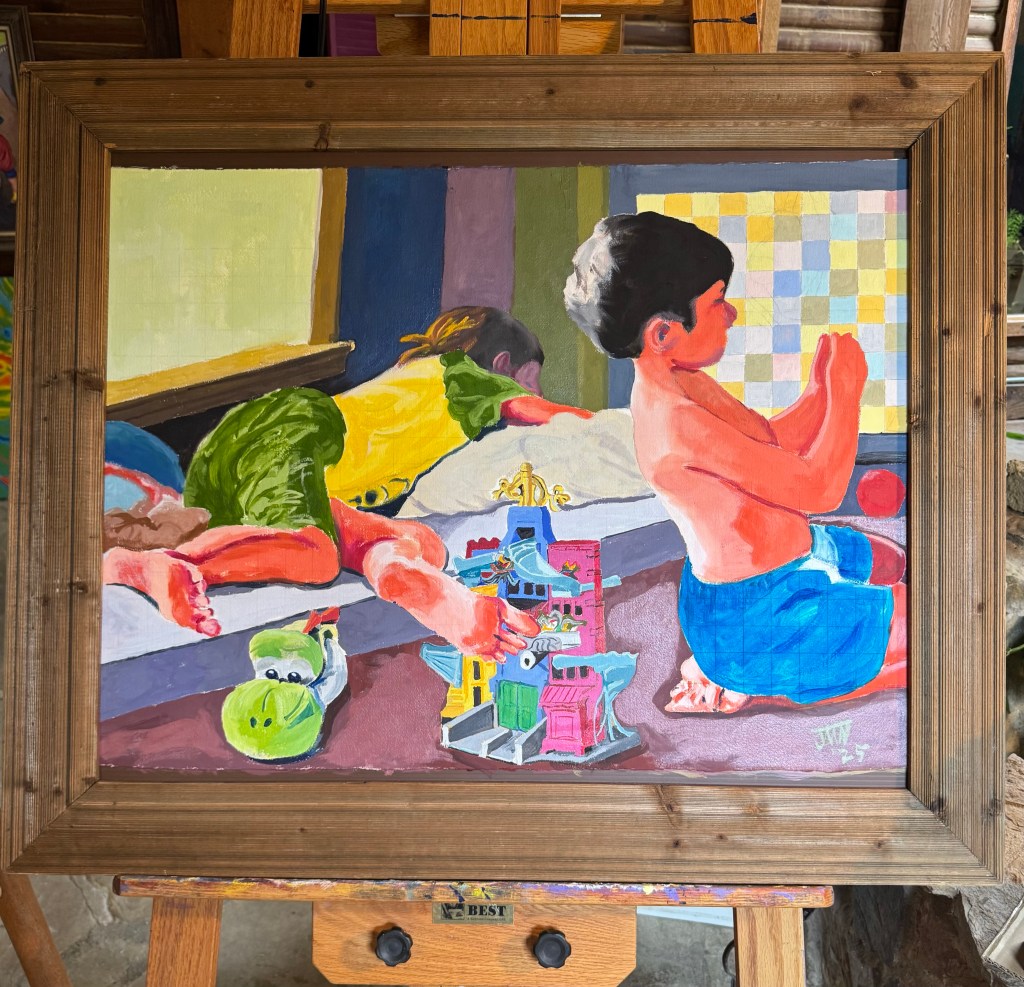
“Time Out,” oil on watercolor paper, 24×30 in. (JMN 2025).
Afterthought foregrounded: This will go down as a wildly utopian, presumptuous, naive, impractical proposition. Imagine a world in which the devout were schooled from an early age to read the foundational scriptures of their respective creeds in the original languages rather than translations. Talk about a conversation of adepts. Would there be fewer arguments over religion? Not likely. But they’d be better ones.
I make my way through the Quran’s Arabic à grands coups de dictionnaire. Why resort to the dictionary when there are translations available? Because translations can diverge considerably, besides often being overly interpretive for the literal-minded language student who wants to hear the plain text talk. I do lookup to pinpoint unvarnished word meanings. It’s an exhilarating sojourn on multiple levels. Here’s an instance from today’s stint of reading (September 24, 2025).
On that Day you shall see the guilty ones secured in chains; — A. Maududi (Tafhim commentary) Et le jour (viendra) où tu verras les criminels enchaînés les uns aux autres (en couples semblables). — Montada Islamic Foundation https://quran.com/14/49
The above are two translations I monitor as I go. They assist me in construing the Arabic. I also consult the Spanish translation of Julio Cortés, who was my teacher. Here’s his version:
49 Ese día verás a los culpables encadenados juntos,
The pivotal word is muqarrab(īna). It’s the past participle in masculine, accusative plural of a Form II verb having causal force with a range of meanings tightly or loosely connected to making or letting someone or something get close. It can include the taking of someone as associate or companion; also, the sheathing, or putting into its scabbard, of a sword. How does this sheathing relate to the “base” meaning, you may wonder. Good question having no immediate answer. Relationships across a semantic range can be untraceable. As with all languages, eons of usage have caused metaphorical, practical, maybe even accidental, drift. This driftiness undoubtedly accounts for some of the variations observable in translations of texts captured from oral transmission in ancient times.
Muqarrab(īna) modifies a nominal present participle, mujrim(īna), “criminals,” describing their condition of being fī-l-‘aṣfād, “in the bonds.” Wehr lists equivalents of ṣafad (pl. ‘aṣfād) as bond,tie or fetter. Why not also chain, shackle, manacle? Who knows? A bilingual dictionary can’t be a thesaurus, though Wehr often comes close. The above translations happen to agree on “chains.”
For muqarrab(īna), the French and Spanish versions key vaguely on its “companion” aspect: “chained together” in Spanish; “chained one to another (in similar couples)” in French. The English reduces it to “secured,” which isn’t exactly accounted for in Wehr’s listing. Or is it? Perhaps “secured” is akin to “sheathed,” though less literal. The putting away of a weapon brings it in companionable proximity to its owner’s waist while neutralizing it. I rather like “sheathed in fetters” for muqarrab(īna) fī-l-‘aṣfād(i). The sinners are rendered harmless in their chains, like a blade in its scabbard. Or, to modernize the simile, like a gun in its holster.
I’d love to know the thing least knowable, which is what exactly any given expression brings to the mind of a native Arabic speaker not tasked with phrasing it in any other tongue. The fantasy analogy that occurs to me is that of a psychic MRI which would show on a screen the image present in the speaker’s mind arising from reading or thinking the expression.
Intelligence is being burned at an alarming rate. Fact incineration technologies birthed in Silicon Gulch have accelerated the depletion of natural reserves.
In the advanced world, gas derived from fact-burning fuels everything from data centers and crypto mining to the private jet fleets of hard-working billionaires.
But there’s hope. Facts scraped from organic motherlodes and combusted like there’s no tomorrow may be replaceable by alternative ones generated from executive wind.
Cheese cut in myriad C-suites currently clogs olfactory assets throughout the global U.S. — from the Gulf of America to Tierra del Rubio; from Guam to Greenland; from Saint Petersburg to Florida.
The buzz in Davos is that capturing and exploiting that abundant resource could be the next sure thing.
Men of stratospheric net worth, look to the future! The rips you let on golf cart cushions alone could drive a zillion rotors powering as many alternative realities in perpetuity.

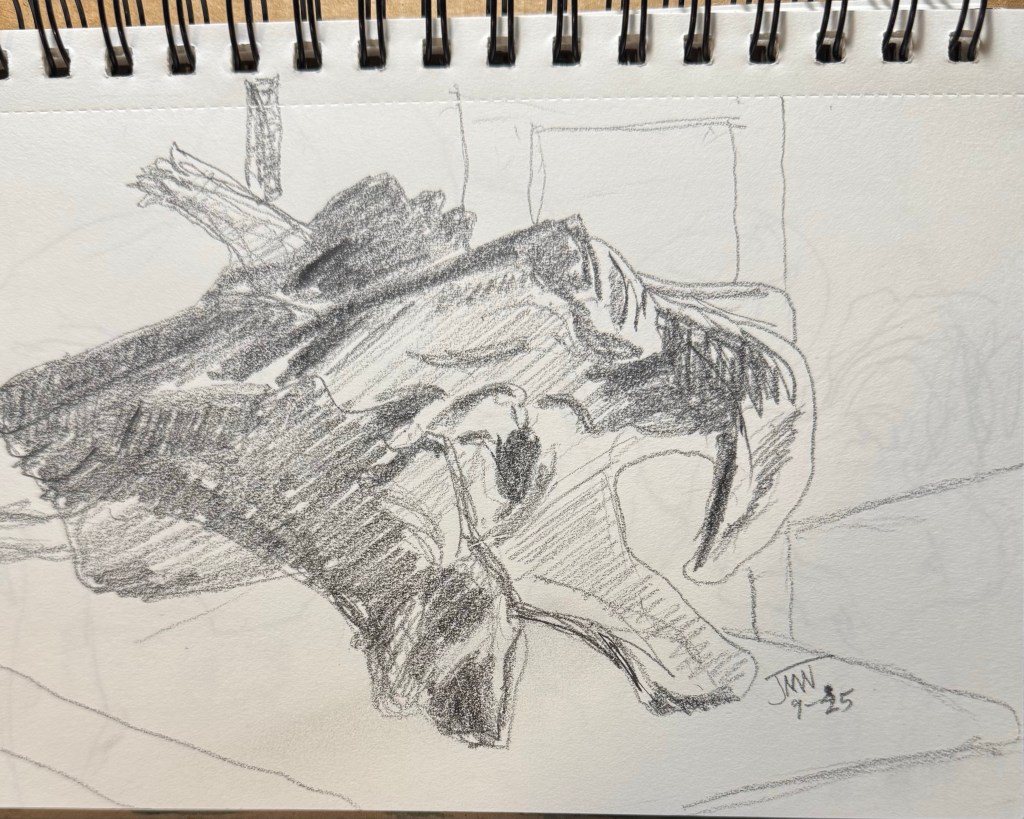
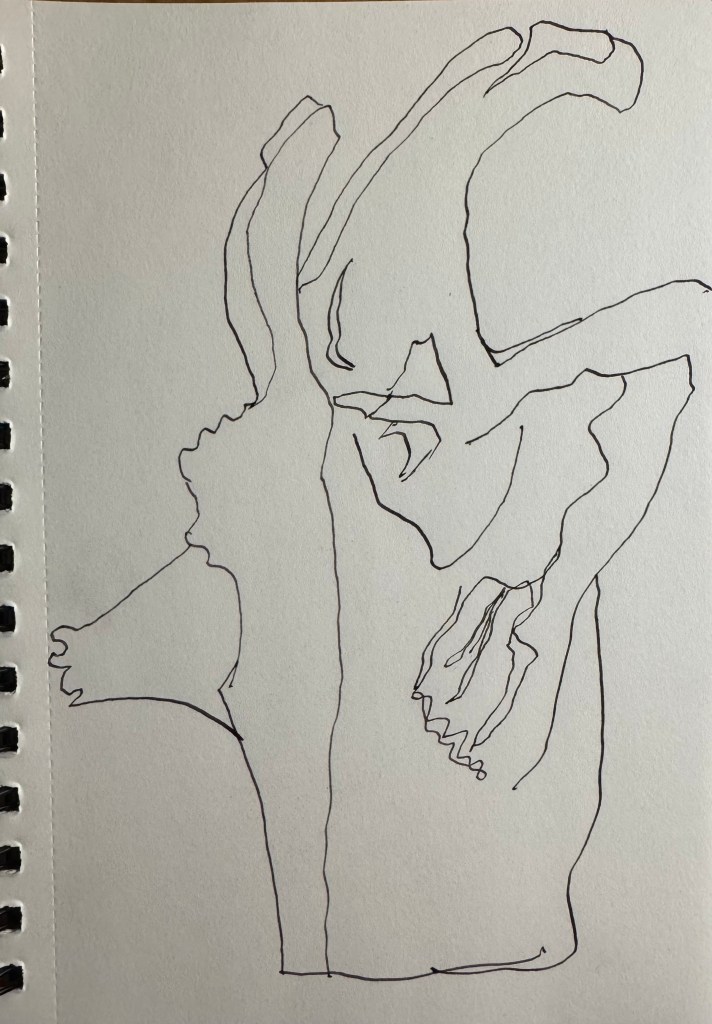
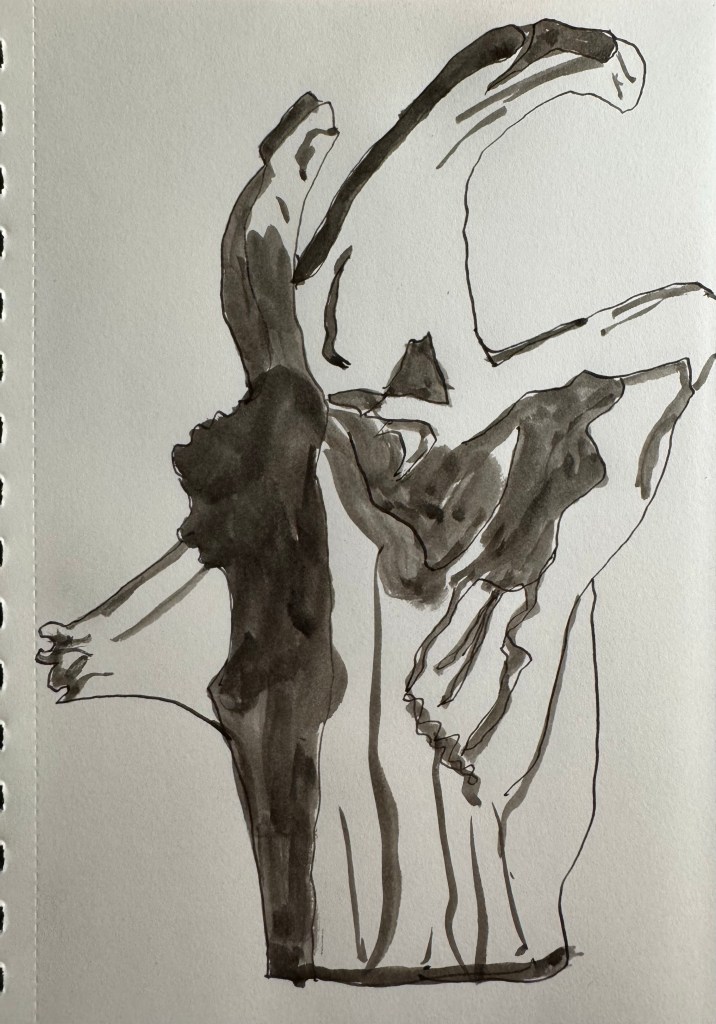
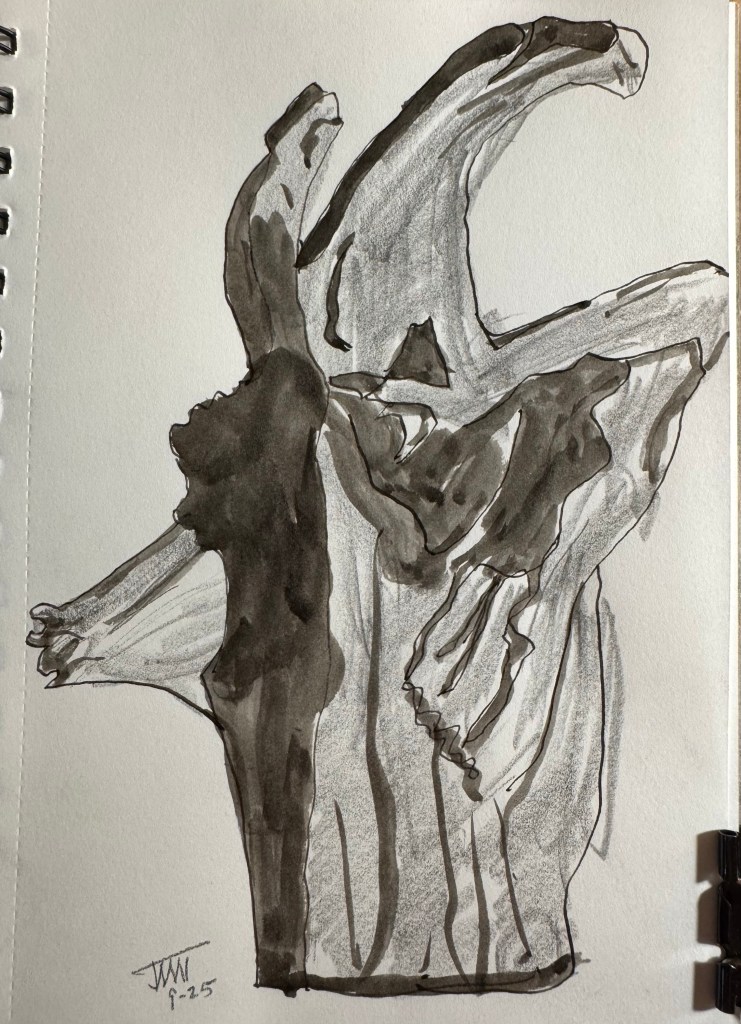

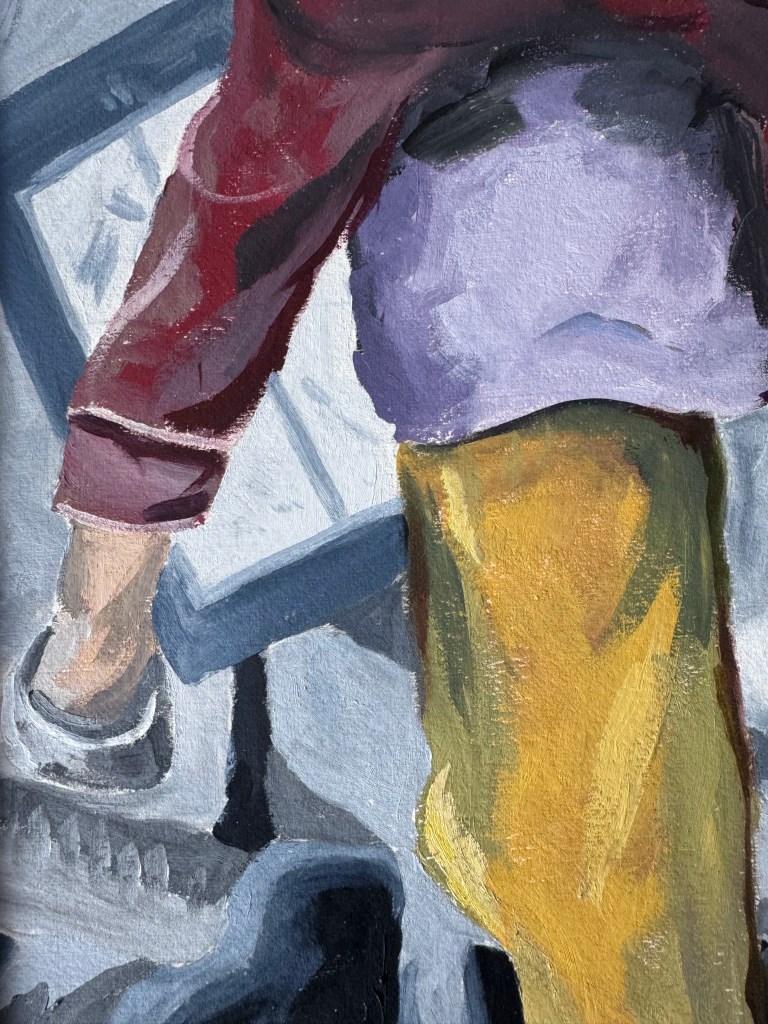
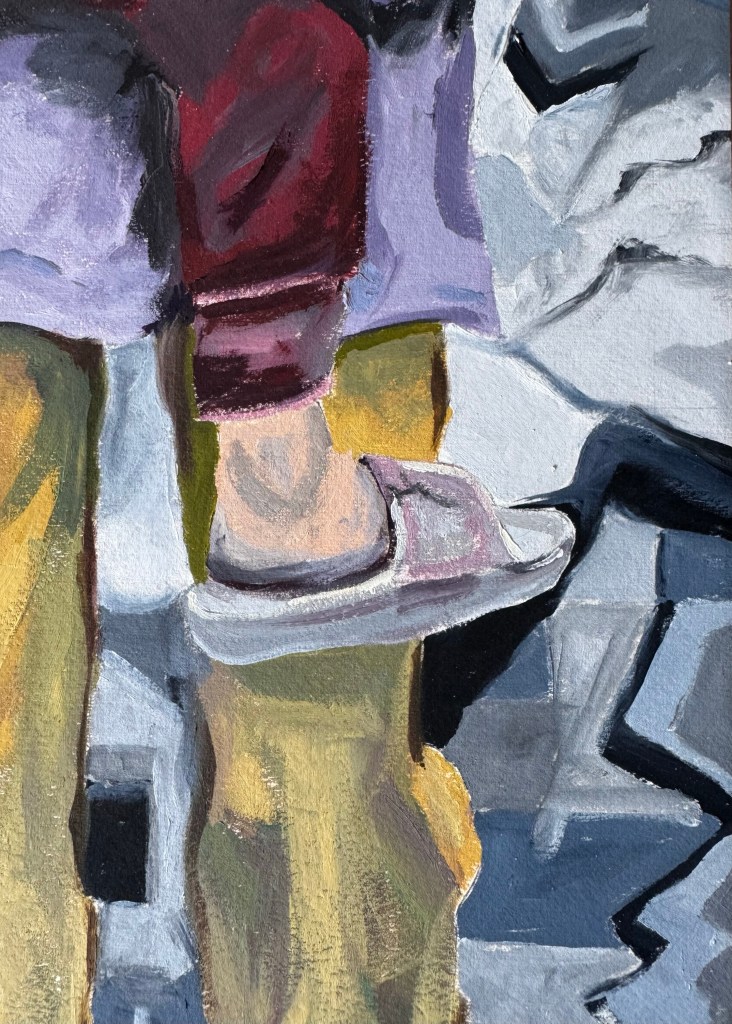
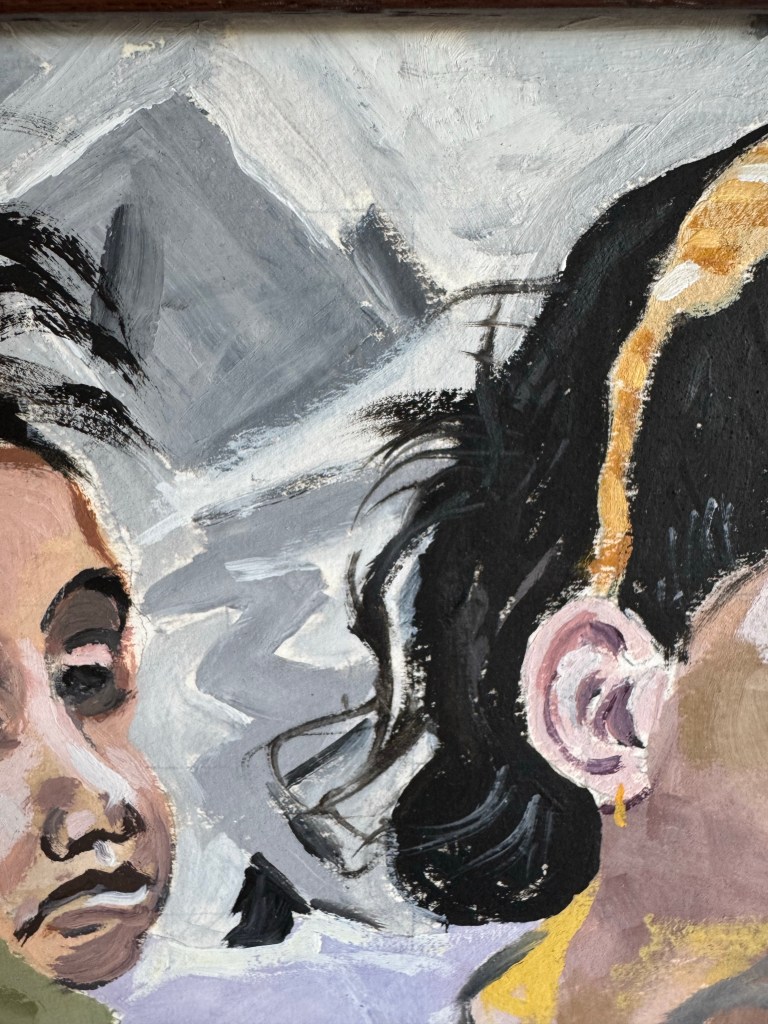

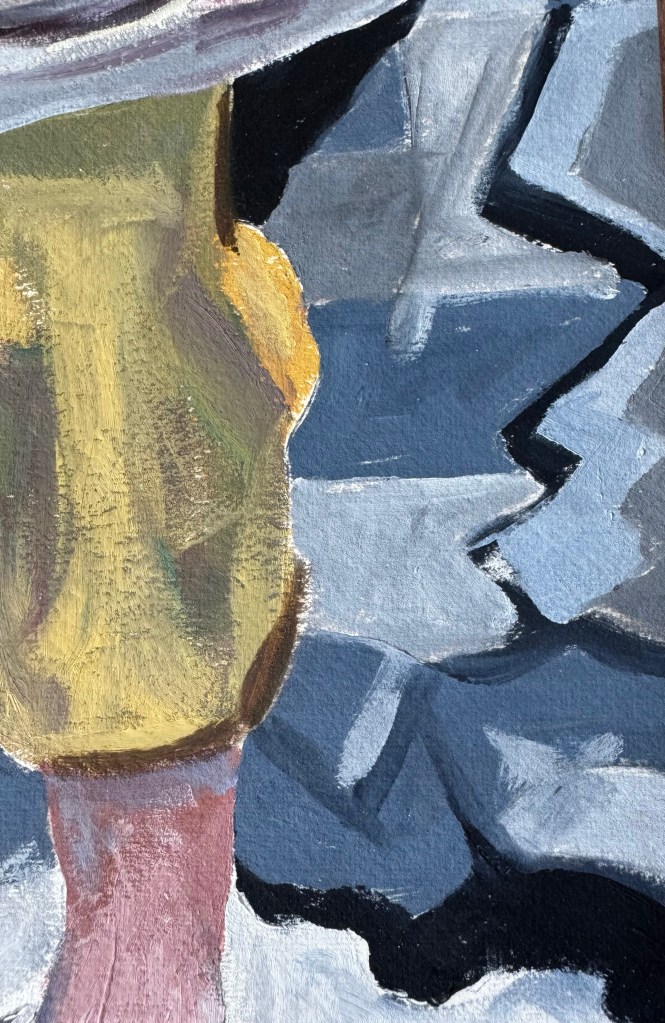


A Poem Is a Sketch
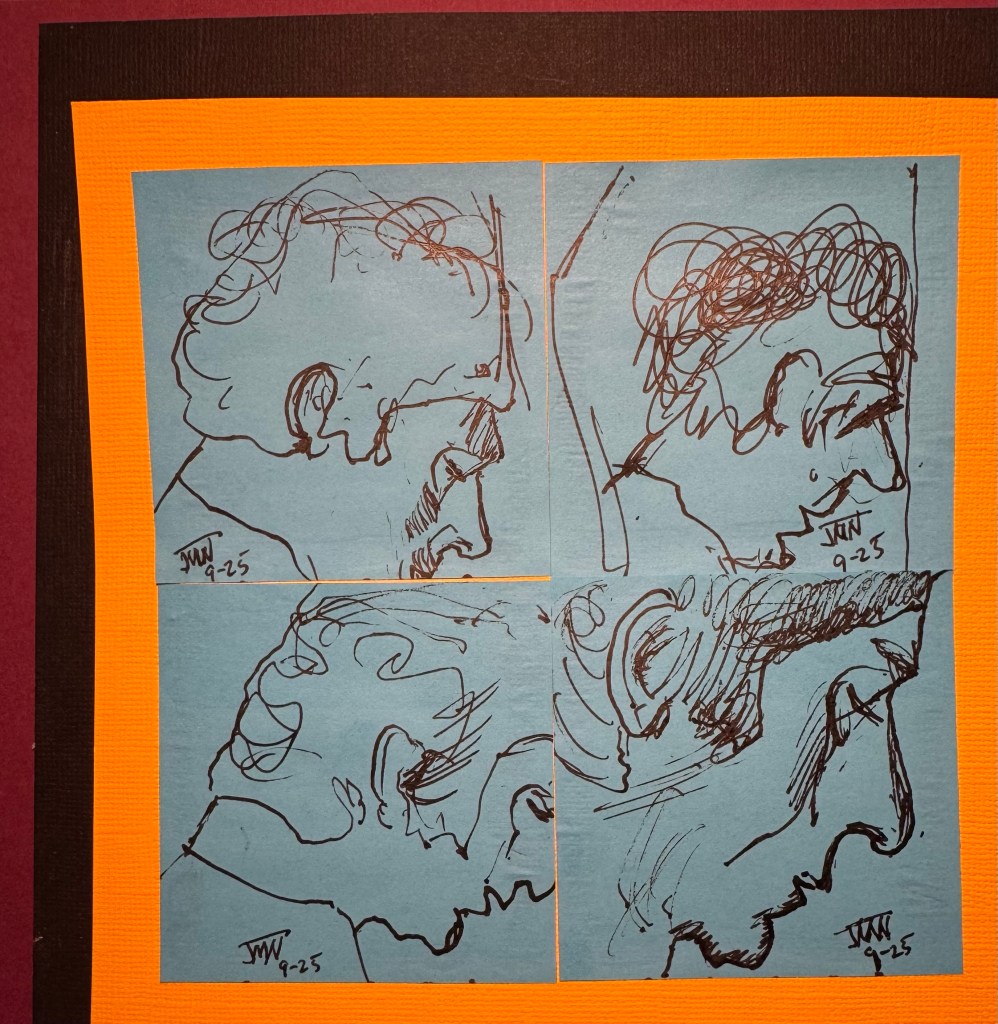
A friend I’ll nickname Stardust, avid prose reader, has remarked that relatively few people have a taste for poetry nowadays. I surmise it’s always been so, even in this or that era when <name-your-Great-Poet> flourished. The Great One would have been lionized by a coterie of fans in a populous land of nonreaders.
Poets are a few obsessives bent on strewing words just so, in a way the next person can’t, applecart-tipping and necessary. Their readers are a peculiar lot bent on stewing over those words. I like to think of doggerel, tangentially, as poetry’s running dog. Hail to thee, blithe mutt! Bird thou never wert.
The pivot point in this spiel is that Stardust is a skilled artist who can reify in line, value and hue what a poet does in words:
I did not want / the moment to end / then stopped wanting / so I could / be, not yearn,…
(Lia Purpura, from “Intersection”, Poetry, September 2025)
“Did not want… then stopped wanting… be, not yearn,” Impossible to say differently that’s better. Both Stardust and Lia Purpura can turn a flash of perception into a thing that lingers, and completes itself in the psyche of another human.
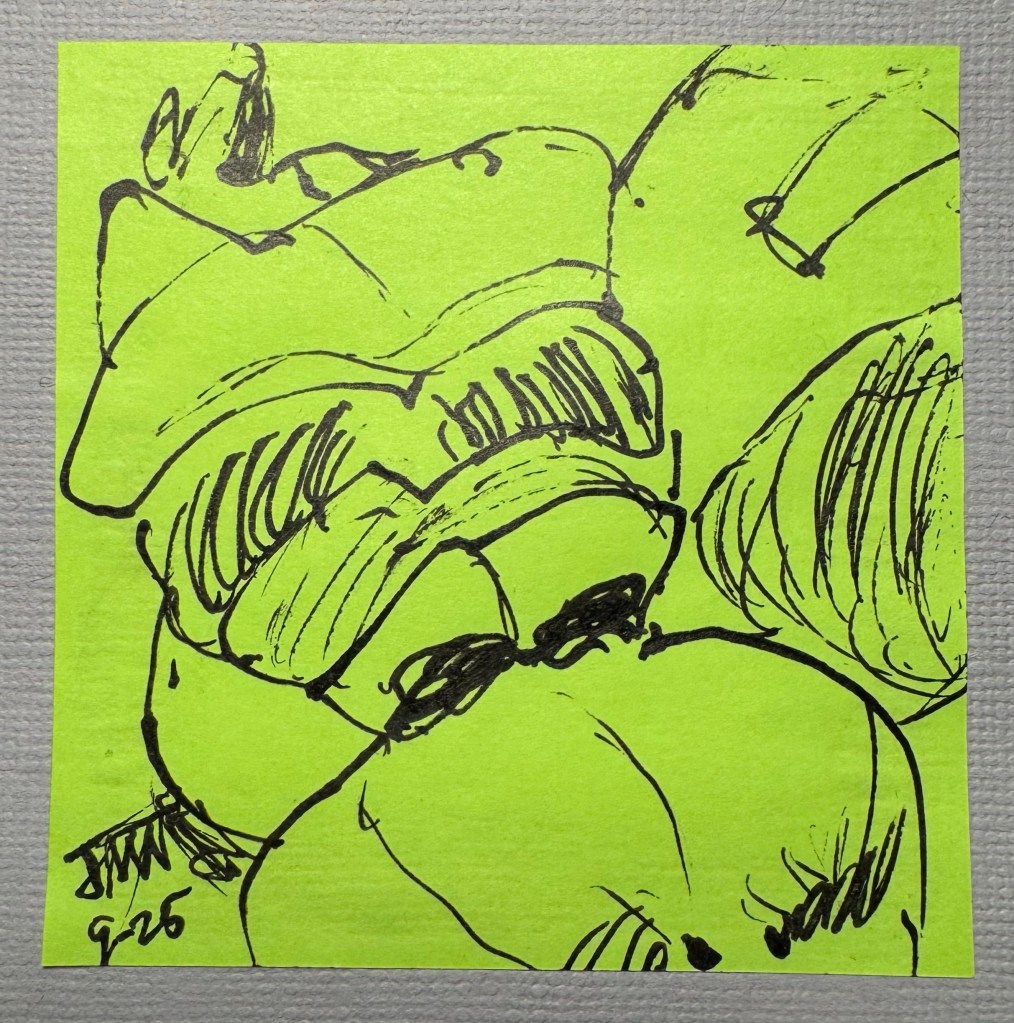
If Stardust is ever pierced by a poem-moment, and there’s no special need for that to happen from where I stand, there’s hundred’s of feet of fertile loam accrued in my friend’s delta of sensibility for it to root in. Stardust will have perceived the poem as lines, akin to a sketch that works unusually well.
(c) 2025 JMN — EthicalDative. All rights reserved