A Black Hole Sings in B Flat

galaxy ngc 1275

Galaxy NGC 1275. Credit NASA.

There is great buzz today around black holes in celebration of the latest observations. The sense of awe these phenomena induce has intersected just now with my private boning up on fundamentals of music theory, leaving me astounded on many levels.

In 2003, an international team led by the X-ray astronomer Andrew Fabian discovered the longest, oldest, lowest note in the universe — a black hole’s song — using NASA’s Chandra X-ray Observatory. The B flat note, 57 octaves below middle C, appeared as sound waves that emanated from explosive events at the edge of a supermassive black hole in the galaxy NGC
1275.

The notes stayed in the galaxy and never reached us, but we couldn’t have heard them anyway. The lowest note the human ear can detect has an oscillation period of one-twentieth of a second. This B flat’s period was 10 million years.


(JoAnna Klein and Dennis Overbye, “What Is a Black Hole? Here’s Our Guide for Earthlings,” NYTimes, 4-10-19)

(c) 2019 JMN.

Posted in Anthology, Quotations | Tagged | 2 Comments

“I don’t paint what I see but what I saw”

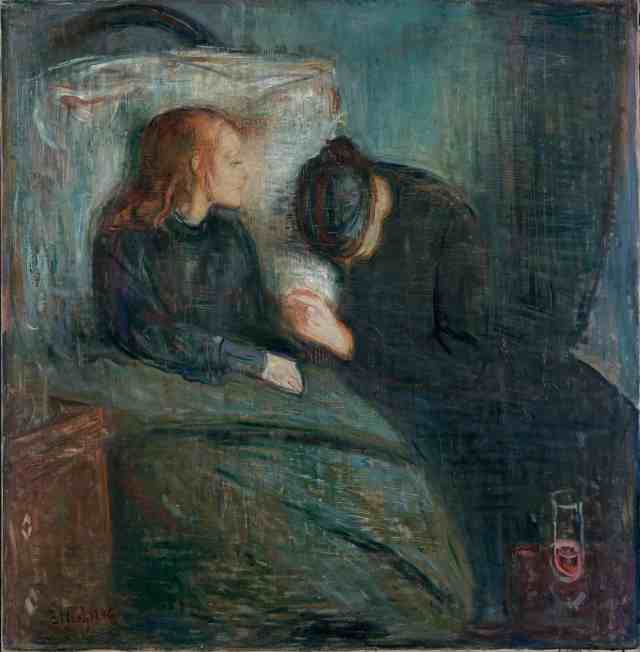
munch sick child

Edvard Munch’s 1896 painting The Sick Child. Photograph: AP.

There’s much that’s discoverable for me about Munch. These excerpts stood out. Artists I admire are similarly self-critical and leery of pretty pictures.

Munch’s house and studio were on a remote hillside above Oslo, where he fled after his 1908 breakdown to escape “the enemy” – critics and fellow artists. He would live there with his beloved dogs, and the occasional horse, until his death. Liberated from his angst and alcoholism, he painted and repainted the nature around him, jealously hoarding his work while treating it with mind-boggling contempt. He would leave paintings outside in in all weathers beneath a narrow mansard, saying: “It does them good to fend for themselves.”

Munch drew animals beautifully, visiting zoos to study them. But he wrote: “We want more than a mere photograph of nature. We do not want to paint pretty pictures to be hung on drawing room walls. We want to create, or at least lay the foundations of, an art that gives something to humanity. An art that arrests and engages. An art created of one’s innermost heart.”

munch outside studio

Edvard Munch with brush and palette with his canvases at his house outside Oslo. Photograph: Munchmuseet.

(Claire Armitstead, “Edvard Munch: booze, bullets and breakdowns,” The Guardian, 4-8-19 — Note: “Armitstead” is not a typo.)

(c) 2019 JMN.

Posted in Anthology, Quotations | Tagged | Leave a comment

Side Hustle

rattlesnake9

How old are “old Chinese sayings” and how many are actually Chinese? Fewer than all of them, I surmise. However, one I encountered said that wisdom consists in getting things by their right names. It appealed to me because it stressed accuracy in speech.

Awash as we are in mendacity, the article quoted here refreshes by signaling how “cute” euphemisms can cloak misery — in this case, “the chaotic truth of working life in today’s America.” The author recommends that we improve the way we talk about work by shunning cynical, exploitative jargon.

The “side hustle” is one of a growing roster of trendy corporatized idioms, like ordinary household appliances that are now “smart” or plain vanilla businessmen and women remade into the more exotic “entrepreneurs.” Our jobs are now “flexible,” although we are the ones contorting ourselves to work at all hours, or we are professionally “nimble” because we are trying to survive on freelance gigs.

So what can we do? For starters, anyone writing about work… should stop glorifying long hours at work or juggling multiple workplace identities… As workers, we might acknowledge that “side hustle” is an insidious term and resolve never to use it again. More broadly, we must fight other forms of this falsifying new jargon and seek out more truthful language….

(Alissa Quart, “The Con of the Side Hustle,” NYTimes, 4-6-19)

(c) 2019 JMN.

Posted in Quotations | Tagged | Leave a comment

Paint-by-Numbers

dan robbins

Dan Robbins, the inventor of painting-by-numbers, who has died aged 93. Photograph: Jim Newberry/Alamy.

For art critics, painting-by-numbers was, and is, a byword for robotic repetition and unoriginality…

(Jonathan Jones, “From Warhol to minimalism: how painting by numbers revolutionised art,” The Guardian, 4-5-19)

At some point in my pre-teen years I was given a paint-by-numbers kit. I vaguely recall doing the little project and being pleased, as well as fascinated, by the result. I may or may not have done another kit — I simply can’t recall. I’ve never connected this humble experience with my lifelong interest in, and sporadic practice of, painting. Having found stimulation in paint-by-numbers, even as a youth, seemed like a lowbrow thing to confess. When I have thought of it, however, and with no reputation to protect anyway, I’ve remembered my brief career as a painter-by-numbers with affection.

The more so now, since I’ve encountered this tribute to Dan Robbins, the man who invented paint-by-numbers. I did not know this history of the thing. In the photograph Mr. Robbins looks like a thoroughly likable man who is enjoying a good joke. Having a taste for parody myself, I like the fact that his invention started as parody, but ended up just being damned fun for a lot of people.

I also did not know that Andy Warhol had paid homage to the paint-by-numbers phenomenon. I have cautious respect for Warhol and a certain appreciation for his work, though I haven’t an inkling as to how silkscreening works. I have found on occasion that mention of Warhol can elicit expressions of loathing by serious artists, some of which seem oriented as much toward things he said as toward things he did. I’m not competent nor inclined to take a position in these interesting discussions.

warhol paint by numbers

[From BBC Front Row, “Transmitting Andy Warhol” linked by Jonathan Jones] Andy Warhol, Do it Yourself (Seascape), 1962 © 2014 The Andy Warhol Foundation for the Visual Arts, Inc. / ARS New York / DACS London.

With respect and affection, however, I salute Dan Robbins, dead at 93, for inciting my own pale practice of “robotic repetition and unoriginality.”

(c) 2019 JMN.

Posted in Commentary | Tagged | 4 Comments

“Perverse Obliqueness”

Brexit defies me as much as my native political scene defies me. Anomalies aside, I find here a stretch of forceful writing to savor for language’s sake. I came to attention from “carapace” forward. What follows illumines for me something I see darkly in my own looking glass. “If this be Englishness,” I mused with perverse pride, “the shoe ruefully fits me.”

Undoubtedly, there was a certain fury in many people’s minds, but the carapace of irony and self-deprecation that obscured it brought to mind one of the ingrained aspects of national identity pointed out by the social anthropologist Kate Fox. In her classic book “Watching the English,” she writes about the deep layers of performance and self-mockery that smother even heartfelt misery and anger: “Even if you are feeling desperate, you must pretend to be only pretending to feel desperate.”

More generally, she talks about “perverse obliqueness”, “emotional constipation” and a “general inability to engage in a direct and straightforward fashion with other human beings”.

(John Harris, “Petitions and jokes will not halt this march into Brexit calamity,” The Guardian, 4-1-19)

(c) 2019 JMN.

Posted in Quotations | Tagged | Leave a comment

“All right — take the picture!”

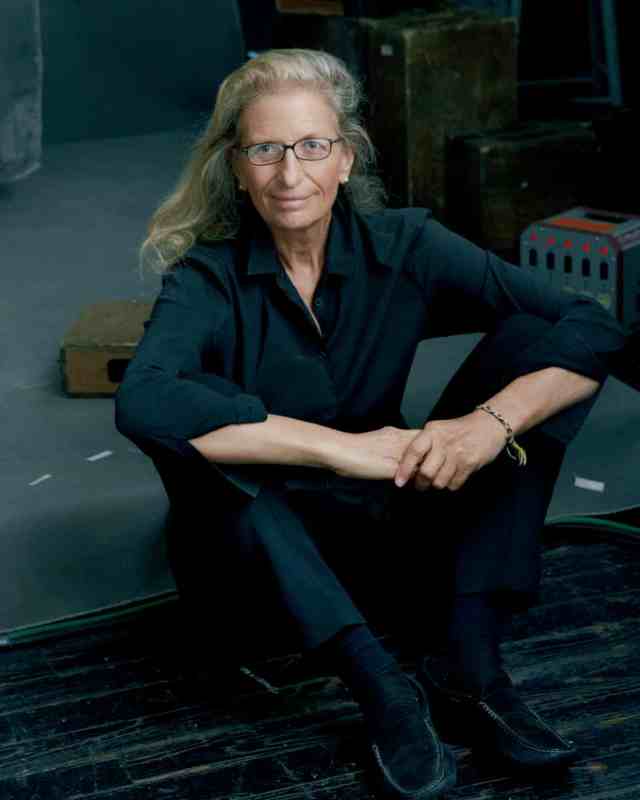
annie leibovitz (2)

‘You have to be insane, obsessed. You have to live it and eat it’ … Leibovitz’s big tip for photographers.

Annie Leibovitz’s latest exhibition of her photography is Annie Leibovitz: The Early Years, 1970-1983. It includes a shot of Henri Cartier-Bresson, one of her idols, during her time roaming Paris as a budding photographer.

The notoriously camera-shy Frenchman glares into her lens. “He wouldn’t let me photograph him,” says Leibovitz. “So I studied his route to work every day and planted myself on a bridge and waited. ‘You!’ he said, when he saw me. Then, ‘All right – take the picture.’”

“It’s a show about photography,” says Leibovitz. “I can stand outside of myself and look back at this young photographer learning how to take pictures, learning how to see.”

“I kind of know what people kind of want to look like,” says Leibovitz [about her portraits of celebrities]. “I can’t always achieve it. It’s like I’m a pushover. I really like to please. This is their life and I like to let them get to wherever the next step is they want to get to. I have no reason not to.”

Jordan Riefe, “Annie Leibovitz on the shots that made her,” The Guardian, 3-31-19)

(c) 2019 JMN.

Posted in Anthology, Quotations | Tagged | 1 Comment

Some Fizz for ‘Fissile’

“That’s Alex Jones’s M.O.,” Owens said of the deposition. “To flood any topic with confusion and doubt so no one can grab onto anything.”

But under oath, Mr. Jones’s tactics fissile.

(Charlie Warzel, “Why Courtrooms Are Kryptonite for Alex Jones,” NYTimes, 3-31-19)

“Fissile,” where I’d have written “fizzle,” caught my eye in this article. With its meaning of “easily split” (chiefly of rock), it’s an interesting alternative in the context. It would need a verb, however: “are fissile” or “prove fissile,” perhaps.

The slips I most appreciate are the ones that are almost too plausible to dismiss.

(c) 2019 JMN.

Posted in Commentary | Tagged | Leave a comment

Stubborn Repetition

james harden beard

“Homage to Wassily Kandinsky, author of first purely abstract painting.” Credit Filip Peraić.

In my own modest easel practice I’m trying to psych myself into painting a subject more than once. Artists I admire do it. Real artists. They dwell and go deep; obsess, in a good way. I’m afraid I have a tendency just to skate over surfaces, then move on. I got a kick out of this article about Filip Peraić, who goes deep on one athlete’s profile.

Filip Peraić needed a career boost. He found one by drawing Harden, the Houston Rockets guard, in profile over and over and over again.

“I like repetition, and I’m a bit stubborn,” he said when asked how he could keep coming back to the same image. “When I made a couple of them I thought, ‘This is really interesting.’ It’s a challenge for me.”

james harden beard again

Filip Peraić.

(Benjamin Hoffman, “What Better Muse Than James Harden’s Beard?” NYTimes, 3-27-19)

(c) 2019 JMN.

Posted in Quotations | Tagged | 3 Comments

Dyspeptic Rumination

exclamation-mark

A French aphorism says, “Plus ça change, plus c’est la même chose”: “the more it changes, the more it’s the same thing.” It’s sometimes paraphrased in English as, “The more things change, the more they stay the same.”

My comments, which are petulant and bombastic, arise from an article published by Bénédicte de Montlaur (“Do You Speak My Language? You Should,” NYTimes, 3-26-19.) She is the cultural counselor of the French Embassy in the United States.

It may come as no surprise that data cited by Mme de Montlaur show that from 2013 to 2016 U.S. colleges cut 651 foreign language programs. In America, 20 percent of K-12 students study a foreign language, while in Europe an average of 92 percent do so. Only 10 states impose a foreign language requirement for high school graduation.

The road to Erewhon is a deeply rutted thoroughfare pockmarked with plangent whimpers that someone “needs to” (or “should”) do something about dire situations such as this.

Government spending on foreign-language education… needs to increase. More states need to enforce… Colleges need to recognize… Parents, students and teachers need to lobby…

… Knowing a foreign language is becoming ever more essential.

There’s no reason to doubt the passion and sincerity behind such cries. It’s only that they’re like scolding the waves for lapping the shore. American indifference, even hostility, to foreign languages runs deep. Ever since I can remember, they have been shambling stubbornly — along with music and art — into the education ditches lined already with twitching corpses of other things deemed “crucial” that pedagoguery has knifed.

As if on cue, the effluvium of “holistic education” wafts into the discussion.

… There is a move toward holistic language education, based on the notion that learning a language should be grounded in the real, everyday use of that language.

Grounding language learning in “real, everyday use” is just another way to describe good teaching technique. Educational holism, however, goes further by positing that second-language study is made relevant if it can be “tied to its application in… other fields of study.” One university has programs “aimed at developing language skills that allow [students] to work more effectively in, and to be more attractive to, international companies and organizations.” Another university offers a program “ ‘for students looking to become truly global engineers,’ which combines a foreign language degree with one in engineering.”

Holism, it seems to me, reflects how our culture frowns persistently on forms of learning that don’t promise to serve a practical end. I’m a foreign language major who fled from the
academic career I thought I was prepared for into the provinces of business and technology. I was fortunate, perhaps, to inhabit a moment when such a transition could still be made. I wasn’t formally credentialed to do the work I ended up doing, but my knowledge of languages got me in the door. I suppose I sing willy-nilly in the choir to which Mme de Montlaur is preaching. My dirty secret is that the only reason I studied those languages in the first place is because I liked them and wanted to live abroad.

At a conference on machine translation in New Orleans I dusted off my French to exchange small talk with an engineer from Lyons. On impulse I declaimed a French sonnet I learned in college: “El Desdichado” by Gérard de Nerval. The engineer nodded appreciatively and, switching to perfect English, said, “You left this out, monsieur.” He then recited two lines from the poem that I had omitted, having forgotten them long ago. That a foreigner spoke my native language I took for granted, as Americans do. What impressed me was that an engineer knew by heart a 19th-century French poem with a Spanish title penned by an eccentric suicide. I still believe the “essential” purpose of learning any language is to court surprises and support conversations outside the hive. The rest is just work.

(c) 2019 JMN.

Posted in Commentary | Tagged | Leave a comment

Cartoon Transfer Technique

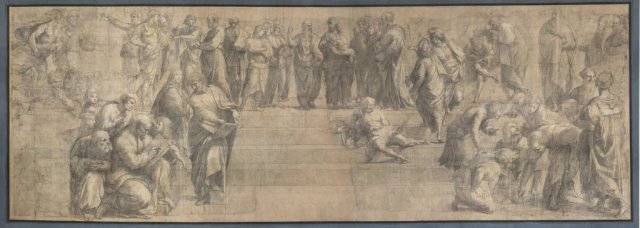
raphael cartoon

The preparatory cartoon for Raphael’s fresco “The School of Athens,” a full-scale drawing used to transfer the image to a wall in the Vatican, has undergone a four-year restoration. Credit Veneranda Biblioteca Ambrosiana, via Mondadori Portfolio.

The article is about Raphael’s preparatory cartoon for his fresco “The School of Athens” in the Vatican. What caught my eye in particular was mention of the method used to transfer the image to the walls.

Its value must have been evident to Raphael’s contemporaries, and rather than use the cartoon itself for the fresco, a copy was used and the original was preserved. That copy was destroyed through use when the outlines of the figures and details were pricked with pins, and the cartoon was dabbed with a cloth bag containing charcoal powder to transfer the image to the walls.

(Elisabetta Povoledo, “How Did Raphael Do It? To Find Out, Get Up Close,” NYTimes, 3-26-19)

(c) 2019 JMN.

Posted in Anthology, Quotations | Tagged | Leave a comment