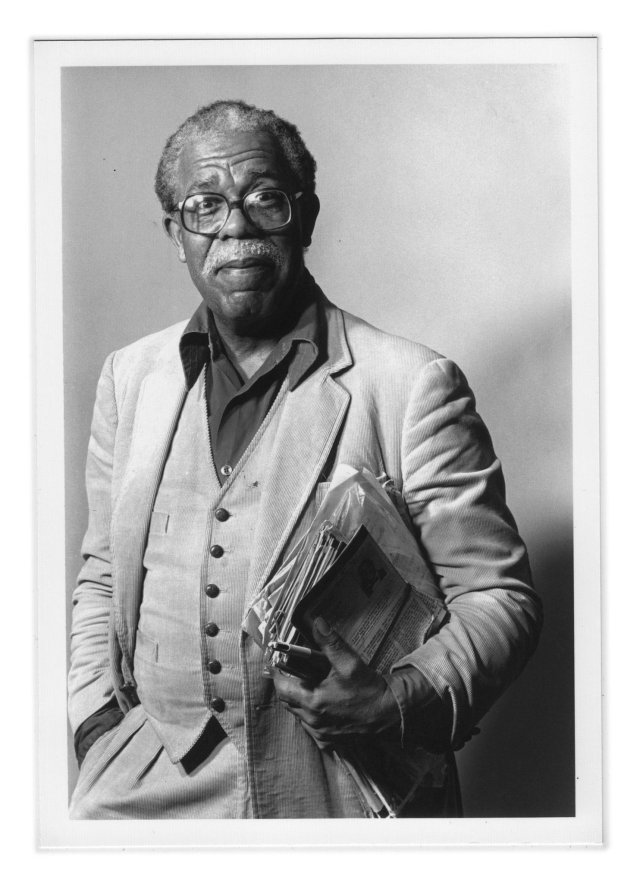
A studio portrait of Dudley Randall, whose Broadside Press helped amplify the voices of prominent black poets. Credit Yancy Hughes/Job Trotter Foto, via Bentley Historical Library/University of Michigan.
Randall started the publishing house, which was based in Detroit, with his librarian’s paycheck, and it swiftly became a success, producing dozens of broadsides — a printing style in which just one side of the paper is used — as part of the Black Arts Movement, a flowering of African-American literature, theater, music and other arts.
“Black authors could not be published by white publications, white magazines or by white publishers,” Randall said in a 1973 interview with Speakeasy Culture, a literary publication out of Central Michigan University. “We had to do it ourselves.”
(Morgan Jerkins, “Overlooked No More: Dudley Randall, Whose Broadside Press Gave a Voice to Black Poets,” NYTimes, 2-13-19)
(c) 2019 JMN.



 EthicalDative
“Flowers” and Candy Bars
[Watercolor by Harold J. Nichols, 1924-2013]
I’ve started viewing “Flowers” on Netflix, a British series starring Olivia Colman. In episode 2, I think I heard a character ask a refreshment vendor for “two Clunks and a Milky Finger.” The vendor hands him three candy bars. Dialog goes at a fast clip in this endearingly daffy comedy, so I can’t be sure, but I’m hoping that’s what I heard. I’ve collected American candy bar names for years — O’Henry, Snickers, Butter Finger, Bit-‘O-Honey, Payday, Almond Joy, Mounds, Three Musketeers, Baby Ruth, Zero, Mister Goodbar — those are ones from the top of my head; however, their names are stale enough to have lost their laughability. If Clunks and Milky Fingers are indeed two wrapped British treats, freshness arrives.
(c) 2019 JMN.