I’ve been reading old nursery rhymes I was exposed to in tinyhood by a teenaged aunt and twenty-year-old mother. They must have enthralled me as I lay me down to sleep in the pre-reason season; they still do. Why? Obscenely simple, laden with gibberish, they start nowhere and lead there — rhythmic, resolute, unapologetic.
A robin and a robin’s son Once went to town to buy a bun. They couldn’t decide on plum or plain And so they went back home again.
But the dipsy-doodle ebullience they awaken, relieved of judgment, exempt from demand, eases me unexpectedly into poetry upon which my dolefully cogitating adult self finds dicey footing, if any. Here’s an excerpt from Justin Rovillos Monson’s “I WISH I HAD MORE TIME IN THE DAY”* (the caps are Monson’s):
There are secrets to keep and secrets we fit inside so I palm the universe so still still still in both hands & speak here in tongues when you come come
around. Long as I’m a city, you’ll always have a place to sit
a wall to lean on & get your fiend on.
‘Thank you for using—‘
If you don’t read with the tyranny of expectation, you get what’s simply there. The repetition. The cadenced quasi-rhyming (lean on… fiend on). The interiority marked by saucy disconnective turbulence. Pie in the face. Finger in the eye. Je m’en foutisme. The if-I-should-die-before-I-wake-ism pounded by protestant grandmothers. The drugginess: Thank you for using. What’s the plural of double-entendre? Redoubled understandings? I’d rather spin the question than know the answer.
It’s hard to put a finger on how verse like Justin Rovillos Monson’s squeaks through doors of reception left half ajar by surreal doggerel squatting in a scratched-up book. But the finger is raised.
It’s a handsome volume* with gloriously voweled Arabic texts opposite English versions by James E. Montgomery, Sir Thomas Adams’s Professor of Arabic at the University of Cambridge and Fellow of Trinity Hall. The poems are by, and attributed to, Abū Nuwās, “arguably the greatest poet of the Arabic language.” This isn’t a review; I’m only starting the book, and these are just some thoughts at the outset.
The Introduction to Abū Nuwās, A Demon Spirit: Arabic Hunting Poems is dense, and parts of it are hard to read:
For all its humanizing strategies and its apparent inability to avoid being interested in the nonhuman only insofar as it is a reflection of what is significant to the human, the poem suggests a different way of conceiving relationality.
The Introduction suggests that the reader paying close attention to the particularities of the Arabic text may need to brace for a lack of transparency in the translator’s English “renderings”:
“… I have prioritized clarity… in an English I have endeavoured to keep uncluttered and economical. I aimed for English renderings that could stand on their own… There remain many poems and lines that are obscure… Consequently, much of my translation remains conjectural, and in such instances I have dispensed with endnotes that signpost my failings.
I’m not sure what “stand on their own” means. Will these translations resemble “imitations” in the vein of a Robert Lowell? As a student of Arabic, that source text on the lefthand page beckons to me like the Sierra Madre. Will I bark up coon-less trees, chasing source-target “relationalities” where none were possible or intended — just because the translator didn’t want to “signpost his failings” with endnotes? (The Introduction has 65 of them!) Let’s face it: In a sense, all poetry translation is conjectural, premised on more or less astute failings.
The book’s first poem is one of nine “description(s) of the dog” (na^t(u)-l-kalb(i)). The dog is the saluki hound used in ancient Arabian hunting. Here’s my transliteration and literal English version:
[qāl(a) yan^at(u)-hu [‘ar-rajaz] He said describing it [‘ar-rajaz (a poetic meter)]
[‘an^at(u) kalb(an) ‘ahl(u)-hu fī kadd(i)-hi] I describe a dog whose people are in his toil.
[qad sa^id(at) judūd(u)-hum bi-jadd(i)-hi] Happy were their fortunes with his good luck,
[fa-kull(u) ẖair(in) ^inda-hum min ^indi-hi] for every good in them was from in him,
[wa-kull(u) rifd(in) ^inda-hum min rifd(i)-hi] and every gift in them was from his gift.
[yaḍall(u) maulā-hu la-hu ka-^abd(i)-hi] His master is become for him like his slave.
[yabīt(u) ‘adnā ṣāḥib(in) min mahd(i)-hi] Nights he spends in greater closeness of an owner than his bed, (My English here is neither uncluttered nor economical per Montgomery’s manifesto, but I’m at pains to preserve the annexed state of the comparative adjective by the following noun in undetermined genitive case.)
[wa-‘in ḡadā jallal(a)-hu bi-burd(i)-hi] and if he goes out at dawn, he wraps him in his cloak. (Hunts were inititated at dawn, and the “dawn hunt” was a trope of the genre.)
[ḏā ḡurraẗ(in) muḥajjal(an) bi-zand(i)-hi] Possessed of a blazed face, white-footed on his foreleg,
[talaḏḏ(u) min-hu-l-^ain(u) ḥusn(a) qadd(i)-hi] gratified by him is the eye, by the beauty of his shape,
[ta’ẖīr(a) šidq(ai)-hi wa-ṭūl(a) ẖadd(i)-hi] the drawing back both corners of his mouth, the length of his cheeks.
[talq(ā)-ẓ-ẓibā’(u) ^anat(an) min ṭard(i)-hi The gazelles meet misery from his hounding. (I wonder why Montgomery transliterates the word for “gazelle” (ẓaby — see below), whose plural ẓibā’ appears in the line.)
[tašrab(u) ka’s(a) šadd(i)-hā bi-šadd(i)-hi] They drink a cup of their running with his charge.
[yaṣīd(u)-nā ^išr(īna) fī murqadd(i)-hi] He hunts down for us twenty in his murqadd (?). (None of my sources help me with murqadd. Is it correctly pointed? Without the šadda which doubles the final consonant, the word could be the Form 4 passive participle of root r-q-d with a meaning such as “being made to sleep.” That doesn’t make loads of sense for the line, but at least it’s a plausible form. Montgomery’s phrase “in a single run” (see below) doesn’t come to grips with murqadd so far as I can tell.)
[yā la-ka min kalb(in nasīj(i) waḥd(i)-hi] What a dog you are! One of a kind! (The phrase nasīj(i) waḥd(i)-hi is listed in Wehr, an instance of how ancient usage persists to modern times. The meanings given are “unique in his (its) kind, singular, unparalleled.” Nasīj can be “a woven fabric, a textile.” The term waḥd centers around a concept of “oneness.” I like to think of “cut from singular cloth” as a possible description for the swift, handsome, lethal hunting hound that Abū Nuwās apostrophisizes.)
Professor Montgomery’s zesty rendering has the last word, as befits:
In His Gift I sing of a dog who feeds his folk— good fortune and well-being are in his gift. His master sleeps by his bed, wraps him in his cloak on dawn hunts, and waits on him like a slave. The eye exults in his beauty: the bright blaze on his head, his white forelegs, fire-stick thin, his long cheek, his scissor bite. He brings death to the ẓabys drinking their speed to the dregs, felling twenty in a single run. What a dog you are — the best of dogs!
*Abu Nuwas, A Demon Spirit: Arabic Hunting Poems, edited and translated by James E. Montgomery, New York University Press, 2024.
Persons who explain philosophy say “as it were” and “if you will” a lot. I’m none the wiser how it were, and no, I won’t.
Persons who explain poetry don’t.
God writes the universe, then says, “Read it. As it were, and if you will.”
One logician said dismissively of another, “He shows you how to chase the truth up the tree of grammar.” Finally! That’s what I do in studying languages, especially Arabic. Hello, clarity!
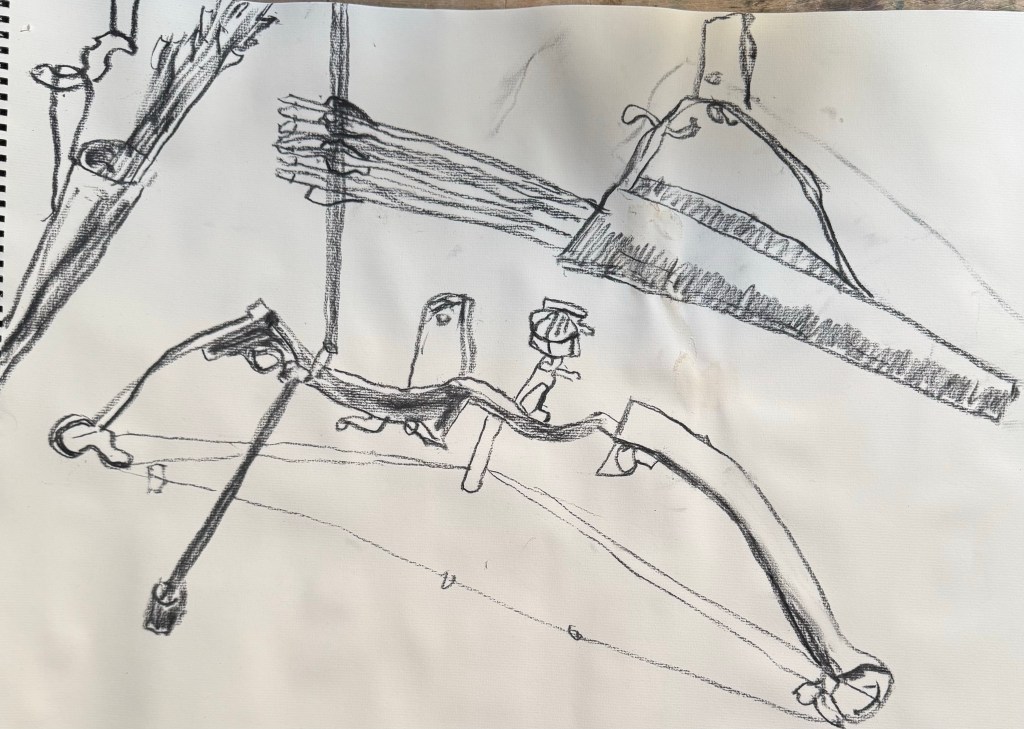
“Instead of focusing on the voters they were losing, Biden and the Democrats kept focusing on the voters they were winning.” Ezra Klein’s comment reinforces my sense that I should continue trying to draw with willow charcoal. It’s for me an uncongenial medium and I’m not winning it over to my side, which argues for continuing the struggle. Stay the course, says my bitter angel. I call my ham-fisted sketch “Page Killer,” a bit of jargon resurrected from my newspaper advertising days. A page killer was an ad big enough to crowd any other ad off the page. Room was left for a smidgin of editorial matter. An advertiser could spend less than the cost of a full page and still get the benefit of having no competition for eyeballs. An ad spanning two full pages was called a “double truck.” Merchants pestered us to guarantee placement of their ad on a lefthand page in section A, but we salespeople were tasked with holding the line, our mantra being, “We do NOT sell position!” Our newspaper had the greatest penetration of any in the region, which gave us leverage. My department, Display Advertising, was its beating heart. The ads were the content; the news was just filler.
“We were never anywhere other than where we were.”
(Ben Tarnoff)
Now and then I let the me called self remain unsure of something when I know full well I could resolve doubt with a peek at the internet known today as “research.” There’s something delicious in giving the mind rein to rusticate in all manner of sweet conjecture, or simply to set the matter aside as not worth pursuing. Will learning how the Stutz-Bearcat got its name improve my life?
Frank Bruni’s feature “For the Love of Sentences” has a quotation which suggests that the suspension of certainty could look a lot like what’s now called “living in the moment.” Isn’t that supposed to be a good thing?
“I belong to the last generation of Americans who grew up without the internet in our pocket. We went online, but also, miraculously, we went offline… We got lost a lot. We were frequently bored. Factual disputes could not be resolved by consulting Wikipedia on our phones; people remained wrong for hours, even days. But our lives also had a certain specificity. Stoned on a city bus, stumbling through a forest, swaying in a crowded punk club, we were never anywhere other than where we were.” ([Quote submitted by] Janice Aubrey, Brooklyn, N.Y.)
Nabokov and Borges differed over how translation should be done, the former favoring literalness (“The clumsiest literal translation is a thousand times more useful than the prettiest paraphrase”), the latter transformation (“Translation is… a more advanced stage of writing”). I gravitate increasingly towards Nabokov’s view, driven most by my practice in reading Arabic.
I like the Spanish word “fidedigno” for its suggestion of “faith-worthiness.” A faith-worthy translation isn’t gassy with interpretation; pays all but servile deference to the letter of the original; doesn’t reach unduly for the “spirit” of the text — that’s for the separate realm of commentary. Equally important, the faith-worthy translation resists overprocessing the source into target-friendly modalities, presuming that the reader must always be protected from strange-sounding language.
“Say: Do I inform you of worse than that, requital-wise, chez God? The one whom God cursed him and He was angry with him and made of them [plural pronoun!] monkeys and pigs and he worshiped idols. Those are worse, place-wise, and more astray from the sameness of the way.”
My reading is a trot, not a translation. It tries to peg analytically the operation of elements in the source text. I try to seize on what seems a core meaning of a word in a Wehr listing; this can mean passing over a dandy English phrase standardized by usage (ex. “right path” versus “sameness of the way”).
About those monkeys: In English a “simian” is an ape or a monkey, but an ape isn’t a monkey. I don’t find the distinction between the two as clearly marked in Arabic and Spanish. (Spanish doesn’t have different words for “elk” and “moose,” either.) For qird (its plural qiradaẗ occurs in the verse), Wehr lists “ape” and “monkey.” Lane lists “ape,” “monkey” and “baboon.”
I’ll cite two versions of the verse to show what solutions translators can hit upon.
Shall I tell thee of a worse (case) than theirs for retribution with Allah? (Worse is the case of him) whom Allah hath cursed, him on whom His wrath hath fallen and of whose sort Allah hath turned some to apes and swine, and who serveth idols. Such are in worse plight and further astray from the plain road. — M. Pickthall
Di: <<No sé si informaros de algo peor aún que eso respecto a una retribución junto a Dios. Los que Dios ha maldecido, los que han incurrido en Su ira, los* [Cortés’s note: ‘Los judíos. C2:65’] que Él ha convertido en monos y cerdos, los que han servido a los taguts, ésos son los que se encuentran en la situación peor y los más extraviados del camino recto.>> (Say: “I don’t know whether to inform you of something worse than that respecting a retribution next to God. Those whom God has cursed, those who have incurred His wrath, those* [Cortés’s note: ‘The Jews. Quran 2:65’] whom He has converted into monkeys and pigs, those who have served the idols, they are the ones who find themselves in the worst situation and strayed furthest from the straight road.”) — Julio Cortés
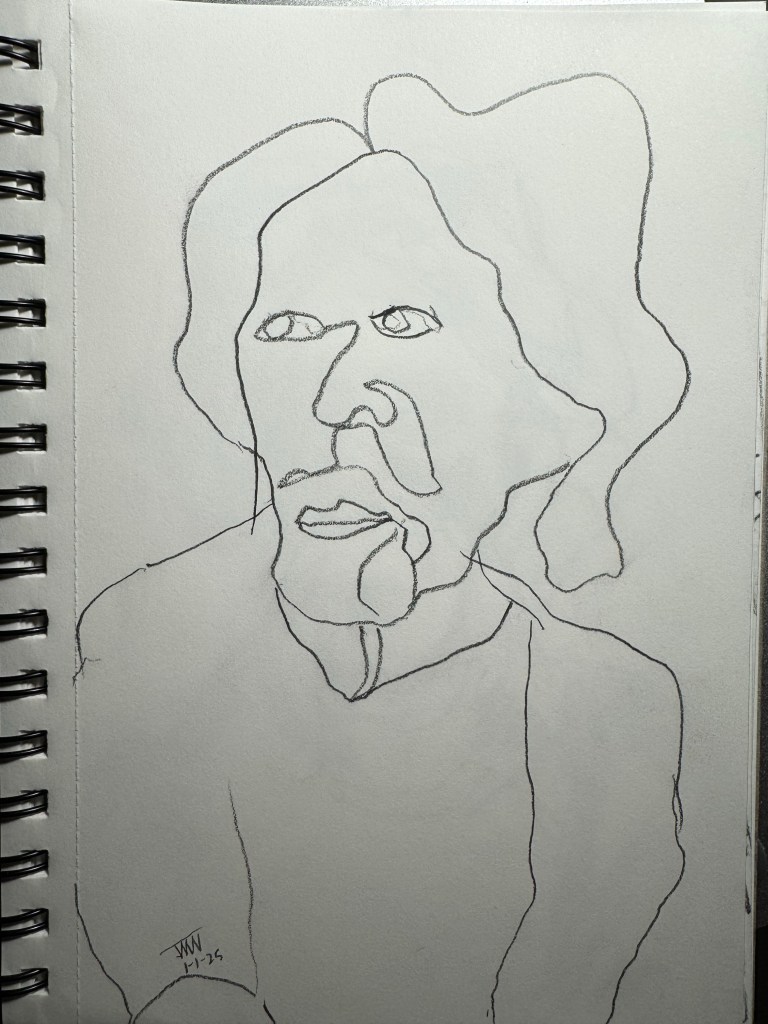
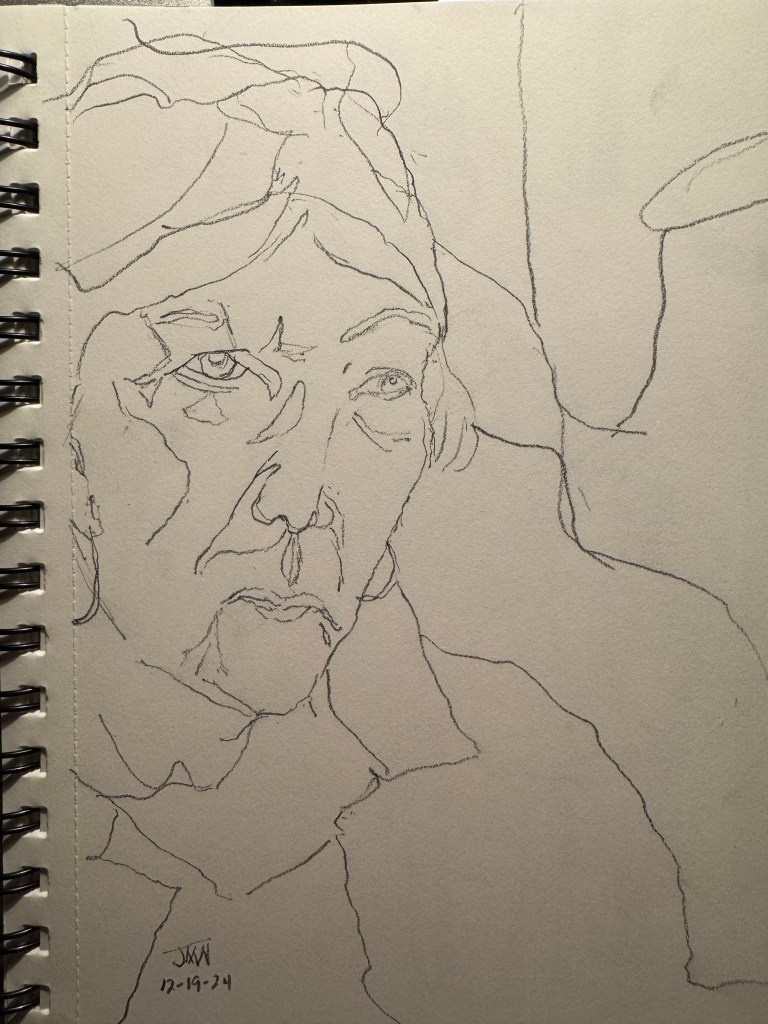
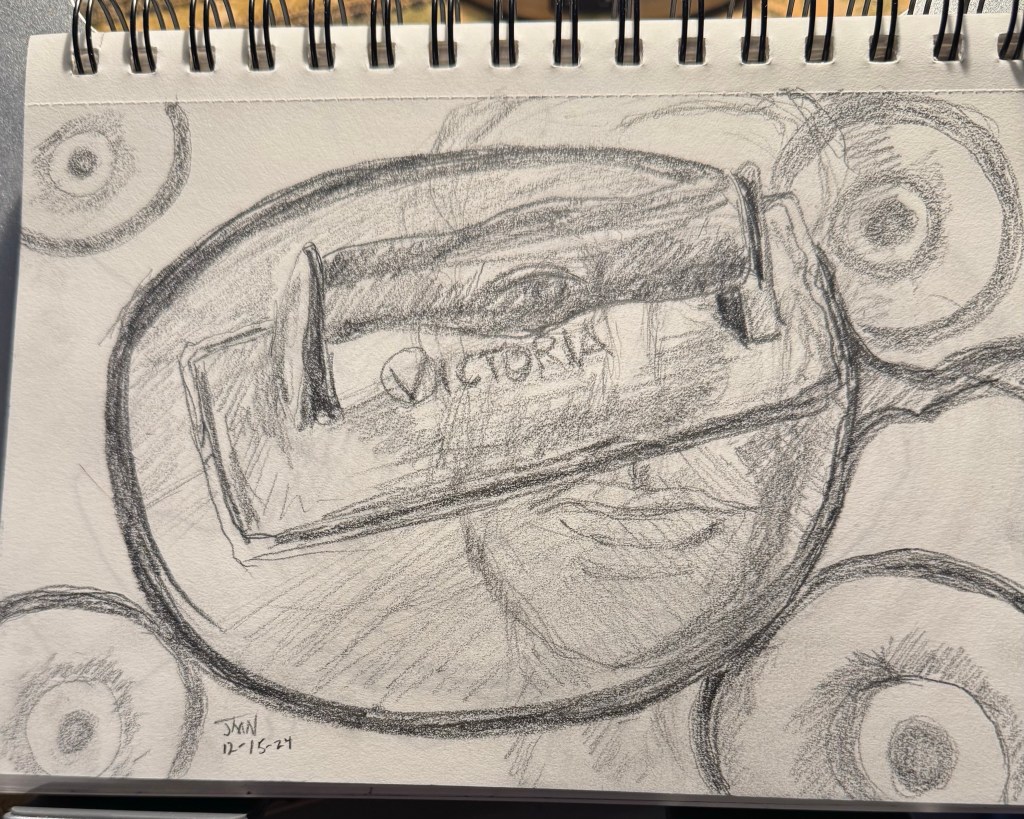
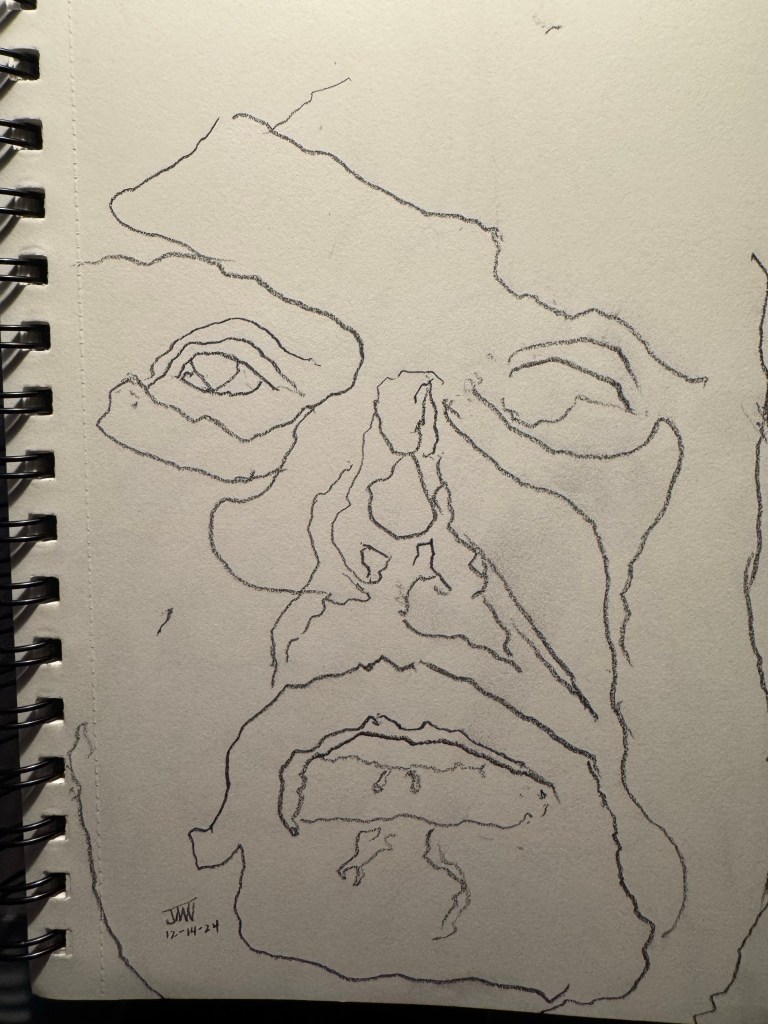
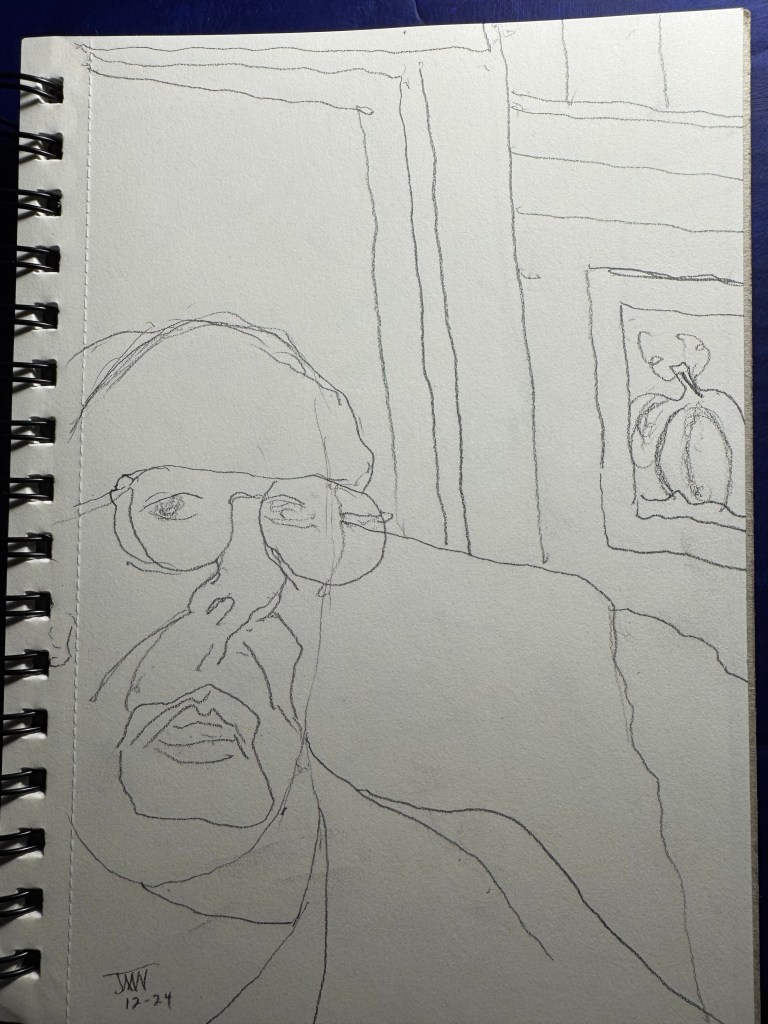
I’m to draw what I find interesting in front of me; what I can perceive to be of interest; what I can make interesting. It’s a confrontation between two undisciplined hands, two bespectacled eyes, and the naked reality of a surrounding, tridimensional soup. “Disquieting” isn’t the half of it. I’ve long dodged the hard work of learning to draw freehandedly, a project which is advanced by — wait for it — practice. A mentor pushes me to overcome my terror of the unguided line. I covenant uneasily with myself to share the outcomes such as (alas) they are. The face I see in the mirror and what lands on the tablet share no resemblance. But I’ve no urge to do self portraiture anyway; were there another live face in the house I’d happily draw it instead. Just yesterday I learned the hard way what my mentor warns against, which is overworking a drawing. The face sketched in several minutes had achieved a certain — what shall I call it? — intact quality, not skillful but at least stable, flawed in a forward direction. Should’ve stopped there. Didn’t. So it goes.
“If all men are born free, how is it that women are born slaves?”
(Mary Astell (1666-1731)
The question of Adam’s and Eve’s navels has been discussed by theologians. It’s interesting, some have thought, for how it bears on the matter of their having come into being through other than a birth canal. I’d never thought of the anatomical detail until its mention on a BBC4 podcast. Religions go where reason deigns not tread.
While talking poetry, I’d like to pay my respects, in one swell foop, to Poetry, November 2024. First, check out the cover, whose credit goes to Andrea Trabucco-Campos. The magazine has adopted a clever, standardized design of its name. The ingenious objectifying of that design on the current cover is highly satisfying.
Jane Hirshfield’s two poems communicate phenomenal directness on their surface. As I read them the term “plainsong” kept circling my mind. They jolted me out of my cynicism that poetry can’t lift me out of my chair immediately. In the poem titled “I am asked a question,” it’s “life” doing the asking. The respondent suggests a better question, one I like more the sound of, / with more pleasing grammar; note the slightly atypical word order of “one I like more the sound of,” as if the dialog with life were conducted in a non-native tongue. The poem shrugs off completely the project of answering any question. Whatever was asked is rightly unstated: life states itself. The speaker’s Candide-like resort to tending garden, practically and spiritually, is its own answer; that, and submission to the act of observing.
I leave the question. I go into the garden and weed.
My life weeds with me.
The knees of my pants are stained.
Hirshfield’s second poem’s title is elegantly un-plain, highflown: “I Was Not, Among My Kind, Distinctive.” A mid-passage, and the poem’s conclusion, show how distinctively it’s knit.
First, the mid-passage, where postpositive, adverbial, subordinate clauses with elided predication administer a happy shock:
My left hand believed it could hold my right when the hammer.
My right hand believed it could hold my left when the fire.
The theme of trial and failure runs quietly through the poem, including this perfect lone hexameter: I failed to reach my sister’s hand before she died.
Now the conclusion, where the poem comes to a self-knowing sort of rest:
Distractions: ordinary. Omissions: rampant. Thinking any of this peculiar to me.
No, I was not distinctive, among my kind.
Showered with pollen, I sneezed. I ate, and by morning found myself once again hungry.
Hirshfield treats deep thoughts with straightforward syntax in her poems. By contrast, the issue ends with two essays full of jazzy riffs, impudent juxtapositions and sinuous syntax such as one might expect to be strewn with line breaks or printed depictively. It’s how poets juice spitballing in prose with their versions of insightfulness.
Antipathy can be an act of discernment, of love, a challenge to readers, a push against them that can paradoxically bring them closer… I want reading a poem to be a bit like risky sex, the kind when, after X leaves, I turn on the bright bedroom light to check for choke marks. But the choking felt so good. (Randall Mann, “On Contempt: I Want to Be Liked”)
Maybe pettiness means not even giving what isn’t yours. And the half-life of pettiness? It may be the bismuth of emotions, the clusterfuck of them. (Andrea Cohen, “On Pettiness: About Those Flying Buttresses”)
Though it technically denotes standoffishness, I like the word “offishness,” to which Sianne Ngai draws our attention in the “Irritation” chapter of her book Ugly Feelings, as a way to describe how poems like “The Fish” — though I can think of no other poem “like” “The Fish” — deploy a kind of distance in their manner that, while felt intensely, can also be crossed almost instantly. (Graham Foust, “On Irritation: Itching, Scratching, Swelling”)
“The Dallas-Fort Worth region is home to more than 6,500 houses of worship, the highest concentration in the top 10 largest urban regions in the country, according to the 2020 U.S. religion census. Four of the 20 largest churches in the country are in the area.”
Fire in the loins alert: Ruth Graham’s article highlights an outbreak of confessed pastorial sinning in the DFW area.
Some evangelicals have proposed a revival of “the Billy Graham rule,” or the principle that a man should never be alone with a woman who is not his wife. Critics point out that it effectively prevents women from advancing in organizations led by men. The “rule” was one of several guidelines developed by Mr. Graham’s team in the 1940s, as the evangelist’s profile was rising — a fortress against the temptations of pride, lust and frequent travel.
(When I read the article, the mention of “fortress” triggered a memory. With sincere nostalgia I recalled from my church-going youth what was perhaps my favorite hymn: “A Mighty Fortress Is Our God.” The lyric and tune stood head and shoulders above the others. I could hear it with pleasure even today.)
Larry Ross, a PR executive who represented Mr. Graham for decades, urges perspective:
A faithful, clean-living pastor is like an airplane taking off or landing successfully at Dallas Fort Worth International Airport, Mr. Ross said, recalling a similar insight from Mr. Graham. It happens thousands of times a day, and no one notices. “But if any one of them crashes, it’s going to be on the news,” he said.
[Mary] DeMuth, [an evangelical author], sees the exposures [of pastor misconduct] as a positive thing, a downstream effect of the #MeToo movement and a rising appetite for transparency in church circles. It’s “God cleaning house and saying, ‘Enough of this tomfoolery,’” she said.
(Ruth Graham, “Around Dallas, the Church Scandals Seem to Have No End,” New York Times, 10-3-24)
I knew an English professor who remarked during the season of final exams that it was time, once again, to see how badly he had failed his students. I loved that an academic identified, at least rhetorically, as the tested one and not the master. I suspected he was a good teacher for it. I myself failed at teaching on various counts, the fundamental one being, in my own estimation, that I couldn’t make students love what I loved.
Today, November 5, 2024, we’re poised to find out how badly we’ve failed our country. Yesterday I savored two eloquent blog posts (here and here). They acknowledge the election, but urge redirection of focus to the higher plane of spirituality without expressing favor for a particular candidate. Sincere piety is ever to be respected. How readily does a pretend Caesar of today distinguish between what’s his and what isn’t? Render to Caesar… exactly what? That seems a practical problem posed by this election.
Edge of the paper.
Whatever the outcome, much is lost. Decent civility has taken a grievous hit. We’ll be united in that loss; riled, roiled and riven, we lose together. It won’t be a blessed feeling for many. If we can negotiate a domestic ceasefire on the rhetoric front, at least, our prospects may improve.
I’m working my way through the archive of the BBC4 In Our Times religion podcast as a means of taking distance from the moment. As it happens, history crowds the moment. An episode from 2018 recounts that 3 weeks before he committed suicide Hitler ordered the execution of theologian Dietrich Bonhoeffer. The name of Bonhoefer brought back earnest, searching seminars conducted by my undergrad religion professor during the death-of-God heyday.
Bonhoeffer is reported on the podcast to have been hanged from a meat hook with piano wire. Two hours elapsed before the Nazi doctor pronounced him dead and his corpse was taken to the crematorium; he didn’t die quickly — an egregiously cruel death (like crucifixion) inflicted on a good man by an egregiously bad man.
Avoid martyr stories. Considering how brutally the human species deals with its own kind, it’s not hard to embrace a notion of “original sin,” if it means the congenital taint of a species prone to wreaking atrocity upon its own kind. Is it impossible to imagine a world with less deity and more amity? One in which unicorns can fly?
Where Dems Fell Foul of the Electorate, On Charcoal, and Living in the Moment
“Instead of focusing on the voters they were losing, Biden and the Democrats kept focusing on the voters they were winning.” Ezra Klein’s comment reinforces my sense that I should continue trying to draw with willow charcoal. It’s for me an uncongenial medium and I’m not winning it over to my side, which argues for continuing the struggle. Stay the course, says my bitter angel. I call my ham-fisted sketch “Page Killer,” a bit of jargon resurrected from my newspaper advertising days. A page killer was an ad big enough to crowd any other ad off the page. Room was left for a smidgin of editorial matter. An advertiser could spend less than the cost of a full page and still get the benefit of having no competition for eyeballs. An ad spanning two full pages was called a “double truck.” Merchants pestered us to guarantee placement of their ad on a lefthand page in section A, but we salespeople were tasked with holding the line, our mantra being, “We do NOT sell position!” Our newspaper had the greatest penetration of any in the region, which gave us leverage. My department, Display Advertising, was its beating heart. The ads were the content; the news was just filler.
Now and then I let the me called self remain unsure of something when I know full well I could resolve doubt with a peek at the internet known today as “research.” There’s something delicious in giving the mind rein to rusticate in all manner of sweet conjecture, or simply to set the matter aside as not worth pursuing. Will learning how the Stutz-Bearcat got its name improve my life?
Frank Bruni’s feature “For the Love of Sentences” has a quotation which suggests that the suspension of certainty could look a lot like what’s now called “living in the moment.” Isn’t that supposed to be a good thing?
“I belong to the last generation of Americans who grew up without the internet in our pocket. We went online, but also, miraculously, we went offline… We got lost a lot. We were frequently bored. Factual disputes could not be resolved by consulting Wikipedia on our phones; people remained wrong for hours, even days. But our lives also had a certain specificity. Stoned on a city bus, stumbling through a forest, swaying in a crowded punk club, we were never anywhere other than where we were.” ([Quote submitted by] Janice Aubrey, Brooklyn, N.Y.)
(c) 2024 JMN — EthicalDative. All rights reserved