[…] Sure my mother did not hold me enough, too tempted by the specter of satiety only alcohol can bring.
It’s a piece of important nonsense; a specter is terrifying, not tempting. And who has ever been “sated” by alcohol? This kind of statement is how a poem makes a play at being interesting. It lays down a dare: Figure that out.
The poem says it woke from a dream of a terrible storm to the sounds of a terrible storm. Then this:
[…] No one was there to hold me, and I was happy. A little curtain of satisfaction fell over my face while I lay there, wanting nothing.
“I was happy”! The poem got more interesting in a bracing zag away from the predictable. Didn’t you expect a pity party here?
The poem says “Jonathan asks me to send him a poem about gratitude.”
At first, nothing comes to mind. All poems, I think, are about lack: language’s inability to capture the real.
Meta-talk, meat for thought; a theory-adjacent enunciation setting up a narrative whose conclusion I really like. The poet sends Jonathan a poem about contentment instead. (“To thank takes work. You must risk foolishness to do it.”)
[…] Jonathan thanked me for the poem. We both knew it was not what he wanted.
The poem concludes with a mini-explication of the poem that Jonathan received:
In the end, the speaker sees birds rising up from gnarled trees and thinks, as they fly off, I need to go there too. When really, the birds should exist without the complication of need. I tell Jonathan I will find a new poem, one without desire, or, better yet, without birds at all.
That ending lifts me up, suggesting what I dimly perceive: that the purest expression of oneself distills one’s self away. Want nothing. See past depicting what you think you represent. Past the birds.
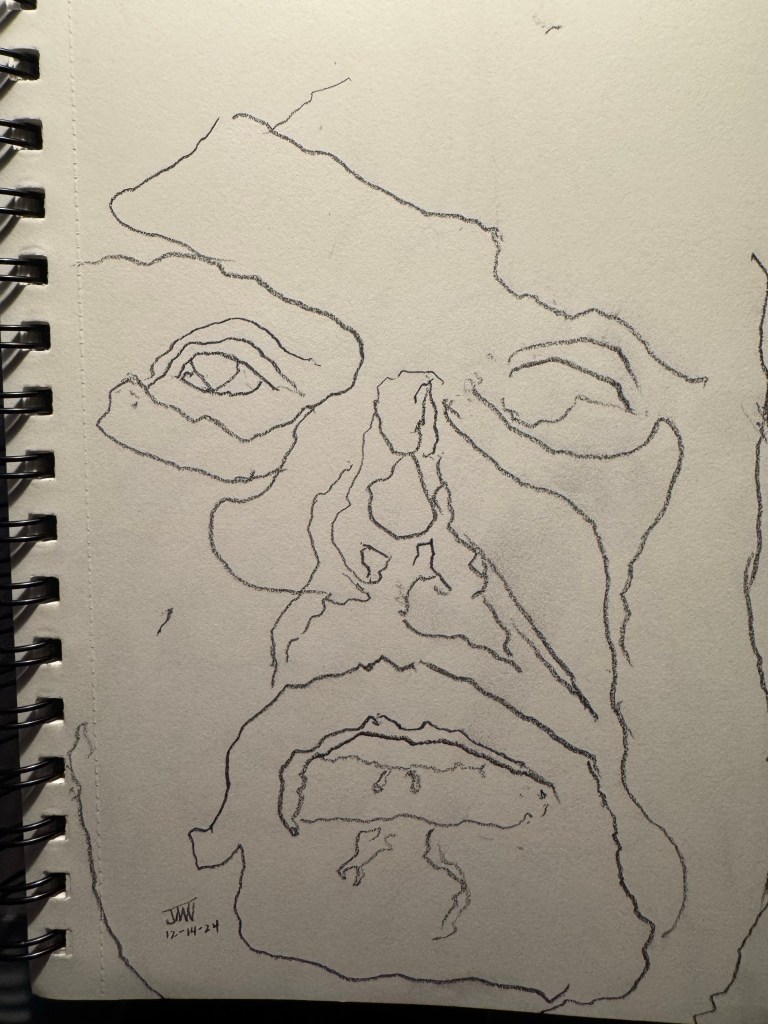
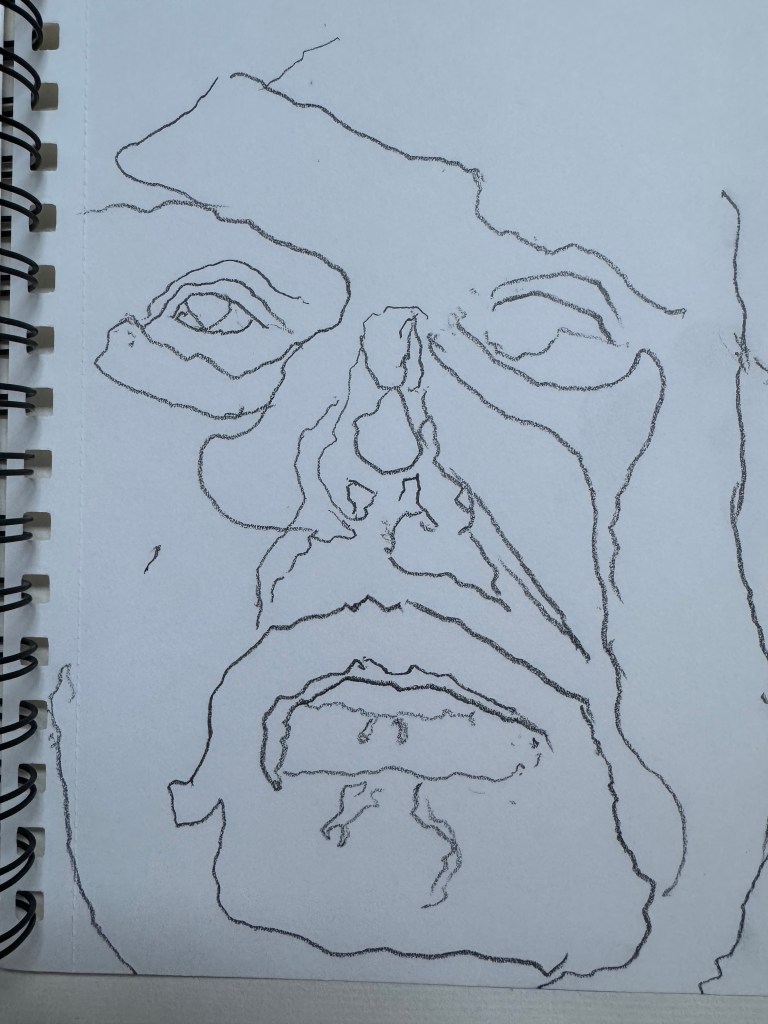
Start at the center of the faceAnd work outwardsThe center’s where the features areWhat surrounds is just outline Start at the center of the centerAnd work out whatIs where the center startsWhat surrounds is more of that Stare at the … Continue reading →
Happens on a Fuji Happens on a Gala Happens on a Honeycrisp Happens on a Granny Smith Halving the apple Quartering the apple Eighth-ing the apple (Can you say that?) Knife slides across skin ’Til skin gives in Apple tears at the blade face Surrendering to pieces How did you say “tears”?
When it’s all over Hands are sticky with… How did you say “tears”? Were you torn? Yes you aren’t an apple No you are
Reiterating at the outset: The “little knowledge” I mention in my title is my own!
Novelist-Poet-Thinker-Dauntless-Traveler Gary Gautier recently touched in his blog on an engrossing philosophical quandary, mentioning an idea expressed by Immanuel Kant:
The idea that we have no access to objective reality but only our subjective models to work with is Kant 101.
Gary cites David Hume:
Hume had already emphasized that we have no access to the objective world…
The comments Gary develops in his post stem from his reading of the abstract of an article about Stephen Hawking’s abandonment of “belief in the ability of science to describe reality in favor of a model-dependent account of truth.” [The cited language is the abstract’s].
Gary takes what could be a scary notion and expands it in a positive direction in succinct, resounding terms:
… Because we share… common subjective strategies of organizing reality, we can communicate meaningfully… Science still gives… valuable, usable insights about our shared interpretation of reality… All the things we value are still valuable…
I haven’t read any of the great works of philosophy (Wittengenstein’s Tractatus lost me on page 2. Fools rush in!), but I’m most receptive to Gary’s raising of the topic and to his handling of it. It feels right and necessary to engage with such matters, especially in a time of civic mourning when the life of the mind reasserts its primacy.
I like to reflect on two slants to the concept of lack of access to objective reality which dawned on me.
One slant is the implication that simply stating that we can’t get to it concedes that an objective (or “transcendent”?) reality exists; it’s locked away from us for assorted reasons. This seems to lead most readily in a theological direction; the Quran, for example, strongly affirms faith-driven submission to “the Hidden.”
A second slant could imply that saying we’ve no access to objective reality is a way of saying that there is none; that, stated crudely, it’s possible we invent our world(s) in our minds — but let’s keep examining what we think we see as objectively as we can (it implies). (I heard in a BBC4 podcast that Dr. Johnson said to Boswell concerning claims that Hume’s idea was irrefutable, “I refute it thus!” and proceeded to slam his walking stick down on something lying in his path until it — the stick or the thing — shattered.)
I make no claim for the intellectual rigor of either of these “slants” as I’ve stated them, but I do find it extremely fruitful to think as deeply as I can, in an embracing frame of mind, about both approaches. One slant foments inquiry that presupposes a Creator, the other slant favors inquiry that doesn’t. Both are enriching. Down the line they may converge, led there in centuries to come by the progeny of Hawking. The long view must be taken, and the long view is in short supply in our moment.
The opportunities which both slants open up to creative thought have occupied reflective humans since our recorded origins. No models built over millenia of cogitation are disposable, be it said. Nihil humanum mihi alienum est. But let’s have no more analogs to crucifixion and burning at the stake. That behavior doesn’t help anyone think. Never has. Never will.
I’ve been reading old nursery rhymes I was exposed to in tinyhood by a teenaged aunt and twenty-year-old mother. They must have enthralled me as I lay me down to sleep in the pre-reason season; they still do. Why? Obscenely simple, laden with gibberish, they start nowhere and lead there — rhythmic, resolute, unapologetic.
A robin and a robin’s son Once went to town to buy a bun. They couldn’t decide on plum or plain And so they went back home again.
But the dipsy-doodle ebullience they awaken, relieved of judgment, exempt from demand, eases me unexpectedly into poetry upon which my dolefully cogitating adult self finds dicey footing, if any. Here’s an excerpt from Justin Rovillos Monson’s “I WISH I HAD MORE TIME IN THE DAY”* (the caps are Monson’s):
There are secrets to keep and secrets we fit inside so I palm the universe so still still still in both hands & speak here in tongues when you come come
around. Long as I’m a city, you’ll always have a place to sit
a wall to lean on & get your fiend on.
‘Thank you for using—‘
If you don’t read with the tyranny of expectation, you get what’s simply there. The repetition. The cadenced quasi-rhyming (lean on… fiend on). The interiority marked by saucy disconnective turbulence. Pie in the face. Finger in the eye. Je m’en foutisme. The if-I-should-die-before-I-wake-ism pounded by protestant grandmothers. The drugginess: Thank you for using. What’s the plural of double-entendre? Redoubled understandings? I’d rather spin the question than know the answer.
It’s hard to put a finger on how verse like Justin Rovillos Monson’s squeaks through doors of reception left half ajar by surreal doggerel squatting in a scratched-up book. But the finger is raised.
It’s a handsome volume* with gloriously voweled Arabic texts opposite English versions by James E. Montgomery, Sir Thomas Adams’s Professor of Arabic at the University of Cambridge and Fellow of Trinity Hall. The poems are by, and attributed to, Abū Nuwās, “arguably the greatest poet of the Arabic language.” This isn’t a review; I’m only starting the book, and these are just some thoughts at the outset.
The Introduction to Abū Nuwās, A Demon Spirit: Arabic Hunting Poems is dense, and parts of it are hard to read:
For all its humanizing strategies and its apparent inability to avoid being interested in the nonhuman only insofar as it is a reflection of what is significant to the human, the poem suggests a different way of conceiving relationality.
The Introduction suggests that the reader paying close attention to the particularities of the Arabic text may need to brace for a lack of transparency in the translator’s English “renderings”:
“… I have prioritized clarity… in an English I have endeavoured to keep uncluttered and economical. I aimed for English renderings that could stand on their own… There remain many poems and lines that are obscure… Consequently, much of my translation remains conjectural, and in such instances I have dispensed with endnotes that signpost my failings.
I’m not sure what “stand on their own” means. Will these translations resemble “imitations” in the vein of a Robert Lowell? As a student of Arabic, that source text on the lefthand page beckons to me like the Sierra Madre. Will I bark up coon-less trees, chasing source-target “relationalities” where none were possible or intended — just because the translator didn’t want to “signpost his failings” with endnotes? (The Introduction has 65 of them!) Let’s face it: In a sense, all poetry translation is conjectural, premised on more or less astute failings.
The book’s first poem is one of nine “description(s) of the dog” (na^t(u)-l-kalb(i)). The dog is the saluki hound used in ancient Arabian hunting. Here’s my transliteration and literal English version:
[qāl(a) yan^at(u)-hu [‘ar-rajaz] He said describing it [‘ar-rajaz (a poetic meter)]
[‘an^at(u) kalb(an) ‘ahl(u)-hu fī kadd(i)-hi] I describe a dog whose people are in his toil.
[qad sa^id(at) judūd(u)-hum bi-jadd(i)-hi] Happy were their fortunes with his good luck,
[fa-kull(u) ẖair(in) ^inda-hum min ^indi-hi] for every good in them was from in him,
[wa-kull(u) rifd(in) ^inda-hum min rifd(i)-hi] and every gift in them was from his gift.
[yaḍall(u) maulā-hu la-hu ka-^abd(i)-hi] His master is become for him like his slave.
[yabīt(u) ‘adnā ṣāḥib(in) min mahd(i)-hi] Nights he spends in greater closeness of an owner than his bed, (My English here is neither uncluttered nor economical per Montgomery’s manifesto, but I’m at pains to preserve the annexed state of the comparative adjective by the following noun in undetermined genitive case.)
[wa-‘in ḡadā jallal(a)-hu bi-burd(i)-hi] and if he goes out at dawn, he wraps him in his cloak. (Hunts were inititated at dawn, and the “dawn hunt” was a trope of the genre.)
[ḏā ḡurraẗ(in) muḥajjal(an) bi-zand(i)-hi] Possessed of a blazed face, white-footed on his foreleg,
[talaḏḏ(u) min-hu-l-^ain(u) ḥusn(a) qadd(i)-hi] gratified by him is the eye, by the beauty of his shape,
[ta’ẖīr(a) šidq(ai)-hi wa-ṭūl(a) ẖadd(i)-hi] the drawing back both corners of his mouth, the length of his cheeks.
[talq(ā)-ẓ-ẓibā’(u) ^anat(an) min ṭard(i)-hi The gazelles meet misery from his hounding. (I wonder why Montgomery transliterates the word for “gazelle” (ẓaby — see below), whose plural ẓibā’ appears in the line.)
[tašrab(u) ka’s(a) šadd(i)-hā bi-šadd(i)-hi] They drink a cup of their running with his charge.
[yaṣīd(u)-nā ^išr(īna) fī murqadd(i)-hi] He hunts down for us twenty in his murqadd (?). (None of my sources help me with murqadd. Is it correctly pointed? Without the šadda which doubles the final consonant, the word could be the Form 4 passive participle of root r-q-d with a meaning such as “being made to sleep.” That doesn’t make loads of sense for the line, but at least it’s a plausible form. Montgomery’s phrase “in a single run” (see below) doesn’t come to grips with murqadd so far as I can tell.)
[yā la-ka min kalb(in nasīj(i) waḥd(i)-hi] What a dog you are! One of a kind! (The phrase nasīj(i) waḥd(i)-hi is listed in Wehr, an instance of how ancient usage persists to modern times. The meanings given are “unique in his (its) kind, singular, unparalleled.” Nasīj can be “a woven fabric, a textile.” The term waḥd centers around a concept of “oneness.” I like to think of “cut from singular cloth” as a possible description for the swift, handsome, lethal hunting hound that Abū Nuwās apostrophisizes.)
Professor Montgomery’s zesty rendering has the last word, as befits:
In His Gift I sing of a dog who feeds his folk— good fortune and well-being are in his gift. His master sleeps by his bed, wraps him in his cloak on dawn hunts, and waits on him like a slave. The eye exults in his beauty: the bright blaze on his head, his white forelegs, fire-stick thin, his long cheek, his scissor bite. He brings death to the ẓabys drinking their speed to the dregs, felling twenty in a single run. What a dog you are — the best of dogs!
*Abu Nuwas, A Demon Spirit: Arabic Hunting Poems, edited and translated by James E. Montgomery, New York University Press, 2024.
Persons who explain philosophy say “as it were” and “if you will” a lot. I’m none the wiser how it were, and no, I won’t.
Persons who explain poetry don’t.
God writes the universe, then says, “Read it. As it were, and if you will.”
One logician said dismissively of another, “He shows you how to chase the truth up the tree of grammar.” Finally! That’s what I do in studying languages, especially Arabic. Hello, clarity!
“Instead of focusing on the voters they were losing, Biden and the Democrats kept focusing on the voters they were winning.” Ezra Klein’s comment reinforces my sense that I should continue trying to draw with willow charcoal. It’s for me an uncongenial medium and I’m not winning it over to my side, which argues for continuing the struggle. Stay the course, says my bitter angel. I call my ham-fisted sketch “Page Killer,” a bit of jargon resurrected from my newspaper advertising days. A page killer was an ad big enough to crowd any other ad off the page. Room was left for a smidgin of editorial matter. An advertiser could spend less than the cost of a full page and still get the benefit of having no competition for eyeballs. An ad spanning two full pages was called a “double truck.” Merchants pestered us to guarantee placement of their ad on a lefthand page in section A, but we salespeople were tasked with holding the line, our mantra being, “We do NOT sell position!” Our newspaper had the greatest penetration of any in the region, which gave us leverage. My department, Display Advertising, was its beating heart. The ads were the content; the news was just filler.
“We were never anywhere other than where we were.”
(Ben Tarnoff)
Now and then I let the me called self remain unsure of something when I know full well I could resolve doubt with a peek at the internet known today as “research.” There’s something delicious in giving the mind rein to rusticate in all manner of sweet conjecture, or simply to set the matter aside as not worth pursuing. Will learning how the Stutz-Bearcat got its name improve my life?
Frank Bruni’s feature “For the Love of Sentences” has a quotation which suggests that the suspension of certainty could look a lot like what’s now called “living in the moment.” Isn’t that supposed to be a good thing?
“I belong to the last generation of Americans who grew up without the internet in our pocket. We went online, but also, miraculously, we went offline… We got lost a lot. We were frequently bored. Factual disputes could not be resolved by consulting Wikipedia on our phones; people remained wrong for hours, even days. But our lives also had a certain specificity. Stoned on a city bus, stumbling through a forest, swaying in a crowded punk club, we were never anywhere other than where we were.” ([Quote submitted by] Janice Aubrey, Brooklyn, N.Y.)
Nabokov and Borges differed over how translation should be done, the former favoring literalness (“The clumsiest literal translation is a thousand times more useful than the prettiest paraphrase”), the latter transformation (“Translation is… a more advanced stage of writing”). I gravitate increasingly towards Nabokov’s view, driven most by my practice in reading Arabic.
I like the Spanish word “fidedigno” for its suggestion of “faith-worthiness.” A faith-worthy translation isn’t gassy with interpretation; pays all but servile deference to the letter of the original; doesn’t reach unduly for the “spirit” of the text — that’s for the separate realm of commentary. Equally important, the faith-worthy translation resists overprocessing the source into target-friendly modalities, presuming that the reader must always be protected from strange-sounding language.
“Say: Do I inform you of worse than that, requital-wise, chez God? The one whom God cursed him and He was angry with him and made of them [plural pronoun!] monkeys and pigs and he worshiped idols. Those are worse, place-wise, and more astray from the sameness of the way.”
My reading is a trot, not a translation. It tries to peg analytically the operation of elements in the source text. I try to seize on what seems a core meaning of a word in a Wehr listing; this can mean passing over a dandy English phrase standardized by usage (ex. “right path” versus “sameness of the way”).
About those monkeys: In English a “simian” is an ape or a monkey, but an ape isn’t a monkey. I don’t find the distinction between the two as clearly marked in Arabic and Spanish. (Spanish doesn’t have different words for “elk” and “moose,” either.) For qird (its plural qiradaẗ occurs in the verse), Wehr lists “ape” and “monkey.” Lane lists “ape,” “monkey” and “baboon.”
I’ll cite two versions of the verse to show what solutions translators can hit upon.
Shall I tell thee of a worse (case) than theirs for retribution with Allah? (Worse is the case of him) whom Allah hath cursed, him on whom His wrath hath fallen and of whose sort Allah hath turned some to apes and swine, and who serveth idols. Such are in worse plight and further astray from the plain road. — M. Pickthall
Di: <<No sé si informaros de algo peor aún que eso respecto a una retribución junto a Dios. Los que Dios ha maldecido, los que han incurrido en Su ira, los* [Cortés’s note: ‘Los judíos. C2:65’] que Él ha convertido en monos y cerdos, los que han servido a los taguts, ésos son los que se encuentran en la situación peor y los más extraviados del camino recto.>> (Say: “I don’t know whether to inform you of something worse than that respecting a retribution next to God. Those whom God has cursed, those who have incurred His wrath, those* [Cortés’s note: ‘The Jews. Quran 2:65’] whom He has converted into monkeys and pigs, those who have served the idols, they are the ones who find themselves in the worst situation and strayed furthest from the straight road.”) — Julio Cortés





 EthicalDative
A Little Knowledge (I Refer to Mine) Is Dangerous (and Fun)
Reiterating at the outset: The “little knowledge” I mention in my title is my own!
Novelist-Poet-Thinker-Dauntless-Traveler Gary Gautier recently touched in his blog on an engrossing philosophical quandary, mentioning an idea expressed by Immanuel Kant:
The idea that we have no access to objective reality but only our subjective models to work with is Kant 101.
Gary cites David Hume:
Hume had already emphasized that we have no access to the objective world…
The comments Gary develops in his post stem from his reading of the abstract of an article about Stephen Hawking’s abandonment of “belief in the ability of science to describe reality in favor of a model-dependent account of truth.” [The cited language is the abstract’s].
Gary takes what could be a scary notion and expands it in a positive direction in succinct, resounding terms:
… Because we share… common subjective strategies of organizing reality, we can communicate meaningfully… Science still gives… valuable, usable insights about our shared interpretation of reality… All the things we value are still valuable…
I haven’t read any of the great works of philosophy (Wittengenstein’s Tractatus lost me on page 2. Fools rush in!), but I’m most receptive to Gary’s raising of the topic and to his handling of it. It feels right and necessary to engage with such matters, especially in a time of civic mourning when the life of the mind reasserts its primacy.
I like to reflect on two slants to the concept of lack of access to objective reality which dawned on me.
One slant is the implication that simply stating that we can’t get to it concedes that an objective (or “transcendent”?) reality exists; it’s locked away from us for assorted reasons. This seems to lead most readily in a theological direction; the Quran, for example, strongly affirms faith-driven submission to “the Hidden.”
A second slant could imply that saying we’ve no access to objective reality is a way of saying that there is none; that, stated crudely, it’s possible we invent our world(s) in our minds — but let’s keep examining what we think we see as objectively as we can (it implies). (I heard in a BBC4 podcast that Dr. Johnson said to Boswell concerning claims that Hume’s idea was irrefutable, “I refute it thus!” and proceeded to slam his walking stick down on something lying in his path until it — the stick or the thing — shattered.)
I make no claim for the intellectual rigor of either of these “slants” as I’ve stated them, but I do find it extremely fruitful to think as deeply as I can, in an embracing frame of mind, about both approaches. One slant foments inquiry that presupposes a Creator, the other slant favors inquiry that doesn’t. Both are enriching. Down the line they may converge, led there in centuries to come by the progeny of Hawking. The long view must be taken, and the long view is in short supply in our moment.
The opportunities which both slants open up to creative thought have occupied reflective humans since our recorded origins. No models built over millenia of cogitation are disposable, be it said. Nihil humanum mihi alienum est. But let’s have no more analogs to crucifixion and burning at the stake. That behavior doesn’t help anyone think. Never has. Never will.
(c) 2024 JMN — EthicalDative. All rights reserved