
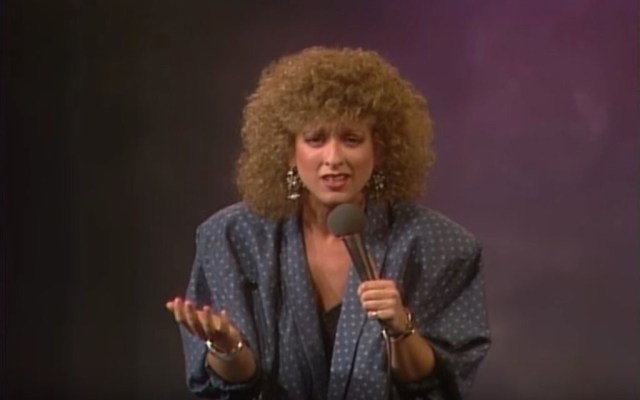
Elayne Boosler in a screen shot from her “Party of One” special, part of a box set of her work. Credit Showtime Networks.
Men, she sighs, expect her to cook breakfast the morning after sex. “They want things like toast,” she says, exasperated. “I don’t have these recipes.”
(Jason Zinoman, “The Comedy Master Who Hasn’t Gotten Her Due: Elayne Boosler,” NYTimes, 10-1-18)
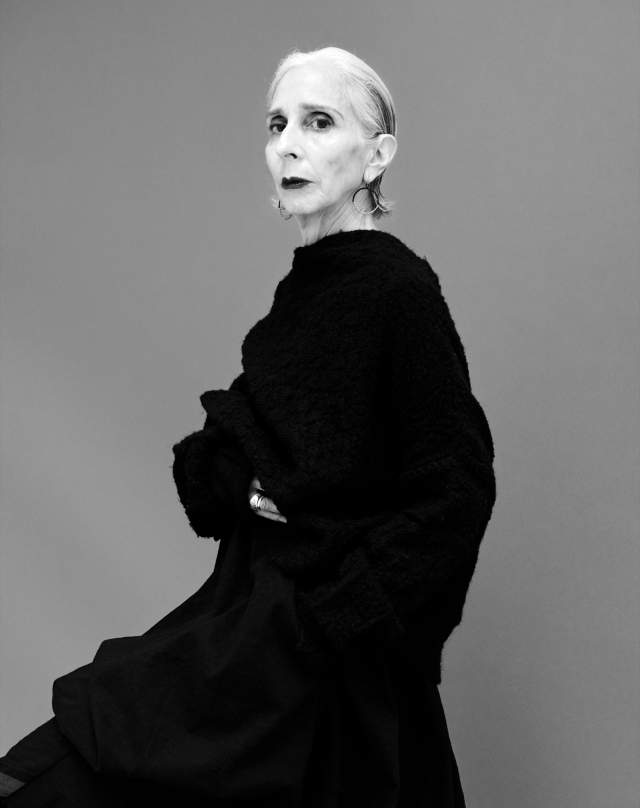
Ruven Afanador for The New York Times.
“I just fall over guffawing when people say, ‘This isn’t who we are.’ Who are you other than what you do?”
(Giles Harvey, “Deborah Eisenberg, Chronicler of American Insanity,” NYTimes, 10-1-18)

‘It’s like, wow, I’m 54 and single again. Didn’t see that coming. It’s pretty grim’ … Cage. Photograph: John Parra/Getty Images for for The Hollywood Reporter.
“I can do photorealism, but I wanted to let it be known that acting can break forms and hark back to something else. I’m a big fan of artistic synchronicity, when you do one form in another, like Munch’s Scream in Ghostrider,” he says, pulling the aforementioned face. “Not natural but truthful, not crazy for craziness’s sake.”
(Hadley Freeman, “Nicolas Cage: ‘If I don’t have a job to do, I can be very self-destructive,’” The Guardian, 10-1-18)
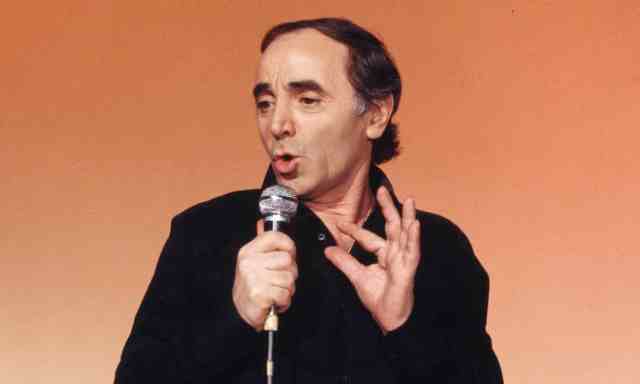
Sometimes spectacularly bleak… Charles Aznavour. Photograph: INA/Getty Images.
Among the pantheon of great chansonniers, Aznavour was a born rule-breaker. “Before Aznavour, despair was unpopular,” joked director Jean Cocteau, who cast him in 1960’s Le Testament d’Orphée….
(Alexis Petridis, “From drag queens to dead marriages, Charles Aznavour was far from easy listening,” The Guardian, 10-1-18)
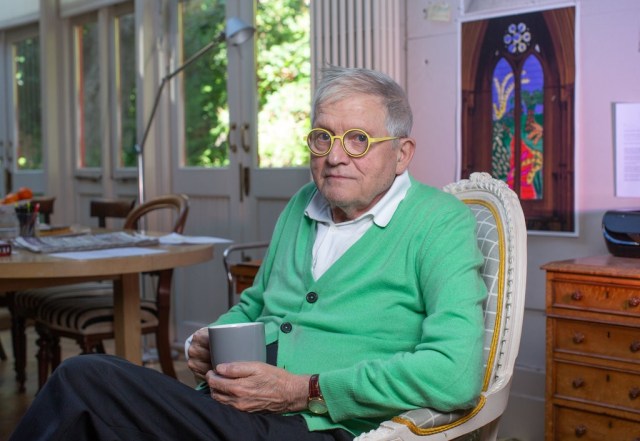
David Hockney in his London living room in September. On his right is a facsimile of the of a stained- glass window he designed, which was formally dedicated at Westminster Abbey on Tuesday. Credit Suzanne Plunkett for The New York Times.
But when he was later asked to paint [Queen Elizabeth], he turned that down, too. In the interview, he recalled [Lucian] Freud’s depiction of the monarch. “He got 10 hours from her, which is not very much for him, but a lot for her to sit… I knew the portrait. It was O.K. But I’m not sure how to paint her, you see, because she’s not an ordinary human being. She has majesty… How do you paint majesty today?… What am I going to do with [money]? An artist can’t really be a hedonist, because he’s a worker… If all you’re aiming for is longevity, it’s life-denying… Everything turns to dust eventually. Even Westminster Abbey will.”
(Farah Nayeri, “David Hockney Wouldn’t Paint the Queen. But He Made Her a Stained-Glass Window,” NYTimes, 10-2-18)
(c) 2018 JMN.









 EthicalDative
Old Mother Goose
Old Mother Goose, Oil on canvas, 48 x 48 in. JMN, 2017.
This is a painting based on a badly faded image in an old children’s book I possess. The image is an illustration by Anne Anderson, a Scottish illustrator (1874-1952). It’s intriguing in various ways, prominent of which for me is a certain unnerving monstrousness. If I were a child and saw this figure making her way down the cobblestone path in my direction, I would likely run in terror in the other direction.
I say this good-naturedly. I admire Anderson’s work. What strikes me in this image is the interesting ways in which her attire is … distorted? Her clothing seems to be literally inflated, like a balloon! Let’s not even dwell on the diamonds and stripes of her costume, the odd, puffy things around her wrists, her rather large feet in the buckled slippers, and the brobdingnagian, witch-like hat!
It’s all wonderful and mysterious and surely period-centric in its way, but not exactly cuddly. In a way it smacks of today’s clowns and Santa Clauses: How many kids want to snuggle with either of those?
(c) 2018 JMN.