
-
Recent Posts
Archives
- October 2026
- September 2026
- August 2026
- July 2026
- June 2026
- May 2026
- April 2026
- March 2026
- February 2026
- January 2026
- December 2025
- November 2025
- October 2025
- September 2025
- August 2025
- July 2025
- June 2025
- May 2025
- April 2025
- March 2025
- February 2025
- January 2025
- December 2024
- November 2024
- October 2024
- September 2024
- August 2024
- July 2024
- June 2024
- May 2024
- April 2024
- March 2024
- February 2024
- January 2024
- December 2023
- November 2023
- October 2023
- September 2023
- August 2023
- July 2023
- June 2023
- May 2023
- April 2023
- March 2023
- February 2023
- January 2023
- December 2022
- November 2022
- October 2022
- September 2022
- August 2022
- July 2022
- June 2022
- May 2022
- April 2022
- March 2022
- February 2022
- January 2022
- December 2021
- November 2021
- October 2021
- September 2021
- August 2021
- July 2021
- June 2021
- May 2021
- April 2021
- March 2021
- February 2021
- January 2021
- December 2020
- November 2020
- October 2020
- September 2020
- August 2020
- July 2020
- June 2020
- May 2020
- April 2020
- March 2020
- February 2020
- January 2020
- December 2019
- November 2019
- October 2019
- September 2019
- August 2019
- July 2019
- June 2019
- May 2019
- April 2019
- March 2019
- February 2019
- January 2019
- December 2018
- November 2018
- October 2018
- September 2018
- August 2018
- July 2018
- June 2018
- May 2018
- April 2018
Categories
Meta
Twitter
Tweets by mansfieldnick
Liberties Taken

“Hoss.” JMN, oil on canvas.
I want to think out loud about how poetry works, but without being too scrupulous about terminology. It just slows me down to try to re-research what the proper name for everything is.
For a specimen I want to take the meter most familiar to me, the two-syllable foot with stress on the second syllable repeated five times in a line. It’s the only one whose name I can keep in my head: iambic pentameter. I want to represent it like this, with stresses capitalized:
ta-DUM ta-DUM ta-DUM ta-DUM ta-DUM.
Examples:
he CAN’T be-LIEVE you GAVE his SHIRT a-WAY
a BARK-ing DOG is RARE-ly KNOWN to BITE
me-THINKS the SCOUN-drel DOTH pro-TEST too MUCH
with BRAINS he IS not O-ver-LY en-DOWED
and BEAU-ty IS her ON-ly CLAIM to FAME
I want to call it an act of “scansion” when one measures an utterance against a meter. I want to say transitively that I’m “scanning” an utterance. I want to say intransitively that an utterance “scans” in a certain way.
I want to distinguish impishly between “poetry” and “poesy.” The former is authentic, the latter is ersatz. Say I want to create a couplet with this utterance: “You came to my window, / Now I’m the one to blame.” But wait! I see an opportunity to inject rhyme, so I change it to: “To my window you came, / Now I’m the one to blame.” I’ve created poesy. How? I’ve modified a natural speech pattern to fit my rhyme requirement. The result is a perfectly “legal” English utterance, but it now has a rosy twinkle of yesteryear to it. It’s slightly quaint. I fight against poesy in my own versifying, and strive for doggerel instead.
Beneath this presumptuous (and amateurish) judgmentalism lies a bias, which is: One comes closer to poetry by crafting verse with syntax (word order) that stays faithful to unembellished, contemporary speech. It squares or even cubes the difficulty of finding unforced or non-trivial rhymes, and of conforming to meter, for that matter, if rhyme and meter even DO matter — and for many poets they don’t. But now that you mention meter, here’s where it gets interesting as well as stressful (pun intended).
I want to distinguish between speech stress and prosodic stress. Speech stress is the stress that falls on certain words and syllables when we talk more or less neutrally or unemphatically. (See how I don’t strive for much rigor in my terms?) Prosodic stress is the stress that conforms to a certain meter — the ta-DUM thing.
I gave five examples above of utterances whose speech stress, to my ear, conforms rather closely to the prosodic stress of iambic pentameter. It becomes apparent that to read or recite fourteen or ninety such verses would quickly ring singsong. Come to think of it, it might sound like poesy. Poetry craftily manages to profit from the counterpoint of verses whose speech stress doesn’t match the prosodic stress. Consider the following lines by Yeats:
Ceremony’s a name for the rich horn,
And custom for the spreading laurel tree.
Scanned against the iambic pentameter pattern, they look like this:
ce-RE-mo-NY’S a NAME for THE rich HORN,
and CUS-tom FOR the SPREAD-ing LAU-rel TREE.
With speech stress they can look like this (rudely — I’m not accounting for secondary stress):
CE-re-mon-ny’s a NAME for the RICH HORN,
and CUS-tom for the SPREAD-ing LAU-rel tree.
This excursus, this disquisition, this nattering over the motes in God’s eye, has already run far too long for any but the most obstinate reader. In shorter followups I want to have more loud thoughts about ways I don’t understand how poetry works, with specimens from Auden, Yeats, Millay, Roethke, Whitman, Arnold, Thomas, and possibly poets I haven’t read yet.
[Copyright (c) 2018 James Mansfield Nichols. All rights reserved.]
Women Declared To Be ‘Persons’!

“We believe that a very large number of women do not desire to vote. They shrink from having to go to the polling booths on election days. They would much prefer staying at home and attending to their household duties.”
So said an article in The Press of Christchurch, New Zealand, after the country became the world’s first to give women the right to vote on this day in 1893.
When women cast ballots later that year, The Press grudgingly admitted that it had happened without “any very remarkably disastrous consequences.”
The victory (which enfranchised Maori women, too) was hard won.
The leading causes of death in New Zealand at the time were said to be “drink, drowning, and drowning while drunk.” With alcoholism taking a toll on family life, the Women’s Christian Temperance Union — fiercely opposed by the liquor industry — spearheaded the suffrage effort, hoping that enfranchised women could get alcohol banned. (They could not.)
Kate Sheppard, New Zealand’s most famous suffragist, noted wryly when the Electoral Act passed that “it does not seem a great thing to be thankful for” that the government has “declared us to be ‘persons.’ ”
Other countries gradually followed suit: the U.S. in 1920, India in 1947, Switzerland in 1971.
The latest country to enfranchise women? Saudi Arabia in 2011.
(Nancy Wartik, “Back Story,” NYTimes, 9-19-18)
[Copyright (c) 2018 James Mansfield Nichols. All rights reserved.]
Grace Under Fire

My spirits purveyor hails from Boston and likes to revel in how ancient certain landmarks are in that city compared to the scrubby, nondescript backwater he and I both inhabit now — I natively, he God knows why. Sometimes I imagine he’s been spirited out of South Boston into the witness protection program.
It’s my way, conforming to my own sickness, to enable and encourage him in his boasting in order to be ingratiating. In Spanish they would say, “Le doy cuerda” — I wind him up. I feed him setup for his punchlines of superiority — it’s what I do. My instinct is that if you’re supportive of other people’s bullshit they’re more liable to like you.
Today I hit a snag. As I finalized my purchase I kissed up to my liquor store proprietor by remarking how paltry the stock of historical monuments in this “buttcrack state” was compared to what must surely be the case in Massachusetts. I have a long history of calling Texas a buttcrack state. I don’t always say it out loud, but in this case I did.
The individual waiting to check out behind me said, “At least we don’t have that black bastard running things anymore.” It sounded like a non sequitur, but I noticed that he was looking at me intently, in such a way that said he had twigged somehow to my liberalness, that I had an ideological stink on me that made his nostrils twitch, that he most likely had a 9-millimeter Glock with extra clips or something like that nestled in his Ford F-150 pickup, and that his fantasy as we spoke was to bust a few rounds in my Obama-loving ass.
My response was epic. I drew myself up to my full height, as they say, and said to him, “I shall not be the one to gainsay you at this time, sir.” Having scorched him with this rejoinder, I made a dignified, if somewhat accelerated, exit from the premises.
[Copyright (c) 2018 James Mansfield Nichols. All rights reserved.]
Family Treesome, Stag Country
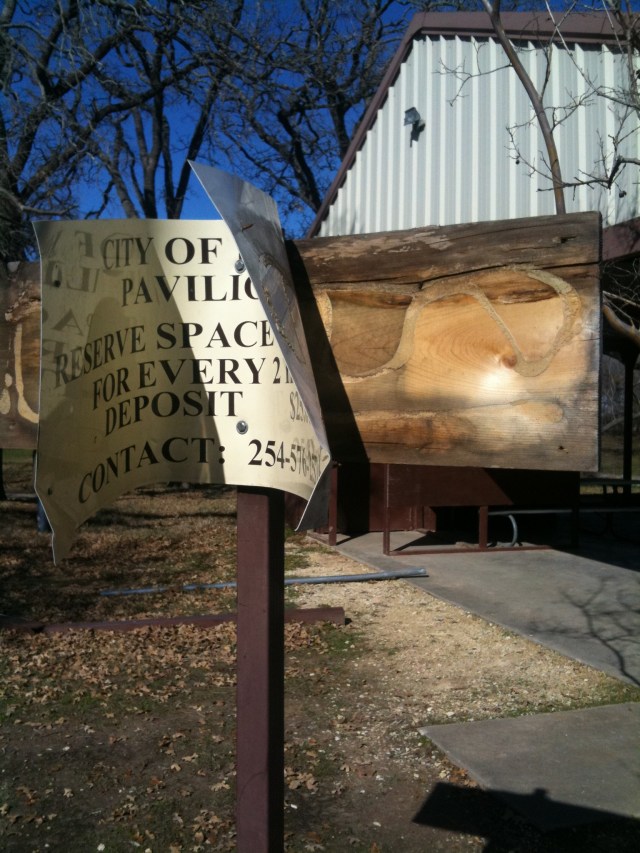
Sign. Photo, JMN.
When Angel Boorschagle’s momma died, her daddy Otto Pavlicheck married a Subaville girl half his age named Madaleen Pope. Madaleen had their baby Travis the same week Angel’s son Wade was born. Otto got backed over by the stock trailer when Travis was five. Madaleen was heavy into dope at the time, so Angel and her husband Lefty took that fatherless child in and raised him like their own along with Wade, who actually was Travis’s half uncle.
When Travis got to high school he played center under Wade’s quarterbacking and people thought they were brothers. Travis decided to go by Boorschagle instead of his birth name Pavlicheck because, after all, Angel and Lefty had raised him, and Madaleen had pretty well bowed out of his life after Otto’s accident.
Big however, though: His senior year Travis got favorable wind of his momma. Madaleen had sobered up, taken her maiden name back, got herself a new man, and opened up the Nail Bowtique in Subaville. God only knows why, Travis decided he wanted to go by Pope, like her. That’s why our game announcer, Lofton Whiteside, would say “Travis Pope” over the loud speaker whenever Travis was in on a play, even though it usually said “Travis Pavlicheck” on the program. Belva Blunt is the school secretary, and she told me it never got changed from “Travis Boorschagle” in the school records.
But where I was going with this is when Carter Pavlicheck, Angel’s younger brother, went bust selling real estate he moved back home and took a shine to Kamilla Knight. Kamilla is the daughter Travis thinks he may have fathered with Kortknee Knight before they got married. Kortknee said Kammie was Travis’s, and Travis said he couldn’t argue with her on that, though some of us wondered why Kammie went by Knight instead of Pope or Boorschagle or Pavlicheck — those were all names she could’ve gone by.
So here’s Carter Pavlicheck dallying with the quote-unquote daughter of Travis Pope, who is Carter’s half brother, and the whole town trying to squirt water on ’em. I guess it’s neither here nor there now. They fell out and broke up with no offspring anybody knows about. Small favors.
[Stag Country, Copyright (c) 2018 James Mansfield Nichols. All rights reserved.]
Feelings and Imagination

I once authored a proto-blog in the BI (Before Internet) epoch, an ante-deluvian moment on the cyber-scale of time. I was based in a rambling bayou city situated in a large, hidebound, arrière-garde, rump-facing state of the sector of the South that doesn’t want you to mess with it — perhaps you can divine the locale.
I called my site “Nick Mansfield’s Branded Fictions.” It was brassy with outspoken presumption and unearned “creative” strutfulness.
I recall holding forth in Branded Fictions on some retrospective event held in the area concerning the Nixon administration. At the event a woman said, “I just can’t feel that President Nixon did anything wrong.” Young “Nick” waxed bold with ironic shock and awe that the lady’s *feelings* were the seat of her conclusion rather than, say, the *thinking* part of her head.
I read (past tense) today that a holder of elected office declared, “I can only say this, he’s such an outstanding man, it’s very hard for me to imagine that anything happened.” The happening hard to imagine is alleged attempted rape.
Now as then, only more so, I’m brought to realize how prominent is the role played by feelings and imagination in our contemplation of crime and morality at the privileged level. Politics assumes its place beside poetry, fiction and the lively arts when it takes these mystical leaps.
[Copyright (c) 2018 James Mansfield Nichols. All rights reserved.]
1987: We enjoyed…

Mark Twain. HJN, drawing.
[Dear Mother,]
We enjoyed your March 15th letter with all the news. Also greatly interested in the Walker Percy pieces and look forward to reading the book. It’s amazing that “The Moviegoer” is that old. I’m continuing to forge desultorily through the Mark Twain biography. It’s pleasantly dull; does that make sense? I think sometimes such reading is therapeutic. I continue to be amazed and amused at the chronic illnesses and indispositions of the women and the blustering, inappropriate reactions of the men folk. Clemens’s daughter Clara professed to cultivate a singing career practically all her life; yet she routinely came down with a sore throat before every concert, and would take to her bed for months on end. Clemens’s presence seemed to send all his women to their sick beds; they would recover when he went away on speaking tours and all sorts of other engagements. Meanwhile, everybody dumped reams of saccharine, verbose correspondence on everybody else. Much of what Samuel Clemens wrote during the last ten years — journalism, essays, occasional pieces, as well as books — seems definitely to be avoided, judging by the critical evaluations in this biography. I do have an impulse, though, to read or re-read something from his great period, just to experience the greatness.
[Correspondence, Copyright (c) 2018 James Mansfield Nichols. All rights reserved.]
1987: I’ve started a little writing project
Selfie, JMN.
[Dear Mother,]
I’ve started a little writing project that I refer to as “Sketches” for now. I try to record or re-create things I hear and have heard from people at work. C** and N**, for example, are big talkers, and on the occasions I’ve ridden with one or the other for the day they have related various stories and anecdotes, or have expressed themselves on one topic or another. I enclose the three I’ve done, hoping you’re not offended by the scatological language or subject matter. Nothing has been invented by me, nor am I striving for any kind of embellishment. I’ll do it until my motivation peters out.
…
[Sketch]
KIM’S INDICTMENT
Kim, our receptionist, issued the most scathing indictment of an individual that I’ve heard for some time. The target was Jay L**, a tall, blonde IBM marketing rep who works the Victoria district.
Jay has a marketing degree from Pan American University, Edinburg, Texas. He’s a soon-to-be-not-eligible bachelor, his fiancée the daughter of a well-heeled Victoria family. He remarked to Kim that he would not normally have considered marrying a Victoria girl because such a girl could not be expected to fulfill his expectations as to culture and intelligence.
“He’s NOT wonderful,” Kim said.
KIM’S TORSO
Kim has an expressive upper body. When she talks, her shoulders go in several directions at once. The lower part of her body goes opposite.
I tried to imitate Kim today, but Nancy, the bookkeeper, said it just wasn’t convincing.
“I guess I don’t have the hormones,” I said.
Kim and Nancy giggled and acted scandalized.
“People’ve made fun of me all my life because I’m so expressive,” Kim said.
“You know what your problem is?” I said. “You’re effeminate.”
“What’s that mean?” Kim said.
“It means… it means you’re all woman,” I said.
“Well, I *thought* it had something to do with feminine,” Kim said.
[Correspondence, Copyright (c) 2018 James Mansfield Nichols. All rights reserved.]
The View from the Middle Ground

The top of the first front page… Credit The New York Times, Sept. 18, 1851.
[Henry Jarvis Raymond and George Jones founded the New York Times in 1851. The quote by Raymond is from the first edition.]
During a time when sensationalist journalism was commonplace in media, The Times vowed to avoid such tactics in favor of neutral, fact-based reporting.
“We do not believe that everything in Society is either exactly right or exactly wrong,” Mr. Raymond said in the introductory article of the paper’s first edition. “What is good we desire to preserve and improve; what is evil, to exterminate, or reform.”
(Adriana Lacey, “Back Story,” NYTimes, 9-18-18)
[Copyright (c) 2018 James Mansfield Nichols. All rights reserved.]


You Have to Break an Egg to… You Know the Rest
Eggs. Photo, JMN.
It’s a cruel trick the Fates play on this hapless heathen, but the odds are just as sure as shootin’ that on the rare day I make a three-egg omelet the THIRD egg will have a double yolk! <picture here an impish emoji with a winkie eye and lips crooked in rueful amusement, maybe some spikes of exasperation radiating from its forehead, or else an emoji with a shaking head and rolling eyes conveying a “my-day-has-to-start-like-this!?” ironic shrug — I couldn’t find the exact support for the graphical meta-commentary that I wanted to append to my flippant expostulation, and words are so inadequate in these situations>.
[Copyright (c) James Mansfield Nichols. All rights reserved.]