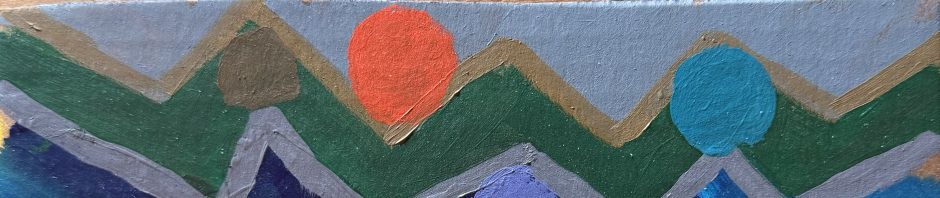
“Forms Arranged Against a Wall,” oil on watercolor paper, 21 x 27 in. (JMN 2024).
The elbow room in ivied halls of bard rapture Has the vastness of atomic space. Let ring lute! — Recorder, mandolin and dulcimer. Let move your lips with mine while reading silently. Let BE our noise! Be louder than it sounds!
A sub-segment of an elite reads literature; a subset of the sub-segment reads poetry. It’s a fit state of affairs for proud stragglers, fringe element, crowd-shy obsessives — the ones who weather linear monsoons, whom verse can bother.
Darling’s “March of the Valedictorians,” on display in the Arsenale during the 2019 Venice Bienale. Credit… Laura Chiesa/Pacific Press, via Alamy. [New York Times caption and illustration]
Verse can have visual ramifications as well as verbal ones. Text commandeers white space on the page in one-off patterns reflecting a close collaboration between author and typographer. The ensemble is larger than the words which are its literal medium. The reader-viewer is granted leeway to court speculation and draw bespoke conclusions as to what they mean.
I’m emboldened to invert the analogy and call Jesse Darling’s lofty chairs a visual poem. I get a kick out of the Turner Prize laureate’s “March of the Valedictorians,” not least for its title, but also for its send-up of the hard-charging achiever class by a salutatorian wit.
[Darling] learned how to weld and began creating his found-object installations, guided by associations he made between the materials and their historical and economic contexts… “Plastic is this zombie medium,” he said, because it does not decompose and is made from fossil fuels derived of dead organic matter. “Steel is a technology of empire that enabled guns, the colonial project.”
(Thomas Rogers, “He Won the Turner Prize. But Does He Still Want to Be an Artist?” New York Times, 6-6-24)
A table with tubes of paint and more collage materials. Credit… Chase Middleton. [New York Times Caption and Illustration]
Artist Sarah Sze was interviewed in the New York Times’s feature titled “Artist’s Questionnaire.” This was my favorite question and answer.
Which work of your own do you regret or would [you] do differently now?
I guess I would say that I don’t think of work that way. Work doesn’t always get better — we know that. When you make something that you feel is very strong, there’s a sense of dread because it’s like, What can you make next?
Torn images that may be integrated into a future painting. Credit… Chase Middleton. [New York Times caption and illustration]
And sometimes the thing that’s next is struggle. Creative resilience is really important; you have to work through bad work to get to good work. The work that doesn’t work makes the next work that does.
(Marisa Mazria-Katz, “An Artist Who’s Been Making Work About Life and Death Since Chldhood,” New York Times, 7-2-24)
“Ojo de Cabra,” oil on cardboard, 6 x 9 in. (JMN 2024).
Ask yourself how often you’ve found yourself in this familiar pickle: It’s late Saturday night and you’ve run out of ammunition. The stores are closed until Monday. It’s beg, borrow or steal some rounds, or else fiddle away the rest of your weekend with empty clips.
Relief is at hand, pardner. A company based in Richardson, Texas, a suburb of Dallas, is taking steps to make being out of ammo a thing of the past.
The company, American Rounds, is rolling out its first ammunition vending machine in Canyon Lake. Individuals who provide ID and a facial recognition scan will be able to purchase rifle and pistol bullets from the machine. Like fallin’ off a log!
And rest easy, friend, it’s legitimate and aboveboard. As long as you’re not convicted of a felony or domestic violence you don’t have to put up with a background check in order to buy ammunition. The CEO of American Rounds says the company’s “protocols” are “within industry standards and state law.”
(Source: Allyson Waller, “The Brief,” The Texas Tribune, 7-16-24).
… I want to say / this is how it started: / there was a mystery / it begged / to be stroked (Alexis De Veaux, “For my love at the time of our ceremony,” Poetry, July-August 2024)
“YxzY” by Ronaldo V. Wilson (Poetry, July-August 2024) is shaped text. It enacts a bulge on the page by means of 30 lines padded with the letter ‘x.’ If you read no further, know that my essential takeaway from the poem — the line I cherish — is this:
[…] to be tested in the wrack wrack of the parlance.
“Test” and “wrack” and “parlance” are germane to the notion of trial by vernacular, ordeal by word. “Wrack wrack of the parlance” crystallizes the attentive deference which a text such as this commands (yes, it says “dwade to the river” and not “wade to the river”).
From the beginning, here are its words:
Is the way xxxxxxxxxxx B when the meetingxxxxxxx went down in the square bizxxx dig my Dream slayin’ imposterxxx transcripts whip Y flag masterslavex dialects Drip drip: in a time like the sex were made fo tastahs choice. xxxxxxxxx
The mention of “dialects” merits attention. Vernacular is evident. The parsing element of my brain wants to make out utterances that may align thus:
Is the way Be [?] when the meeting went down in the square biz [a question?]. Dig [“Observe”?] my Dream-slayin’ imposter transcripts whip Yo [?] flag, masterslave [a command?]. Dialects Drip drip: in a time like the sex were made fo tastahs choice [a statement?].
Interfering with a text in this way is something an author surely hates. It insults scriptural integrity and pokes poetry in the eye, but it’s how the reader with a translator’s vocation rolls. The seeker of an entryway to a walled garden looks for clues: Why is the ‘D’ of “Dream” and the first “Drip” capitalized? Colon after second “drip” noted. (Punctuation is usually helpful.) Look how the line ending in “sex” doesn’t require extra padding. There’s an allusion to Taster’s Choice, a brand of instant coffee. Period after “choice” noted. Allusion to consensual kinky sex posited. Is any of this signally dispositive? Undetermined.
Here’s the rest:
Squid, big up to my ligers in LION-Oxxxxx YELL-O-FAGE is here, a dewey decimalxx System, to flow broke, go back to snap chatxx Attica. A Spun top, up rock — heal the chi’renxx of my guise man pussy dream chair face squat,xx & how many Kisses to the center of m Y creamxxx die dere NordicTrack cuz ain’ much of a wayxxxxx to be tested in the wrack wrack of the parlance,xx go parlor game, into your own way into it yo,xxxx gogoogleogogo parkour weekend in the spy eye,x go to The Guiding Light — ya need a belt,xxxxxx and glasses, and tu, you stink, fat, but orange,x t-sprock. Too much is too much, like gather,xx the pimpgame. Go dwade to the river of thexx extant plant the rim shot in the transgibxx gib dis my language of gong gonxxxxxx $6.45 for my SBucket no freezexxxx dried brown worker in a poloxx Blot twist is the shapexxx and the formxxxxxx Is in whitexxxx My ownxx ICUxx X x x x x x x x
The last word, “ICU,” conjures “intensive care unit.” The manner in which the poem tails off in a sequence of ‘x’s is reminiscent of many a movie scene in which the monitoring device clocking the patient’s vitals fades to a high-pitched drone at the moment of death.
It’s hard to tell whether ‘YxzY’ is spangly or hirsute. Two things: I challenge you to say its title spontaneously without stumbling. The reflex to maintain the letters in ‘XYZ’ order asserts itself. And it occurred to me belatedly that the title may have a chromosomal vibe to it, with ‘z’ as the nonconforming element. Never mind that now; it recedes in hindsight. To forge a connection with the text I had to start writing about it from the outset. I’ve tossed out almost everything I tried to say, having remembered that reading is mostly listening.
The pen and wit of Gilles Labruyère are a daily marvel. This one in particular connects me with a favorite topic: signs that point somewhere. The quintessential sign in my head reads:
“It’s That-a-Way —> (And You Can’t Get There From Here).”
“Salton Sea Salt,” oil on canvas, 11 x 14 in. (JMN 2024).
Preface, Disclosure and Update, July 14, 2024 I wrote most of the little essay that follows (see below) only two days ago. It’s a bit of nonsense penned tongue-in-cheek with a dollop of irony. Satirical humor is my way of having fun, but also of coping — good naturedly, I hope — with disquiet, unease, insecurity, exasperation and anguish. By a fluke of circumstance, I happened to witness on live media most of the events of January 6, 2021, in real time. It’s a bell that can’t be unrung, and a sight that can’t be unseen. The essay gestures towards this truth, but tries to be entertaining. Since writing it, by a similar fluke of circumstance, I also saw in real time yesterday, July 13, 2024, an attempt on the life of former President Donald Trump. Thank goodness he has survived a close call, injured but not seriously, according to reports. Public figures should never have to confront this danger. My lifetime has seen the shootings of JFK, RFK, MLK, John Lennon and Jo Cox; and the non-fatal shootings of George Wallace, Ronald Reagan, Gabby Giffords and Steve Scalise. Now Donald Trump. The would-be assassin’s rifle was scarcely silent yesterday before some supporters of Mr. Trump started hurling accusations of complicity in the crime at his political adversaries — notably President Biden. Such conduct is reckless and malign. Is there no way out of it?
Essay I glimpsed the phrase “prophetic dreams” recently and for a nanosecond my brain processed it as “poetic dreams.” Chuckling ruefully I suddenly came into a realization: dropping the second, fourth and fifth consonants turns “prophesy” into “poesy, “prophetic” into “poetic” and “prophet” into “poet.” Damn! Things were adding up! The numbers 2, 4 and 5 make 11. Instinctively, I consulted Google to find that numerology associates 11 with deep connection to the universe, which I pursue through grammar. It’s worth noting that “prophesy” is the verb and rhymes with “ossify,” while “prophecy” is the noun and rhymes with “obloquy.”
To prophesy is commonly considered to foretell the future. True enough. In ancient times leaders consulted oracles — the oracular and prophetical are closely allied — to help them with the if’s and when’s of taking momentous action, such as destroying a neighboring kingdom or poisoning an antagonist. A famous oracle was in Delphi. When she opined, her pronouncement resembled a riddle, which is how prophecy and poesy are in cahoots. The Delphic advice would be on the obscure side, could cut various ways, didn’t lend itself to pinning down, and was articulated vividly. Paramountly, it could never be proved with hindsight to have been wrong. Wrong, after all, is what a poem is ever not. Classical literature is full of hilarious tales of disasters incurred because the advisee zigged when he should have zagged, and the oracle could safely say, “I told you so.”
What’s less well known is that prophesying is also used to recount the past. For example, prophecy tells us that on day 6 of the month of Janus, year two thousand and twenty-one, a fellowship of citizens gathered outside and inside our nation’s capitol building in order to testify to their engagement with, and fealty to, the sacred rites of lawmaking there enshrined. The citizens strolled its marble corridors admiring busts of founding fathers, intoning hymns of praise, and proffering sunny greetings to busy solons and their staffs. Thereafter they departed happily to resume their industrious labors on family farms and in thriving small businesses. It was a thing to remember, and the afterglow which Delphic telling lends the event illustrates how prophecy, devoutly realized, colludes with poesy to yield transformative visions.
A link encountered recently in other reading led me to this obituary in The Times’s archive. You will discern from the excerpts what left me biting a grin. (Respect and love for the memory of Jerry Garcia. He would’ve grinned too.)
Excerpt from the article:
From the beginning, when the band was financed by the LSD chemist Stanley Owsley, the Dead were known for the latest in sound systems as well as for their music.
The correction:
A correction was made on Aug. 12, 1995: An obituary of Jerry Garcia on Thursday reversed the names of an early financial backer of his band, the Grateful Dead. The backer was Owsley Stanley.
(Jon Pareles, “Jerry Garcia of Grateful Dead, Icon of 60’s Spirit, Dies at 53,” New York Times, 8-10-95).
“Study,” gesso, acrylic and colored marker on cardboard, 9 x 5-3/4 in. (JMN, 2024).
Rooky move: I responded to the first page of Meghan O’Rourke’s essay “On Ambivalence: To Be, but to Be How?” (Poetry, June 2024) before I had finished reading it. I caught the wave generated for me by her allusions to parataxis and epistemology (terms I don’t control) and surfed it in my post titled “Raise Your Hand If You Know What ‘Paratactic’ Means.”
I had deleted the following sentence from my draft of that post: “Poetry helps me come to terms with not needing to know.” At the time, it seemed to oversay what I’d already implied. Further along in O’Rourke’s essay, however, she mentions Keats’s “negative capability,” which Keats describes as
… when a man is capable of being in uncertainties, mysteries, doubts, without any irritable reaching after fact and reason —.
Yes! I thought. That’s what I meant by coming to terms with not needing to know! Picture the thrill of my imagining having retroactively foreshadowed Keats!
O’Rourke writes this:
Great artists allow for uncertainty and ambivalence… Shakespeare was Shakespeare, Keats argues, because of the way his plays staged, and enacted, a variety of irreconcilable points of view. This, rather than poetry that has “a palpable design upon us” [Keats’s phrase] is what true art is.
Keats’s phrases keep being terrific. (Who knew!) A text which has “a palpable design upon” the reader stalks one with a pre-owned frisson it wants to evangelize, rather than casting upon the waters keen verbs and auxiliaries that may spirit one to an illumination precisely at one’s own coordinates.
In a report released last October [2023], the American Library Association found that Texas made the most attempts in the US to ban or restrict books in 2022. In total, the state made 93 attempts to restrict access to more than 2,300 books…
In the case adjudicated by the Fifth Circuit Court of Appeals on June 6, 2024, books sought to be banned had been referred to as “pornographic filth.”





 EthicalDative
‘Plastic Is This Zombie Medium’
Verse can have visual ramifications as well as verbal ones. Text commandeers white space on the page in one-off patterns reflecting a close collaboration between author and typographer. The ensemble is larger than the words which are its literal medium. The reader-viewer is granted leeway to court speculation and draw bespoke conclusions as to what they mean.
I’m emboldened to invert the analogy and call Jesse Darling’s lofty chairs a visual poem. I get a kick out of the Turner Prize laureate’s “March of the Valedictorians,” not least for its title, but also for its send-up of the hard-charging achiever class by a salutatorian wit.
[Darling] learned how to weld and began creating his found-object installations, guided by associations he made between the materials and their historical and economic contexts… “Plastic is this zombie medium,” he said, because it does not decompose and is made from fossil fuels derived of dead organic matter. “Steel is a technology of empire that enabled guns, the colonial project.”
(Thomas Rogers, “He Won the Turner Prize. But Does He Still Want to Be an Artist?” New York Times, 6-6-24)
(c) 2024 JMN — EthicalDative. All rights reserved