Thoughts and prayers from the legislatures. Thoughts and prayers from the donors. Thoughts and prayers from the councils. Thoughts and prayers from the courts. Thoughts and prayers from the boards. Thoughts and prayers from the embassies. Thoughts and prayers from the churches. Thoughts and prayers from the armories. Thoughts and prayers from artificial intelligence. Thoughts and prayers from air, land and sea. Thoughts and prayers from you and me.
If you say all the words out loud, it works.
This is neither the time nor the place to record that I’m loath to divulge where, but have just encountered Aldous Huxley’s phrase “batrachian grappling.” It will haunt my day.
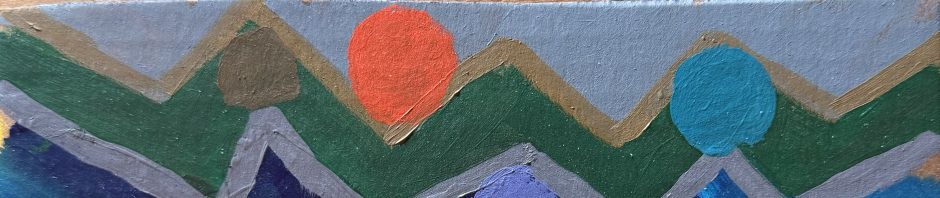
Untitled, oil on watercolor paper, 14 x 22-1/2 in. (JMN 2024).
Frank Stella has died. He’s the one who said, “What you see is what you see,” with reference to painting (his painting, at least), a slogan someone described as “pithy and enduring.” I liked it so much I had it printed on a tee-shirt several years ago. Then wore that shirt.
I’ve adapted Stella’s slogan, with added emphasis, to reading poetry, because I have a bias, which is this: Publishing has consequences. I should have a say commensurate with the writer’s as to what a poem “means.” It falls to me, a humble (?) reader, to sense its burden and weigh its import. My job is to summon attentiveness, the poem’s to deserve it. What I make of the poem needn’t be, nor even can be, what Helen Vendler or Yvor Winters made, or would make, of it.
This cocky stance gravitates against a nagging unease that a poem will hover beyond my grasp, that I will fail to apprehend the message or signal encoded in it. Here’s a thought: The poem’s words and their layout on the page are its signal. The poem’s message becomes what I take from it and keep for a length of time. If it leaves no mark, verse stayed on the page, poetry didn’t happen.
My attitude makes nothing happen critically, but it keeps me chugging through shed-loads of verse with a mulish resolve verging on enjoyment.
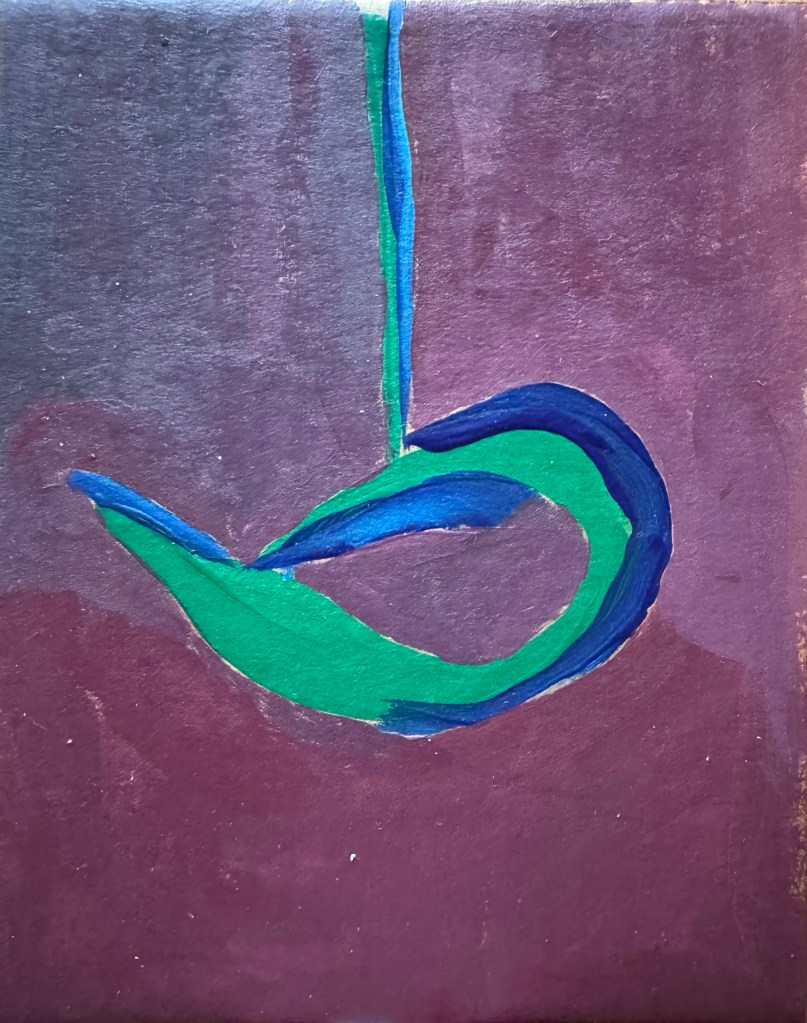
“Love With Nowhere to Go,” oil on watercolor paper, 14 x 30 in. (JMN 2024).
The most terrifying exercise I know is to calculate how many seconds I can expect to live. I refuse. Never send to know for whom the clock ticks. It ticks for thee (not me). I heard my dad in his sixties tell a buddy, “I don’t plan to die.” He was sipping and smoking and enjoying himself. He had another couple of decades left in him at the time. It was a good plan.
Time, time, time… You can’t live with it and can’t live without it. Can’t pump more of it or drill for new reserves. Just runs out when it’s good and ready, and you’re done. Let it count down on its own clock, not on mine.
Blame these straggly thoughts on Trey Moody. In “Against Distance” (Poetry, May 2024) he writes a single sentence that goes for fourteen lines of a seventeen-line poem. The sentence starts here…
I don’t know who needs to hear this other than me, but the moon will never leave you,…
and ends here:
… so when you try counting your remaining moments with the moon, the moon that will never, ever leave you, give up.
It’s a transparent, readable sentence, too, not Proustian or Jamesian — you know what I mean. Then Moody does a deft turn in the last three lines: Writes three sentences in quick succession, and one of them is a zinger. By that I mean it has the aphoristic sheen of a nugget so quotable it cries out for citation even out of context. I don’t take the bait. Here in toto are the last three lines of the poem with the embedded zinger:
Even the moon inches a little more distant every year. I’ve heard grief is only love with nowhere to go. But then you look up.
It may not be the “best” poem of the lot — who am I to distinguish good from bad? — but the moment of my reading it, usually morningtide, and the fact of it saying a particular something in a given way conspire not to “trigger” in me — that word is grubby now — but to wring from me a flicker of joy. You take it where you find it.
Commentary blogs, or clogs, are thriving. There’s also a raft of ‘fluencer blogs, or flogs, out there. The difference between clogging and flogging can be subtle. In general the flogger is covertly, if not overtly, selling something; the clogger is engaged in expressing impressions more or less for their own sake. Cloggers like to be liked — the more of it, the more we clog; floggers want to be paid, sooner rather than later, if possible.
‘Fluencers, by the way, have led a wave of migration to platforms such as YouFlog, where eyeball-centric flogging, termed egging by its enthusiasts, is trending. You name it and it’s egged on YouFlog: recipes, cancer cures, diets, gun kits, escorts, alternative facts, amazing tools, this incredible glue….
Some of us cloggers are crafting ways to slow-walk, if not stymie, the takeover by generative AI next month. We are the sloggers. There are only so many opinions in God’s language model, and we intend to hold as many as possible before the algorithm comes for us. Obiter dictum, Altman!
Call it the agony of the long-distance reader. There’s a lot of verse out there. It’s hard to give any one text a non-cursory read. On occasion there’s a specimen I’d like to flounder around in, nudge and knock about, importune, reconnoitre. Something lands; or tickles; or excites; or provokes; or befuddles. But wait… what’s this? More verse coming down the pike! Must… keep… reading. <Gasp>
An upside hides in what I’ve depicted as the downside of a landslide. I know that I will know when I’ve bumped into greatness. It will be when a text has shattering immediacy. It will poke through the scree, knock me sideways, shock me to a standstill. A writer will have been astonishing and I’ll have met the poem. I’ve gotta be ready, loins girded for the long haul.
Idra Novey’s “That’s How Far I’d Drive for It” (Poetry, November 2023) tickled. A cross between wry poetry and delicious standup (think Tig Notaro), it limns a beautiful, trippy, preposterous expedition to transplant a venerable rhubarb plant. Here’s how it takes off:
I’m in the car with Helen, supreme guide to proceeding otherwise.
My relatives refused to travel hours for a rhubarb, but Helen said, why get out of bed, if not for a private quest of minor significance to anyone else?
It’s a question of libido, she said, sometimes you wake up craving sex.
Other days a hunger comes for shoveling, to dig up whatever your relatives deem worthless.
As the poem arcs and flies it mentions this:
Meaning is a hunger. Some of us need to eat and eat it.
“Frank Marshall Davis: Writer” (Poetry, December 2023) sprang a sticky line on me: “I was black and black I always was.” (Davis lived from 1905 to 1987.) Among other things the poem says this:
I was a weaver of jagged words, A warbler of garbled tunes A singer of savage songs I was bitter Yes Bitter and sorely sad For when I wrote I dipped my pen In the crazy heart Of mad America
Sonia Delaunay’s “Robe Simultanée” (1913), a grand patchwork dress evokes the movements of her lively paintings and is a highlight of the Bard Graduate Center’s show “Sonia Delaunay: Living Art.” Credit… Bruce White, via Pracusa. [New York Times caption and illustration]
Inspired by the theorist Michel Eugène Chevreul — whose 1839 treatise on color harmony is on display in this show — Sonia [Delaunay] and her fellow pioneers in abstraction had to train the individual elements of color, such as contrast and inversion and value, to speak for themselves as never before.
I’m familiar with the phrase “color scheme,” but I’ve got this far without having encountered its synonym “colorway”:
Floated in glass dividers between the swatches are Sonia’s instructional “color cards” to the fabric manufacturer. Exacting and propulsive, these colorways show that she understood the kinships and rivalries of hue with a shrewdly marketable instinct.
The color cards Sonia Delaunay dispatched in the 1920s to her Dutch manufacturer, explaining which patterns and colorways she wanted printed on crepe silk. Credit… Bruce White, via Bard Graduate Center. [New York Times caption and illustration]
… Only in Bard’s dense wardrobe of a show do the sources of Sonia’s painterly voice become obvious: the bunchable, joinable, repeatable textures of cloth.
In her late painting “Rhythm-Color” (1970), Sonia Delaunay returned to the same contrasts of texture and color she had used in her early patchwork dresses and vests of the 1910s, breakout garments that put her on the map of early abstraction. Credit… Richard Nixon Presidential Library and Museum. [New York Times caption and illustration]
It’s fun to see a handsome black-and-white illustration in an article celebrating color (as well as geometry):
While sheltering in Portugal during World War I, Delaunay painted vases, jugs, books and tablecloths with vibrant zig-zags, pie pieces and bull’s-eyes. “I have lived my art,” she once said. Credit… Bibliothèque nationale de France. [New York Times caption and illustration]
Also stimulating to note the connection between Sonia’s handiwork and her husband’s still life:
Robert Delaunay’s “Portuguese Still Life” (1916) expands upon the abstract geometries his wife, Sonia, had emblazoned on their housewares. The husband’s inclusion in the show, while designed to illuminate his wife’s work, “affirms the old ‘power couple’ reputation of these two artists,” our critic says. Credit… Norton Museum of Art, West Palm Beach, Fla. [New York Times caption and illustration]
(Walker Mimms, “One for the Ages: Sonia Delaunay’s Wearable Abstractions,” New York Times, 4-27-24)
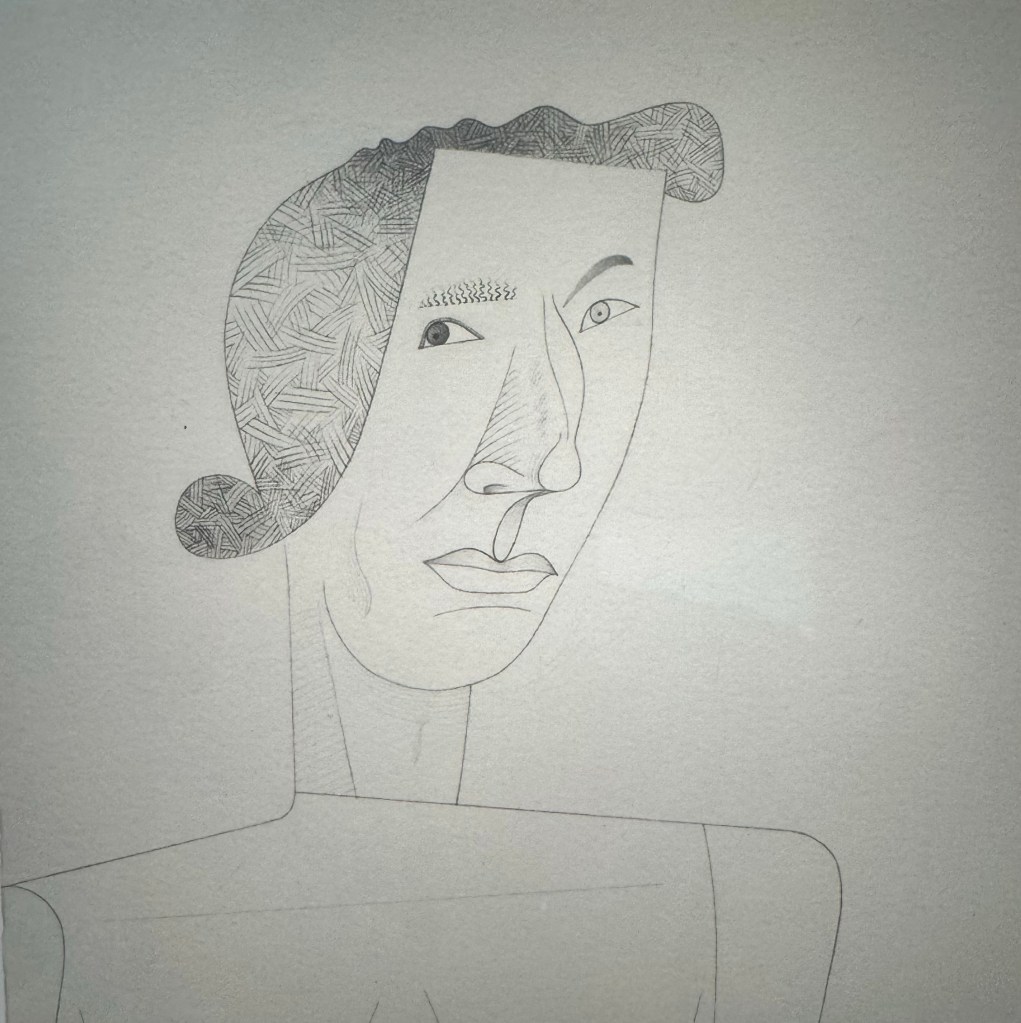
An untitled work from Nutt’s new show of graphite drawings at David Nolan gallery… Credit… via Jim Nutt and David Nolan Gallery. [New York Times caption and illustration]
The artist Jim Nutt has been making a version of this imagined portrait for the last 40 years, a mode that has dominated his practice… His women never age, never seem to dislodge from a midcentury stylistic amber: all wearing smart up-dos, all clad in demure clothing.
If I’m honest, I savored this article about Jim Nutt in late 2023 as much for what he says, and what’s said about him, as for what he does. There are assertions in this appraisal by Max Lakin that threaten to outrun the interestingness of the art they describe.
Nutt, 84, can be both elliptical and impenetrable. He is happy to talk at length about the chemical bonding qualities of acrylic paint and the glassiness of hot-pressed paper, but shies away from things like his own thinking…
… Untitled work from 2022… Credit… via Jim Nutt and David Nolan Gallery. [New York Times caption and illustration]
His forms have focused, from deliberately messy to phlegmatically planar figures, and his economy now is so precise that many figures materialize in as few as three or four marks…“They’re rather spare,” Nutt said,… “I work ‘em to death…”
The painter Carroll Dunham… told me, “I don’t think he’s hiding anything… It’s refreshing not to have to listen to a speech about somebody’s intentions. There’s nothing there except the pictures.”
“Untitled,” 2023… Credit… via Jim Nutt and David Nolan Gallery. [New York Times caption and illustration]
“Quite often I really want to paint in a different world than the previous painting, even though it slowly morphs back into the same world… It’s like, I’m not going to eat any more tomatoes, I’m going to have a tangerine. Both are round.”
… Credit… via Jim Nutt and David Nolan Gallery. [New York Times caption and illustration]
In 2003 Nutt said, “I rather liked the idea of being contemporary and modern. But, when I tried to do something modern, I just had no idea, no justification. Not only could I not rationalize it, it just felt terrible.”
(Max Lakin, “Jim Nutt’s Art Remains a Mystery. Even to Him,” New York Times, 9-14-23)
Last December The Times published an article about an exhibition at Columbia University’s Wallach Art Gallery, titled “Partisans of the Nude: An Arab Art Genre in an Era of Contest, 1920-1960.”
The show spotlights 85 rarely seen works in the nude genre, including paintings, sculptures and drawings created after the fall of the Ottoman Empire in 1922, as Arabs transitioned from living under British and French rule to independence. The exhibition raises several questions: What is considered nude art? Who gets to create it? And what does it mean to be Arab? (Sara Aridi, “Spotlighting the Body in a Nascent Arab Art World,” New York Times, 12-14-23)
I was especially taken by the following painting:
Hamed Abdalla, “Al-Haml (Pregnancy),” 1959,… At the Wallach Art Gallery. Credit… via Dar Abdalla. [New York Times caption and illustration]
Things need to work themselves out.A round of unkinking is due.Mistakes were made. Put a few fires out. Make nice again.Fast backward to the good times.Park the ordnance. Cool your jets. The killing, the killing, give it a rest! LOLBled … Continue reading →
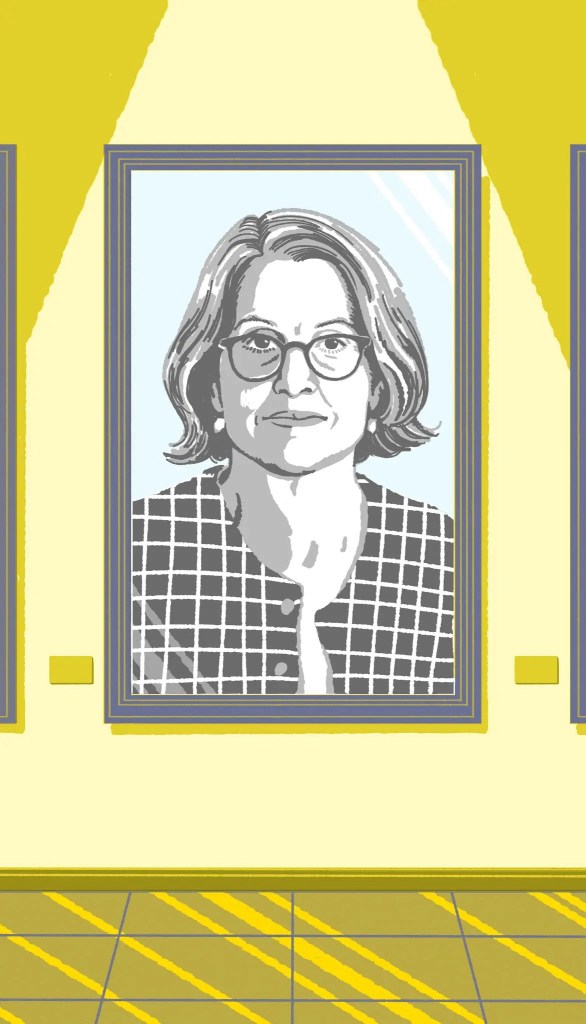
Claire Merchlinsky [New York Times caption and illustration]
Over her 38-year career at The Times, Ms. Smith cultivated a reputation for intimate observations conveyed in accessible prose.
I became a critic in the same way a lot of people become critics: by immersing themselves in a subject and having enough confidence to listen to their opinions. Criticism isn’t really an academic subject. I don’t think it can be taught at school; it’s much more visceral. It happens when you’re in front of art, examining it, articulating opinions and trying to convert those opinions into clear prose.
I had never taken a journalism course. Editors and copy editors — especially at The Times — were my real teachers.
Critics need to be more flexible than artists. You have to be open to being changed and pushed into new directions by art. I don’t feel an obligation to take a strong stand on things.
(Sarah Bahr, “Roberta Smith Looks Back on Three Decades of Art Criticism,” New York Times, 4-11-24)






 EthicalDative
Training Color to Speak for Itself
I’m familiar with the phrase “color scheme,” but I’ve got this far without having encountered its synonym “colorway”:
Floated in glass dividers between the swatches are Sonia’s instructional “color cards” to the fabric manufacturer. Exacting and propulsive, these colorways show that she understood the kinships and rivalries of hue with a shrewdly marketable instinct.
… Only in Bard’s dense wardrobe of a show do the sources of Sonia’s painterly voice become obvious: the bunchable, joinable, repeatable textures of cloth.
It’s fun to see a handsome black-and-white illustration in an article celebrating color (as well as geometry):
Also stimulating to note the connection between Sonia’s handiwork and her husband’s still life:
(Walker Mimms, “One for the Ages: Sonia Delaunay’s Wearable Abstractions,” New York Times, 4-27-24)
(c) 2024 JMN — EthicalDative. All rights reserved