The linguist’s mind ripples with muscle beneath his unprepossessing skull. Most days, reclusive and modest, he contemplates exotic texts in his remote book-cave. Occasionally, however, an English specimen from Digital City issues a cry for help. The linguist springs into action (spilling his tea)…
In my fantasy I’m a super-editor tasked with swooping down to rescue important writing from distress. When I don my hero-togs I make the world in my head a little safer for good grammar.
All of this augurs poorly for a real constitutional crisis — where, armed with public support, some person or institution in our system openly defies the constitutional checks and balances imposed by another. The pushback, in such a case, is going to require nuance and statesmanship — nuance to make clear to the public exactly what the crisis is (and isn’t) and how it was provoked; statesmanship to provide at least some response from those of the same political ilk for why the long-term costs of such subversion of the Constitution outweighs the short-term benefits. (Stephen I. Vladeck, “What’s Really Happening in Biden vs. Abbott vs. the Supreme Court,” New York Times, 2-1-24)
Which of the following is the subject of the verb “outweighs”?
(a) “pushback” (b) “crisis” (c) “statesmanship” (d) “ilk” (e) “subversion” (f) none of these
You got it! How would you fix the problem? It must be said, remedying the peccadillo we’ve identified does little to ease the trudge through Professor Vladeck’s clotted prose.
Stephen I. Vladeck (@steve_vladeck), a professor at the University of Texas School of Law, writes the One First weekly Supreme Court newsletter and is the author of “The Shadow Docket: How the Supreme Court Uses Stealth Rulings to Amass Power and Undermine the Republic.” [New York Times biotag]
Ask César Cuauhtémoc García Hernández, holder of the Gregory Williams Chair in Civil Rights and Civil Liberties at Ohio State University. Ask Atahualpa Yupanqui (1908-1992), born Héctor Roberto Chavero Aramburu, holder of a guitar in Argentina.
Ask Helen-Marie Lyon-Dalberg-Acton, wife of David Runciman, 4th Viscount of Doxford. Ask Sixtus Dominic Boniface Christopher Rees-Mogg, 6th son of Sir Jacob William Rees-Mogg (elder sibling of Annunziata Mary Rees-Mogg) and wife Helena Anne Beatrix Wentworth Fitzwilliam de Chair. (These are living people as we speak on 16 Mar 2024.)
Do not ask J.R.R. Tolkien, J.K. Rowling, C.S. Lewis, E.M. Forster, G.K. Chesterton, D.H. Lawrence, P.G. Wodehouse, P.D. James, J.B.S. Haldane, H.L.A. Hart or A.S.D. Smith.
As a child I would say, “Mother, I’m a lone, lorn crittur and everything goes contrary with me.” She would raise her eyebrows approvingly and murmur, “Now, now, old mawther.” (Or was it “There, there”?) Mrs. Gummidge’s lament was our bond. Mr. Micawber inhabited our deep lore.
(César Cuauhtémoc García Hernández, “This Immigration Bill Was Never Going to Fix the Border,” New York Times, 2-7-24)
César Cuauhtémoc García Hernández is the author of “Welcome the Wretched: In Defense of the ‘Criminal Alien’” and holds the Gregory Williams Chair in Civil Rights and Civil Liberties at Ohio State University. [New York Times biotag]
‘Romer’s Gap’ by Tian-Ai is published in Poetry, January/February 2024.
Romer’s gap, supratidal, intertidal, subtidal, fly agaric, snailfish, and aphotic are terms I boned up on in scaling the text.
Italic print sets off three sections, headed by the tidal terms, and one quotation. There are no capital letters. The text is comprised of commands (draw back —) and noun phrases (fear of grief).
draw back — fear of grief. disdain toward desired thing.
The speaker speaks to the speaker’s self in shorthand, as if jotting things in a Field Notes 48-Page Memo Book that fits in a shirt pocket or lab coat: perceptions, associations, phraseology registered on the fly.
Coherence emerges on the wings of inference when one notices punctuation. Periods are pivotal, helping to extrapolate statements from cryptic enunciations. Em-dashes and colons connote connective pauses. Of commas there are two; they’re helpful. Stanzas organize the flow; they capture discrete psychic events: lab experiences, biomarine observations, internet forays, carnal rumblings, note taking, perhaps staring out a window and letting a reflective mind roam (through window, cormorants / arrow into the sea.)
google medieval torture boxes. google eradication of female genitalia without mutilation.
carve orifice out of fruit. toy with idea of sharing. in sunlight, anemones
ball their fists. write text. delete text. note several ways to hide.
That rare declarative sentence couching an arresting description — in sunlight, anemones ball their fists — is notable also for its violent enjambment spanning a stanza break.
Intrigue centers around certain of the speaker’s self-directed exhortations. They seem to reflect a grappling with the world and with feelings it lights up. Here are key imperatives sliced alive (vivisected!) from the poem:
draw back — […] suppress memory. unsuppress memory. withdraw permission. […]
The poem turns a corner unearthing a childhood list of desired objects:
nautilus cidada husk tender zing of
freshly toothless hole — permission granted:
The mementos are admitted to the mind’s workings. Perhaps they bridge the gap in the speaker’s own fossil record. The permission — to be impinged upon? bestow access? — withdrawn earlier is granted now, culminating in an achieved resistance, or perhaps a fortified self-containment:
emerge immune to rapture.
Immune, not prey, to rapture. Thank goodness for facile conclusions forgone; the well-trod path would have led to rapture realized — a being sucked up rather than a taking hold.
The poem leaves me keepsakes. I make out a spicy exhortation which I can take on board, especially in my painting (sometimes in life):
for once, careen.
I also borrow a clue on how to navigate poetry’s dark reaches:
in the aphotic zone, creatures must conjure their own light.
Carve orifice out of fruit. Yes! I’ve no idea whether I’ve intersected with the several ways to hide which the poem reifies, but my privilege, indeed function, as reader is to own what the text makes me, not its author, see.
Portrait of Berthe Weill (c 1920) by Émilie Charmy (Credit: Galerie Bernard Bouche, Paris). [BBC caption and illustration]
The plasticity of the modeled flesh; the acuity of the subject’s skeptical gaze distorted by skillfully hinted pince-nez spectacles; the wristwatch: the rich blacks of garb against a brushy olive background: these excite notice in the expressive portrait of Berthe Weill by Émilie Charmy.
The title of the article is “How female Fauvists were some of history’s most audacious painters,” though half its illustrations are by men. Indeed, its first reference is a link to Matisse’s “Woman with a Hat” (1905), a hot mess of a painting.
Here is the banner painting by Émilie Charmy featured in the article.
Self-portrait by Émilie Charmy (Credit: Galerie Bernard Bouche, Paris /Photo Credit: Studio GIBERT). [BBC caption and illustration]
Here are the paintings of other Fauves linked to in the article:
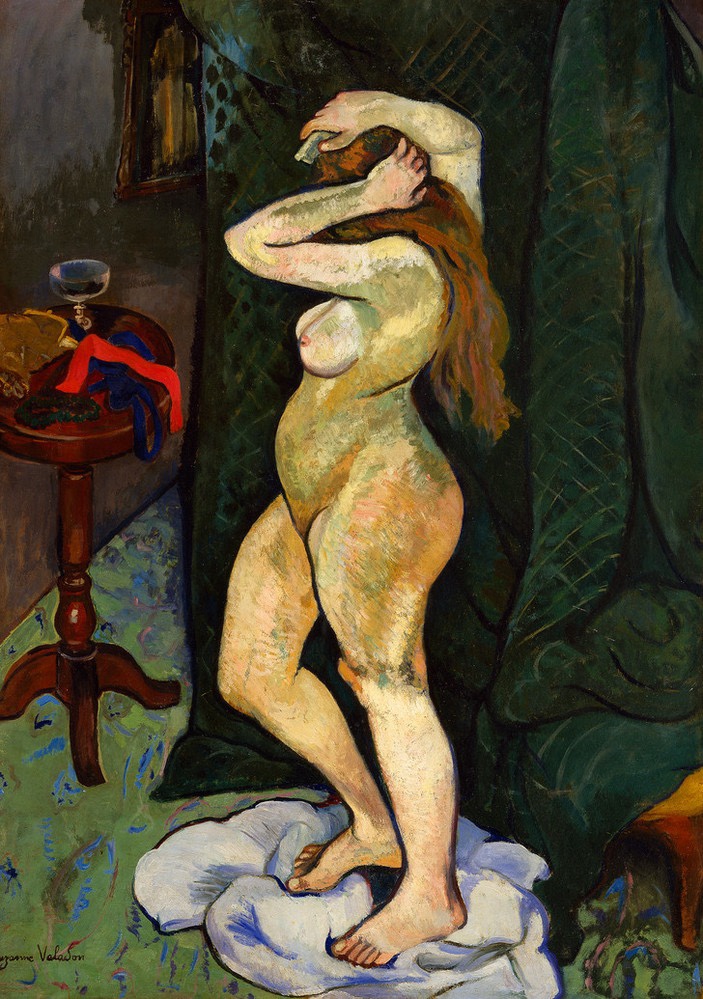
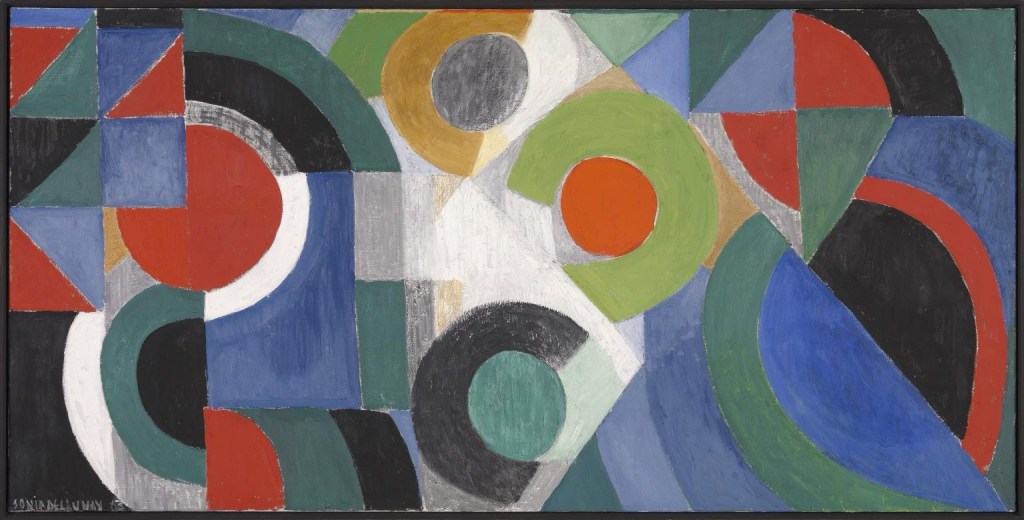
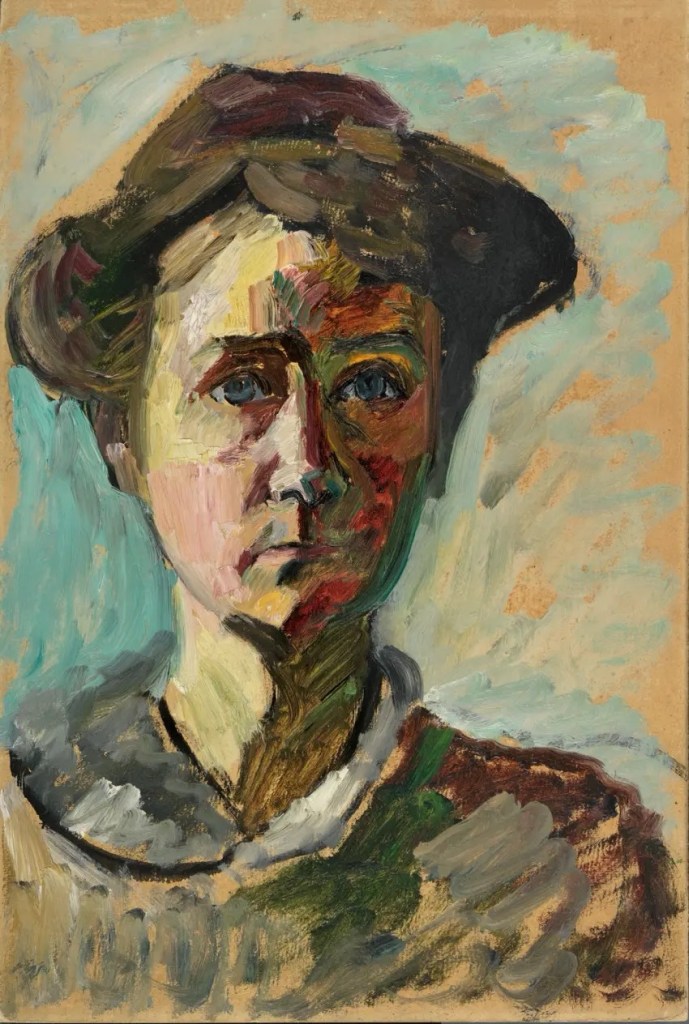
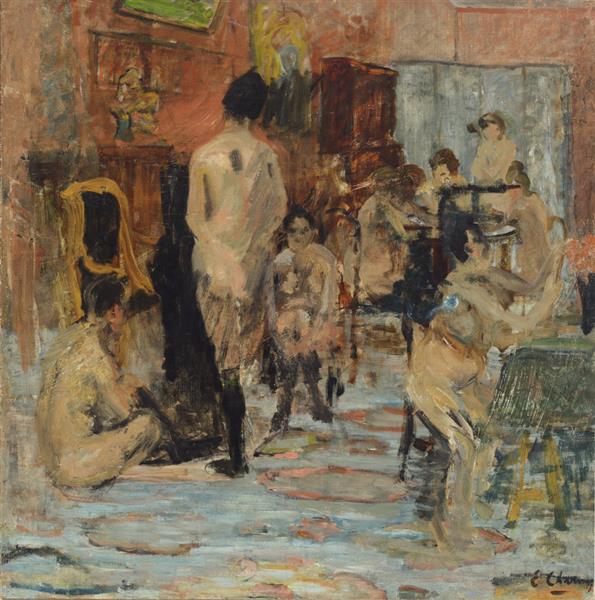
Émilie Charmy, “The Dressing Room,” 1902. Wikiart.orgSuzanne Valadon (mother of Maurice Utrillo), “Nude Arranging Her Hair.” Nmwa.orgSonia Delaunay, “Triptych,” 1963. Tate.org.ukGabrielle Münter, “Self-Portrait,” c. 1908. Royalacademy.org.uk. “My pictures are all moments of life,” Münter once remarked. “I mean instantaneous visual experiences, generally noted very rapidly and spontaneously. When I begin to paint, it’s like leaping suddenly into deep waters, and I never know beforehand whether I will be able to swim.”Marianne Werefkin, “Twins,” 1909. Royalacademy.org.uk
(Deborah Nicholls-Lee, “How female Fauvists were some of history’s most audacious painters,” bbc.com, 9-12-23)
We all have moments when we’re prone to paraglide on feelings in lieu of actually knowing a thing or two. Here’s a way to break out of your stasis quo:
Park your smart phone. Knock back a snort of tequila. Drive to a tavern where bikers congregate. Approach the burliest man you see. Lock him in a fixed stare and say, “You got a problem with me?”
It’ll start a conversation every time. The vibrant exchange will cover a wide range of your problems examined from a fellow citizen’s perspective. In convalescence piercing insights accrue.
You’re skeptical — I get it. Take heart. Simply remember something a politician thinks Churchill said, write it down, stick it in your pocket. It will get you to the tavern.
The Arabic letter ta’ in isolation makes a smiley face.
“People who are coming from parts unknown, countries that you’ve never heard of. Languages that nobody in this country speaks. We don’t even have teachers of some of these languages. Who would think that we have languages that are like from the planet Mars? Nobody, nobody, knows how to, you know, speak it.”
Some cartoon premises are so good they hold up even without the drawing. Gary Larson’s “Professor Schwartzman” walks the suburban neighborhood in his antenna-festooned helmet. The device enables him to be the first human to understand “what barking dogs are actually saying.” As it happens, every dog in the frame, and there are several, is saying the same thing, which is, Hey! Hey! Hey! Hey!
It transports me, laughing, to a piercing birdcall heard in a former springtime. A lone bird close to my window uttered two syllables relentlessly with rising intonation — something like too-WEE! too-WEE! too-WEE! Instinct told me it was a young male angling for a first mating. I knew in my heart that his call was bird language for I’m HERE! I’m HERE! I’m HERE! It’s meant to bring the love candidates flocking. Every guy has tried it in his own time.
Max Beckmann “Self-Portrait With White Cap, 1926,” at the Neue Galerie in New York. His sober and analytical gaze was an artistic project born from disastrous war and political disenchantment. Credit… Artists Rights Society (ARS), New York; via Christie’s Images. [New York Times caption and illustration]
“I have been drawing,” Beckmann wrote to his wife one evening, after a day caring for men who’d survived the trenches. “That protects one from death and danger.”
Though he never served at the front, Beckmann had a nervous breakdown by the end of 1915. The war went on, but Beckmann, now in Frankfurt, began painting biblical scenes with nightmarish directness: a sharp-angled “Descent from the Cross” …
Condemned by the Third Reich as a “degenerate” artist, he spent his later life in the Netherlands and eventually the United States…
Max Beckmann, “Paris Society,” which he began in 1925 and reworked in 1931 and again in 1947. The show reveals how the expressionism of the early 1900s would be distilled into the hard-boiled objectivity of the Weimar years. Credit… Artists Rights Society (ARS), New York; via Solomon R. Guggenheim Museum. [New York Times caption and illustration]
Beckmann did not depict the war head-on. He preferred satire, effrontery, and a certain artistic sacerdotalism…
Max Beckmann, “In the Tram,” a Berlin public transport scene from 1922. The shallow spaces and hard angles Beckmann initially applied to Christian motifs get reapplied to acid views of Weimar society. Credit… Artists Rights Society (ARS), New York; via Drypoint Museum of Fine Arts, Boston. [New York Times caption and illustration]
The more urgent paintings and prints here are those that hold fast to the greatest virtue of German art of the years after World War I: Sachlichkeit, or “objectivity,” a view of society purged of emotion, which saw the substance of things on their surfaces.
Beckmann’s “Trapeze,” 1923, shows acrobats tumbling one over the other in a hopelessly failed circus act. Credit…Artists Rights Society (ARS), New York; via Toledo Museum of Art. [New York Times caption and illustration]
(Jason Farago, “For Max Beckmann, Art’s Ironist, Crisis and Rediscovery,” New York Times, 11-10-23)
“People who don’t speak languages. We have languages coming into our country, nobody that speaks those languages. They’re truly foreign languages. Nobody speaks them.”
A promotion that Mr. Tscherny designed for the Strathmore Paper Company in 1966. Credit… George Tscherny, via SVA Archives. [New York Times caption and illustration]
He recognized from an early age the way that high art and commercial art overlapped, blended together and even nestled inside each other.
I called myself a space salesman when I worked in newspaper advertising. When I was made ad manager, I “dummied” each day’s newspaper, which meant placing all the ads sold for the next edition, after which the editor could count up the column inches left over which he could fill with something to read which wasn’t an advertisement. That was then; the internet is now.
The digital titans have long since harvested our personal details. They can rifle advertising instead of shotgunning it like in the old days. They know what foods make me gassy and which cheek I shave first; they know when your period starts. They can micro-purvey amenable product for every susceptibility, disposition and failing of yours, mine, his, hers and theirs. Never mind that it’s deeply creepy.
But that’s an aside. I came here to admire a man I met in his obituary. George Tscherny (pronounced CHAIR-nee), who died in late 2023, created the logo for the School of Visual Arts in Manhattan.
The SVA logo.
It’s a squiggly flower “positioned next to the school’s name, written in what [Tscherny] called the ‘icy perfection’ of the elegantly formal Bodoni typeface…” Bodoni was the default typeface for the ads we laid out at the newspaper, so I registered its mention with affection. (The newspaper taught me to use no more than a couple of typefaces in an ad; to avoid script fonts like the plague; and to convince local merchants that white space was their friend.)
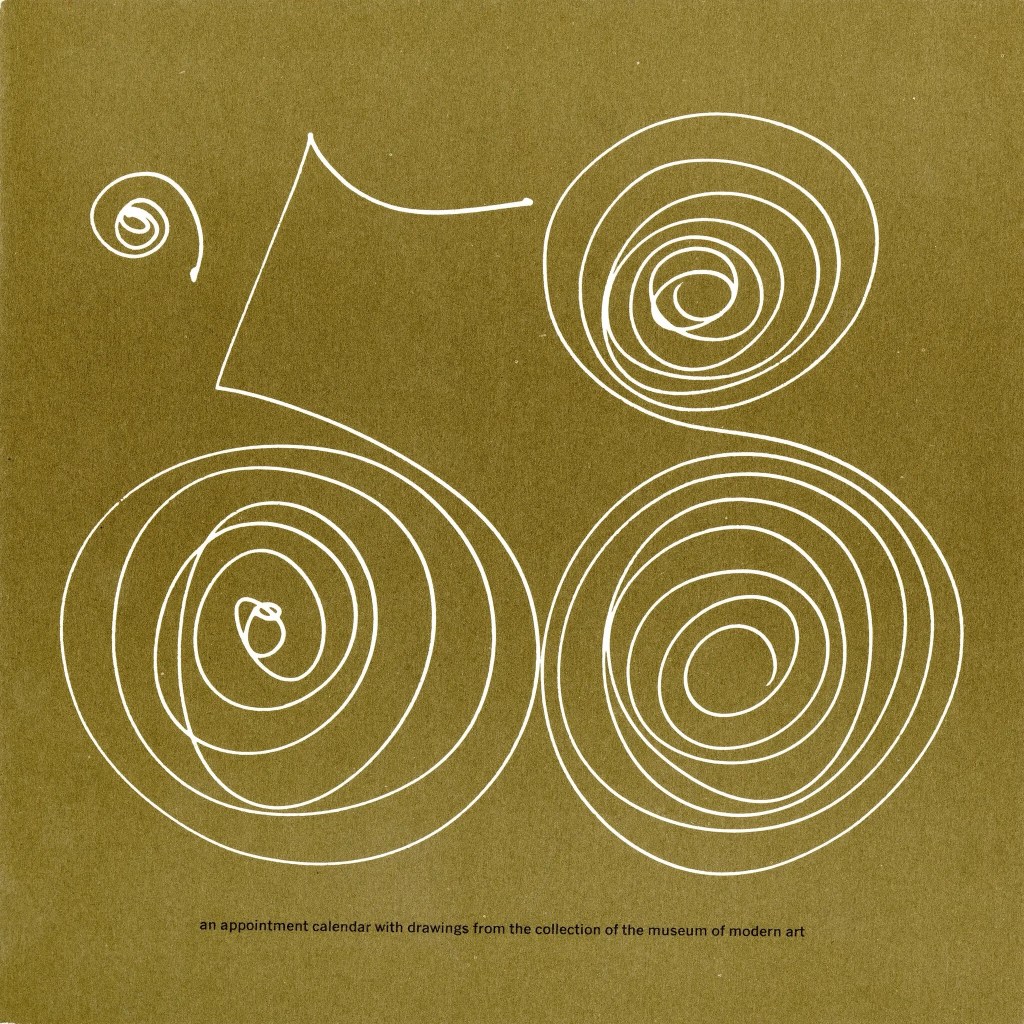
The cover of a 1958 appointment calendar. Credit… George Tscherny, via SVA Archives. [New York Times caption and illustration]
When Tscherny went to work there in 1955, the SVA was still called the Cartoonists and Illustrators School (with no apostrophes!). Why couldn’t it keep that name? “School of Visual Arts” has neither originality nor distinction.
“I see myself as a bridge between commerce and art,” Mr. Tscherny said in an interview for the Art Directors Club in 1997, when the club inducted him into its Hall of Fame. “For just as copy can be literature, design can be art when it reaches certain levels of originality and distinction.”
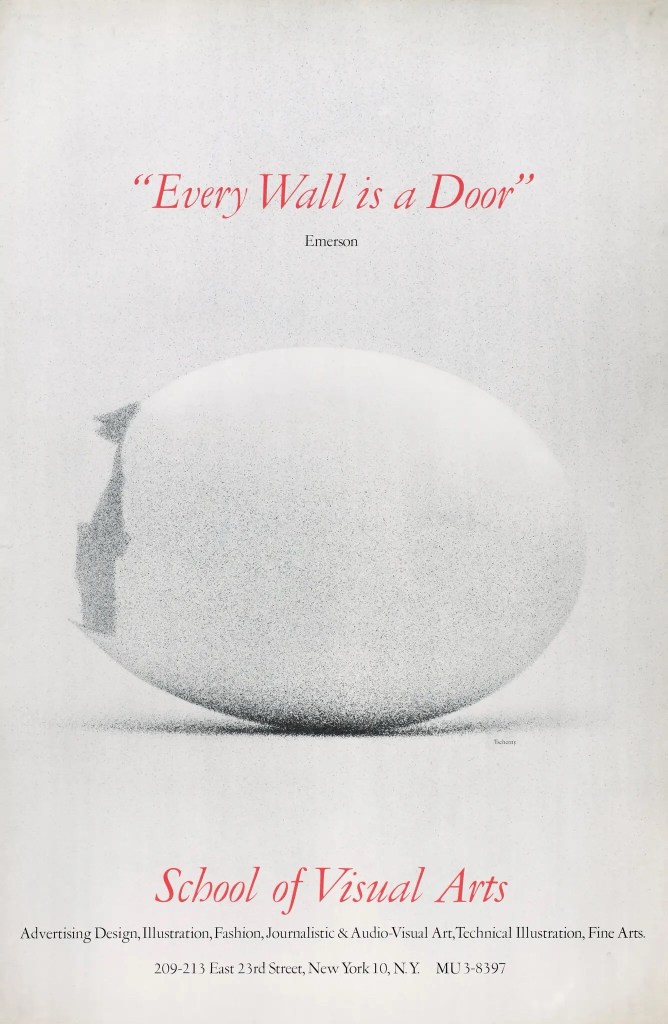
A poster for the School of Visual Arts in New York, with which Mr. Tscherny was long associated. Credit… George Tscherny, via SVA Archives. [New York Times caption and illustration]
(Clay Risen, “George Tscherny, Whose Graphic Designs Defined an Era, Is Dead at 99,” New York Times, 11-17-23)
Remember me to one who waits there, She once was a server of mine.
Love to Michelle and Phyllis in their respective states; to Raúl in Barcelona at the university bar; to the vendor near the Plaza de Cataluña who put extra cheese on my bocadillo (¿Desea más queso?); to the Parisian bartender who crafted the p’tit café crême which I drank standing every morning; to all the fine staff of the world’s eateries who put the heart in hospitality, the joy in dining out. And to Paul and Art for the music.








 EthicalDative

The Caped Grammarian
The linguist’s mind ripples with muscle beneath his unprepossessing skull. Most days, reclusive and modest, he contemplates exotic texts in his remote book-cave. Occasionally, however, an English specimen from Digital City issues a cry for help. The linguist springs into action (spilling his tea)…
In my fantasy I’m a super-editor tasked with swooping down to rescue important writing from distress. When I don my hero-togs I make the world in my head a little safer for good grammar.
All of this augurs poorly for a real constitutional crisis — where, armed with public support, some person or institution in our system openly defies the constitutional checks and balances imposed by another. The pushback, in such a case, is going to require nuance and statesmanship — nuance to make clear to the public exactly what the crisis is (and isn’t) and how it was provoked; statesmanship to provide at least some response from those of the same political ilk for why the long-term costs of such subversion of the Constitution outweighs the short-term benefits.
(Stephen I. Vladeck, “What’s Really Happening in Biden vs. Abbott vs. the Supreme Court,” New York Times, 2-1-24)
Which of the following is the subject of the verb “outweighs”?
(a) “pushback” (b) “crisis” (c) “statesmanship” (d) “ilk” (e) “subversion” (f) none of these
You got it! How would you fix the problem? It must be said, remedying the peccadillo we’ve identified does little to ease the trudge through Professor Vladeck’s clotted prose.
Stephen I. Vladeck (@steve_vladeck), a professor at the University of Texas School of Law, writes the One First weekly Supreme Court newsletter and is the author of “The Shadow Docket: How the Supreme Court Uses Stealth Rulings to Amass Power and Undermine the Republic.” [New York Times biotag]
(c) 2024 JMN — EthicalDative. All rights reserved