“Whatever happened to Gary Cooper? The strong silent type. That was an American. He wasn’t in touch with his feelin’s. He just did what he hadda do. So what they didn’t know is once they got Gary Cooper in touch with his feelin’s, THEY WOULDN’T BE ABLE TO SHUT ‘IM UP!”
… It’s about a woman named Joan who’s sort of like a mid-level manager at what appears to be a big Silicon valley tech company, and she discovers one day that unbeknowst to her there is a TV show being made about her life starring Salma Hayek as her and basically this show is running on this fictional version of Netflix called Streamberry using some kind of like generative AI quantum computer that can like take the things that she is saying and doing and put them into a TV show that’s basically like a one-to-one representation of her life.
Yeah, it was sort of like talking to like your most conspiracy-minded friend … and I always just kind of love that kind of behind-the-scenes detail because it’s so easy to like appreciate the effort of someone who like sat in a little hut in the wilderness for six months to like get the perfect shot of the snow leopard on the one day that it like emerged and tripped the camera sensor, like that is the kind of delicious detail that just makes it so much more enjoyable knowing that someone spent all that effort just to get that one shot that you saw on your TV, like that is the kind of thing that makes me think that AI-generated movies may be a long way off.
(Transcribed from The Hard Fork, a New York Times podcast about technology)
… The dead wake for nothing. Or wake & nothing is still there.
The wide meadow. Deep grass. Distant ships. The far fires
Only glimpsed from a distance. Nothing looks back,
blinks twice. … (Kevin Young, from “Usher”)
That “blinks twice” produced a red-letter reading moment for me, a laugh of surprised delight and recognition. Recognition of what? I ask myself. I suppose it’s recognition of a conceit, an old word, I think, in the poetry vineyard. It turns on the term “nothing,” a workaday word if ever there was one, repeated 3 times in an increasingly interesting way. When it’s still there, fair enough; when it looks back, wait a minute! When it blinks twice, the full punch is delivered.
Spooky and delicious. Rather than a container of absence, “nothing” is turned into a presence, perhaps even ominous and aggressive. I think of the Canadian forest fires “blinking” at us. The mega-nothing which they imply encroaches.
The entire poem, with others of Kevin Young’s, is published in Poetry, July/August 2023.
Jamelle Bouie cites a passage from Racecraft: The Soul of Inequality in America by the historians Karen and Barbara Fields:
Consider the statement “black Southerners were segregated because of their skin color”— a perfectly natural sentence to the ears of most Americans, who tend to overlook its weird causality. But in that sentence, segregation disappears as the doing of segregationists, and then, in a puff of smoke — paff — reappears as a trait of only one part of the segregated whole.
The actor vanishes from the act because the statement is in the grammatical passive voice. In this construction, the victim becomes the apparent subject of the sentence, and his own skin color masquerades syntactically as the cause of his affliction.
A rump-end “agent” phrase introduced with “by” is the only way to smoke out the doer of the deed:
Black Southerners were segregated because of their skin color by White Southerners.
Here’s the statement in active voice:
White Southerners segregated Black Southerners because of their skin color.
(Jamelle Bouie, “The John Roberts Two-Step,” New York Times, 7-8-23)
… And yet the escapement enforces its circle of unbreakable numbers…
Sakia Hamilton’s verse “From ‘All Souls’” in Poetry, July/August 2023 refers to a pocket watch in a cupboard.
Dancing with a technical term in a poem is a wily achievement. Words like “escapement” have a life of their own even when you don’t know exactly what they mean. Lookup is a chance to phrase a complex definition in one’s own words — an act of assimilation. Here goes: An escapement is a contrivance that triggers a periodic, measured shift of position in one mass relative to another. Using those words gives me a sense of owning the term, and a greater appreciation of how it enforces its circle / of unbreakable numbers in the poem.
Hamilton throws a curve ball in what follows, which is also the conclusion of her poem:
… Someone has let it run down. Don’t turn back, it’s the wrong way, is the relation of chronology to history at all valuable here.
At first blush I want to see a question in the last sentence, yet the structure makes it impossible. What I perceive instead is a flex of syntax permitted by English in which a subordinating conjunction and copula are elided before an adjectival clause modifying “relation.” The words “that is” are to be understood before “at all valuable here.”
Perhaps I should have said that the poem has remarked prior to this on the fragility of the wound-down clock’s hands: They would snap off with pressure / from the smallest finger. Turning them back is the wrong way to rewind the clock. The numbers, on the other hand, are unbreakable, and the escapement enforces an inexorable forward motion around them. History likewise flows in only one direction, and that’s the relation to clock time that has value.
Entering a novel is like going on a climb in the mountains: you have to learn the rhythm of respiration, acquire the pace; otherwise you stop right away. The same thing is true of poetry. Just recall how unbearable poems become when they are recited by actors, who, wanting to “interpret,” ignore the meter of the verse, make dramatic enjambements as if they were declaiming prose, concern themselves with the content and not with the rhythm. To read a classical poem in rhyme, you have to assume the singing rhythm the poet wanted. It’s better to recite Dante as if he had written children’s jingles than to pursue only his meanings to the exclusion of everything else.
(Umberto Eco, author’s postscript in his novel The Name of the Rose. This quotation was shared with me by OutsideAuthority.)
The horror vacui principle applies to messaging. A logodivergent text provokes suck-up from the reader’s own psychic aquifer. Demands are made, surmises enacted, leaps taken. A lucky text seduces its audience of one into a slow-reading entanglement.
Is it the translator’s job to help a text make sense? Putting it into “natural” or convincing English seems contingent on doing so. Or is the job rather to convey something of the experience of reading the original? Can you ride both of these bulls?
Are there cases where reading in one’s native tongue is an act of translation? Is paraphrase a legitimate recourse? My impression is that poets think it’s namby-pamby.
Maybe it’s not the writer’s role to care how the text feels to the reader. This is a challenging premise; it makes the act of writing look devil-may-care: Fuck you, reader, I’m doing me. But the mere act of propelling one’s words by hook or crook into the public sphere is an act of hawking. A reader is a buyer.
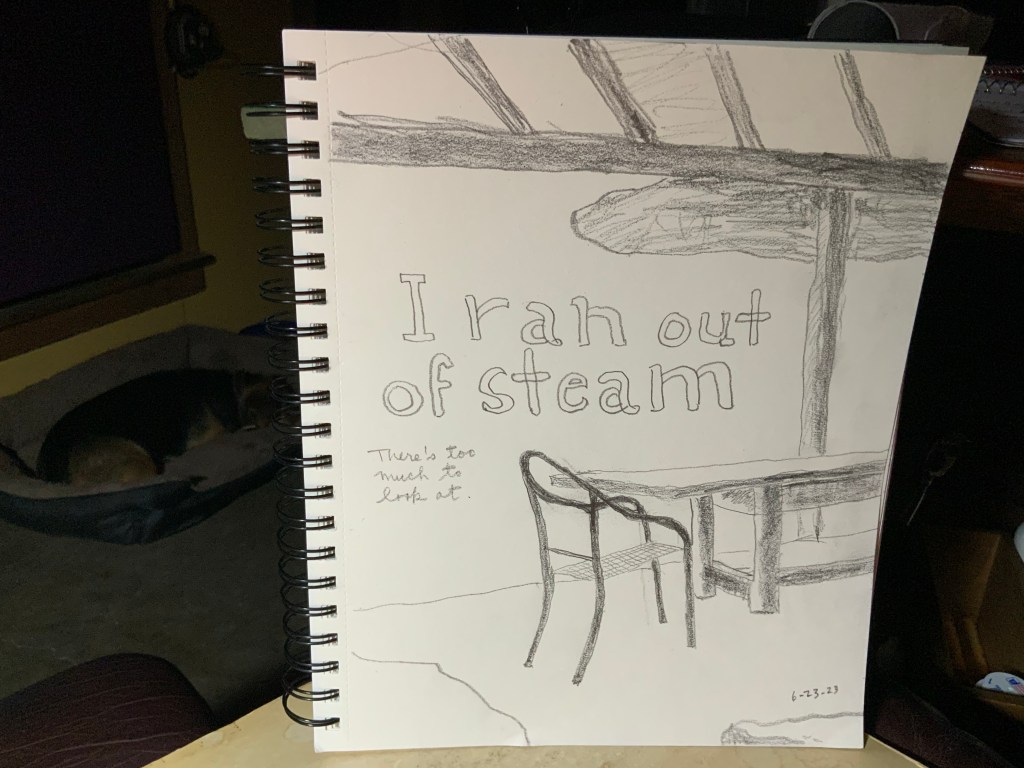
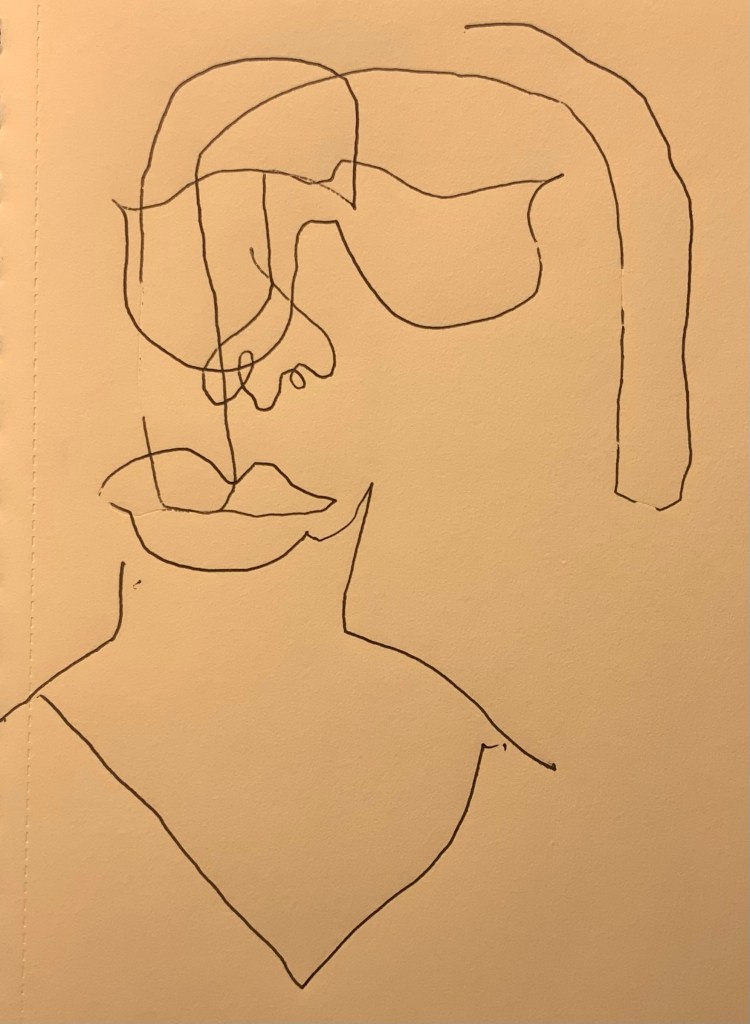
None of this is dark gray or light gray; it’s somewhere in between. To write (or draw) fulfills by alleviation; we talk to the self we occupy and fend off terror. But it’s also a way to drop a piece of that self in the dirt to see if anyone picks it up. When someone does, it feels good.
There are poems whose gist I imperfectly apprehend. Putting such a poem into an acquired language can be a form of beaconing for bounce-back from latent referents. It’s therapy for bafflement. The drill induces closer confrontation with the text, on one hand, and gives an airing to my cloistered Spanish on the other. There’s potential for lossy gain: Certain of the poem’s images may stick faster in the mind; a hint of narrative or of grounding context may gel; a turn of phrase may grow in appeal. What amounts to a deflecting process can provide a path to Pyrrhic defeat, as it were; no victory, to be sure, but a modicum of salvage and a hint of closure.
“Alarm” by Bradley Trumpfheller is in Poetry, July/August 2023.
Alarm
Self are you toward the pool No then closer
Yo estás hacia la piscina No entonces más cerca
Night’s not on the list of the glass-green water
La noche no está en la lista del agua color de vidrio verde
It loves your legs the water It is mica and night honey mushrooms and legs
Adora tus piernas el agua Es mica y miel nocturna champiñones y piernas
I tell you about my childhood You hum over your future tattoos
Te hablo de mi niñez Tú canturreas sobre tus tatuajes futuros
Who is this Phillips person? — I wondered after reading aloud what had looked like a forbiddingly long poem in Poetry, July/August 2023. (The biographical note tells me what I dread knowing: He’s a distinguished professor of English!)
The poem, “Child of Nature,” has knocked me silly and induced a state of maudlin rapture. (Everything I jot down here I’ll surely regret as hasty over-sharing, leaving a good poem hard done by with my petty tribute. That’s my disclaimer.)
Only a dozen lines or so into “Child of Nature” did I detect blank verse — so unforced, transparent, vernacular, yet so true to measure throughout. The writer weaves internal rhyme and flashes of sonic dazzle, light-touch literary and of-the-moment cultural reference, ironic self awareness, and language-conscious wit with an extended meditation on what “nature” is and how it’s intuited by one whose roots are urban.
Starting with the line No one is ever alone with their thoughts, I had to stop reading for a moment. You know that constriction in the throat and onset of congestive nasality that signals getting all swimmy-eyed, when your next words will surely be croaky or sound like a wheeze, so you fall silent to regroup? That’s what happened before I steadied voice and followed the poem to its serene consummation:
Alone on a cliff or here beside me, We are crowded by presence and perchance Where listening to stream and street we hear The other, even as one of them gleams And the other gleams we can’t forget One or the other; ethereal stream And electric street are parts of the same long Link in the same human chain. I came To this poem, the long one, with a lot to say. I’d sung my art before this with real zeal, Chanting through three moods so as not to forget: The ground, then heaven, then the weapon. Years Passed. And now from my high window, the cliffs And canyons of these avenues call me Back to sing through fire for their sweet sake.
My title sounds like a hoary aphorism distilling virtuous wisdom passed down through the ages in simple, God-fearing households. But I just made it up.
The “aphorism” models usage gone all but missing from English. An encounter with it in current writing, especially journalism, is bracing, and feels like hearing English spoken by a harpsichord.
Here’s the specimen encountered in the New York Times (my bolding):
But the way we typically test advances in medicine — a rigorously designed randomized clinical trial that takes years — won’t work here. After all, by the time the trial were complete, the technology would have changed. Besides, the reality is that these technologies are going to find their way into our daily practice whether they are tested or not.
Most speakers would write “by the time the trial was complete.” “Was” is the way English works now. Correctness isn’t at issue, only modern versus classical style.
What the doctor who writes the article expresses is a condition contrary to fact followed by its future, theoretical outcome. It calls for a verbal mode that English has (mostly) discarded. That mode, the subjunctive, is alive and well morphologically in other languages. In Spanish, for example, the sentence might look like this:
Después de todo, cuando se hubiera completado la prueba, la tecnología habría cambiado.
It’s a conditional sentence that’s also predictive. The pluperfect subjunctive “hubiera completado” marks the protasis, the conditional perfect “habría cambiado” the apodosis. The construction can show a shift from indication or confident expectation to conjecture, doubt, fear, joy and other speaker states of mind concerning the message.
A reader may have noticed that my aphorism doesn’t quite align with the topic. It should read:
When the work were done, then rest would come.
Or better yet:
When the work had been done, then rest would have come.
(Daniela J. Lamas, “There’s One Hard Question My Fellow Doctors and I Will Have to Answer Soon,” New York Times, 7-6-23)



 EthicalDative
The ‘Weird Causality’ of Passive Voice
Jamelle Bouie cites a passage from Racecraft: The Soul of Inequality in America by the historians Karen and Barbara Fields:
Consider the statement “black Southerners were segregated because of their skin color”— a perfectly natural sentence to the ears of most Americans, who tend to overlook its weird causality. But in that sentence, segregation disappears as the doing of segregationists, and then, in a puff of smoke — paff — reappears as a trait of only one part of the segregated whole.
The actor vanishes from the act because the statement is in the grammatical passive voice. In this construction, the victim becomes the apparent subject of the sentence, and his own skin color masquerades syntactically as the cause of his affliction.
A rump-end “agent” phrase introduced with “by” is the only way to smoke out the doer of the deed:
Black Southerners were segregated because of their skin color by White Southerners.
Here’s the statement in active voice:
White Southerners segregated Black Southerners because of their skin color.
(Jamelle Bouie, “The John Roberts Two-Step,” New York Times, 7-8-23)
(c) 2023 JMN — EthicalDative. All rights reserved