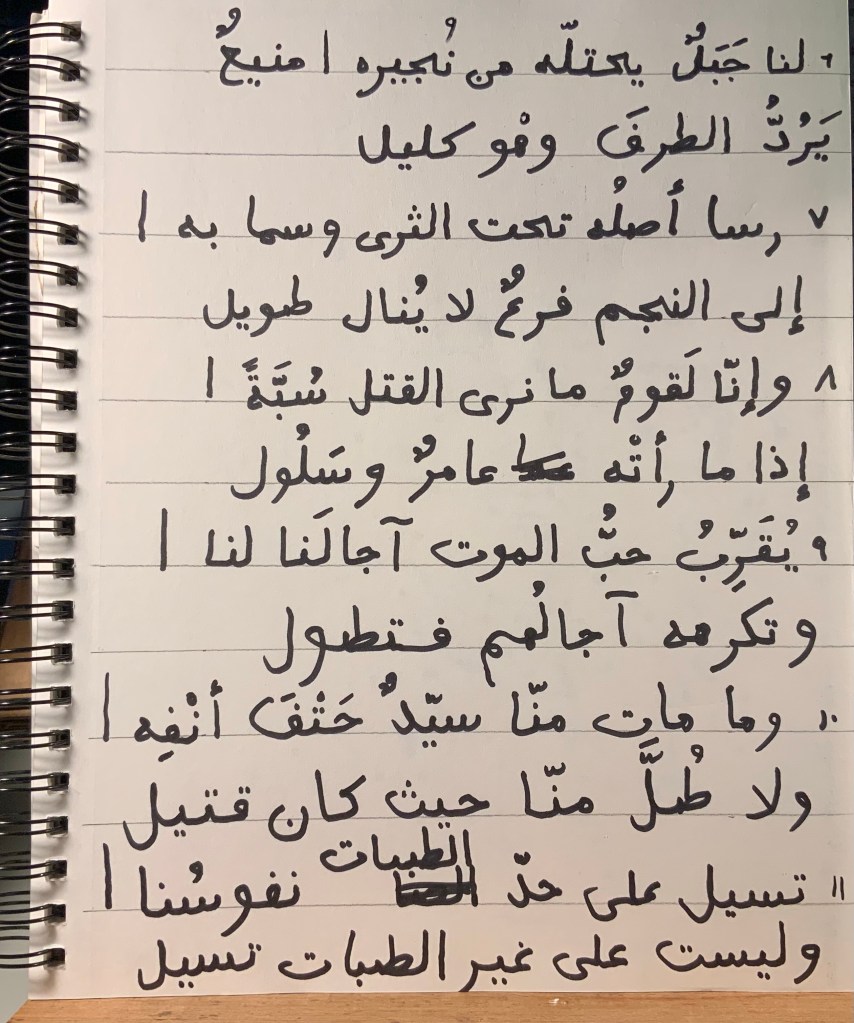
7 rasā ‘aṣl(u)-hu taḥta-ṯ-ṯarA wa-samā bi-hi | ‘ilaA-n-najm(i) far^(un) lā yunālu ṭawīl(u)
8 wa-‘in-nā la-qaum(un) mā narāY-l-qatl(a) subbaẗ(an) | ‘iḏā mā ra’at-hu ^āmir(un) wa-salūl(u)
9 yuqarribu ḥubb(u)-l-maut(i) ‘ājāl(a)-nā la-nā | wa-takrahu-hu ājāl(u)-hum fa-taṭūlu
10 wa-mā māta min-nā sayyid(un) ḥatf(a) ‘anf(i)-hi | wa-lā ṭulla min-nā ḥaiṯ(u) kāna qatīl(u)
11 tasīlu ^alāY ḥadd(i)-ḍ-ḍub(āti) nufūs(u)-nā] | wa-laisat ^alāY ḡair(i)-ḍ-ḍub(āti) tasīlu
This post is continued from here.
The segment evokes the lofty mountain refuge available to the speaker’s confederates, then exalts his tribe’s martial disposition and willingness to die in battle and avenge the fallen.
6 We have a mountain where those we shelter settle down; impregnable, it turns away the eye, tired from looking.
7 Its trunk anchors underneath the soil; a branch lifts it to the stars. It’s not got hold of; it is towering.
8 We’re a people who don’t consider killing a disgrace the way that ^Amir and Salūl have thought it.
9 Love of death advances for us our final moment; their final moment loathes it, therefore is drawn out.
10 No sayyid of ours dies a death of his nose, nor was the blood of any of us made to go for nought, like dew, where he lay dead.
11 Our souls flow out on sword-blade edge, and nowhere but on sword-blade edge do they flow out.
Notes
(Unless otherwise noted, quotations are from Arberry.)
6 tired from looking: The mountain is so lofty it defies the eye’s attempt to take it in. Arberry notes the “mountain” may be taken metaphorically, or “as referring to the mountain-fortress of al-Ablaq (al-Fard), the famous redoubt of al-Samau’al.”
8 don’t consider killing: i.e., being killed. “[^Amir and Salūl] are the names of rival tribes…”
9 love of death, etc.: “Sc. our warriors die young, those of our rivals live on into old age.”
10 dies a death of his nose: i.e., dies a natural death in which life exits with a last breath. The warrior’s life was considered to exit through his bleeding wounds, as verse 11 makes explicit. Nor was the blood, etc.: i.e., our slain have always been avenged.
11 “The commentator al-Tibrīzī explains the second half of this verse as excluding death by the dishonourable instruments of sticks and staves and the like.”
(c) 2023 JMN — EthicalDative. All rights reserved







 EthicalDative
Is Brain Rack Journey or Destination?
Have you ever suspected people who “play devil’s advocate” are often expressing their actual opinions, but without having to take responsibility for them?
I worked in the tech industry a while. I should be more interested in ChatGPT. Why am I crouched against it? Stodginess? Instinct? Paranoia?
I’ve read Farhat Manjoo since he covered tech at Slate. He’s now at the New York Times, and is exploring how ChatGPT can be useful to the journalist.
It proves invaluable, he writes, “in digging up that perfect word or phrase you’re having trouble summoning… I’ve spent many painful minutes of my life scouring my mind for the right word. ChatGPT is making that problem a thing of the past.”
Here’s my devil’s advocate response, except it’s my real opinion: Isn’t the painful scouring of one’s mind for right words a fortifying activity in itself, like how a muscle needs exertion in order not to atrophy? Is our farming out of such mental activity to a machine not a further step down the slippery slope to early-onset senescence occasioned by cerebral decadence resulting from septic brain stasis?
On reliability: It’s known that ChatGPT can spout convincing bull along with good stuff. A colleague of Manjoo’s suggests giving it the same credence as to a “blabbermouth blowhard at a bar” who is three sheets to the wind. Sometimes he knows what he’s talking about. Figure out when.
Fine and dandy, but how often do you want to hang out with blabbermouth blowhards in bars?
(Farhat Manjoo, “ChatGPT Is Already Changing How I Do My Job,” New York Times, 4-21-23)
(c) 2023 JMN — EthicalDative. All rights reserved