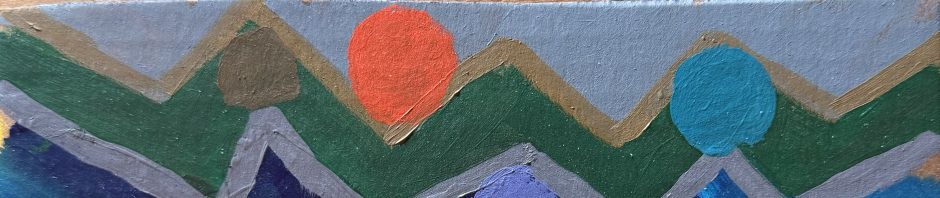
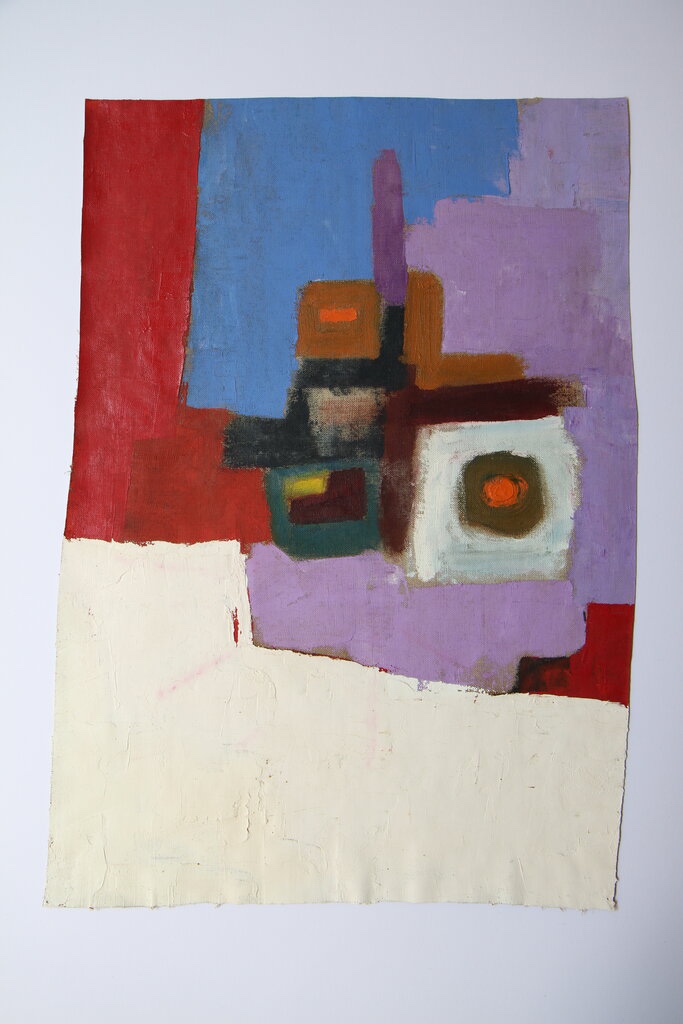
Lebanese-American painter-poet-novelist Etel Adnan (1925-2021) was interviewed by Gabriel Coxhead for the June 2018 issue of Apollo.
In the 1970s, having returned to Beirut to work as a journalist, she was forced to flee to Paris when the civil war broke out… Living mainly again in California, she published numerous volumes of poetry and prose… such as The Arab Apocalypse (1980), Of Cities and Women (Letters to Fawwaz) (1993), and In the Heart of the Heart of Another Country (2005).
“If I were just a painter, maybe my work would have been different, more encompassing. But my writing is rather pessimistic, because of the angle of history I got involved with, being born in Beirut. Also, it’s because words are social. I think it’s more natural if an event bothers you to express it in words. Art also is a kind of language – but it’s a language of feeling. When I paint, I am happy. I am both an optimistic, happy person, and caught in and aware of tragedy. And although I lived in California most of my life, I never had a spell of time where I could forget about the problems of the Middle East. Every morning the newspaper would remind me.”
(c) 2023 JMN — EthicalDative. All rights reserved





The ‘Weird Causality’ of Passive Voice
Jamelle Bouie cites a passage from Racecraft: The Soul of Inequality in America by the historians Karen and Barbara Fields:
Consider the statement “black Southerners were segregated because of their skin color”— a perfectly natural sentence to the ears of most Americans, who tend to overlook its weird causality. But in that sentence, segregation disappears as the doing of segregationists, and then, in a puff of smoke — paff — reappears as a trait of only one part of the segregated whole.
The actor vanishes from the act because the statement is in the grammatical passive voice. In this construction, the victim becomes the apparent subject of the sentence, and his own skin color masquerades syntactically as the cause of his affliction.
A rump-end “agent” phrase introduced with “by” is the only way to smoke out the doer of the deed:
Black Southerners were segregated because of their skin color by White Southerners.
Here’s the statement in active voice:
White Southerners segregated Black Southerners because of their skin color.
(Jamelle Bouie, “The John Roberts Two-Step,” New York Times, 7-8-23)
(c) 2023 JMN — EthicalDative. All rights reserved