Trigger Me, Poet

Poetry March 2023 has arrived in my box.

Jenny George powers the issue to a strong start with a poem whose title, unusually, helps read it. Here are the first 4 of its 11 lines:

A snake lies in the open, dormant
in its sleeve of heat. A gilded orphan
on the sun-warmed dirt, eye-slits ajar,
waiting for the infinite to arrive.
(“The Artist”)

Nam Le has 6 rambunctious verse-structures containing (among others) the words “mitotic,” “mitogenic,” “exophones,” “chrismed,” “lexithymia” (= “alexithymia”), “entelechy” and “yarrow.” Entelechy “makes actual what is otherwise merely potential,” according to the Internet. One Nam Le structure actualized laughter for me, which is a coveted trigger. Here’s its crescendo, referring to the Vietnamese language:

… Leaving, at last:

214.— The number of Kangxi/Nôm radicals.
Upon which all articulations hinge.
From which all possibilities spring.
But is this all there is to it? At the end
of number — mere/more language?
(“[29. ARITHMETICAL]”)

I thought of the tedium of Numbers in the King James Bible. But it’s Pound whom Nam Le mentions elsewhere, reminding me of the tedium inflicted by the Cantos on the aspiring Romance linguist who years later writes these lines.

It’s not fair to dribble snippets of Nam Le, but I like this sententious apothegm:

The Way that lets itself be said to be The Way
Is not the Way….

(“[11. VIOLENCE: ANGLO-LINGUISTIC]”)

Dorothea Laskey’s “Framed Pictures” slides past me for 29 lines, then a poem breaks surface in this resonant conclusion:

The dead only speak through poetry
So make the poems be the things
That you give everything
They must carry on

The nod for most radical enjambment goes to KB Brookins:

… The snake plant
’s grooves also remind me of your hips moving like water
to Bad Bunny, bare-faced and singing translations in my ear.
(“The Snake Plant”)
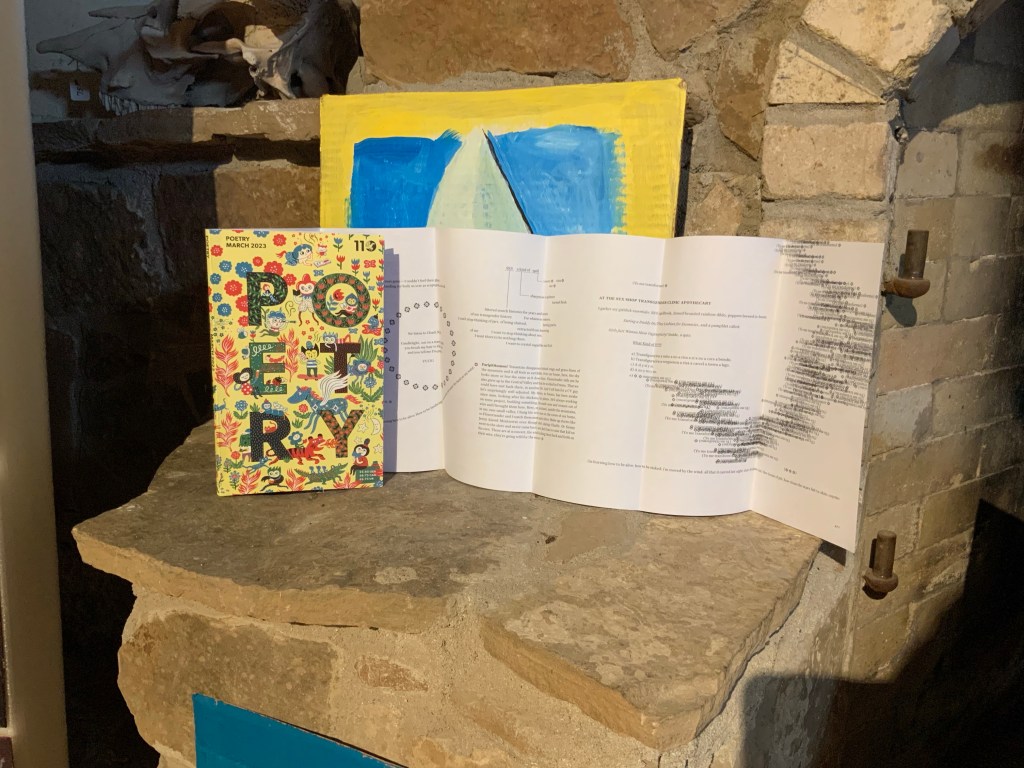
The foldout is devoted to “Jotxland Epic” by Rodolfo Avelar.

Writers who identify as poets assay discourse that repels paraphrase. I’m beginning to find this liberating. It seems a fool’s errand to restate verse in order to “reveal” what it intends to say, or to extrapolate an arc. (I imagine writers hate when readers do this.) The words are simply there, in ink, on paper (physically or virtually). They’re mine now. I don’t have to goose them into a figuration. I can just be a thrill seeker.

(c) 2023 JMN — EthicalDative. All rights reserved
Posted in Anthology | Tagged , , | Leave a comment

As Sure as Dearth and Texas

This bumptious slogan was adopted by TxDOT in 1986 for its anti-littering campaign. The worst offenders were young men aged 16 to 24. The slogan was thought to have “that Texas bravado” which would appeal to those scoundrels. It did. If you need to know more, see this article.

An old saying for something that’s drearily predictable is, “It’s as sure as dearth and Texas.”

Dearth is so prevalent, it’s easier to name things there’s not a dearth of: inequality and bad weather come to mind. Weather can be fixed, but inequality is an Act of God.

As for Texas, suffice it to say that Texas is sort of everywhere, and not in a good way. From Texarkana to Tallahassee, Austin to Martha’s Vineyard, Waco to Sturgis, Amarillo to Scottsdale, Dallas to San Jose, El Paso to Raleigh, everywhere you turn, there’s just more Texas out there messing with America.

The next time I explain old sayings to you, we’ll talk about “Monet is the root of all evil.”

(c) 2023 JMN — EthicalDative. All rights reserved
Posted in Commentary | Tagged , , | 2 Comments

John Donne and Tate

JMN fecit

There’s a biography of John Donne I’d like to read. As a preacher he was a crowd magnet in the pulpit of Saint Paul’s in London. He wrote love poems, some laced with misogyny, and later wished he hadn’t. He fell in love with and took to wife a teenager, Anne More, confined his affections to her, as he put it, and impregnated her 12 times in 16 years of marriage. Her 12th pregnancy was a stillbirth, and Anne died five days later.

Andrew Tate is jailed in Romania for possible crimes. The targets of his evangelism, juvenile males, take his glorification of brutality and Bugattis seriously. Tate’s lawyer retails the thesis that it’s merely a performance.

Donne was a rake for part of his life, but some of his rakishness was pose.

For Rundell [his biographer], Donne was “an exhausted oversexed lover in the imagination only, but he caught that voice of the libertine and exploded it, made it his own. … If you are looking for a master class in how to look and sound like a womanizer, he offers it.”

Donne did some great writing. Tate has nothing in common with him except as putative fantasist and creator of another hell for women. Counselors are exhorting schoolboys to ignore him. (That should work!) What about girls? It’s hoped they, too, will be helped to avoid being fodder for sexual terrorists and priapic preachers.

(James Shapiro, review of Katherine Rundell, “The Libertine’s Voice: The Life and Love Poems of John Donne,” New York Times, 9-16-22; Emma Bubola and Isabella Kwai, “‘Brainwashing a Generation’: British Schools Combat Andrew Tate’s Views,” New York Times, 2-19-23)

(c) 2023 JMN — EthicalDative. All rights reserved
Posted in Commentary | Tagged , , , | Leave a comment

To Be or Not to Be That, Is the Question

You’ve been punctuated! In my title, moving the pause (caesura) signaled by a comma turns Hamlet’s proposition into something different. Whatever “that” may be, being it or not being it is what’s now in play.

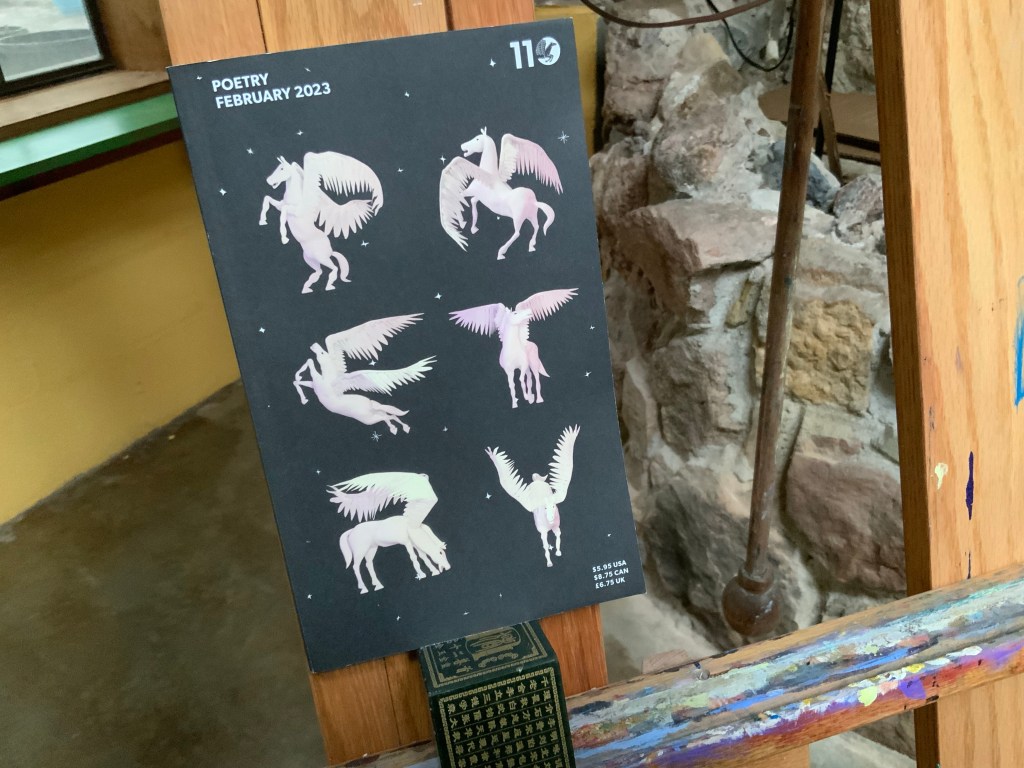
The New York Times publishes a poem by Magdalena Zurawski, “[Dog Is a Way of Thinking],” that features “intrepid use of caesura.” The phrase is Anne Boyer’s, who introduces the poem. “The poem’s frequent midline interruptions of otherwise overflowing (enjambed) lines creates a gentle resistance to the ordinary flow of thought,” Boyer writes. She makes delicious mention of “the dog’s keen-nosed present sense” (so close to “present tense”!), and states that “Dogs thrill at palpability.” Here’s the poem’s ending:

Your dog, if he could
talk, my language tells
me, would, every
day, like a radio,
catch an air wave and
say, “Today. … ”

“Even a mere comma can be the conductor of time” is Boyer’s introductory parting shot. Uh-oh. “Even” or “mere,” but not both! This quibble over redundancy outs a dirty secret: I sweat the detail. I love strategic punctuation, parsable syntax, penetrable diction and rational typography. Clear structure enables complex speech. Verse fails when it conflates oddity and license with inspiration. Does this bias render me unfit to read Poetry magazine? I hope not.

Read Zurawski’s poem. It’s short and very sweet.

(c) 2023 JMN — EthicalDative. All rights reserved
Posted in Anthology | Tagged , , , , | 1 Comment

Can This Be Poetry? It’s Direct, Clever and Fun!

Poetry, February 2023, celebrates William J. Harris (still living). Reading the issue’s portfolio of Harris’s poems gave me some laugh-out-loud moments. Here are two (in full):

On Wearing Ears
As long as people
continue to wear
ears
there won’t
be much
peace and quiet
in this world.

How We Met
Barbara said,
“I got to take a shit.
Why don’t you two
Get to know each other?”

I was stunned at the refreshing paucity of hocus-posery in Harris’s statement of purpose:

Since I am a comic poet… I am always on the lookout for funny, deeply funny, humanly funny poems… My poems are as straightforward as I can make them… I want my poems to make the reader feel, understand and laugh — it is nice when a poem does all three. (Quoted from Howard Ramsby II’s introductory essay.)

Feel. Understand. Laugh. Tic. Tic. Tic. Amazing. I guess it’s poetry.

Here, in full, is another of Harris’s pieces from Poetry’s portfolio:

For Bill Hawkins, a Black Militant
Night, I know you are powerful and artistic
in your misspellings.
How distinctively I sense your brooding,
feel your warm breath against my face,
hear your laughter — not cruel only amused
and arrogant: young —
insisting on my guilt.
Night, let me be part of you
but in my own dark way.

(c) 2023 JMN — EthicalDative. All rights reserved

Posted in Anthology | Tagged , , , , | 1 Comment

The Agony of Hamline and Macalester

“Art need not defer to religion. If that’s no longer obvious we’ve gone astray.”

(Michelle Goldberg)

(Michelle Goldberg, “A Left-Leaning College Didn’t Want to Offend, So It Closed Down Her Art Show,” New York Times, 2-13-23)

The story of what befell the work of Iranian-American artist Taravat Talepasand at Macalester College (St. Paul, Minnesota) is as disheartening as what transpired several weeks ago at Hamline University only a short distance away. (It’s telling that The Times includes no images of Talepasand’s offending art.)

Goldberg’s art-not-deferring summation is attractive and aspirational, but it’s pie in the sky, I’m afraid. Full-throated art always tangles with something — often it’s with religiosity (faith’s evil twin). Henry Louis Gates Jr. elsewhere calls the urge to censor art “a symbolic form of vigilante policing.” There’s a lot of it about.

(c) 2023 JMN — EthicalDative. All rights reserved
Posted in Commentary, Quotations | Tagged , , | 4 Comments

Diametric ‘Scape States

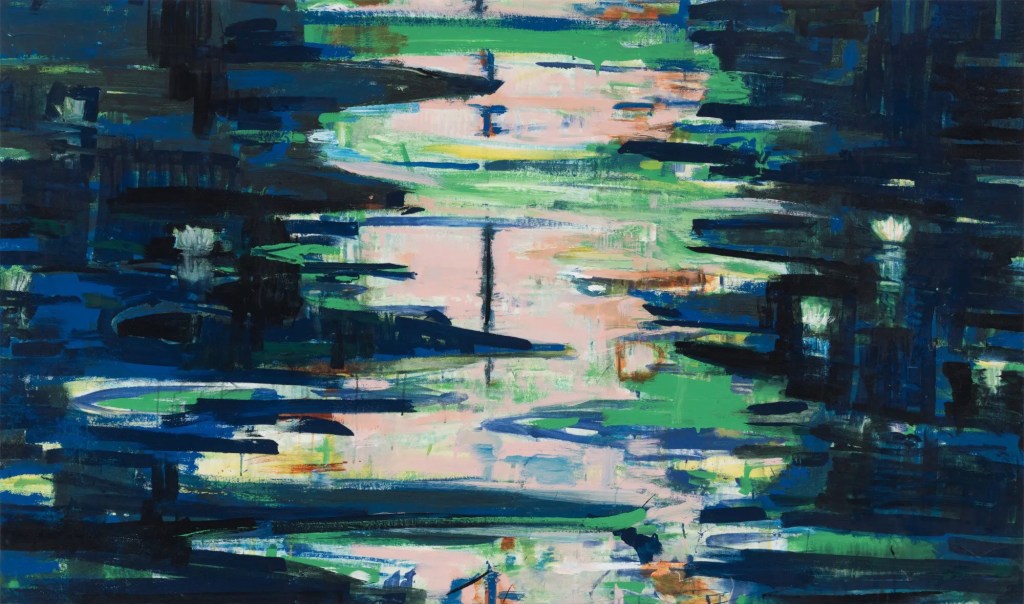
Cy Gavin, “Untitled (Grass growing on a weir),” 2022… Credit…via Gagosian; Photo by Rob McKeever.

“He’s showing us in the natural world our own inner landscape,” said [collector Bernard] Lumpkin, who owns four Gavin canvases. “When you’re inhabiting a painting by Cy, you’re inhabiting a world which is simultaneously strange and familiar; real and surreal; local and foreign.”

(Robin Pogrebin, “A Modern Take on the Hudson River School Tradition,” New York Times, 2-1-23)

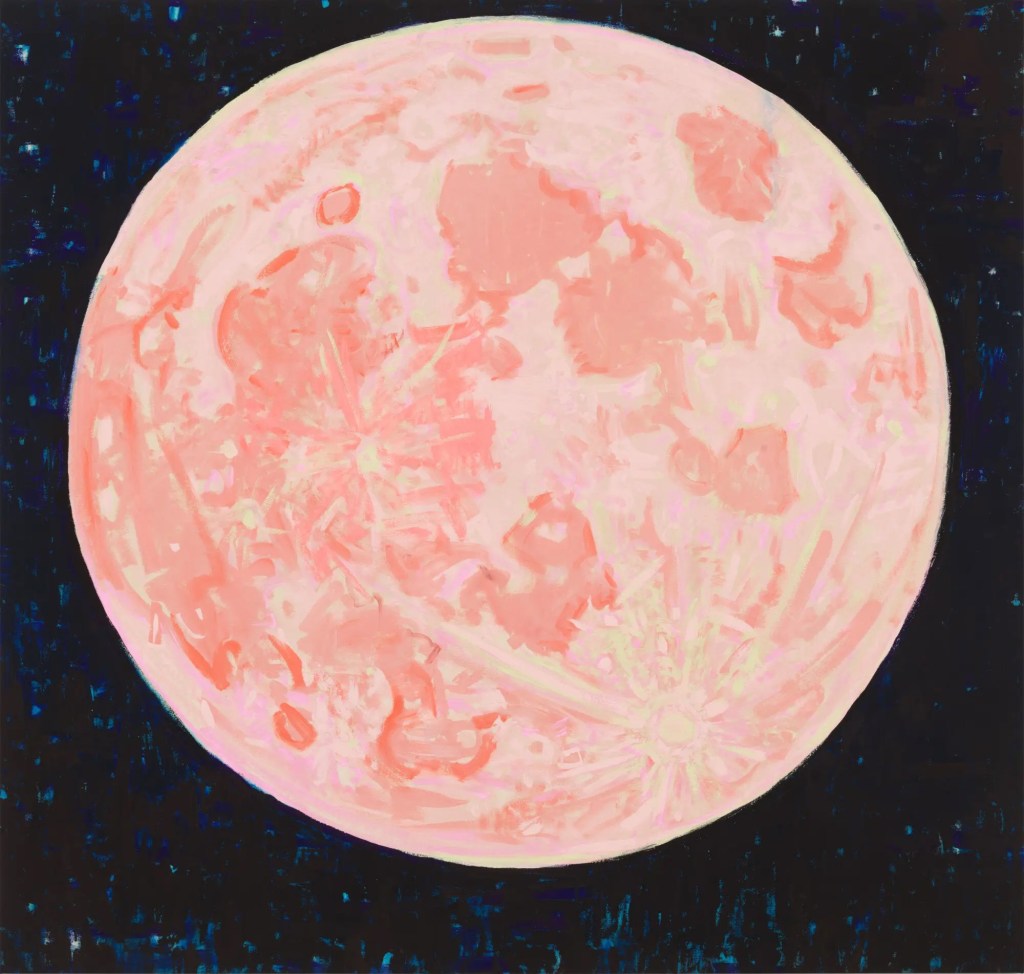
Cy Gavin, “Untitled (Moon),” 2022. Credit…via Gagosian; Photo by Rob McKeever.

The manscape I inhabit’s belly button is simultaneously inward and outward.

(c) 2023 JMN — EthicalDative. All rights reserved
Posted in Commentary, Quotations | Tagged , , , , | 1 Comment

Verse from Two Directions

“I tire of being made to feel smart rather than pleased.”
(Peter Schjeldahl)

1. Online

One finds lineated speech flowing freely, touching on themes of love, nostalgia, rage, nature, disillusionment, mortality and healing. There’s earnestness, the odd hard edge, whiffs of crypticism, irony, humor… It’s like wading in a limpid pool of collective versifying. The impulse to make words march in formation to boost their signal and focus the mind or incite passion must be ingrained in our species.

2. Poetry Magazine

Screened by the magazine’s professional readers (see note), the verse served up by Poetry is of a sort that exacts bemused pondering. A session with the journal is like wading into a murky pool of uncertain depth. You can’t see the bottom. RESOLVED: In 2023, I’ll read each issue entirely before the next one arrives. If I glimpse poetry in a text I’ll visit with it, let it work on me; if not, tant pis, moving on. There’ll soon be a new volume coming down the pike from Superior Street.

Note
Editorial: Adrian Matejka, Lindsay Garbutt, Holly Amos, Angela Flores, Jeremy Lybarger, Shoshana Olidort, Winshen Liu.
Readers: Sarah Ahmad, Noah Baldino, Whitney Devos, Jenna Peng, Naima Yael Tokunow.

(c) 2022 JMN — EthicalDative. All rights reserved
Posted in Commentary | Tagged , , , | Leave a comment

‘Cucumber Sandwiches. Season with Pepper Apparently’

My title is, in full, a text message received from a correspondent in early morning with no context. I read it silently then more attentively aloud. With growing alarm I realized it was a perfect dactylic pentameter.

Rubbing sleep from my eyes I laughed bitterly. My correspondent, I surmised, had been infected with the doggerel virus I carry. No one is safe from me, I brooded.

I do my utmost to confine my speech and writing to prose, yet the malign affliction will out itself in verses one way or another. Usually they are mine and easily dismissed; it’s concerning when the contagion leaps across space and time from me to an unsuspecting interlocutor who themselves suffers a verse eruption.

The hoped for outcome is that my fears are unfounded, the ominously rhythmic message was accidentally lyrical, related to an exchange about food, and not a symptom of wasting poesy onset.

(c) 2023 JMN — EthicalDative. All rights reserved

Posted in Commentary | Tagged , , , | 2 Comments

The French Are Okay with Being ‘The French’

“We recommend avoiding general and often dehumanizing ‘the’ labels such as the poor, the mentally ill, the French, the disabled, the college educated.”

(Tweet from The Associated Press Stylebook)

How “the French” constitutes a “label” left many French people mystified. It is simply who they are… Certainly, no French diplomat has ever complained that being called an envoy of “the French” was somehow dehumanizing. In fact, the French rather like being stereotyped as the French, if that is the issue. They undergo Frenchness with considerable relish.

(Roger Cohen, “The French Want to Remain the French,” New York Times, 1-27-23)

(c) 2023 JMN — EthicalDative. All rights reserved

Posted in Quotations | Tagged , , , | Leave a comment