
Given the exiguous outbound appeal I muster, I work hard at not being longwinded. I revel, though, in venting puffs of comment on my adventure with Arabic and its poetry.
A.J. Arberry’s essential anthology of 31 poets spans a period from mid-6th-century A.D. until mid-20th-century. The British scholar’s slightly old-fashioned English translations (he calls al-Khansa’ a “poetess”) sit opposite the Arabic texts he scrupulously edited, providing strategic voweling and useful notes, references and biographies, not to mention a formidable introductory essay. The volume is a primer — and a crucial resource for me at this stage.
From schooling in Arabic that started adventitiously at the University of Barcelona and proceeded deliberately at UNC, I’m in reasonable control of Arabic morphology and syntax despite a hiatus wasted in earning a mediocre living; I know enough for the incredible Wright’s grammar to be useful when needed. Building up recognition and recall vocabulary is the job now. It’s enthralling. Classical verses are packed like sticks of dynamite. I read them slowly and aloud, consulting Hans Wehr and Lane for voweling and meanings. I transliterate the verses, and I draw them. By then they’re largely memorized.

Arberry’s translations provide valuable guidance, but they aren’t the last word for me. I don’t contest them, of course; it’s simply that for their virtues of style and readability his versions don’t always track the Arabic as closely as I need. I want to own the verses in my personal English so as to feel I’ve caught what powers them in their element as best I can. Literal translations serve me more than literary ones.
(c) 2023 JMN — EthicalDative. All rights reserved




 EthicalDative
‘They Can Feel Almost Like Exquisite Texts to Be Read’
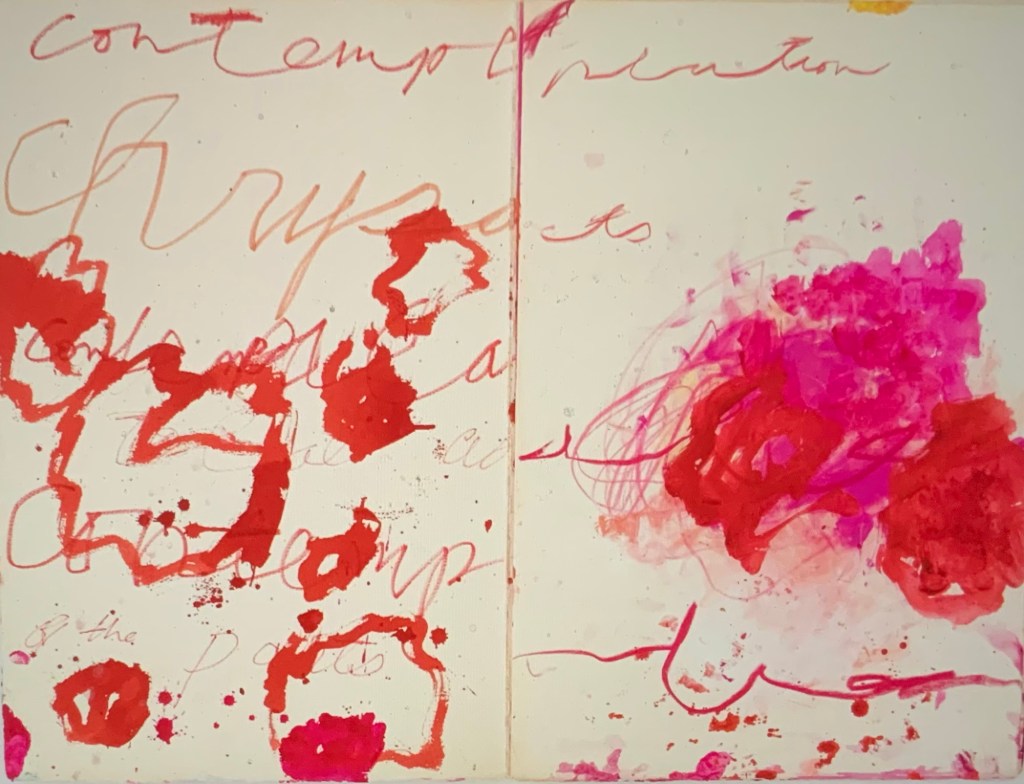
… Each [painting] presents so much information that you have to move in close for further contemplation and deciphering, trying to figure out how the paintings were made and which of their weird little details are accidental, which deliberate. They can feel almost like exquisite texts to be read [my bolding]. But instead of words, you follow painterly events of different sizes; one color gives way to another; smooth passages blur adjacent colors and then break apart into patchy areas that resemble reptile skin or tiny islands that expose multiple layers of color. Sometimes the blue layer with which Richter usually starts a work is visible, or it may be scraped far down to reveal nearly bare canvas.
“Painterly events”! I found exhilarating the spectacle of a prominent art critic delving into the grit of paintings to probe their “information.” It reassures me that, analogously, my reflex to decipher verse at a grammar level in pursuit of its “poetry” may not be goofy.
An interesting detail is that Richter, aged 85, says he finds painting tiring now and will devote his energies to drawing. His drawings slap me in the face with a reality that I struggle in all honesty to fathom, ratify and prosecute in my own trivial practice: Drawing is important; what you draw is not.
(Roberta Smith, “Gerhard Richter Rides Again,” New York Times, 3-16-23)
(c) 2023 JMN — EthicalDative. All rights reserved