Once Was Lost, But Now Is Found

Praxitella by Wyndham Lewis, who was the founder of the radical and short-lived Vorticist movement.

“We were flabbergasted. It has taken 100 years to rediscover Atlantic City.”

[Petulant style note: Equally flabbergasting is British journalism’s insufferable convention of not setting off titles with quotes or italics. What two researchers rediscovered was not the coastal city located in New Jersey, but a painting named “Atlantic City” by the artist Helen Saunders.]

Icily repellant, she’s fruit of the Tin Man’s dalliance with a galvanized hussy bucket. “Praxitella” of the ruby lips, faceted contours and catatonic gaze is a morose, Depression-era robot stitched in a tar paper frock with elephantine, copper-banded bloomers. She has the charm of a mud fence. It would take a hydraulic winch to hoist the lump of reductive figuration from her pharaonic chair.

Atlantic City by Helen Saunders, who was one of only two women to join the vorticists. “A black and white image of the painting appeared in Blast, the avant garde journal of the vorticists produced shortly before the outbreak of the first world war.”

Wyndham Lewis’s portrait of film critic Iris Barry is discovered to have been painted on top of a work called “Atlantic City” by fellow Vorticist Helen Saunders. He may have been irritated with Saunders.

An X-ray of Praxitella revealed uneven texture and glimpses of bright red through cracks in the surface paint.

(Harriet Sherwood, “‘Fit of pique’: lost vorticist masterpiece found under portrait by contemporary,” theguardian.com, 8-21-22)

(c) 2022 JMN — EthicalDative. All rights reserved
Posted in Commentary | Tagged , | 2 Comments

Bill Lynch Painted on Wood

… Untitled work by Bill Lynch painted on five planks. Photograph: Rob Harris/ Brighton CCA

“I realised that the art of the 20th century is the fruit of personal revelation,” Lynch wrote, “while ancient art is the product of mystery initiation.”

I’ve no idea what Bill Lynch (1960 – 2013) meant by his incantation about the meaning of art, using words ending in -ation. The journalist isn’t helpful in contextualizing the comment, writing only that it’s “taken from a letter to a friend in the 1990s.” She adds, “It is surprisingly hard to discover very much about him… He died of cancer aged 53, but his inner life appears private, unknown even to the curator of this show.”

Four Corners Sunset, 1994, by Bill Lynch. Photograph Bob Harris / Brighton CCA.

Born in Albuquerque, Lynch studied art at Cooper Union in New York, lived in California for a time, and ended up in Raleigh, North Carolina.

Untitled by Bill Lynch. Photograph Bob Harris / Brighton CCA.

Old plywood, used planks, the top of a table pocked with woodworm: he found a way of painting on this hard and resistant substrate as if it were as light as parchment. And his brushwork, moreover, is rightly described as calligraphic. Owls, hawks, tangled blossoms, the pale discs of honesty seeds hanging like silver moons from skeletal black boughs: his art has all the delicacy of nature, combined with a swirling, stuttering, sometimes wayward abruptness.

Still Life With Milkweed Seed, undated, by Bill Lynch. Photograph Bob Harris / Brighton CCA.

(Laura Cumming, “Bill Lynch: The Exile of Dionysus review — the greatest American artist you’ve never heard of?” theguardian.com, 8-21-22)

(c) 2022 JMN — EthicalDative. All rights reserved

Posted in Commentary, Quotations | Tagged , | Leave a comment

On Saying and Meaningness

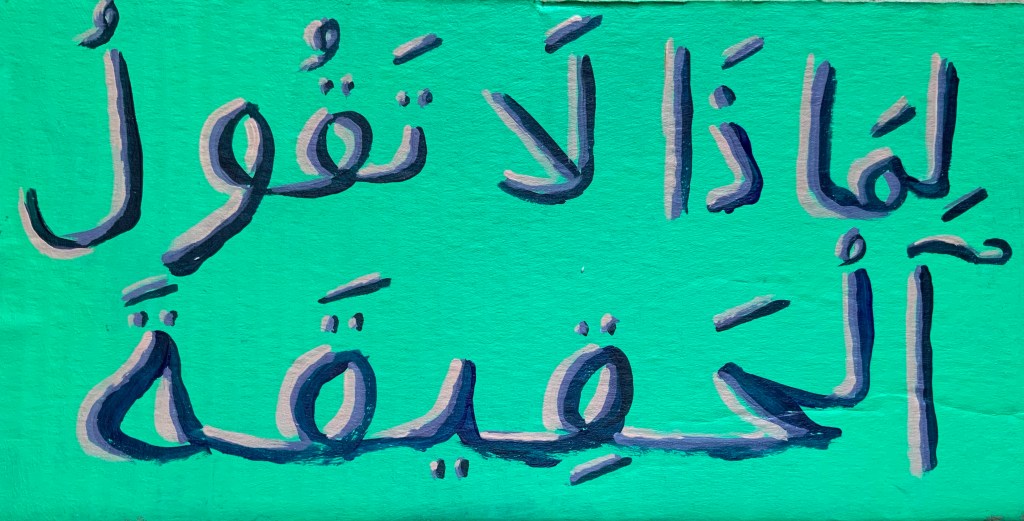
‘al-bidāyaẗu-l-mafqūdaẗu, The Lost Beginning

I painted it all tried to paint my thoughts / And caught so little / The world still grows it grows relentlessly / And yet there is always less of it
(From “The Old Painter on a Walk” by Adam Zagajewski, translated from the Polish by Clare Cavanagh, The New Yorker, 11-21-22)

Poetry! How do you translate it? I don’t know a word of Polish, but surely translator Clare Cavanagh has tapped transmissible gold from Adam Zagajewski’s poem? Look alone at how the transgressive run-on sentences evoke a perception of headlong welter!

Does winkeling out what a poem says shed light on what it’s “about”? A poet may say, “You’re asking the wrong question; the poem is about what it says. Just feel the burn, revel in the mystery!” Perhaps followed by tips on “how to read poetry.” My dinghy sails past these rodomontades with me lashed to the mast. Words that aren’t more than the sum of themselves are forgettable, and my project is to remember them.

Part 2 of Gilgamesh’s Snake (1) is titled ‘al-bidāyaẗu-l-mafqūdaẗu: “the beginning the lost,” i.e., The Lost Beginning.

(1) O master,
‘ayyuhā-s-sayyidu
Master!
(2) don’t write history for nothing(ness).
lā tū’arriẖ li-l-^adami
Don’t write histories for no reason.
(3) Don’t say came who came
lā taqul jā’a man jā’a
Don’t talk about someone arriving
(4) and left who left.
wa ḏahaba man ḏahaba 
and someone else going away.
(5) Don’t draw back from eternity
lā takšif ^ani-l-ẖulūdi
Don’t let anyone glimpse that white shadow
(6) your pale essence.
huwīyaẗa-ka-l-bāhitaẗa
called Eternity, which you cast.

Verses 5 and 6 say, “Don’t draw back from eternity / your pale essence.” Verb kašafa with preposition ^an means to draw back something like a curtain or veil, thus laying bare what it conceals, which in this case is “eternity” — ‘al-ẖulūd. The “curtain” sought by the speaker not to be drawn back is the apostrophized master’s “pale essence.” He’s a historian. In the Glenday-Iskander version (italicized), the historian’s pallor colors eternity, which is the shadow he casts. This gussies up an obscure conceit with razzmatazz, which may fit Borges’ notion that “a translator should seek not to copy a text but to transform and enrich it.” (2) But it’s also Transgressive. (3)

Postscript: I can’t stop fidgeting over that odd comma casting its shadow in verse 6.

Post-Postscript: I need a good calligraphy brush. The paintbrushes I improvise with splay and fudge the script hideously. I’m discovering that a brush is like string: you can pull, but not push it.

Notes
(1) Gilgamesh’s Snake and Other Poems, Ghareeb Iskander, Bilingual Edition, Translated from the Arabic by John Glenday and Ghareeb Iskander, Syracuse University Press, 2015. In text citations, the published translation is in italics beneath my literal rendering and transliteration.
(2) Jiayang Fan, “Han Kang and the Complexity of Translation,” The New Yorker, 1-8-18.
(3) My invented labels are Congruent (matches the source text fairly closely, with minimal liberties taken for readability); Omissive (suppresses elements of the source text without obvious justification); Expansive (adds interpretive structure or content not discernible in the source text but plausibly deriving from it); Inventive (carries the “expansive” element to a level not obviously supported by the source text); Transgressive (departs from the source text in a way that seems to betray the poem’s letter or spirit).

(c) 2022 JMN — EthicalDative. All rights reserved
Posted in Anthology | Tagged , , , | Leave a comment

Sensing the Presence of Vinegar: Food Poetry

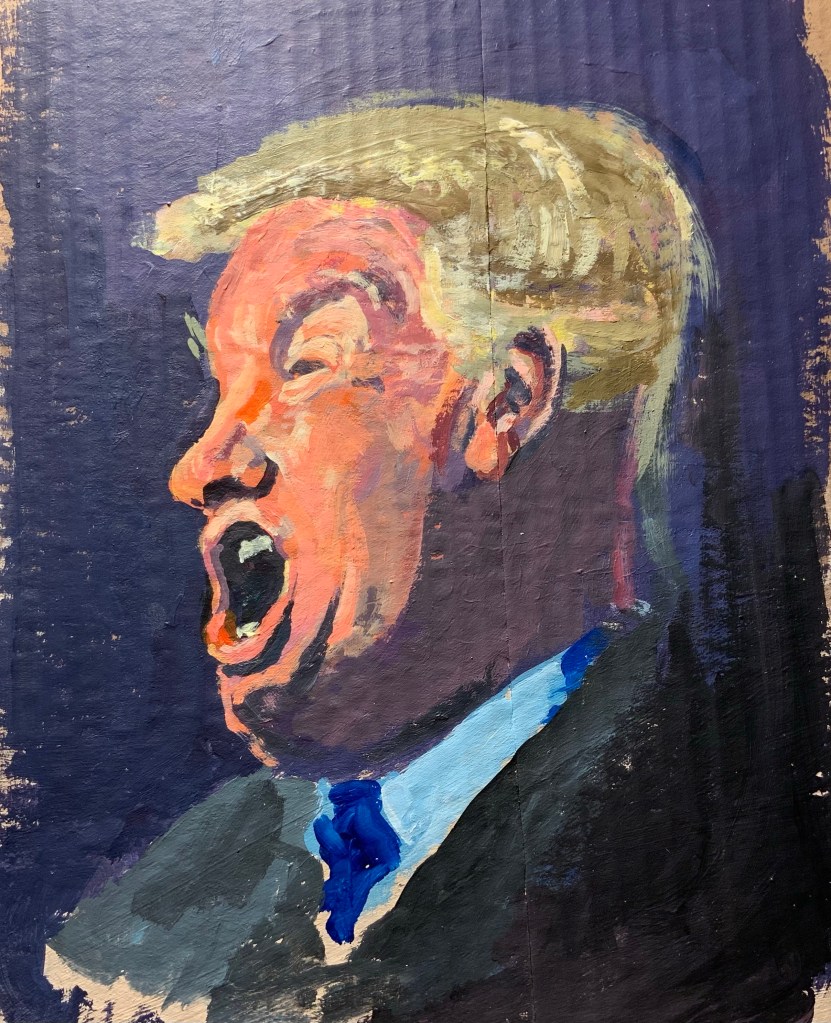
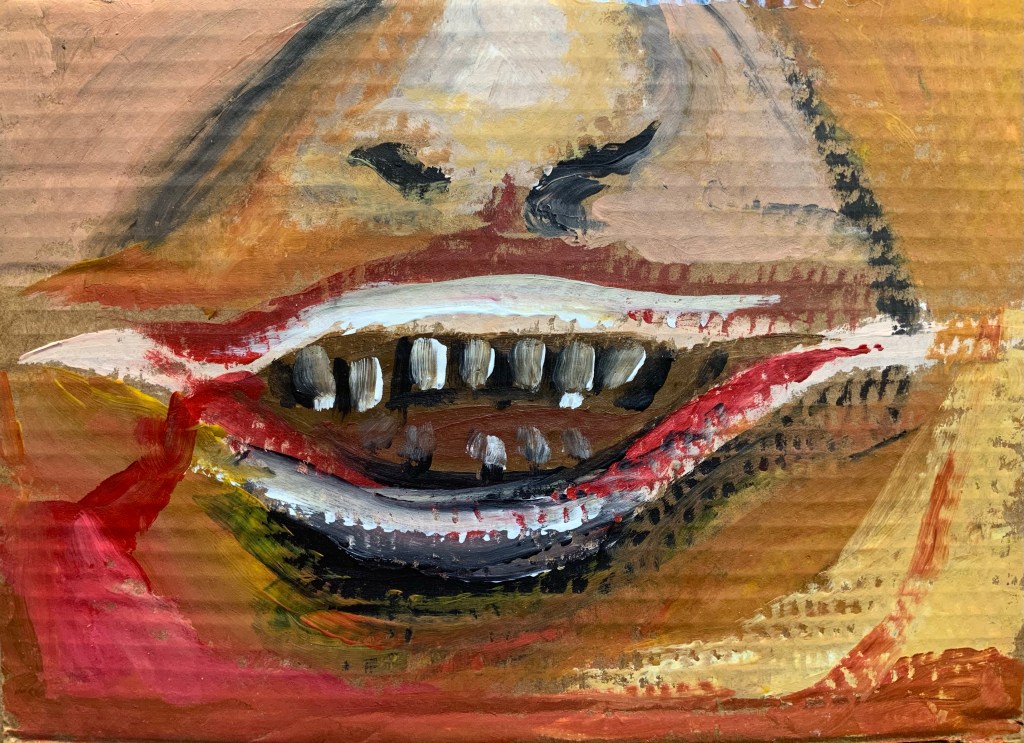
Acrylic on cardboard. “Yoshino may be the only restaurant in New York that will slip cod semen into the middle of a very expensive tasting menu.”

(A squalid detail to put behind us: “vichyssoise” is misspelled in the review as “vichysoisse.” Slipshod, to be sure, but my esteem for Pete Wells’s writing remains intact. Even Homer nodded.)

Pete Wells said once that when he became restaurant critic for The New York Times he resolved not to write about food in a hackneyed way. Wells doesn’t seek umpteen ways to say a dish tastes good or lousy. That would be all about him and his feelings. He skirts foodie raptures as resolutely as poets shun sunsets.

— … Two mini-slabs of monkfish-liver terrine… are impossibly soft for something that has edges and corners.
— … Karasumi, mullet roe that is salted, pressed and aged into something that tastes like fish-egg ham.

What telegraphs the passion is disdain for low-hanging ecstasies in favor of down-and-dirty detail. Close naming of ingredients, process, presentation and ambience serves to instantiate food in a gustatory headspace shared with the reader, who stands to attention as if summoned by bugle before mysteries such as monkfish liver and cod semen.

— In late fall and into the winter, there may be shirako, sacs of cod milt in loose white coils over ponzu sauce.
— The rice will be just sticky enough to hold together for a few seconds on its way to your mouth. It will be just tart enough that you can sense the presence of vinegar without quite tasting it.

(Pete Wells, “Restaurant Review: Four Stars for Yoshino, Where the Omakase Stands Alone,” New York Times, 11-15-22)

(c) 2022 JMN — EthicalDative. All rights reserved

Posted in Commentary, Quotations | Tagged , , , , , | 2 Comments

Less Democrazy, More Malumacy: El señor Fútbol señala al insigne artista colombiano

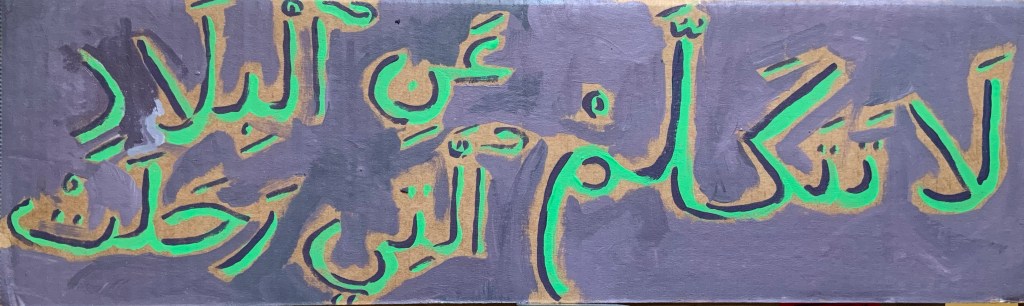
Acrylic on cardboard. ‘iḏā-l-mar’u lam yadnas mina-l-lu’mi ƹirḍu-hu / fa-kullu ridā’in yartadī-hi jamīlu (As-Samaw’al ibn ƹādiyā’)

“I will say something which is crazy, but less democracy is sometimes better for organizing a World Cup. When you have a very strong head of state, that is easier for us organizers.”

(FIFA secretary general Jérôme Valcke, 2013)

Nota Bene: The style of the benemérito presidente of the Fédération Internationale de Football Association (FIFA) is “His Excellency.”

(c) 2022 JMN — EthicalDative. All rights reserved

Posted in Quotations | Tagged , | 2 Comments

Is Soccer Sick? I Keep Hearing of Catarrh

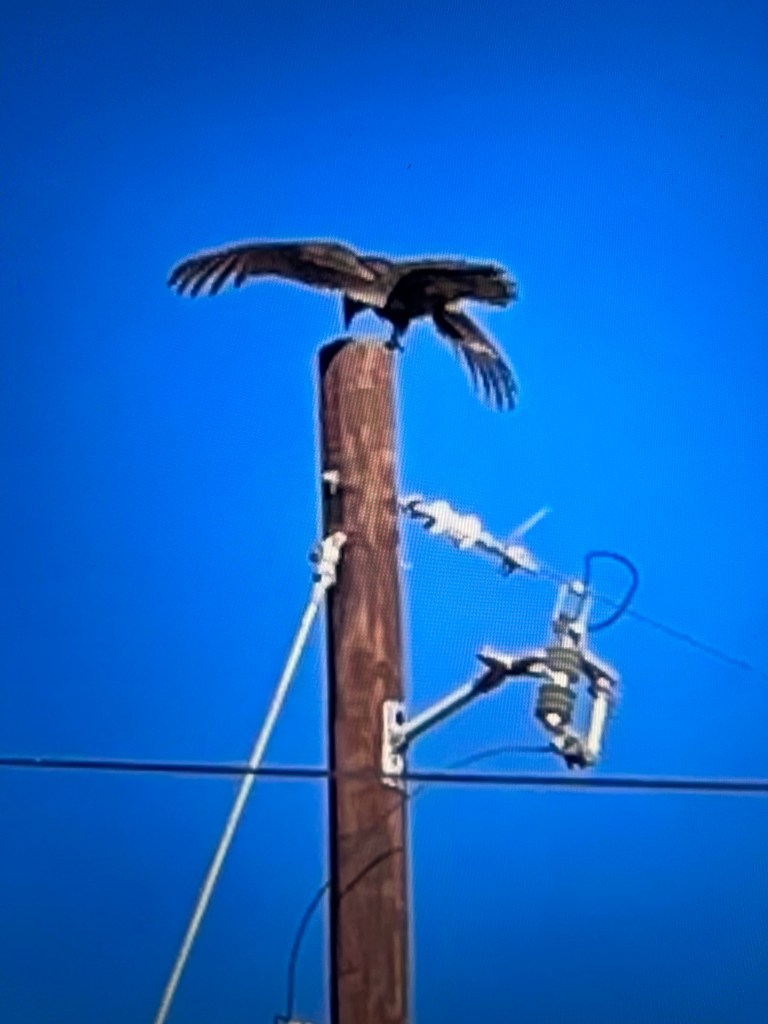
Acrylic on cardboard.

“We all have difficult lives…”

(Infantino)

Bent like Beckham, rich as Croesus.
This Bud’s for you, now let ‘em fleece us.
He marinated in the sauce,
pronounced himself the biggest boss.
“I’m fed up with your utter gall.
Zip it now and kick the ball.”

The arc of history tends to rhyme:
Look away, there is no crime.

Postscript: Breaking news from Colorado Springs, USA. Massacre at a gay club: 5 dead, 18 wounded, and counting.

(c) 2022 JMN — EthicalDative. All rights reserved
Posted in Commentary | Tagged | Leave a comment

Rock ‘Em Sock ‘Em Sober Soccer

FIFA’s president, Gianni Infantino, during his pre-World Cup news conference on Saturday in Doha, Qatar. Fabrice Coffrini/Agence France Presse — Getty Images.

“I feel 200 percent in control of this World Cup.”

(FIFA lord Gianni Infantino)

With four games per day in the opening group stage, all played in what is effectively a single city-state, Infantino said the movement of large groups of fans within such a compact environment carried greater risks if they were fueled by beer.

(Tariq Panja, “On Eve of World Cup, FIFA Chief Says, ‘Don’t Criticize Qatar; Criticize Me,’” New York Times, 11-19-22)

Two-hundred-percent control is a lot of clout. History is on Infantino’s side. Booze is recorded as uncorking a bit of hyper fan-zest in annals of the beautiful game.

(c) 2022 JMN — EthicalDative. All rights reserved

Posted in Quotations | Tagged , , | Leave a comment

Hardcore Arabic: ‘Treble Formation’

firaq(un), ‘afrāq(un)

The language has astonishing sweep and granularity that are explicit and penetrative to a degree redolent of lore and legend. The open-sesame to Arabic’s magic for this English speaker is Wright’s majestic grammar. (1) Here, of an early morning on this date in this place, settling with a mug of coffee and oat milk into my ongoing tour of the broken plurals, I encounter the following:

“Sometimes there is even a treble formation; firqaẗ(un), a band, a party or sect…”

The “treble formation,” meaning the three possible plurals for the term, are: firaq(un), ‘afrāq(un), ‘afārīq(un).

‘afārīq(un)

Wright continues:

“Such secondary plurals can be properly used only when the objects denoted are at least nine in number, or when their number is indefinite.” (1)

“Properly used”: be still my heart. What this rule has in common with poetry is that it seduces with strangeness, yet eludes unspooling into paraphrase and applicability. What exactly are the “objects” to be counted? Bands themselves, or the individuals comprising them? But does it matter? What’s gleaned about another language culture’s approach to multiplicity is glorious: To describe several of a thing is contingent on the measure of its more-than-oneness.

It’s possible that Wright’s record on this point, as on others, is archaeological; the linguistic fact, however, and the wonder of it, stand recognized and felt. It broadens the mind and quickens the sympathies to take note of distinctions that fellow humans have made, and do make, in talking about their world.

Notes
(1) W. Wright, A Grammar of the Arabic Language, Simon Wallenberg Press, 2007. Reprint of the classic work first published in 1874, and updated in 1896, ii, 232, D.
(2) My character set is this: ‘ a ā A i ī u ū ay aw b t ẗ ṯ j ḥ ẖ d ḏ r z s š ṣ ḍ ṭ ẓ ^ ḡ f q k l m n h w y

(c) 2022 JMN — EthicalDative. All rights reserved

Posted in Commentary, Quotations | Tagged , , , , , | Leave a comment

View from the Low Side of Town

Acrylic on cardboard.

My illustration is an abstraction derived from the layout of structures and spaces on my squat down by the Big Muddy. The turgid Waddy Loopy is a conduit of Texas Hill Country drainage that lumbers past me on its way to do a bay dump south of here. (See note.)

What a body wanted for his abstraction was clout: hard-edge pigment-power with boss saturation. What a body got was the loose-goose-dookie translucency of tinted water, aka acrylic. Fool, gesso up the cardboard first! Ignore that voice. The point of smearing cardboard is to smear cardboard.

Note
Say “waddy” in Arabic, you’ve said the word for “river valley.” Guadix, Guadiana, Guadalquivir, Guadalete, Guadarrama, Guadalajara, Guadalmena, and yes, Guadalupe are rivers in old Spain. The “lupe” part may be from Latin “lupus” for “wolf,” a mashup from the elbow-rubbing of Semitic and Latin dialects in the good olde tymes. I christen my river The Guadalobo. The etymology has the pleasantly bogus plausibility of popular wisdom.

(c) 2022 JMN — EthicalDative. All rights reserved

Posted in Commentary | Tagged , , | 2 Comments

The Charm of Sharm Is Lost Upon the Gentleperson from Sweden

Sharm el-Sheikh.

“It’s like being in Las Vegas, but somehow worse.”

(Swedish COP27 Delegate)

It’s possible the fossil-lobby-infested, desultory yak-a-thon held at a glittering tourist watering hole in The Tonino Lamborghini International Convention Center — let me repeat that for its delicious music: The Tonino Lamborghini International Convention Center — will sing from the same hymn sheet as the previous 26 COP-outs. The name of the tune is “What Happens in Sharm el-Sheikh Stays in Sharm el-Sheikh.”

Even the cloud cover of a sickened planet can have its silver lining, however. This one is the opportunity afforded to learn more Arabic, ever to be seized upon by your humble blagueur who is devoted to the monuments of poetry in this “infinitely rich and highly articulated language” of “a people so conservative and tenacious of antiquity as the Arabs.” (1)

The verb šarama (yašrimu) means to split, slit or slash something. Its verbal noun šarm (pl. šurūm), meaning cleft, crack, split, rift, slit, slot, can also be taken as a “cleft,” etc., in a coastline, hence the extended sense of small bay, inlet.

The title šayẖ (pl. šuyūẖ, ‘ašyāẖ, mašyaẖa(ẗ), mašāyiẖ, mašā’iẖ) comes from verb šāẖa (yašīẖu), to grow old, attain a venerable age. Hans Wehr’s first translation for it is an elderly, venerable gentleman. It has wide application as an honorific in various guises across the Arabic-speaking world. Sheik, adopted by English, is one of the 13 possibilities listed by Wehr.

Sharm el-Sheikh.

So in šarmu-š-šayẖi, which is “Sharm el-Sheikh” transliterated with case endings and the definite article assimilated to the sun letter, we have initially “the small bay of the elderly, venerable gentleman.” Shall we Vegas-ize Sharm el-Sheikh and call it “Sheik’s Cove”? Cocktails at 5 in the Rudolph Valentino Room. (2)

(“‘Like Vegas, but worse’: Sharm el-Sheikh fails to charm COP27 delegates,” theguardian.com, 11-11-22)

Notes
(1) The words are those of Sir Hamilton Gibb and R.A. Nicholson, respectively, quoted by A.J. Arberry in the introduction to his Arabic Poetry: A Primer for Students, Cambridge University Press, 1965.
(2) An old rule of proper composition says you shouldn’t number your notes unless you have more than one. Here’s the second note.

(c) 2022 JMN — EthicalDative. All rights reserved
Posted in Commentary | Tagged , , | Leave a comment