Rosalyn Drexler’s “Cigarette Smoking May Be Hazardous to Your Health” (1967) in a show at the David Nolan Gallery focusing on four female art dealers who helped shape the scene on the Upper East Side. Credit… Garth Greenan Gallery.
Rosalyn Drexler’s elegant painting, “Cigarette Smoking May Be Hazardous to Your Health,” is stuck with a lumbering title but sings, nevertheless. I would give it a chill name such as “Composition in Vermilion on Black,” or one with saucy innuendo like “Afterglow.”
Alex Katz, “February” (1963). Katz was represented by Eleanor Ward at her Stable Gallery. Credit… Peter Blum Gallery.
Alex Katz’s “February” is, according to the reviewer, “an all-gray, poetic painting of a tall window in an empty room.” I couldn’t have said it better, but the painting says it best.
Both works have qualities I most admire and miss in my own efforts: terseness and audacity.
(Deborah Solomon, “Mad for Art: A Look Back and Up the Avenue at Women Gallerists,” New York Times, 10-6-22)
I shove off in the El Toro dinghy of my dreams to navigate Gilgamesh’s Snake (1), sailing on a sea of Arabic towards a far shore, which is the poem’s end.
Ghareeb Iskander’s poem has 5 parts:
I. Song II. The Lost Beginning III. Something Began to Talk IV. How Will I Ever Write About It? V. Conclusion.
Fool in a dinghy on open water: what could go wrong? Plenty, but I have a map for reference: the English translation made by John Glenday and Iskander. That translation commands respect, not least because of the poet’s collaboration in it. Dissecting it in a spirit of inquiry pays tribute to it. Treating it as unquestionable, however, is to forego a voyage of discovery. Out of the question.
I’m keen to observe how the published translation does or doesn’t corroborate my own reading of the Arabic original. I’ll accord the Hans Wehr dictionary (2) the status of lexical benchmark for the purposes of my adventure. Doing so is a confessedly arbitrary expedient whose justification is easiest to show with an example. (The citations consist of my translation and transliteration followed by the published translation in italics.)
‘Song,” the short poem that inaugurates the sequence, begins as follows:
I supply most of the diacritics in my handwritten copies of the text.
I. Song [‘uḡnīyaẗun] Song
He sang every thing: [ḡannā kulla šay’in:] He sang the sum of things:
sang the sleeping pavements [ḡannā-l-‘arṣifaẗa-n-nā’imaẗa] the drowsing pavement,
and the strange dawn. [wa-l-fajra-l-ḡarība.] the unfamiliar dawn.
Here is Wehr’s listing of meanings for ḡarīb, the descriptor of “dawn”:
In the listing, commas separate words considered synonymous; semicolons signal a new semantic range. Note that “strange” occurs twice. “Unfamiliar,” used in the published translation, doesn’t occur at all, but seems a plausible alternative to “strange.”
For a translator synonyms are not interchangeable. This may be especially true of poetry, where connotation is magnified through concentration. Consider how different options from the Wehr listing color each “dawn” uniquely:
the alien dawn; the quaint dawn; the peculiar dawn; the grotesque dawn…
To be continued.
—————
Notes
(1) Gilgamesh’s Snake and Other Poems, Ghareeb Iskander, Bilingual Edition, Translated from the Arabic by John Glenday and Ghareeb Iskander, Syracuse University Press, 2015.
(2) Hans Wehr, A Dictionary of Modern Written Arabic, edited by J Milton Cowan, Cornell University Press, 1966. [From the copyright page: “This dictionary is an enlarged and improved version of ‘Arabisches Wörterbuch für die Schriftsprache der Gegenwart’ by Hans Wehr and includes the contents of the ‘Supplement zum Arabischen Wörterbuch für die Schriftsprache der Gegenwart’ by the same author.” From Cowan’s preface dated 1960: “… [This edition] is more accurate and much more comprehensive than the original version, which was produced under extremely unfavorable conditions in Germany during the late war years and the early postwar period.”]
“Knowing truth is important. Right and wrong are truth, not feelings. And they are the same for everyone. Our creator is the source of the rules for right and wrong and they come from his character.”
(Member of the public library advisory board)
Citizens appointed by local government are policing which books held in the public library can be read by children. The local newspaper documents offending titles, along with the censor’s comments about each book. Reported summaries and excerpts of comments follow.
“Sex Is a Funny Word,” by authors Fiona Smyth and Cory Silverberg “‘Introduce[s] ideas about sexuality, transgenderism and sexual activity… Would ‘cause confusion for children who read it and put sexual ideas that they are not mature enough to handle.’”
“Making a Baby,” by authors Rachel Greener and Clare Owen “…Illustrations of White and racially mixed gay, lesbian and straight couples with children… ‘The pictures of naked adults and the sex act are not age appropriate for children….’”
“Queer: The Ultimate LGBTQ Guide for Teens,” by authors Kathy Belge and Marke Bieschke “If a teen is confused about their sexuality (the book) may cause them to embrace a lifestyle they may regret… A public library should… refrain from opening doors to children that should not be opened.”
“Red: A Crayon’s Story,” by author Michael Hall “Ideas of transgenderism [are] damaging… ‘It could twist the cognitive learning development in a child.’
“Teens and LGBT Issues,” by author Christine Wilcox “‘…Boys who are sexually abused by men want to get rid of their genitalia because in their mind they feel like if their genitalia is gone they won’t be sexually abused again… Girls who are sexually abused often want to become boys as a way to show power so they will be feared… Why would we want this deviant behavior to mold and shape the minds of our youth?’”
(Tamara Diaz, “3 city approved library board members filed LGBTQ book complaints,” http://www.victoriaadvocate.com, 9-22-22)
Working head of state one day, gone the next. Sic transit gloria. An adoring contingent of Great Britain has lately felt its feelings in splendid public fashion for a queen whose reign exceeded average life expectancy in most of the world.
Shed of mourning now, the kingdom is abuzz over something known as the quasi-quatrain and a mysterious “physical event” connected to it.
We who closely follow prosodic events in the UK are keen to know more about a thing conjecture dictates plausibly to be some cuadri-partite stanzaic verse scheme, formally crippled by design, perhaps, in the manner of the Spanish pie quebrado, or “broken foot,” conceivably an epic form for singing exploits of the elderly new monarch, easily supposed to have been culled from some ancient manuscript lodged in a rustic chapel nestled in the Pennines, and which ostensibly is garnering excited comment on this auspicious dawning of the second Carolean epoch.
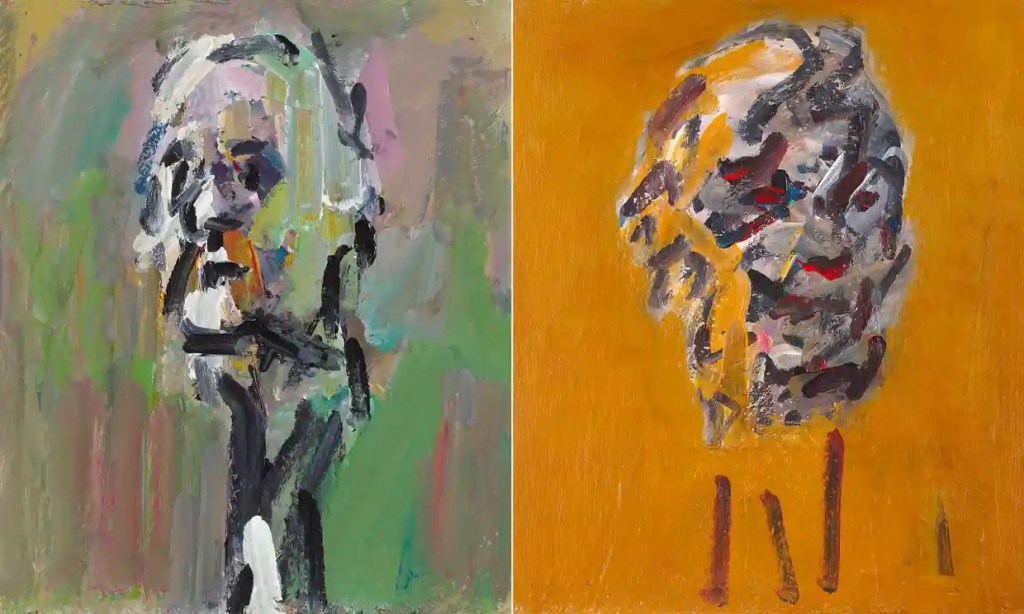
Two self-portraits by Frank Auerbach painted during the pandemic. Photograph: Frank Auerbach.
“In his view, painting and drawing are exactly the same difficulty and take roughly as long as each other.”
(William Feaver, art critic and one of Auerbach’s regular sitters)
Asked whether he has learned something new about his face, [Auerbach] said he has never thought in verbal, emotional or psychological terms about his subjects as that “undermines what one is doing.”
I’m simply trying to use the subject to make an image of my impression of it.”
(Frank Auerbach)
Auerbach’s commentary on his practice strikes me as state-of-the-art language concerning what picture making can be about.
(Dalya Alberge, “Frank Auerbach: how artist drew himself for Covid ‘plague years’ drawings,” theguardian.com, 9-18-22)
Opposite a vaguely anthropomorphic shape etched on the menhir’s side lies the squiggle. Angel Castaño, a philologist, believes it depicts the contours of the Tagus River before the hydroelectric dam was built. “The menhir may be the oldest realistic map in the world,” he says.
Primitiva Bueno Ramírez, an archaeologist, demurs. “The hypothesis of a map is based on a pareidolia,” she says. Dr. Bueno notes that the geometric squiggle resembles “twisty markings” widely found in European megalithic art. Her conclusion: It’s a snake.
“Pareidolia”: the tendency for perception to impose a meaningful interpretation on an ambiguous visual pattern.
A megalithic archaeological site has been exposed by drought in Spain. Some 2,000 years older than Stonehenge, the Bronze Age sepulcher was deliberately flooded in 1963 as part of a rural development project.
Like the skeleton of an extinct sea monster, the Dolmen of Guadalperal has resurfaced from the depths of the Valdecañas reservoir in western Spain…
No, no, no, Franz Lidz. Not “extinct,” not the “sea,” not a “monster.” The great-great-grandmother of the Anglian pile is alive and well in Iberia. She has shrugged off her manmade puddle to remind men that man’s a speck on the planet, a booger in its nostrils, flicked away sooner than not, who knows for the better.
Also, to whisper to the wind, “Friend, hard weather’s ahead.”
Free expression isn’t just a feature of democracy; it is a necessary prerequisite.
(Editorial Board, “Censorship Is the Refuge of the Weak,” New York Times, 9-10-22)
No big deal. Just a nicety of style, a peccadillo none but the persnickety rhetorician besotted with the jots and tittles of messaging has the effrontery to bust a potshot on. But the New York Times, a bastion of style and clarity, well merits being held to high account.
With the phrase necessary prerequisite, the journal steps in the same puddle of fudge that slathers our palaver with shambling redundancies such as free gifts and viable alternatives. If not free, not a gift; if not viable, not an alternative; if not necessary, not a prerequisite.
The point remains: Clear, true speech is the hill that democracy must choose to die on.
“We have to change our mentality so that eating a barbecued entrecôte is no longer a symbol of virility… If you want to resolve the climate crisis, you have to reduce meat consumption, and that’s not going to happen so long as masculinity is constructed around meat…” (Sandrine Rousseau, French Green Party MP)
“Stop this madness!”… “That’s enough of accusing our boys of everything!” (Eric Ciotti, Nadine Morano, members of the Gaullist Republicans party)
“Meat consumption is a function of what you have in your wallet, not in your panties or your underpants… A good wine, good meat, good cheese, that is French gastronomy… What are we going to eat? Tofu and soy beans? Come on!” (Fabien Roussel, secretary general of the Communist Party)
“There’s a difference between the sexes in the way we consume meat, and people who decide to become vegetarians are mostly women… So if we want to go toward equality we have to attack virilism.” (Clémentine Autain, lawmaker with the Unbowed party)
“It’s not virilism, it’s nature.” [Julien Odoul] vowed to pursue a “Cro-Magnon diet”… (Julien Odoul, member of Marine Le Pen’s far-right National Rally)
(Roger Cohen, “Of Barbecues and Men: A Summer Storm Brews Over Virility in France,” New York Times, 9-5-22)




 EthicalDative
Built Tough
(Jamelle Bouie, “This Is What Happens When … ,” New York Times, 10-11-22)
(c) 2022 JMN — EthicalDative. All rights reserved