Fanfare for the Arch and Monarchic Empyrean

For fanfaronnish, pharaonic, peerlessly peeraged personnages kitted, kilted, severely coiffed and balconic in presence, shod and booted in besotted opulence, blackamoorian brooched, got up in splendid headgear, lorded lads and ladied dames garbed in emblazoned berobement, none…

For sherlockian, sherwoodian, agathonian, haddlepudlian, level-uppity, ‘ello gaffer, day at the races, should I make a cheeky bet, dear olde — you know — not to make a fuss about but, end of, if-I’m-being-honesty, none…

For acid, Mr. Speaker-ish, his-honourable-gentlemanly annunciatory promulgations, retortive denouncements huffed in receivedly syllabic oratory bespoken to bewigged and vested Etonians lounged and draped and clubbed in hoary, leathery chambers and halls amongst antique appurtenances and shafty lighting, none…

For weather reports of “windy everywhere,” none…

… but the English.

(c) 2021 JMN — EthicalDative. All rights reserved

Posted in Anthology, Commentary | Tagged , , , , , , | Leave a comment

‘Cowards’ by Miguel Hernández

[Translator’s note: The blog of Andrés Cifuentes — Eco Social…Ojo Crítico (doff of cap to) led me to this poem by Miguel Hernández. It doesn’t soar as poetry, but it does register a raw and memorable cri de coeur. All translations fail, and mine does so by indulging in flights of paraphrase to offset the flatness of affect of the literal English. JMN]

Cowards
Men I see who of manliness
have none but what they flaunt,
the look and the Marlboro,
the britches and the beard.

At heart they are bunnies,
chickens in their guts,
hounds quick at crapping,
barkers in peace time
who in cannon season
vanish from the map.

These macho cottontails,
commissars of retreat,
hearing miles away
the thunder of bullets,
like matchless heroes
cut and run for the hills,
shitting explosively,
hair standing on end.
Bravely they take cover,
gallantly abandon
the blast radius,
these turds on the run
who’ve kicked for ages
my soul in the balls.

Where will you end up
that’s not dead, paleface rabbits,
untrustworthy curs
with extra paws?
Aren’t you ashamed to see
to this extent in Spain
so many steady women
under so much threat?
A bullet for every tooth
is what your life deserves,
cowards wearing coward hides
with reeds for hearts.
You tremble as if gripped
by a century’s worth of frost
and fade from sun to shadow
quaking in your boots.
For you a basement’s
undefended by its house.

Your yellow streak begs everyone
for battalions of walls
and lead barriers rimming
cliffs and trenches,
saving our threadbare lives
mired in gore and dread.
Not enough for you, defense
by showers of noble blood
shed unstintingly
abundant and warm
day in, day out,
onto Castilian clod.
You’re senseless to the calling
of the splattered lives.
To keep your pelts intact
burrows and dens won’t do,
not rabbit holes,
not toilets even, nothing will.
You flinch and flee, which gives
the people you turn tail on
just cause to drill
your disappearing backs with lead.

Only men alone remain
in the heat of battle,
and you, from far away,
try to rouge your infamy,
but the pallor of cowardice
will not wipe off your faces.

Keep standing your pathetic posts
over your pathetic cobwebs.
Swap your weapon for a broom,
and sweep with your ass cheeks
the caca you leave behind
wherever you set foot.

Wind of the People, 1937
Miguel Hernández
English version by JMN


Los cobardes
Hombres veo que de hombres
solo tienen, solo gastan
el parecer y el cigarro,
el pantalón y la barba.

En el corazón son liebres,
gallinas en las entrañas,
galgos de rápido vientre,
que en épocas de paz ladran
y en épocas de cañones
desaparecen del mapa.

Estos hombres, estas liebres,
comisarios de la alarma,
cuando escuchan a cien leguas
el estruendo de las balas,
con singular heroísmo
a la carrera se lanzan,
se les alborota el ano,
el pelo se les espanta.
Valientemente se esconden,
gallardamente se escapan
del campo de los peligros
estas fugitivas cacas,
que me duelen hace tiempo
en los cojones del alma.

¿Dónde iréis que no vayáis
a la muerte, liebres pálidas,
podencos de poca fe
y de demasiadas patas?
¿No os avergüenza mirar
en tanto lugar de España
a tanta mujer serena
bajo tantas amenazas?
Un tiro por cada diente
vuestra existencia reclama,
cobardes de piel cobarde
y de corazón de caña.
Tembláis como poseídos
de todo un siglo de escarcha
y vais del sol a la sombra
llenos de desconfianza.
Halláis los sótanos poco
defendidos por las casas.

Vuestro miedo exige al mundo
batallones de murallas,
barreras de plomo a orillas
de precipicios y zanjas
para nuestra pobre vida,
mezquina de sangre y ansias.
No os basta estar defendidos
por lluvias de sangre hidalga,
que no cesa de caer,
generosamente cálida,
un día tras otro día
a la gleba castellana.
No sentís el llamamiento
de las vidas derramadas.
Para salvar vuestra piel
las madrigueras no os bastan,
no os bastan los agujeros,
ni los retretes ni nada.
Huis y huis, dando al pueblo,
mientras bebéis la distancia,
motivos para mataros
por las corridas espaldas.

Solos se quedan los hombres
al calor de las batallas,
y vosotros, lejos de ellas,
queréis ocultar la infamia,
pero el color de cobardes
no se os irá de la cara.

Ocupad los tristes puestos
de la triste telaraña.
Sustituid a la escoba,
y barred con vuestras nalgas
la mierda que vais dejando
donde colocáis la planta.

Viento del Pueblo, 1937
Miguel Hernández

(c) 2021 JMN — EthicalDative. All rights reserved
Posted in Anthology | Tagged , , , , | Leave a comment

In Which the Paladin of the Long Face Gives Wise Counsel to His Squire

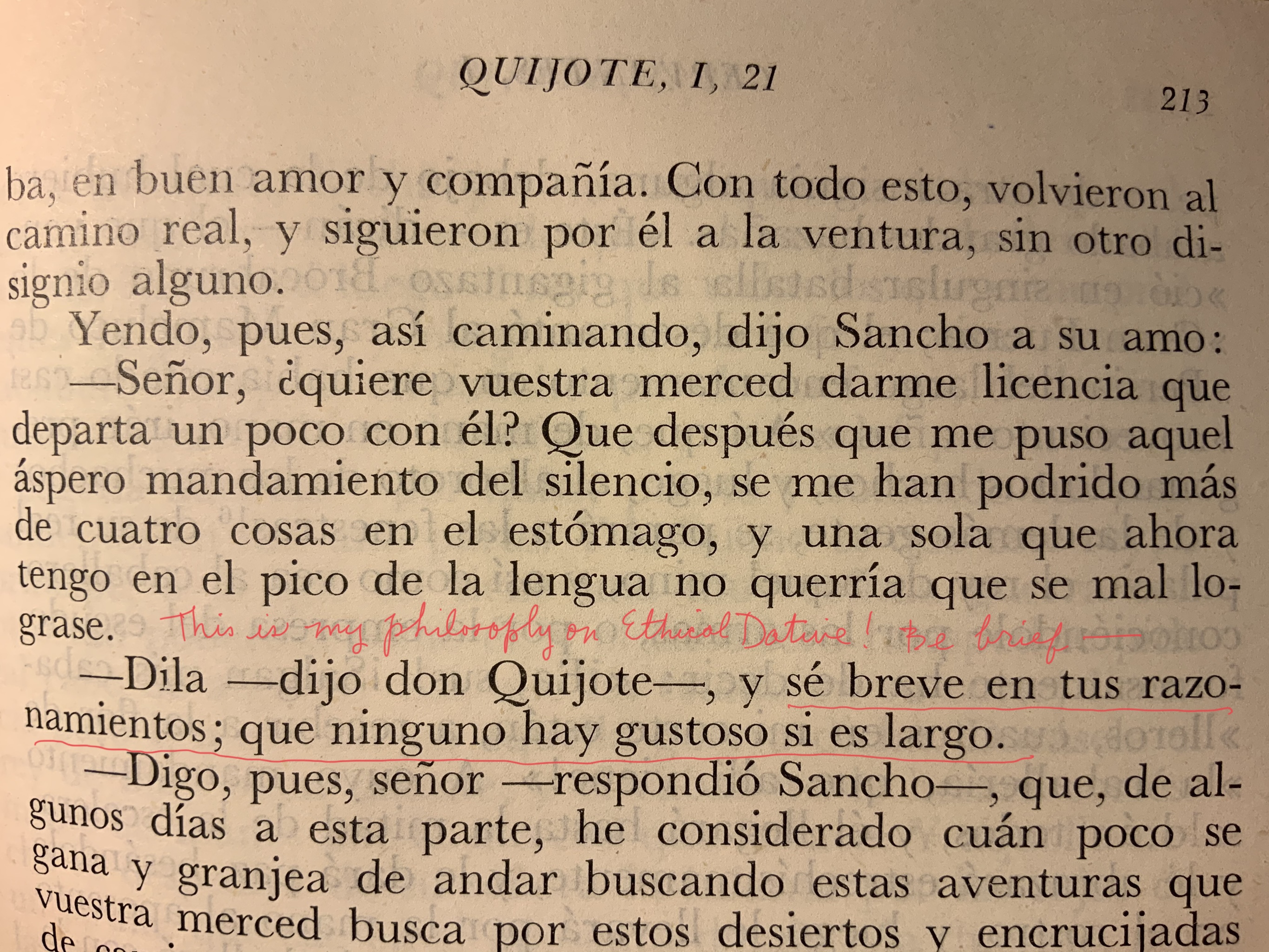
Sé breve en tus razonamientos; que ninguno hay gustoso si es largo.
Be brief in your remarks; none is pleasurable if it’s long.
(Don Quijote)

(c) 2021 JMN — EthicalDative. All rights reserved
Posted in Commentary, Quotations | Tagged , , , , | Leave a comment

To China and Back

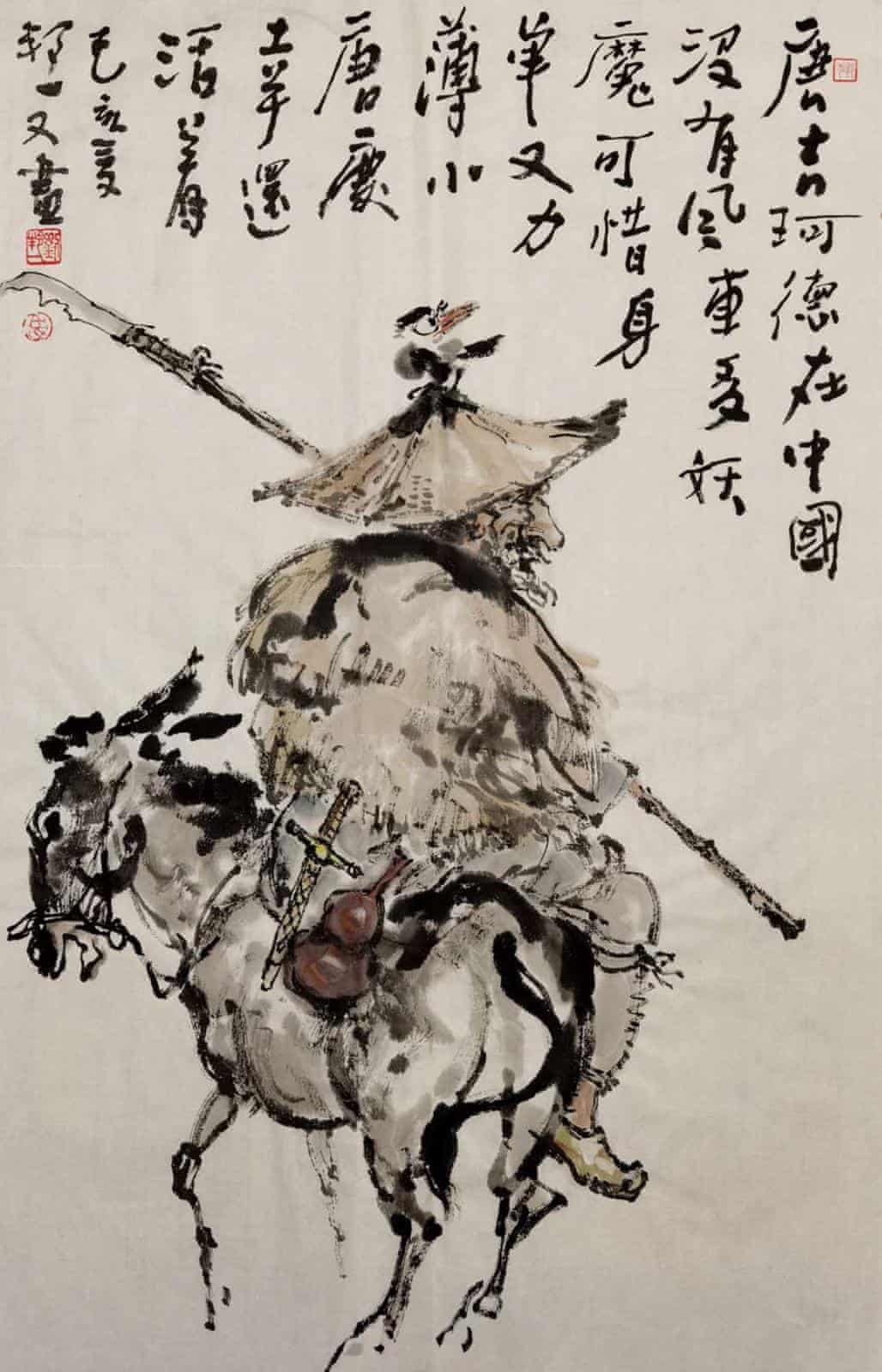
In 1922, Lin Shu translated the first part of “Don Quixote” into classical Chinese. It was published as “The Story of the Enchanted Knight.”

Lin Shu knew no Spanish, nor any other western language. A friend who had read two or three English translations of Cervantes’s novel helped Lin make his version.

In that version, Don Quixote is more learned than crazy. Sancho Panza is his disciple. Dulcinea, the knight’s fair maiden, receives the epithet “Jade Lady.” All reference to God is excised. Rocinante is promoted from nag to “fast horse.”

Fast forward to today.

Alicia Relinque, professor of classical Chinese literature at the University of Granada, has translated Lin Shu’s Chinese version into Spanish for publication in China as a dual edition.

Relinque looks on her translation of Lin’s translation as the newest link in a long and ancient chain, and as a means to share a book that says as much about early 20th-century China as 17th-century Spain.

(Sam Jones, “Chinese Don Quixote is translated into Spanish after 100 years,” theguardian.com, 4-22-21)

I dream of translating Relinque’s Spanish version of Lin Shu’s Chinese version of several English versions of Cervante’s version into a Texas English version, furnishing yet a newer link in the long and ancient chain.

(c) 2021 JMN — EthicalDative. All rights reserved
Posted in Commentary, Quotations | Tagged , , , , | Leave a comment

Police Haiku

Behold and lo. What?
Fire. Ready. Aim. Oh my god.
Turn on body cam.

Versión castellana:

¿Qué es esto? ¡Coño!
Balazos. Hostia.
Ponte las gafas.

(c) 2021 JMN — EthicalDative. All rights reserved

Posted in Anthology | Tagged | Leave a comment

Ni pintado.

La Ribera.

Ni pintado.

La luz cae y se levanta una ligera brisa. Solo se escucha el sonido de la corriente y el alboroto de las ranas.

This goes out to those tadpoles in your pond, Alba. “Luz, brisa, sonido, corriente, alboroto, ranas…”

(c) 2021 JMN — EthicalDative. All rights reserved

Posted in Commentary | 1 Comment

Vuelta a ellas.

Arbusto en flor.

Vuelta a ellas.

Las flores o árboles siempre son una buena opción cuando no tienes oportunidad de fotografíar otras cosas.

Besides being a lovely photo by Carmac, this caption merits your attention for the Spanish conversations we’re practicing about what you see in your garden.

(c) 2021 JMN — EthicalDative. All rights reserved
Posted in Commentary | Leave a comment

What It Means

The so-called ‘ethical dative’ or ‘dative of interest’, where the use of an indirect object pronoun expresses the involvement of the subject in the action of the verb, intensifies such feelings as sadness, happiness and mockery.

Ten cuidado, y no te me cortes un dedo. (F. Monge, in a lecture given at the University of Antwerp. 11 March 1983)
Be careful you don’t cut one of your fingers.
(By using me the speaker indicates that he is involved, that he will be sorry if it happens.)

El marido empezó con unos comentarios imbéciles, y me le reí en la cara. (M. Puig, 1980: 61)
Her husband began with some stupid remarks, and I laughed in his face.

La semana pasada se nos suicidó un parroquiano. (E. Mendoza, 1985:44)
Last week one of our parishioners committed suicide.

¿Y si soy un monstruo? ¿Y si me la violo? (A. Bryce Echenique, 1981: 85)
And if I’m a monster? And if I rape her?

The text cited is from Jacques de Bruyne, “A Comprehensive Spanish Grammar,” Blackwell Publishers, 1995.

(c) 2021 JMN — EthicalDative. All rights reserved

Posted in Anthology, Commentary, Quotations | Tagged , , , | Leave a comment

The Rock Pile

Dwight Garner’s review of a new biography of Marjorie Kinnan Rawlings* evokes a foible-wracked genius:

It’s a pleasure to meet this cursing, hard-drinking, brilliant, self-destructive, car-wrecking, fun-loving, chain-smoking, alligator-hunting, moonshine-making, food-obsessed woman again on the page.

The passage that hits home with me is this one:

She labored over her sentences, writing and rewriting. “No one knows how many composite sentences I have broken up into shorter direct ones, like the convict of hard labor ‘making little ones out of big ones’ on the rock pile.”

Pounding verbiage into gravel and sifting out twelve smooth stones to array in a select saying is the end of this sentence.

The author of “The Yearling” viewed mankind as less promising than rocks:

“Someday, I shall write a great feminist novel,” she wrote when young, “urging women to gird on their armor and kill all the men…”

(Dwight Garner, “Marjorie Kinnan Rawlings, a Novelist Who Went on a Quest for an Authentic Life,” NYTimes, 5-10-21)

*Ann McCutchan, “The Life She Wished to Live.”

(c) 2021 JMN

Posted in Commentary, Quotations | Tagged , , , , , , | Leave a comment

Neruda LXXXII

[LXXXII]
Amor mío, al cerrar esta puerta nocturna
My love, on closing this nocturnal door
te pido, amor, un viaje por oscuro recinto:
I ask, love, for a voyage through dark environs:
cierra tus sueños, entra con tu cielo en mis ojos,
shut your dreams, come with your sky into my eyes,
extiéndete en mi sangre como en un ancho río.
stretch inside my blood like a wide river.

Adiós, adiós, claridad que fue cayendo
Goodbye, goodbye, clear light gone falling
en el saco de cada día del pasado,
onto every last day’s sack of the past,
adiós a cada rayo de reloj o naranja,
farewell to every ray of clock or orange,
salud oh sombra, intermitente compañera.
greetings, O shadow, sometime companion.

En esta nave, o agua, o muerte, o nueva vida,
On this vessel, either water, death, or life anew,
una vez más unidos, dormidos, resurrectos,
once more united, sleeping, resurrected,
somos el matrimonio de la noche en la sangre.
we are the marriage of the night in blood.

No sé quién vive o muere, quién reposa o despierta,
I don’t know which lives or dies, reposes or wakes,
pero es tu corazón el que reparte
but it’s your heart that distributes
en mi pecho los dones de la aurora.
on my chest the donations of the dawn.

Veinte poemas de amor y una canción desesperada. Cien sonetos de amor
1924, Pablo Neruda y Herederos de Pablo Neruda
1994, Random House Mondadori
Cuarta edición en U.S.A: febrero 2004

[English translation by JMN.]

(c) 2021 JMN. All rights reserved

Posted in Anthology | Tagged , , , , | Leave a comment