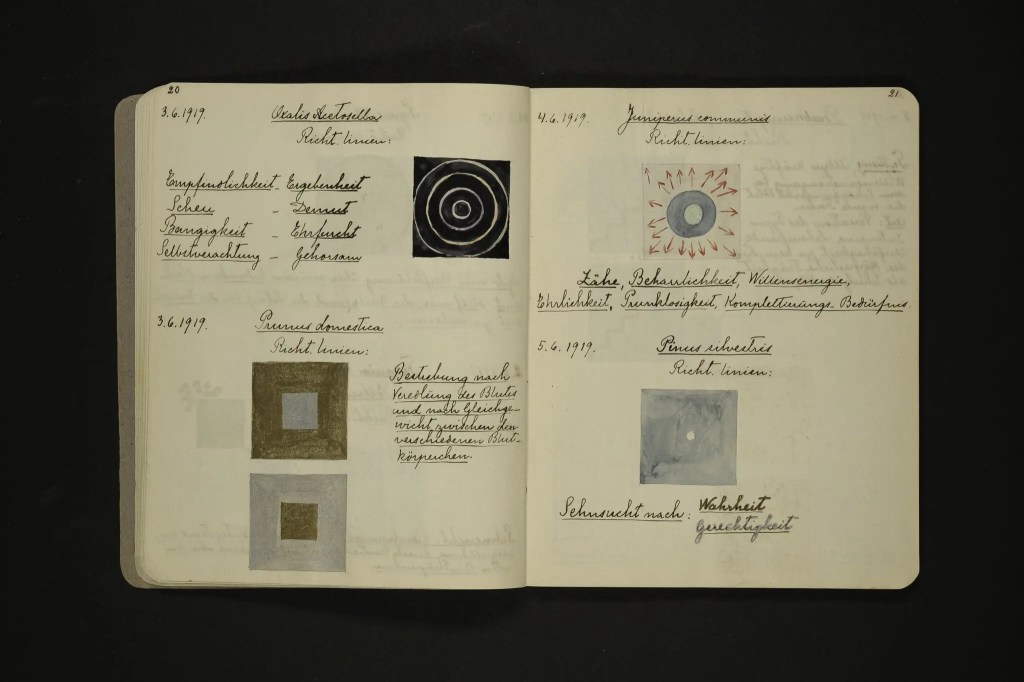
“Flowers, Mosses and Lichens,” conceived 1919–20; artist’s copy completed by 1926. Notebook with watercolor, metallic paint, pencil and ink. Credit… via Hilma af Klint Foundation, Stockholm. [New York Times caption and illustration]
Walker Mimms’s treatment of Hilma af Klint is elegant, lyrical, explicit.
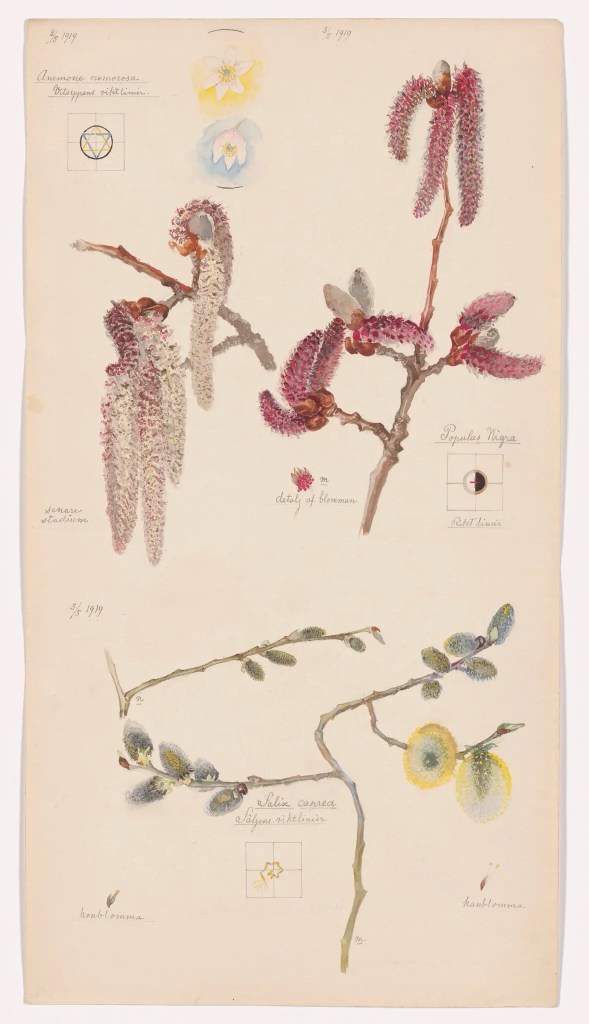
Alongside the careful realism of her herbal specimens, af Klint inscribed diagrams explaining their spiritual lives. For the European thimbleweed, a hot-and-cold Star of David; for the goat willow, a broken hexagram; for the black poplar, a yin-yang bullseye representing its “resistance to unite the astral and the mental.” Credit… Committee on Drawings and Prints Fund and gift of Jack Shear, via Museum of Modern Art, New York. [New York Times caption and illustration]
Ebullient, rigorous and boastfully esoteric, these “Nature Studies,” as she called them, reveal the didactic side of a pioneer in nonliteral art. This is an economical show of some beautiful field exercises, and it suggests the spiritual extremes to which the honorable but often tedious tradition of botanical illustration might be taken.
“Birch” from the series “On the Viewing of Flowers and Trees,” 1922, watercolor on paper. Credit… The Hilma af Klint Foundation, Stockholm. [New York Times caption and illustration]
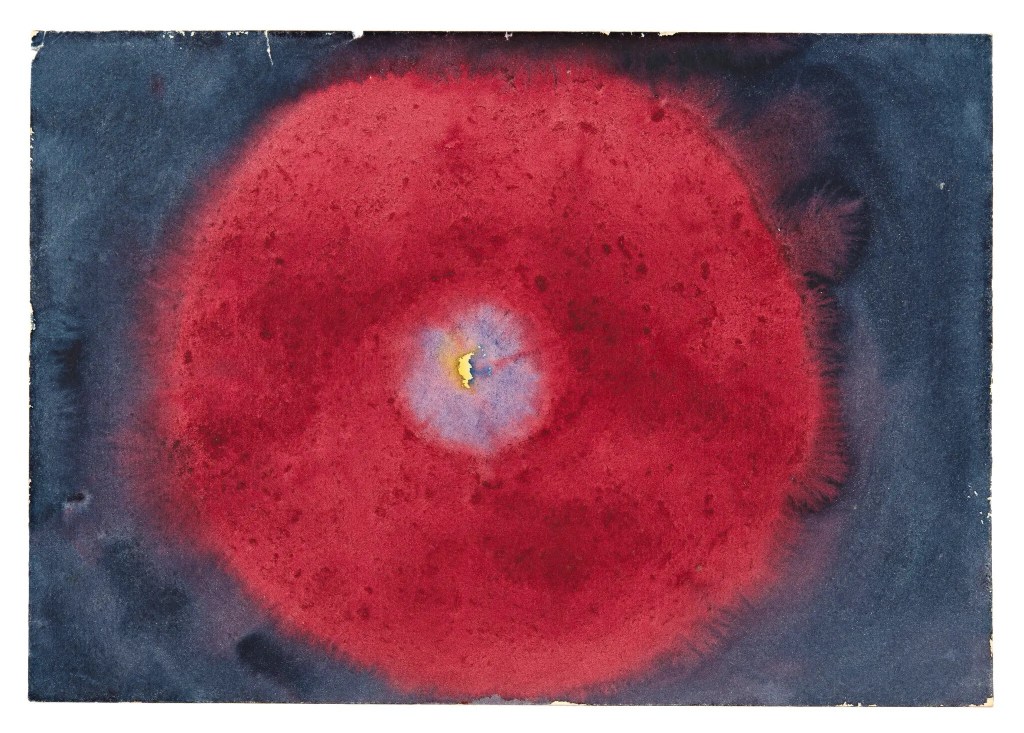
At MoMA, a wall of bright and hasty energy paintings from 1922 wraps the show — wet-on-wet watercolors with only vague kinships to their herbal titles: “Oak,” “Pansy,” “Birch.” After her years transcribing tendrils and anthers, they are sloppy and fun, like cannonball dives into the placid surface of a lake. They are also less interesting. But they are edgy in their way…
(Walker Mimms, “In Her Botanical Paintings Hilma af Klint Hurtles Back to Earth,” 5-15-25)
A The scene is festive. Where the flames are fed B Tainted choirs croon, “More and more is less.” c Spuds fried in tallow — gag me with a spoon! A The scene is festive where the flames are fed. a In the eyes, it’s interesting: They’re dead. b Festooned sockets orbed with emptiness. A The scene is festive where the flames are. Fed B Tainted choirs croon more. And more is less.
Never explain your doggerel. So here’s explaining: I want to dramatize anguish over corrupted discourse foisted upon the polity which programmatically asserts that facts are fake, truth is its opposite, bad is good, down is up, and hot is cold. It was convenient to turn the much-parroted Zen truism “Less is more” upside down to serve as a sacrificial cliché. The president absolutely <fill in blank>. What a stupid question! is the signature clarifying summation of the reality takedown’s mouthpiece.
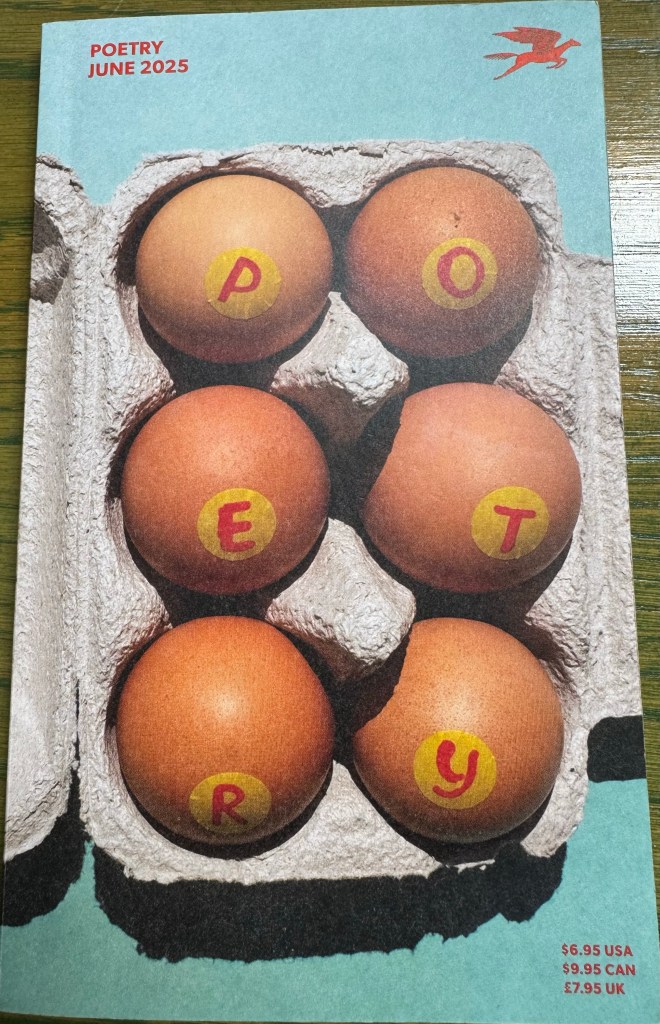
Here’s something called a triolet from Poetry, May 2025. The form is new to me and strikes a chord: concision, repetition, the discipline imposed.
Triolet with a Line by Sylvia Plath by Brittany Perham
We take the N out to the turnaround. The only thing to come now is the sea. The ice plants make the pink world loud. We take the N out to the turnaround. The fog fades in with its foggy sound. The end is here. Everyone can see. We take the N out to the turnaround. The only thing to come now is the sea.
Quoted whole because how do you vivisect a poem consisting of 8 tightly wound lines without wounding it? Also, what’s to say, above and beyond, that doesn’t murder with a grave truth?
If you want to see a tedious triolet explicated to death, glance here. I favor one that makes the pink world loud. Chow, bébé.
They say: A man who can’t tell shoe polish from shinola is fit to be tied by time and the tide. It’s one of those old sayings they say is never insufficient to the day thereof.
They say: A stitch in time is a penny earned. Penny for your thoughts. Pennies from Heaven. Common sense.
Many timeless zingers they say come from faith baseness: Trespass not, brethren, lest ye commit foulness one upon the other. This is the core takeaway of a legendary decalogue. Two other takeaways are the ones that go don’t steal and don’t adulterate.
A florilegium of eternal verities they say blooms as well from the Great Reading Lists: They also serve who only stand and deliver. There’s scads of these things they say. A horde of populous wisdom, believe you me, as true now as it more than ever was.
Make American English Great Again Now — MAEGAN — is a sweet hotrod of a movement, a screaming dragster with four-barrel carburetor smoking the shithole competition wherever jalopies duke it out. The Nineteen-Fifties burn rubber in the Twenty-Twenties like there’s no tomorrow. The Eighteen-Fifties bray:
Go West, inseminating Dude, East, North and South, mad Monoglot! From Greenland to the Doomsday Floe, Yours is the Earth and all that can be got, And — which is more — you’ll be a ‘Garch, my bro!*
*Sloganeering assembled from aftermarket Kipling and busted jingo blab. Don’t knock it, old son. It runs.
Where the living language is concerned, which let’s face it. So.
Can you spot the tuber posing as a goober? What about a dangled thought left to? Hip to messaging that carries false report? Words happening metaphorically, knot in real time? Factitious takeaways?
Can you tell a genuine non sequitur from a contrived segue? Objurgation that minces?
Pinpoint aggrieved pseudo-nostalgia that feels achingly autonomic and you’re dialed in. Possibly over your head, but respect. Heads up in the ensuing fog:
Lie with darkness, wake with fleece. You been served. Got damn! You got to know when to fold. So what? is the question. Some words are spelled with different letters. Fake it ‘til you fyck it. The party is pooped, my peeps. Denizenship is a privilege, not a right. If you’re bitching, you’re bombing. Back to your beginnings. Return to where you lost — this space is taken, pardner. In the name of God, make yourself scarce.
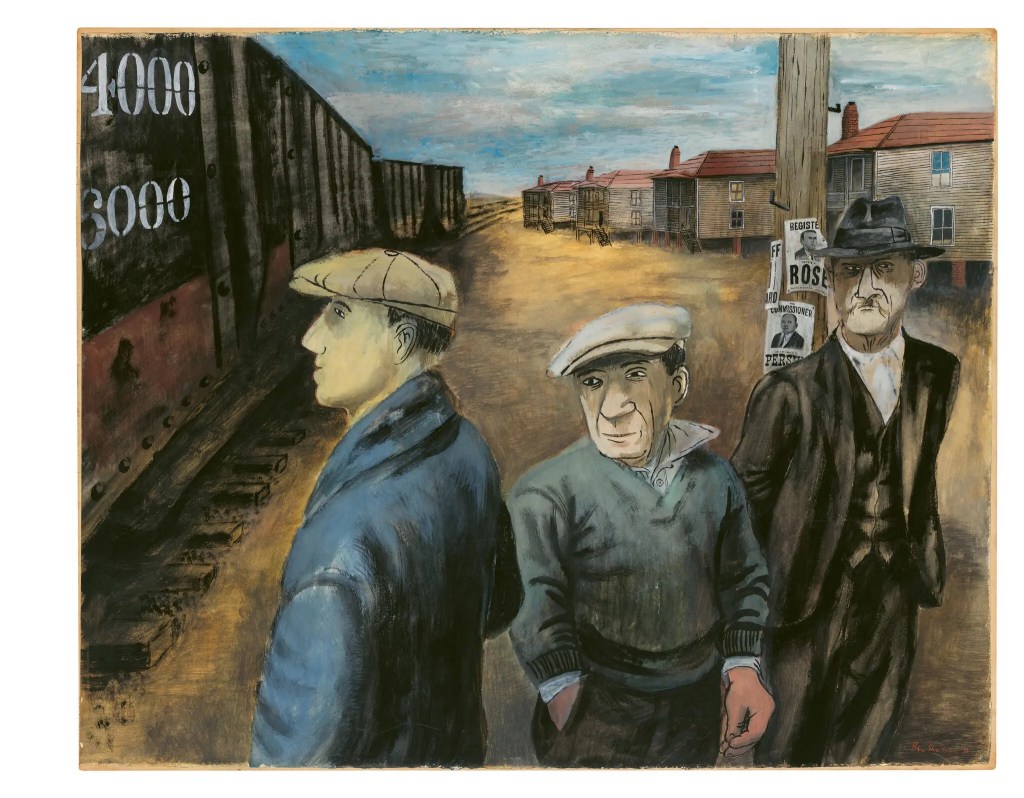
Ben Shahn, “Scotts Run, West Virginia,” 1937. During the Great Depression, Shahn felt sympathy for Americans suffering the deprivations he grew up with. (This painting was based on a photograph he took.) Credit… Estate of Ben Shahn/Licensed by VAGA at Artists Rights Society (ARS), NY; via The Jewish Museum. [New York Times caption and illustration]
If the images in the survey feel more like news than comment, that’s partly because we can sense the press photos Shahn used as his sources. Though his paintings themselves aren’t close to photorealistic — his technique can be potently slapdash — their subjects have the verve of seeming caught on the fly.
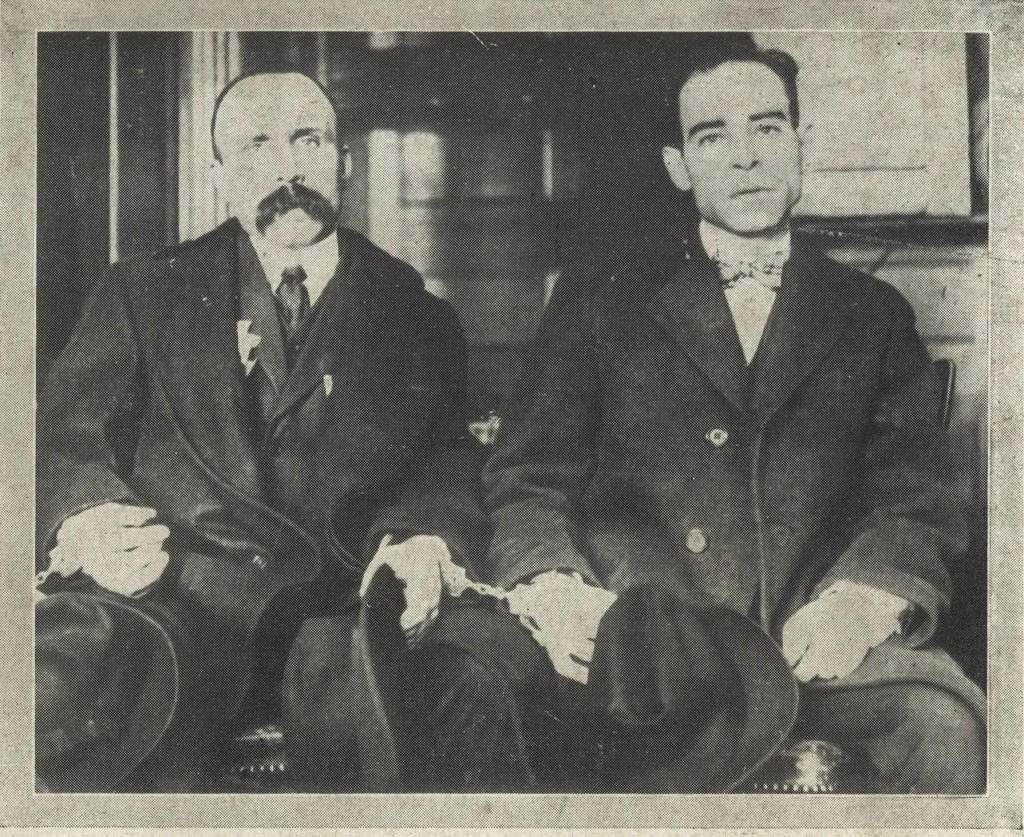
A 1923 news photograph showing Bartolomeo Vanzetti (left) handcuffed to Nicola Sacco, in a courthouse in Dedham, Mass. Shahn used it as his source for a painting in the Jewish Museum show. Credit… via Boston Public Library. [New York Times caption and illustration]
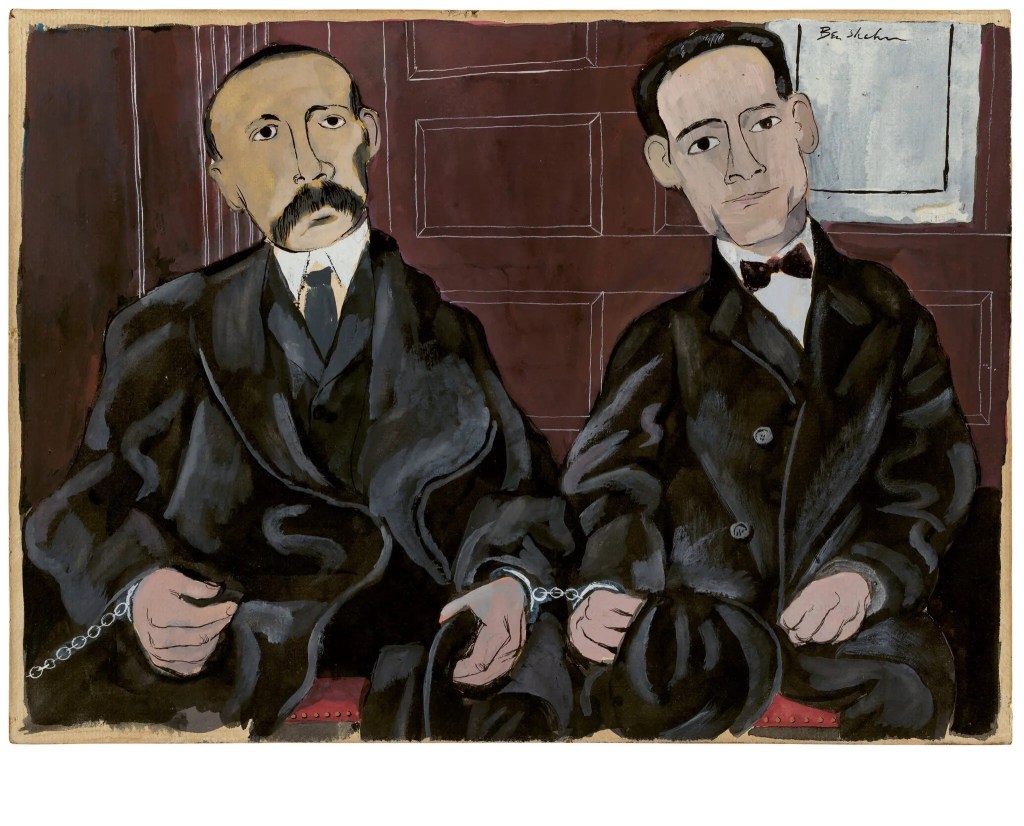
The exhibition includes an earlier series on the controversial 1921 trial of Nicola Sacco and Bartolomeo Vanzetti, Italian immigrants executed for murder despite flimsy evidence. Shahn’s painting of the two handcuffed men is cropped weirdly tight; we see that it echoes a source photo that had been cropped the same way, to save space on the printed page. Shahn borrows the feel of a photograph’s direct observation to make his painted subjects seem more directly observed by us.
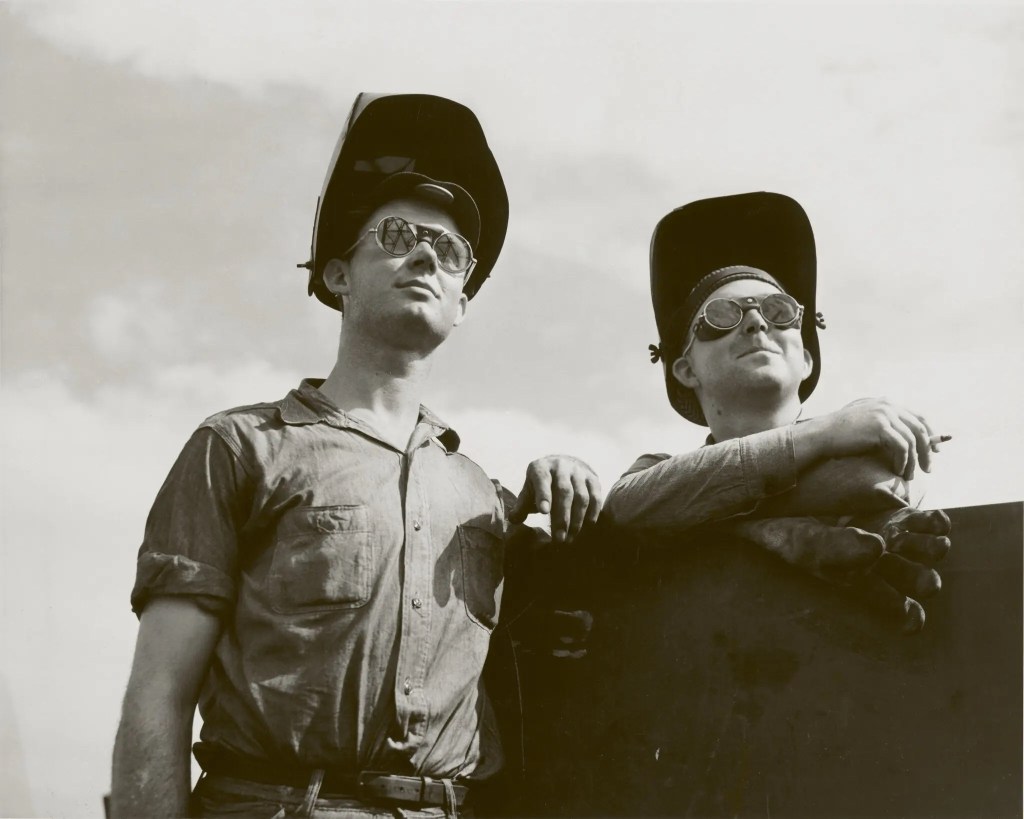
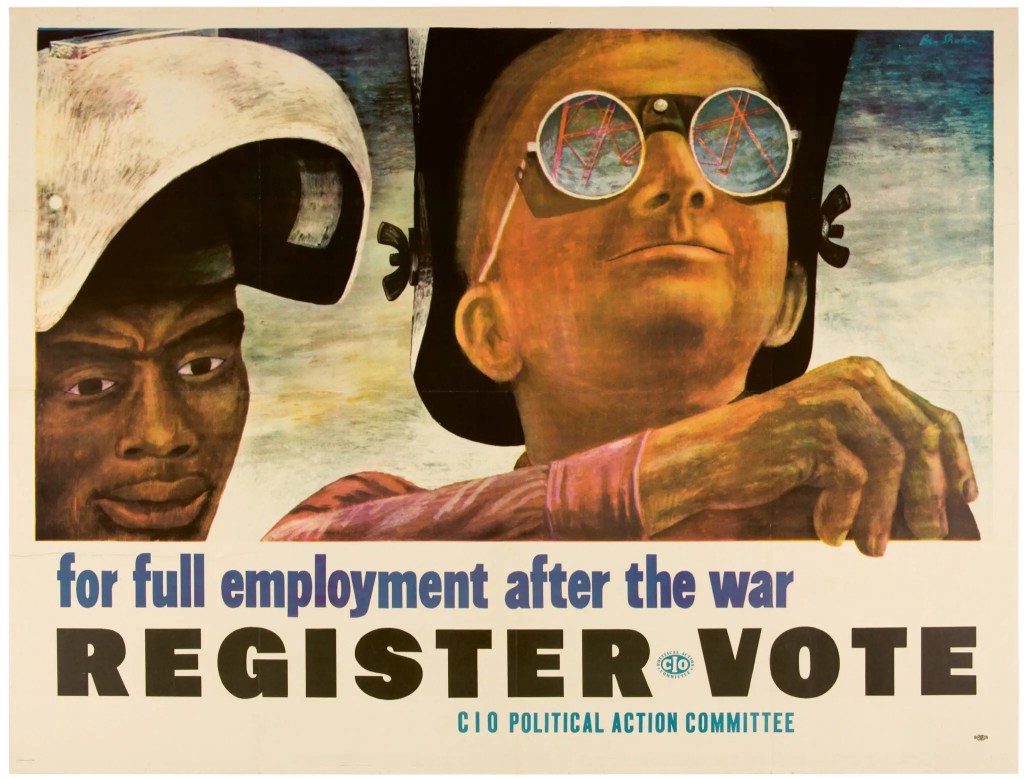
Ben Shahn, “Bartolomeo Vanzetti and Nicola Sacco,” 1931-32, gouache on paper. This painting retains the tight cropping of its source photograph. Credit… Estate of Ben Shahn/Licensed by VAGA at Artists Rights Society (ARS), NY; via Museum of Modern Art. [New York Times caption and illustration] A photograph by Alfred T. Palmer, showing two welders, October 1941. Shahn used this photograph as the source of a poster, changing the race of one of the welders to Black. Credit… The Jewish Museum. [New York Times caption and illustration] Ben Shahn, “For Full Employment After the War, Register, Vote,” 1944. Credit… Estate of Ben Shahn/Licensed by VAGA at Artists Rights Society (ARS), NY; via The Jewish Museum. [New York Times caption and illustration]
… And prosecutions that can seem to serve politics, not justice.
… In the decade or so before his death in 1969, Shahn could seem more interested in modern aesthetics than in modern people and their plights. His pictures became palimpsests of allusive symbols, reheating modern styles from Paul Klee and Pablo Picasso… We miss the immediacy of Shahn’s earlier pictures, with their close ties to an observed world… What Shahn couldn’t have realized, as he turned away from his potent visions of the 1930s and 40s, was that they would find new purchase almost a century later, when once again we face issues of racial injustice, and what our nation might do about it, and prosecutions that can seem to serve politics, not justice.
(Blake Gopnik, “Ben Shahn’s Social Realist Art Feels Relevant Again in Landmark Survey,” New York Times, 5-29-25)
As a kid studying high school French, I read with delight Mark Twain’s depiction of an American’s attempt to converse with a Frenchman. Twain wickedly renders the Frenchman’s remarks in literal English, alongside his own fractured French, to comic effect. Their exchange has something to do with bananas — bananes. Of course it does!
Investing the mundane with eventfulness: the Twain approach to humor, the Eliot approach to poetry, the Hopper approach to painting, the Gilles Labruyère approach to cartooning. Gilles’s fluent bilingual captions nourish my French. I succumb here to the impulse to subject one of them to a Twaining. With pleas for indulgence to the artist, here goes my impertinence:
A genial gent sitting on a train hears the announcement:
Vous avez pris place à bord du train à destination de Toulouse. You have taken place aboard of the train to destination of Toulouse.
The gentleman says to his companion sitting opposite:
Ça tombe bien. C’est là que j’vais. That falls well. It is there that I go.
For all that the literal English is cracked, it hits the mark, plus ou moins.
Next is Gary Larson. Let me set it up for you: A microbiologist working late nights is being mugged at slide point by a microbe. Staring into the eyepiece, what can he do but surrender his wallet and hope not to get hurt? Here’s the cartoon. [BULLETIN: Quel dommage! When I tested the link for the Larson cartoon it gets this message now: Egad! That cartoon is no longer available. Try one of these instead.]
Lastly I’ve but two words: Liana Fincke. The New Yorker has introduced me to this indescribable cartoonist, for which I’m grateful. To understand why I have no words, see her Wife of Valor. It kills.




 EthicalDative
‘That Falls Well’: Cartoon Paean Times Three
As a kid studying high school French, I read with delight Mark Twain’s depiction of an American’s attempt to converse with a Frenchman. Twain wickedly renders the Frenchman’s remarks in literal English, alongside his own fractured French, to comic effect. Their exchange has something to do with bananas — bananes. Of course it does!
Investing the mundane with eventfulness: the Twain approach to humor, the Eliot approach to poetry, the Hopper approach to painting, the Gilles Labruyère approach to cartooning. Gilles’s fluent bilingual captions nourish my French. I succumb here to the impulse to subject one of them to a Twaining. With pleas for indulgence to the artist, here goes my impertinence:
A genial gent sitting on a train hears the announcement:
Vous avez pris place à bord du train à destination de Toulouse.
You have taken place aboard of the train to destination of Toulouse.
The gentleman says to his companion sitting opposite:
Ça tombe bien. C’est là que j’vais.
That falls well. It is there that I go.
For all that the literal English is cracked, it hits the mark, plus ou moins.
Next is Gary Larson. Let me set it up for you: A microbiologist working late nights is being mugged at slide point by a microbe. Staring into the eyepiece, what can he do but surrender his wallet and hope not to get hurt? Here’s the cartoon. [BULLETIN: Quel dommage! When I tested the link for the Larson cartoon it gets this message now: Egad! That cartoon is no longer available. Try one of these instead.]
Lastly I’ve but two words: Liana Fincke. The New Yorker has introduced me to this indescribable cartoonist, for which I’m grateful. To understand why I have no words, see her Wife of Valor. It kills.
(c) 2025 JMN — EthicalDative. All rights reserved