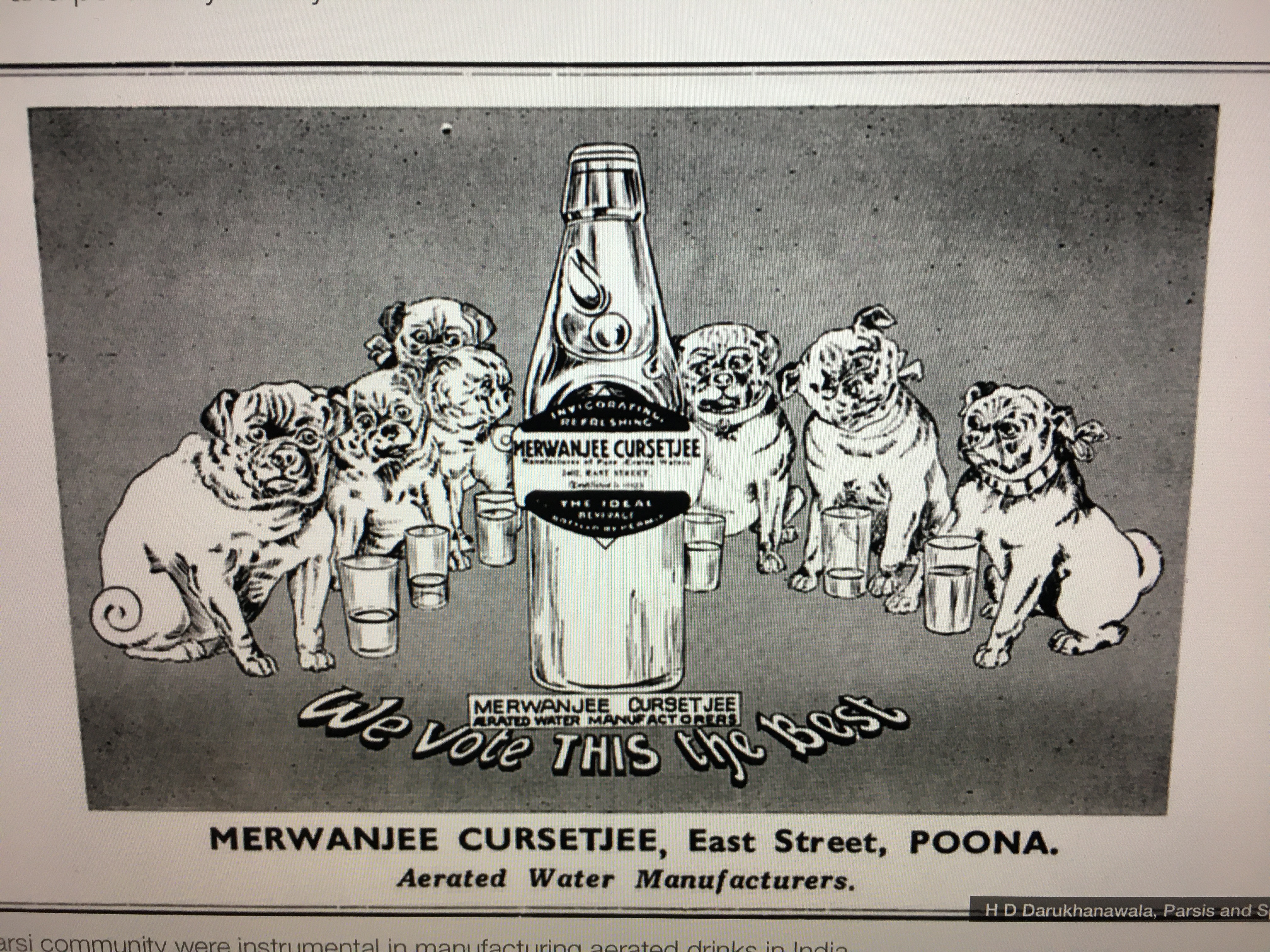
Mr. Patel, a historian, chronicles how soda pop became fiendishly soda-popular in India; or in his finer language: “how Parsis helped shape India’s taste for soft drinks.”
The Parsis, whose name means “Persians,” are descended from Persian Zoroastrians who emigrated to India.
It’s hard to realize today that sugary beverages were originally adopted for their healthful benefits.
Before Mumbai completed its modern waterworks in the late 19th Century, it relied on well water, which was filthy and potentially deadly… Drinking carbonated water could be a life-saving habit. After all, carbonic acid in soda killed bacteria and viruses.
…
By 1913, the city boasted more than 150 licensed soda factories. Parsis played a commanding role in this trade, as is evidenced by the surnames they adopted: Sodawaterwala, Sodawaterbottlewala, and even Sodawaterbottleopenerwala.

A major limitation was bottle supply, since glass bottles cost far more than the carbonated contents poured inside. So the Marolia family [in Nizamabad] used special round-bottom bottles which were difficult to set down on flat surfaces. These encouraged customers to drink sodas in one gulp and quickly return the bottles for reuse.
(Dinyar Patel, “Fizzy nostalgia: The origins of India’s taste for soft drinks,” bbc.com, 3-22-20)
(c) 2020 JMN





 EthicalDative
‘Stretched by an Unholy Desire’
“Stretched by an unholy desire to be outrageous.” More than I care to admit, my pleasure in reading art criticism can amount to quivering at a splash of brandished lingo. I also quiver to Kahn’s paintings, which remind me of English Midlands landscape.
“These are not colors that sunlight finds in nature; they are colors that an aroused sensibility finds, with joy, in the act of painting.” (Peter Schjeldahl, quoted in the article)
“The paint spills and runs,” The New York Times wrote of [Kahn’s first solo show in 1953], “color crackles with vivacity and the brush might just as well have been guided by a tornado as by hand. Yet this is no manner for manner’s sake. Kahn is a high-spirited, lyrical artist who paints the way he does because a leonine manner seems to fit exactly his response to what he sees.”
As one who often treats the easel as a place to attack visual problems, I note the “leonine” manner that responds to the seen rather than trying to dominate it.
In an interview with the gallerist Jerald Melberg in 2011, [Kahn] described working on a painting in Italy in 1963, trying to create a modern-day version of van Gogh walking through an Italian landscape.
“I kept moving the figure,” Mr. Kahn said. “First it was here. Then it was there. And then finally I put it over here. Then finally I painted it out altogether.”
“As soon as I painted the figure out, I was happy,” he added. “Because I felt free.”
(Neil Genzlinger, “Wolf Kahn, Who Painted Vibrant Landscapes, Is Dead at 92,” NYTimes, 3-24-20)
(c) 2020 JMN