Frank Gehry, “Guggenheim Abu Dhabi,” April 2020, sketched at his home in Santa Monica. Credit…Frank O. Gehry.
I’m at my dining room table sketching now. And they’re raw sketches. Just a Pilot pen on tracing paper. (Frank O. Gehry)
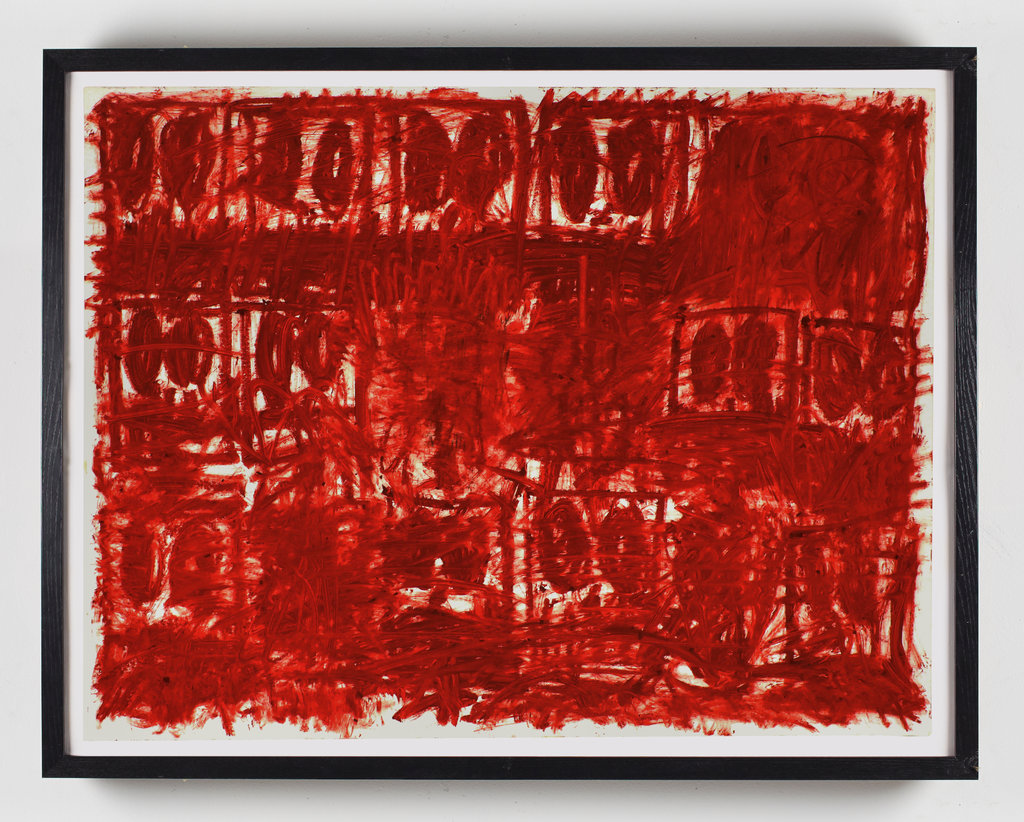
Rashid Johnson, “Untitled Red Drawing” (2020), oil on cotton rag. This work was made by the artist in his small home studio two weeks ago. Credit… Rashid Johnson.
I’ve actually been busy doing drawings similar to one from 2018 called “Anxiety Drawing.” They were black, and now they are red. (Rashid Johnson)
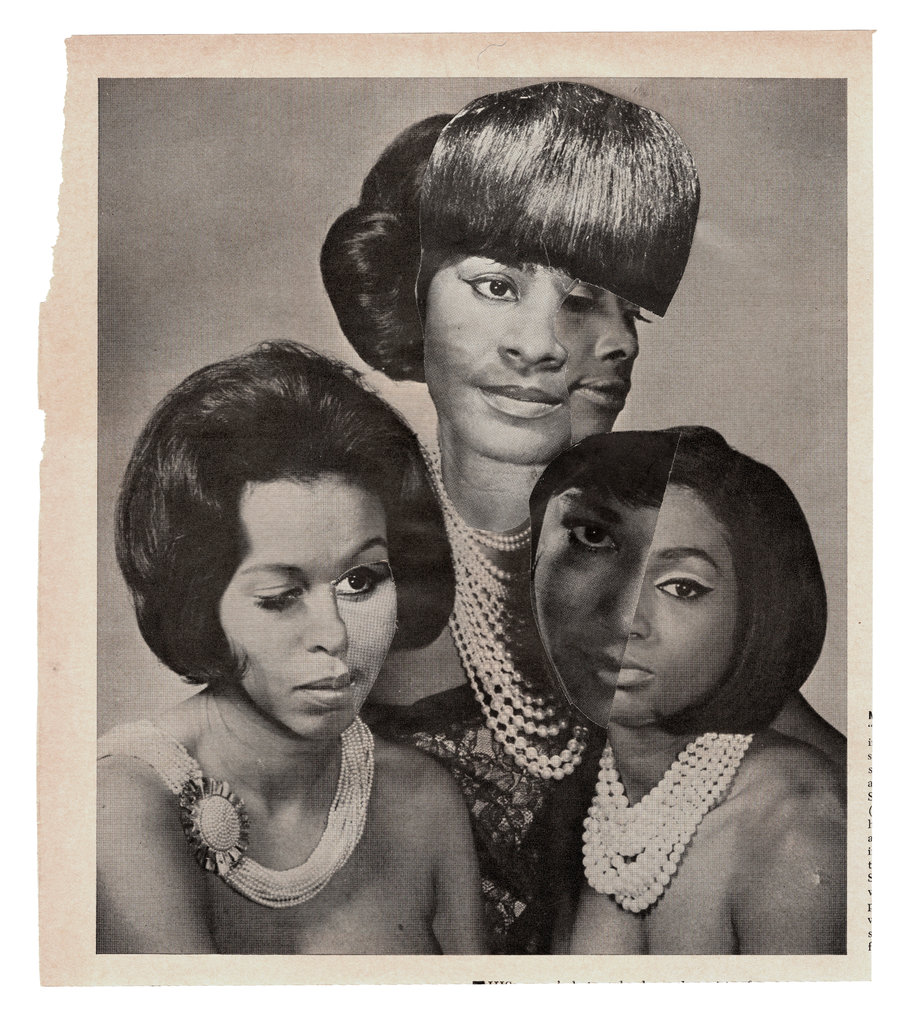
Lorna Simpson, “Walk With Me,” April 7, 2020. She made the collage in her Los Angeles home, from magazine clippings, the old-fashioned way: with glue, scissors and a knife. Credit… Lorna Simpson and Hauser & Wirth.
It is a portrait of three women… It’s always kind of fun to juxtapose things and keep it moving. (Lorna Simpson)
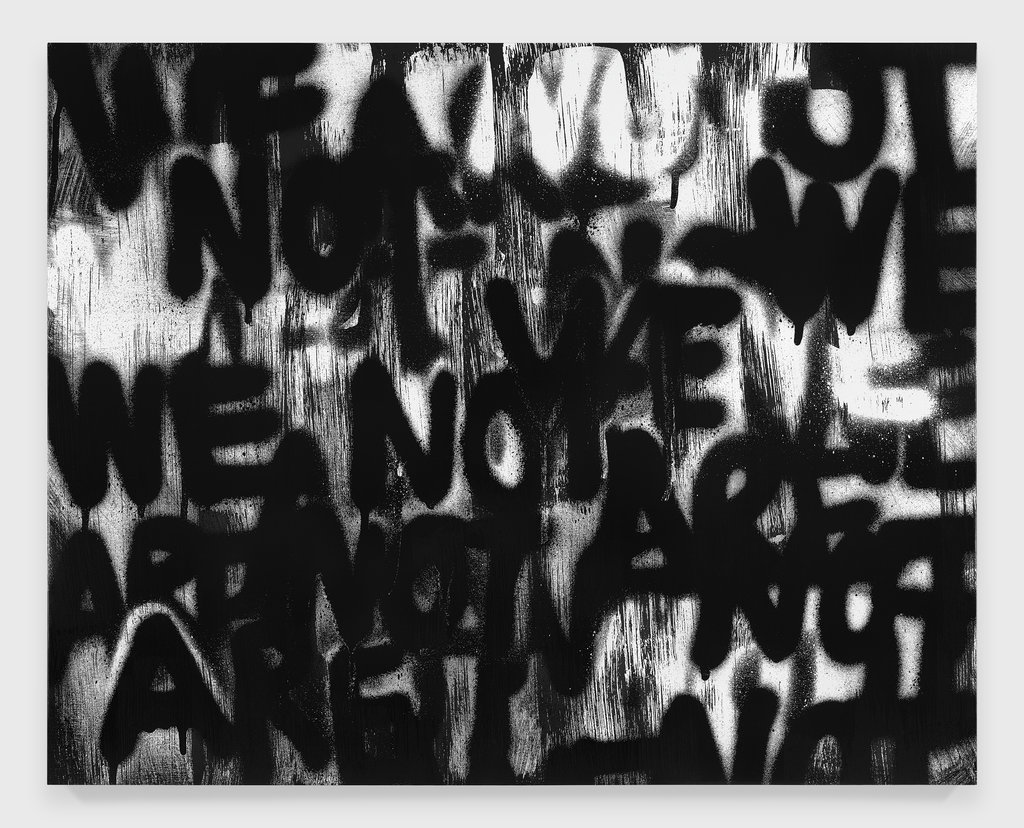
Adam Pendleton, “Untitled (WE ARE NOT),” from 2020, silkscreen ink on canvas. The artist frequently works with text. Credit… Adam Pendleton.
Right now, I’m looking out across a road to an open plot of land, and the grass is sort of that rusty, red color with a little bit of sand tone to it. And there’s a small evergreen blowing in the wind. And I think it’s the fact that nothing is happening — other than this sort of welcoming but barren landscape — that is the most inspiring thing at the moment. (Adam Pendleton)
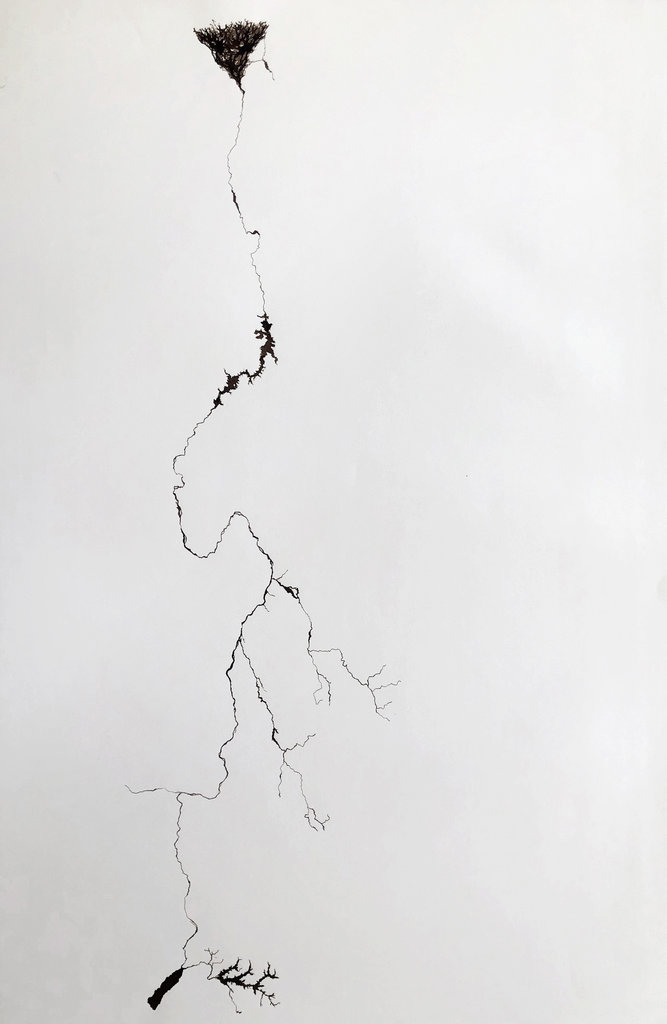
Maya Lin, “Nile Drawing,” walnut ink. Ms. Lin finds rivers a consistent source of inspiration, as in this 2019 work. Credit… Maya Lin Studio; via Pace Gallery.
I’ve been looking out the window and I’m starting a series of drawings that are about rivers, in walnut ink… I’m also starting to read a book on Alexander von Humboldt… (Maya Lin)
William Eggleston, “Untitled,” c. 1971-74. In quarantine, he has been looking at older images, including this one. Credit… Eggleston Artistic Trust; via David Zwirner.
Just a few weeks ago I was in Los Angeles editing my next book. It is a group of previously unseen work called “Outlands” that should be published this fall. These volumes represent the last definitive pass of my early work shot on Kodachrome… We reviewed images that I haven’t seen in more than 40 years — all from Memphis and environs, with very much a pure use of color, and of a vanishing world at the time. (William Eggleston)
(Ted Loos, “Artists Are Hunkered Down, But Still Nurturing Their Inner Visions,” NYTimes, 4-21-20)
A journalism professor at the University of Oklahoma has been criticized for comparing the term “boomer” to a racial slur. Credit… Nick Oxford for The New York Times.
Language is awash in slurs: racist, ethnist, nationalist, sexist, ageist, classist, occupationist, sexual orientationist, “ism-ist,” and so on and so forth. The human race is a slurring race.
I’m far from wishing to resurrect offensive words from their just entombment. Very occasionally, however, and with cause, citing a slur by its name is a prerogative of responsible reporting, especially if maladroit paraphrase can lead to a misreading of what’s reported.
There are sufficient displays of cant and rant by all parties in this story, but noteworthy is how it echoed in the NYTimes, which permitted the following headline:
“University Condemns Comparison of ‘OK, Boomer’ to Racial Slur by Professor.”
Clarity is of the essence in good journalism. It’s a single-impact genre, unlike essay or poetry, whose audience has more of a commitment to close reading. For a second, I thought someone had compared the phrase “OK, Boomer” to a racial slur uttered by a professor.
Not quite, but the subheading didn’t help:
“A professor at the University of Oklahoma provoked outrage by saying the phrase “OK, boomer” was like a racial slur for black people. He later apologized to students.”
For black people “OK, boomer” was like a racial slur? Still not quite. My point is that ambiguity could have been avoided by a headline such as this:
“University Condemns Professor’s Comparison of ‘OK, Boomer’ to the N-Word.”
Writing “the N-word” is not the same as spelling out what it euphemizes, and would have given immediate context to the outrage on campus, which is the story:
Molly Kruse, a 21-year-old senior who was in the class… said she walked out of the class at that moment and went to the dean’s office… Ms. Kruse said she hoped the incident spurred changes at the university. “The fact that someone could really think that ‘boomer’ is the equivalent of the n-word, I don’t know,” she said. “I hope this is a wake-up call that our college needs more diversity and professors need to be trained in how to include all students.”
… An organization of black student leaders with the stated mission of confronting racism on campus, said on Twitter that it expected “full action to be taken against the professor and college… In addition, we expect accommodation be made for the students who have experienced trauma because of this.”
“The use of the most offensive word, by a person in a position of authority, hurt and minimized those in the classroom and beyond,” [Interim president Joseph Harroz Jr.] said.
In his email to students, [Peter Gade, director of graduate studies at the university’s journalism school] wrote, “I made an inexcusable mistake this morning in class with my choice of a word… I was wrong. I am sorry. I realize the word is hurtful and infuses the racial divisions of our country, past and present. Use of this word is inappropriate in any — especially educational — settings…” He asked students to “please give me an opportunity” to show he was an instructor who was “trustworthy and respectful of all.”
(Maria Cramer, “University Condemns Comparison of ‘OK, Boomer’ to Racial Slur by Professor,” NYTimes, 2-12-20)
There it is, in several nutshells: the not-knowing, the trauma, the minimizing, the sorrow.
Credit… Dimitri Staszewski for The New York Times.
The restaurant business is suffering from the corona-crash like many other sectors of commerce. Legitimate concerns are expressed for the many workers in food and hospitality whose livelihoods are blighted now.
There’s a certain irony, therefore, in the thesis of this article: That many people are benefitting, healthwise, from eating out less.
A poor diet is the biggest underlying cause of mortality in America, and that poor diet is largely delivered by large food companies like Pepsi, Coca-Cola, Chick-fil-A and McDonald’s. Just 10 dietary factors (such as high intake of processed meat and refined grains) are estimated to cause more than 1,000 deaths per day from heart disease, stroke and diabetes alone. More than 100 million Americans have diabetes or pre-diabetes and 122 million have cardiovascular disease.
Frequent cooking could make a difference in outcomes — on average, people who frequently cook at home eat less fat and sugar than other people. Most restaurants and many large food companies, after all, use levels of salt, sugar and fat that would be inconceivable for home cooks.[my bolding]
(Hans Taparia, “How Covid-19 Is Making Millions of Americans Healthier,” NYTimes, 4-18-20)
I’ve been in several relationships in which my partner has been averse or indifferent to cooking, leaving it to me to assume the chef’s hat in the domestic arrangement. As a living-alone person now, my private slogan has been: “The man who doesn’t cook for himself eats poorly and dearly much of the time.” The mantra helps me make lemonade from lemony circumstance, if you will; however, it may be truer than I realized.
Author Yi-Zheng Lian, a professor of economics at Yamanashi Gakuin University in Japan and contributing Opinion writer for the NYTimes, makes a crucial point in this article about Covid-19:
Of course, the virus isn’t Chinese, even if its origin eventually is traced back to a cave in China; nor is the disease that it causes.
It makes as little sense to attribute nationality to a virus as it does to attribute it to plankton. The corollary that Yi-Zheng Lian states is equally crucial:
Epidemics, on the other hand, are often societal or political — much like famines are usually man-made, even though droughts occur naturally.
For me the distinction he draws brings a moment of clarity amid the maelstrom of obfuscation and fault-finding that’s abroad in the world. The agency of human beings in epidemics, as in famines, must be recognized.
From here Yi-Zheng Lian proceeds to enunciate the following point about Chinese culture and support it with observations about that culture:
Punishing people who speak the truth has been a standard practice of China’s ruling elite for more than two millenniums and is an established means of coercing stability.
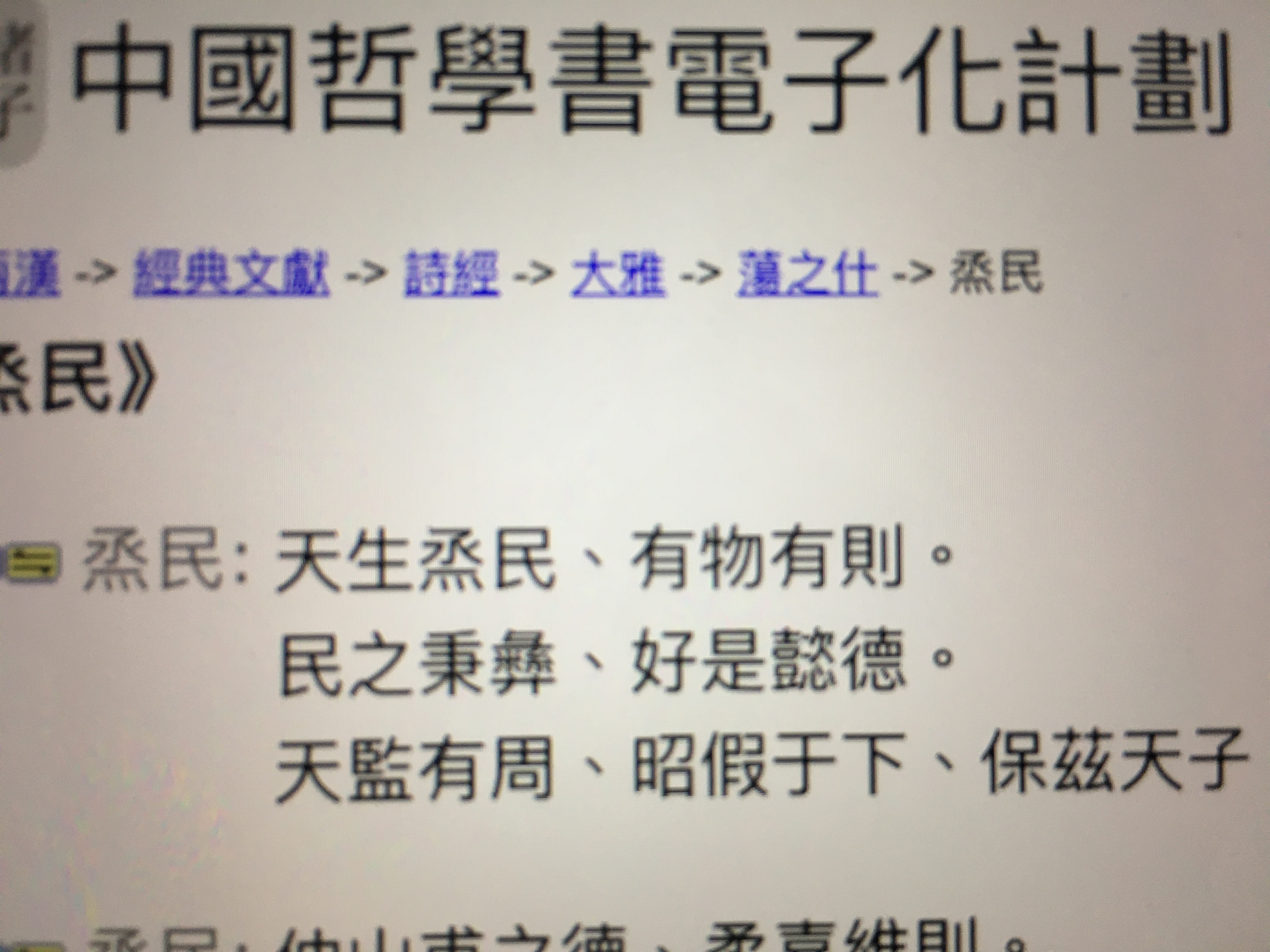
There are several handles to grab on this essay, prominent among them the themes of Chinese food culture and traditional medicine. Because it’s what I’ve least encountered, however, I was captured by the references to classical Chinese literature, including associated Chinese script.
Here’s a sample:
The sage [Confucius] took a page from… “The Classic of Poetry” (also known as “The Book of Songs”), a collection of songs and poems dating to the 10th century B.C. or before, and adopted a rule from it: “To Manifest the Way, First Keep Your Body Safe.” (明哲保身) That may sound innocuous enough, until you consider the fate of one of Confucius’s beloved students, Zi Lu (子路), also known as Zhong You (仲由), after he ran afoul of the precept: For trying to rebuke a usurper in a power struggle between feudal lords, he was killed and his body was minced. (It is said that Confucius never ate ground meat again.)
Others:
In the third century, the maxim took on some literary flair and a cynical didactic twist in an essay on fate by the philosopher Li Kang (李康): “The tree that grows taller than the forest will be truncated by gales” (木秀于林,風必催之). This, in turn, eventually gave rise to the more familiar modern adage, “The shot hits the bird that pokes its head out” (槍打出頭鳥).
(Yi-Zheng Lian, “Why Did the Coronavirus Outbreak Start in China?” NYTimes, 2-20-20)
The 15th Amendment to the U. S. Constitution was ratified 150 years ago, on Feb. 3, 1870. It prohibits denying or abridging the right to vote on the basis of race.
The right of citizens of the United States to vote shall not be denied or abridged by the United States or by any State on account of race, color, or previous condition of servitude.
The amendment guaranteed political equality for African-American men. (Women’s right to vote would come 50 years later with the 19th Amendment.) That guarantee was soon honored in the breach because of the collapse of Reconstruction in the South and the accession to power of white-supremacist state governments.
By the early 20th century, black voter registration in the South had fallen into the low single digits. The 15th Amendment was a dead letter in the South, and it would not be revived in a meaningful way until the Voting Rights Act of 1965.
Jesse Wegman points out that the 15th Amendment has a central flaw — and the flaw is language-based.
Its words were cast in the negative. It told the states what they could not do — “shall not be denied or abridged.” It did not tell people they had an affirmative right to vote.
And that wording has made a world of difference.
In places like North Carolina, Wisconsin, Florida and Ohio, Republican politicians pass voter-ID laws, conduct voter-roll purges and push other measures that drive down turnout among people who lean Democratic — especially black, young and lower-income voters. In the absence of an explicit constitutional right to vote, laws like these are harder to strike down…
“There are still many, many people in this country who think the right to vote should be limited in one way or another,” [Eric Foner, author of “The Second Founding”] said. “Step back, and you’ve got the Electoral College, gerrymandering, all these ways people try to hold on to power by manipulating the right to vote.”
Gladys Nilsson’s “Plain Air” (2018), acrylic on canvas. With two solo shows, she says of success: “I’m ready!” Credit… Gladys Nilsson; John and Susan Horseman; Garth Greenan Gallery and Matthew Marks Gallery.
Gladys Nilsson, who turns 80 in May, at home in suburban Wilmette, Ill., in her attic studio. Credit… Alexa Viscius for The New York Times.
You and Jim [Nutt] have a significant collection of work by self-taught artists, such as Martín Ramírez and Joseph Yoakum. What draws you to that kind of work?
The work that interests me is by people who have a need to explain or explore or put down what they have to get out. They aren’t stopping because they don’t have formal training. They’re following their thread without worrying about it.
(Jonathan Griffin, “She Painted With the Hairy Who. Now She’s Going Big, at 79,” NYTimes, 1-30-20)
The above response by Nilsson to the question posed is profoundly uninformative, and therein lies its charm.
Her psychedelic, cartoonish paintings grow on me entertainingly. In this one I enjoy how the two men hold the canvas for the naked painter as she airily attacks her picture with a hook shot. The fellows’ packages are blatantly apparent, and they watch the diva carefully, alert to her every evolving requirement.
Gladys Nilsson, “Gleefully Askew” (2019), acrylic on canvas. It’s the largest painting she has ever made — 84 inches high. In it, a nude woman paints while two men hold the canvas. Credit…Gladys Nilsson, Garth Greenan Gallery and Matthew Marks Gallery.
In the following one I resonate to the bug-eyed intensity with which the puckishly enbosomed female surveys the tiny floating homo-tadpole.
Gladys Nilsson, “Observing” (2019), acrylic on canvas. Observation is a central part of her process; she likes to watch people in public. Credit… Gladys Nilsson, Garth Greenan Gallery and Matthew Marks Gallery.
Nilsson’s painting is cleanly of the sportive sort to me. I have no idea what to make of it other than as something at which to have a clean, bug-eyed look without worrying about it (as she might say).
The Harvard Business professor Clay Christensen in 2016. He died last week from cancer. Credit… Bryan Bedder/Getty Images for The New York Times.
In late January Kara Swisher paid tribute to Clay Christensen, who died that month at age 67. Christensen was a Harvard professor of management whose seminal book “The Innovator’s Dilemma” appeared in 1997. His ideas on “disruptive” technologies influenced the founders of many legendary startups in Silicon Valley.
Swisher writes that Professor Christensen’s innovative thinking “took a turn for the worse in tech.”
Silicon Valley failed to marry disruption with a concept of corporate responsibility, and growth at all costs became its motto.
Swisher sees the notion of destructive innovation crystallized in Facebook’s famous slogan: “Move Fast and Break Things.”
I have always wondered why the company chose those words. I have no problem with “move fast,” which Professor Christensen would not have quibbled with, since being nimble was a core competency that he touted. It was the word “break” that stuck in my head like a bad migraine.
Why use a violent and thoughtless word like “break” and not one more hopeful, like “change” or “transform” or “invent”? And, if “break” was to be the choice, what would happen after the breaking? Would there be fixing? Could there be any fixing after the breaking? “Break” sounded painful.
Christensen could inspire with snappy quotables. Swisher cites these:
“It’s easier to hold your principles 100 percent of the time than it is to hold them 98 percent of the time.”
“Decide what you stand for. And then stand for it all the time.”
(Kara Swisher, “Tech Loses a Prophet. Just When It Needs One,” NYTimes, 1-29-20)
This article by David Quammen appeared on January 28, 2020, in the NYTimes. That seems a long time ago in light of what has transpired in February, March, and half of April; however, the article has aged well.
Quammen is the author of “Spillover: Animal Infections and the Next Human Pandemic.” He offers glancing insights into the predicament of scientists whose work begs for the attention of what seems a resolutely heedless world.
That the virus emerged from a nonhuman animal, probably a bat, and possibly after passing through another creature, may seem spooky, yet it is utterly unsurprising to scientists who study these things…
One such scientist is Zheng-Li Shi, of the Wuhan Institute of Virology… It was Ms. Shi and her collaborators who, back in 2005, showed that the SARS pathogen was a bat virus that had spilled over into people. Ms. Shi and colleagues have been tracing coronaviruses in bats since then, warning that some of them are uniquely suited to cause human pandemics.
“We’ve been raising the flag on these viruses for 15 years… Ever since SARS.” (Peter Daszak, one of Ms. Shi’s longtime partners.)
The list of such viruses emerging into humans sounds like a grim drumbeat: Machupo, Bolivia, 1961; Marburg, Germany, 1967; Ebola, Zaire and Sudan, 1976; H.I.V., recognized in New York and California, 1981; a form of Hanta (now known as Sin Nombre), southwestern United States, 1993; Hendra, Australia, 1994; bird flu, Hong Kong, 1997; Nipah, Malaysia, 1998; West Nile, New York, 1999; SARS, China, 2002-3; MERS, Saudi Arabia, 2012; Ebola again, West Africa, 2014. And that’s just a selection. Now we have nCoV-2019, the latest thump on the drum.
(David Quammen, “We Made the Coronavirus Epidemic,” NYTimes, 1-28-20).
An election worker and voters casting ballots in Seoul on Wednesday. South Koreans turned out in droves, despite the pandemic, to re-elect the ruling party. Credit… Kim Hong-Ji/Reuters.
South Korea is steadily dropping in the rankings of countries worst-hit by the pandemic. Once second only to China (population: about 1.4 billion), South Korea (population: 51.6 million) is now recording fewer total cases than Ireland (population: 4.9 million) and fewer deaths than the state of Colorado (population: 5.7 million).
… As early as late January, public health officials greenlighted efforts by the private sector to build up capacity for widespread testing for the coronavirus… As those test results came in, the Korea Centers for Disease Control and Prevention and the Ministry of Public Health and Welfare made sure the information was passed on swiftly and systematically to those who needed it: the general public… Contact tracing and public data-sharing of the kind just beginning in hard-hit states like Massachusetts has been a standard feature of daily life here.
... South Korea has drawn on its strengths as a liberal society to address the public health crisis — and this week its people doubled-down on democracy by turning out in droves to re-elect its leadership… Mr. Moon now has wind in his sails as he enters his last two years in office. For the foreseeable future, his focus, like that of every head of state across the planet, will be pandemic management.[my bolding]
(John Delury, “How Democracy Won the World’s First Coronavirus Election,” NYTimes, 4-16-2020)
Officers have been policing parks in England to enforce social distancing guidelines among visitors. Credit… Ben Stansall/Agence France-Presse — Getty Images.
But some religious authorities, too, have acted with anti-adaptive zeal. In my own Catholicism, the diocese of Raleigh, N.C., didn’t just cancel Masses and close churches; it forebode[my bolding] its priests to attempt experiments like drive-through confessions that might make social distancing and the sacraments compatible.
(Ross Douthat, “When Coronavirus Lockdowns Go Too Far,” NYTimes, 4-14,20)
The past tense of “forbid” is “forbade.”
The past tense of archaic “forebode” is “foreboded.”











 EthicalDative
Blurred Slur
Language is awash in slurs: racist, ethnist, nationalist, sexist, ageist, classist, occupationist, sexual orientationist, “ism-ist,” and so on and so forth. The human race is a slurring race.
I’m far from wishing to resurrect offensive words from their just entombment. Very occasionally, however, and with cause, citing a slur by its name is a prerogative of responsible reporting, especially if maladroit paraphrase can lead to a misreading of what’s reported.
There are sufficient displays of cant and rant by all parties in this story, but noteworthy is how it echoed in the NYTimes, which permitted the following headline:
“University Condemns Comparison of ‘OK, Boomer’ to Racial Slur by Professor.”
Clarity is of the essence in good journalism. It’s a single-impact genre, unlike essay or poetry, whose audience has more of a commitment to close reading. For a second, I thought someone had compared the phrase “OK, Boomer” to a racial slur uttered by a professor.
Not quite, but the subheading didn’t help:
“A professor at the University of Oklahoma provoked outrage by saying the phrase “OK, boomer” was like a racial slur for black people. He later apologized to students.”
For black people “OK, boomer” was like a racial slur? Still not quite. My point is that ambiguity could have been avoided by a headline such as this:
“University Condemns Professor’s Comparison of ‘OK, Boomer’ to the N-Word.”
Writing “the N-word” is not the same as spelling out what it euphemizes, and would have given immediate context to the outrage on campus, which is the story:
Molly Kruse, a 21-year-old senior who was in the class… said she walked out of the class at that moment and went to the dean’s office… Ms. Kruse said she hoped the incident spurred changes at the university. “The fact that someone could really think that ‘boomer’ is the equivalent of the n-word, I don’t know,” she said. “I hope this is a wake-up call that our college needs more diversity and professors need to be trained in how to include all students.”
… An organization of black student leaders with the stated mission of confronting racism on campus, said on Twitter that it expected “full action to be taken against the professor and college… In addition, we expect accommodation be made for the students who have experienced trauma because of this.”
“The use of the most offensive word, by a person in a position of authority, hurt and minimized those in the classroom and beyond,” [Interim president Joseph Harroz Jr.] said.
In his email to students, [Peter Gade, director of graduate studies at the university’s journalism school] wrote, “I made an inexcusable mistake this morning in class with my choice of a word… I was wrong. I am sorry. I realize the word is hurtful and infuses the racial divisions of our country, past and present. Use of this word is inappropriate in any — especially educational — settings…” He asked students to “please give me an opportunity” to show he was an instructor who was “trustworthy and respectful of all.”
(Maria Cramer, “University Condemns Comparison of ‘OK, Boomer’ to Racial Slur by Professor,” NYTimes, 2-12-20)
There it is, in several nutshells: the not-knowing, the trauma, the minimizing, the sorrow.
(c) 2020 JMN