An election worker and voters casting ballots in Seoul on Wednesday. South Koreans turned out in droves, despite the pandemic, to re-elect the ruling party. Credit… Kim Hong-Ji/Reuters.
South Korea is steadily dropping in the rankings of countries worst-hit by the pandemic. Once second only to China (population: about 1.4 billion), South Korea (population: 51.6 million) is now recording fewer total cases than Ireland (population: 4.9 million) and fewer deaths than the state of Colorado (population: 5.7 million).
… As early as late January, public health officials greenlighted efforts by the private sector to build up capacity for widespread testing for the coronavirus… As those test results came in, the Korea Centers for Disease Control and Prevention and the Ministry of Public Health and Welfare made sure the information was passed on swiftly and systematically to those who needed it: the general public… Contact tracing and public data-sharing of the kind just beginning in hard-hit states like Massachusetts has been a standard feature of daily life here.
... South Korea has drawn on its strengths as a liberal society to address the public health crisis — and this week its people doubled-down on democracy by turning out in droves to re-elect its leadership… Mr. Moon now has wind in his sails as he enters his last two years in office. For the foreseeable future, his focus, like that of every head of state across the planet, will be pandemic management.[my bolding]
(John Delury, “How Democracy Won the World’s First Coronavirus Election,” NYTimes, 4-16-2020)
Officers have been policing parks in England to enforce social distancing guidelines among visitors. Credit… Ben Stansall/Agence France-Presse — Getty Images.
But some religious authorities, too, have acted with anti-adaptive zeal. In my own Catholicism, the diocese of Raleigh, N.C., didn’t just cancel Masses and close churches; it forebode[my bolding] its priests to attempt experiments like drive-through confessions that might make social distancing and the sacraments compatible.
(Ross Douthat, “When Coronavirus Lockdowns Go Too Far,” NYTimes, 4-14,20)
The past tense of “forbid” is “forbade.”
The past tense of archaic “forebode” is “foreboded.”
Before reading the article I scanned this painting as a king and courtier munching a corona-bat monster that has been spitted and roasted. The courtier picks his teeth and licks his fingers while the king gnaws a bone ruminatively and ponders where he will take his next bite from.
“Crucifixion,” 1959. Souza’s most notable works embraced the sacred and profane, teetering at times on the edge of violence. Credit… Tate/Estate of F.N. Souza. All rights reserved, DACS/ARS 2020.
The article mentions the painting as follows:
His brutal “Crucifixion” (1959), purchased by the Tate in 1993, showed a black, jagged-edged Christ, “scourged and dripping, with matted hair tangled in plaited thorns,” as Souza described it in his collection “Words and Lines” (1959).
I got the “brutal” more or less right in my first impression. Then there’s this:
“With a few slashing lines and a raw, expressive energy, Francis Newton Souza stripped away all subterfuge,” The Times of India wrote in a 2010 review of a retrospective of his work at the Dhoomimal Gallery in New Delhi. “Be it the sluts or the suits, the seamy side of life or the steamy, the gnomish, pox-scarred boy from Goa who went on to become one of the first Indian artists to be feted in the salons of Europe, laid it bare.”
(William Grimes, “Overlooked No More: F. N. Souza, India’s Anti-Establishment Artist,” NYTimes, 4-9-20)
Having been involved with languages, both natural and programming, for a time, I always experience a moment of pleasurable surprise when I meet a word I feel I should have met before.
Today’s new friend is “precariat.” It comes to me from Viet Thanh Nguyen, a writer who teaches English at the University of Southern California; author, most recently, of “The Refugees” and editor of “The Displaced: Refugee Writers on Refugee Lives.”
A precariat is a person from a class that lives in a state of precarity, whose employment and income are insecure, whose existence lacks predictability as well as security.
The word has the added attraction of (a) being British, and (b) being a portmanteau word built from “precarious” and “proletariat.” What’s not to like? — as it says on the wall of my favorite Jewish deli.
Here’s how Mr. Nguyen uses “precariat”:
If the illusion of invincibility is shredded for any patient who survives a near-fatal experience, then what might die after Covid-19 is the myth that we are the best country on earth, a belief common even among the poor, the marginal, the precariat, who must believe in their own Americanness if in nothing else.
His essay points to the root of our precarity:
What this crisis has revealed is that, while almost all of us can become vulnerable — even corporations and the wealthy — our government prioritizes the protection of the least vulnerable.
(Viet Thanh Nguyen, “The Ideas That Won’t Survive the Coronavirus,” NYTimes, 4-10-20)
While the English and French languages mix freely on the streets of Montreal, traffic signage is largely in French. Credit… Nasuna Stuart-Ulin for The New York Times.
Mixing English and French with artistic abandon “irks some purists.” The irking of purists is always and never a good sign for those who straddle irkdom.
FouKi, a popular Quebec rapper whose real name is Léo Fougères, observed that Franglais rapping didn’t just irritate those determined to preserve French.
“My father will hear my raps and say to me, ‘Isn’t there a word for that in French?’” he said. “But other older people say to me, I don’t understand anything you say.”
(Dan Filefsky, ‘What Rhymes With Purell?’ Franglais Rappers Push Language Boundaries in Quebec,” NYTimes, 4-7-20)
I can almost identify with older people, although at a venue near me where youth gather the Saxonized Anglo locution “motherfucker” makes itself persistently heard on Pocho-inflected, hip-hop breezes, so not all gets by me.
Mathieu Bock-Côté, a sociologist and influential columnist, has pointed out the ghastly consequences of young Québécois “turning to English as a default to show emotion and express themselves”:
“And that man’s a doctor!” as the endearing old refrain of the vouching Jewish mother goes.
A recurring thread in recent news is how in a decapitated republic certain U.S. governors are stepping up to provide badly needed leadership in responding to the pandemic.
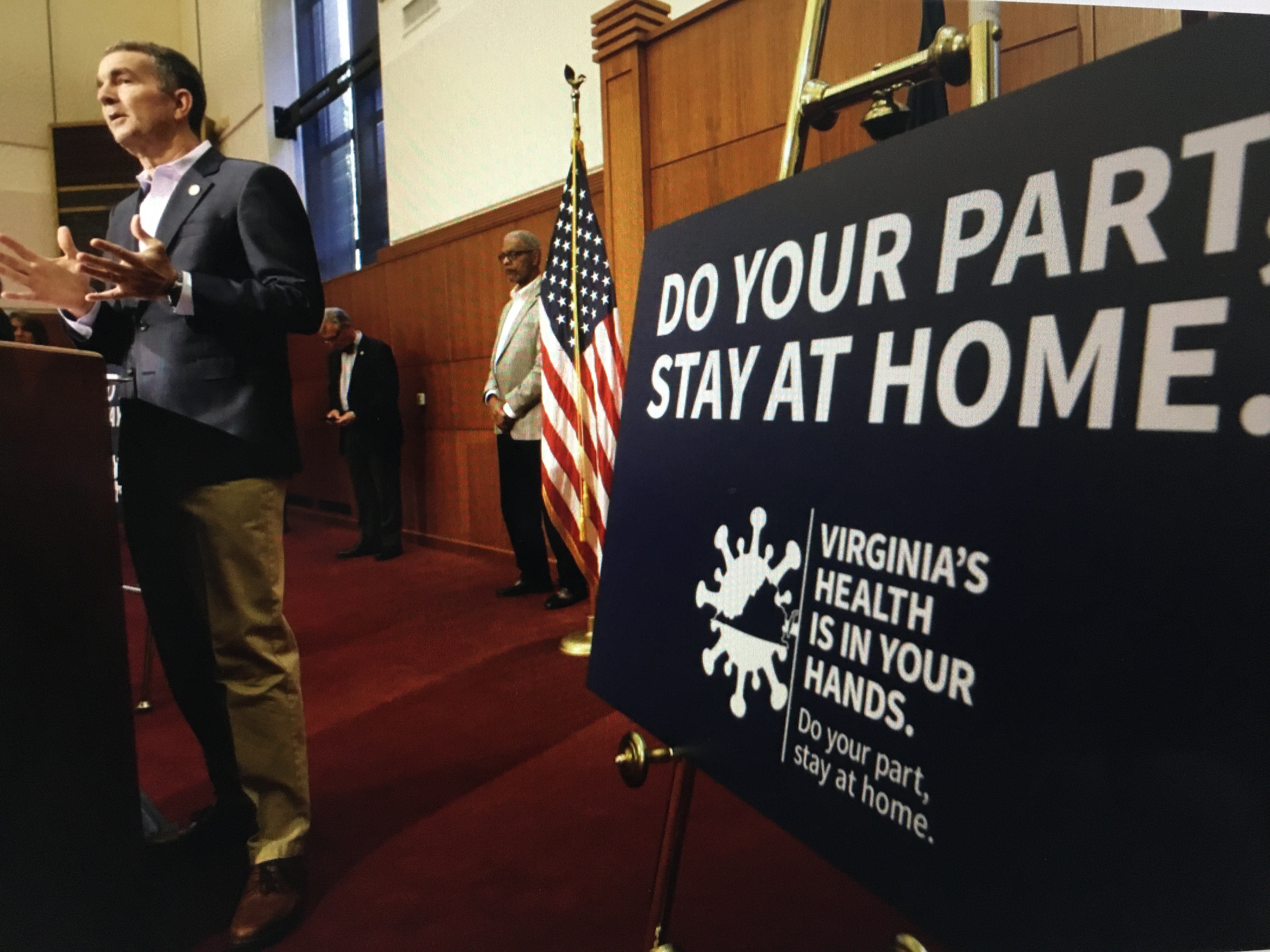
While discussing the desperate need for supplies at a recent news conference, [Virginia governor Ralph Northam] methodically listed all the resources a single coronovirus patient in the ICU would use in terms of staff — nurses, an attending physician, a cardiologist, a pulmonologist, an infectious disease specialist, a respirator therapist, a pharmacist and technicians to administer IVs and X-rays. The same patient would also require about about 240 items of protective equipment.
(Alan Suderman, “Nation’s only doctor governor offers sober voice on virus,” AP, abcnews.com, 4-9-20)
A highway checkpoint in Nakuru, Kenya, last month, set up to detect coronavirus symptoms. Suleiman Mbatiah/Agence France-Presse — Getty Images.
With the United States now leading the world in Covid-19 cases, the health care system fraying and the economy faltering, some American citizens — especially those living abroad — are starting to see their country in a new, unsettling light. As a result, some Americans have decided to stay in Africa, which was among the places that President Trump notably described with a disparaging and vulgar epithet.
“Africa just felt better,” said John Shaw, who has lived for two years in Nairobi, Kenya, with his wife and two sons. “There are a lot of unknowns in terms of how Americans will deal with this crisis. It didn’t feel obvious to us at all that it will go well there.”
(“For some American expats, ‘Africa just felt better’ amid the pandemic,” NYTimes, 4-8-20)
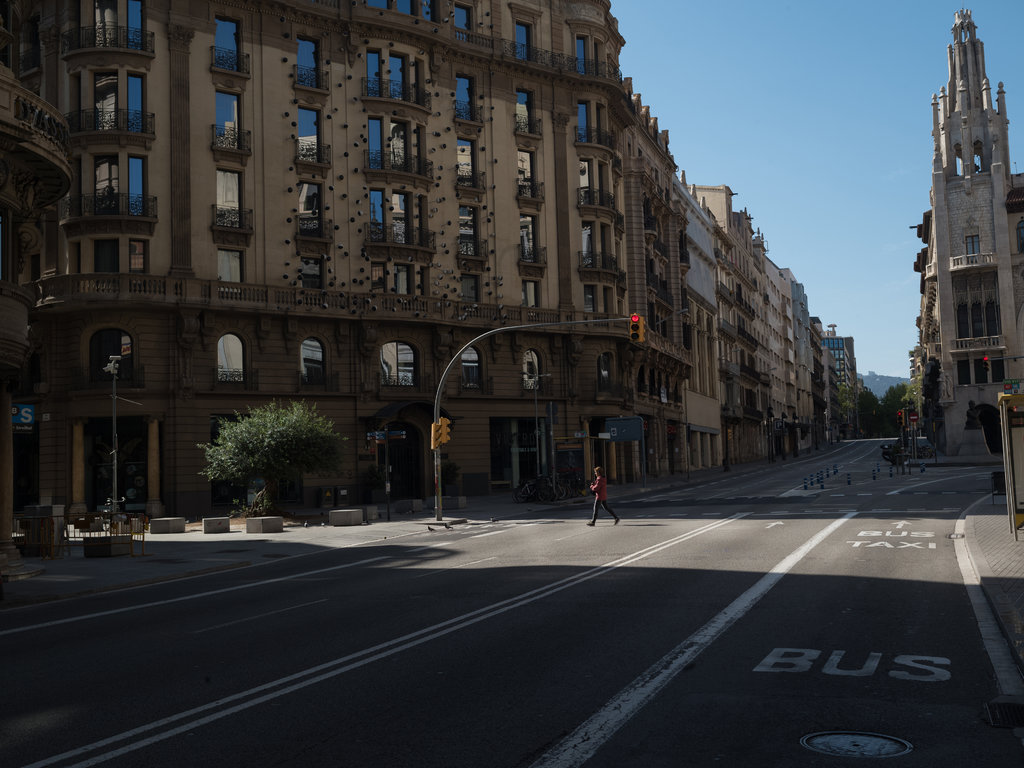
An empty street in Barcelona on Sunday. The health ministry reported on Wednesday another increase in the number of dead — 757 deaths overnight — bringing Spain’s toll to 14,555 since the start of the outbreak. Credit… Samuel Aranda for The New York Times.
As news filtered from the Joaquín Rosillo nursing home on the outskirts of Seville that a few residents had tested positive for coronavirus, worried families scrambled for information.
But amid a nationwide lockdown, with their movements limited, there were no clear answers. Manuel Borrego, whose mother lives in the home, heard through contacts that people were dying. But the nursing home’s management told him that it was “fake news.”[my bolding]
On April 6, 2020, 24 people were reported to have died at the facility.
(“Families fight for answers from Spanish nursing home where dozens died,” NYTimes, 4-8-20)
Henry Adams. Credit… Bettmann/Getty Images. [ca. 1883 per Wikipedia]
A photo of Henry Adams helped draw me into a review by George F. Will of an anthology of conservative thinkers (“American Conservatism: Reclaiming an Intellectual Tradition,” Edited by Andrew J. Bacevich).
In “The Education of Henry Adams (1907),” Adams recalled “visiting ‘the great hall of dynamos’ at a 1900 exposition of modern technologies.”
There he felt “his historical neck broken by the sudden irruption of force totally new.” This illustrates Bacevich’s theory that “modern” American conservatism “emerged in reaction to modernity,” by which he means “machines, speed and radical change — taboos lifted, bonds loosened and, according to Max Weber, ‘the disenchantment of the world.’”
(George F. Will, “The Mind of Conservatism,” NYTimes, 4-1-20)
My bond with Henry Adams’s work is not with his famous “Education,” but with his “Mont Saint Michel and Chartres,” privately published in 1904. Wikipedia describes it as
a pastiche of history, travel, and poetry that celebrated the unity of medieval society, especially as represented in the great cathedrals of France. Originally meant as a diversion for his nieces and “nieces-in-wish”, it was publicly released in 1913 at the request of Ralph Adams Cram, an important American architect, and published with support of the American Institute of Architects.
It’s good to be reminded during a plague of soulless conservatism that a sensibility and tongue such as Adams’s once stood and spoke for the better kind, even in disenchantment.
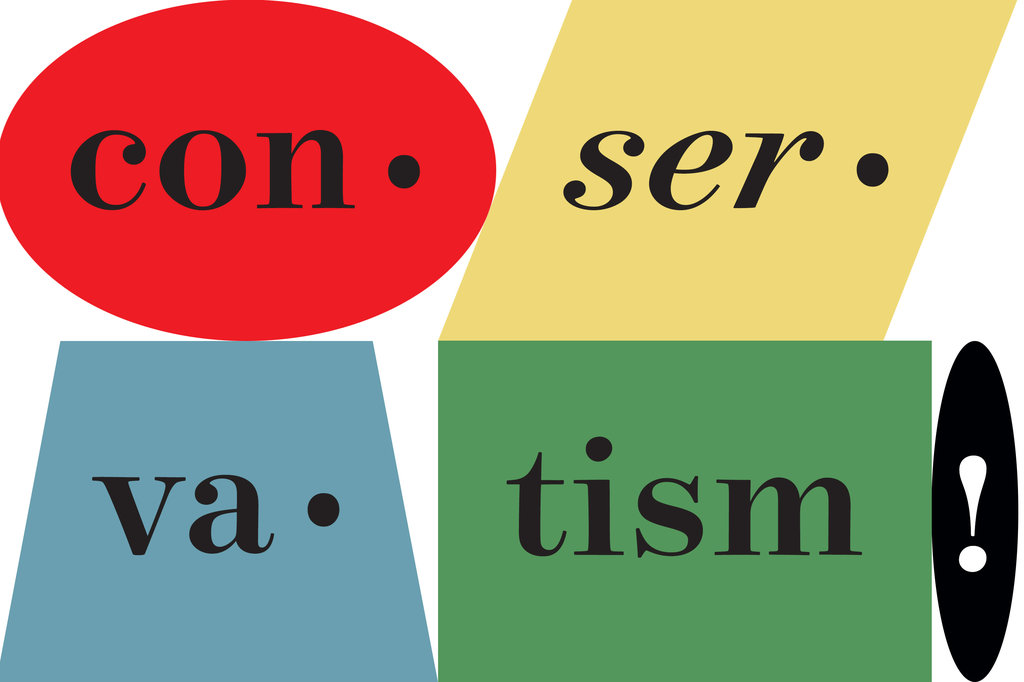
George Will reviews “American Conservatism: Reclaiming an Intellectual Tradition,” Edited by Andrew J. Bacevich. Being susceptible to typography-based graphics I was drawn in by the illustration. Will’s opening statement added enticement.
When assembling an anthology of writings representative of a political persuasion, the challenge is to acknowledge the persuasion’s varieties without producing a concoction akin to sauerkraut ice cream, a jumble of incompatible ingredients.
Two passages of Will’s critique sum it up. In the first, note the “however”; it betokens serious preceding quibbles.
The volume is, however, a nourishing cafeteria of writers, many of them justly forgotten but still interesting because they once were interesting.
Joan Didion. Credit… Associated Press.
The second passage credits Bacevich’s most inspired selection to be Joan Didion’s “1972 stiletto of an essay ‘The Women’s Movement,’ which begins, ‘To make an omelette you need not only those broken eggs but someone “oppressed” to break them.’”
Didion, who long ago contributed to National Review and in 1964 voted for Barry Goldwater, here exemplified an analytical acuity, stylistic verve and unenthralled mentality that conservatism, like other persuasions, rarely attains.
(George F. Will, “The Mind of Conservatism,” NYTimes, 4-1-20)
I confess to having to be reminded that there are, or have been at least, capable minds behind conservatism. The current scene belies it.







 EthicalDative
What Winning Looks Like
South Korea is steadily dropping in the rankings of countries worst-hit by the pandemic. Once second only to China (population: about 1.4 billion), South Korea (population: 51.6 million) is now recording fewer total cases than Ireland (population: 4.9 million) and fewer deaths than the state of Colorado (population: 5.7 million).
… As early as late January, public health officials greenlighted efforts by the private sector to build up capacity for widespread testing for the coronavirus… As those test results came in, the Korea Centers for Disease Control and Prevention and the Ministry of Public Health and Welfare made sure the information was passed on swiftly and systematically to those who needed it: the general public… Contact tracing and public data-sharing of the kind just beginning in hard-hit states like Massachusetts has been a standard feature of daily life here.
... South Korea has drawn on its strengths as a liberal society to address the public health crisis — and this week its people doubled-down on democracy by turning out in droves to re-elect its leadership… Mr. Moon now has wind in his sails as he enters his last two years in office. For the foreseeable future, his focus, like that of every head of state across the planet, will be pandemic management. [my bolding]
(John Delury, “How Democracy Won the World’s First Coronavirus Election,” NYTimes, 4-16-2020)
One hopes.
(c) 2020 JMN