More Wit, Less Affirmation!

aphorism

Illustration by Linda Huang; Photograph by Ophelia, via Getty Images.

Jessa Crispin cites two writers to illustrate the distinction she draws between aphorism and affirmation.

Aphorism: “He who fears death will never do anything worthy of a man who is alive.” (Seneca)

Affirmation: “I do not need the kind of love / that is draining, / I want someone / who energizes me.” (Rupi Kaur)

Poetry already has much in common with the aphorism, using structure, rhythm and metaphor to say something essential in a deceptively simple way. But somewhere along that road with the Instapoets, aphorism got confused with affirmation — those things you tape onto your mirror to remind yourself not to text your ex. The purpose of the aphorism is to bring unexpected perspective. The affirmation… only reinforces what we think we already know.

Crispin also plugs humor and brevity as useful tools.

With our highly divided attention, it is perhaps only humor that can provide us with a moment to pause and reflect… You know what they say: “If you want to tell people the truth, make them laugh, otherwise they’ll kill you.”

(Jessa Crispin, “Why Isn’t Instagram More Witty?” NYTimes, 6-1-19)

(c) 2019 JMN

Posted in Quotations | Tagged , , , | 1 Comment

Poetry for the Kitchen Slops Bucket

letitia

Leigh Guldig.

Lucasta Miller is the author of “L.E.L.: The Lost Life and Scandalous Death of Letitia Elizabeth Landon, the Celebrated ‘Female Byron.’” Landon’s “scandalous” death occurred at her own hand with prussic acid at age 36.

Even today, Letitia Landon provokes a virulently gendered response, as I have discovered after publishing a biography of her. One male critic wrote that I should have left her in the “kitchen slops bucket” of literary history. A female critic in the Italian press, on the contrary, thought Landon ought to be taught in schools.
(Lucasta Miller, “The Cautionary Tale of the ‘Female Byron,’” NYTimes, 6-1-19)

I don’t know the full context of the male critic’s remark; however, it seems unsuitably poisonous even in a dismissive appraisal of an artist’s work. There may be something other than strict weighing of poetic merit in play. Did Lucasta Miller flaunt feminist rhetoric in her narrative of Letitia Landon’s life?

To be fair, there might be perceived gender taint in the judgment of the Italian female critic who wants Landon taught in schools. Her language, however, doesn’t appear as fulsome as the male critic’s is feculent. Doubts flap in the wind absent a firsthand reading of the texts.

(c) 2019 JMN

Posted in Commentary | Tagged , , , | Leave a comment

Guide by the Perplexed — No Money Shot

gris guitar

Juan Gris, “Guitare sur une table,” from 1916, at Helly Nahmad. Credit via Helly Nahmad Gallery.

An old advertising tag-line for an investment firm was voiced by the British-American actor John Houseman: “We make music the old fashioned way; we earn it.” Houseman, of course, said “money,” not “music.”

In my effort to show with strong, plain words how I want to earn music, an inconvenient analogy has surfaced. There is something called PornHub. I’m going to imagine its analog as “MusicHub.”

On MusicHub, the dude pulls some sweet riffs and licks from his Fender. Then he tells how you can make those sounds, too, especially if you subscribe. The orientation is positional and result-minded; a tad exhibitionistic. Do this, do that, until “Sweet Home Alabama” happens.

Let’s be glib: PornHub is sexual but not sensual; MusicHub is digital but not musical. I want note awareness and the architecture of song before release. I want to explore a nuanced relationship with the instrument — slow, not fast; soft, not loud; tender, not dominating; intuitive and expressive, not wham-bam-thank-you-ma’am.

But, you say, “I merely want to learn several chords and strum some accompaniment. Maybe hammer out a few bars of ‘Smoke on the Water.’ I’m not looking for a committed relationship with a guitar.” Well, yes, there is that too, I concede. MusicHub does have its uses if your needs are basic and your standards are modest.

The way of perplexity is the long way around. It hinges on a dawning awareness that there’s no quick fix for musical longing. This isn’t self-help pablum; if anything it’s self-hindrance apologia, though the shame of nakedly hitching my wagon to difficulty and not gratification shines through.

There you have it. It’s time to get back down to brass tacks — coming next.

(c) 2019 JMN

Posted in Anthology | Tagged , , | 6 Comments

Francophilia

notre dame

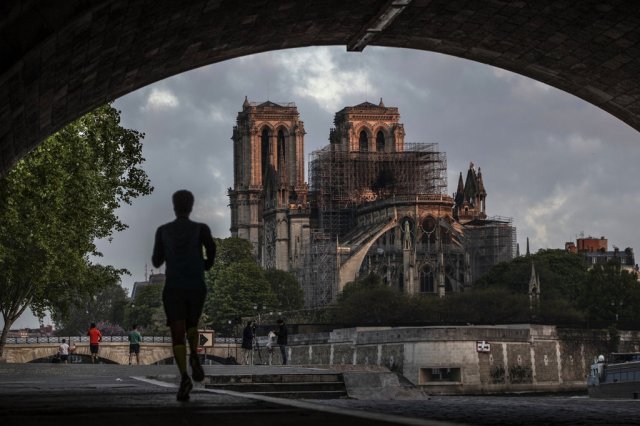
Notre-Dame cathedral in Paris at sunrise on April 17, two days after it was badly damaged by fire. Credit Dan Kitwood/Getty Images.

Where I live I have not encountered in recent memory an American who knows, or wants to know, French. Roger Cohen’s encomium to the language and culture is touching. It’s poignant to share French love with another outsider.

To be a Francophile is a life sentence… a slightly illicit gift of ever-renewed pleasures… Paris has been important to me… It’s where I began to see that writing is not a choice but a need…
Style, as Flaubert observed, is “the discharge from a deeper wound.” … Paris reassures me. It is a repository of our fantasies, a redoubt of hope, a source of courage.
(Roger Cohen, “The Lessons of Paris and the Violence of Hope,” NYTimes, 5-31-19)

(c) 2019 JMN

Posted in Commentary | Tagged , , | 4 Comments

Second Take

art critic schjeldahl

The art critic Peter Schjeldahl. Credit Gilbert King.

Learning something about a picture — how it’s made or its origin, for example — can trigger or enhance appreciation. I wonder if an artist really wants that? Wouldn’t he or she prefer that the work commune directly and totally with the viewer? (Poets do, I think.)

Art critics make a living telling people what they (the critics) think and feel about art works. Although they’re not necessarily prescribing how viewers should react, critics qualify as influencers if they’re good at what they do.

What does being good at criticism entail? The looking is important, of course, but a large part of the knack is in the writing. Charles Finch (a novelist and critic) bestows the crown of “artist” on Schjeldahl’s output straightaway in his review.

Peter Schjeldahl is a great artist… Is criticism an art? It’s a valid, exhausting question. Criticism follows other people’s work; then again, so does all human invention. What lab-pure operant-conditioning chamber do we imagine “real” artists spring from?
(Charles Finch, “The Penetrating Gaze of One of America’s Most Brilliant Art Critics,” NYTimes, 5-24-19)

Weakness for a glib turn of phrase makes me vulnerable to critical rape. Something Roberta or Peter (or Charles) has written may have me looking anew at a painting, searching for what she or he saw, before realizing I’ve been molested.

When I was a professional student (irony noted), I would bridle internally when literature professors called me to account for the critical theory surrounding a particular school or period — the secondary writings. Wait! I would think. Let me have my unfiltered moment with the primary writings first!

(Flashback: The most awkward moment during my dissertation defense was when Juan Bautista Avalle-Arce asked me had I read so-and-so’s book on the subject. My reply in the negative felt lame. Excuse me, I was busy with the subject! I harrumphed silently).

(c) 2019 JMN

Posted in Anthology | Tagged , , , | Leave a comment

Pursuant There Two

hyena

The threads of spirituality and of blogging are starting to intersect for me.

The bedrock of my spirituality is the intuitive knowledge (not faith) that what made me made every virus. If I were assisted by something religious it would be the sixth commandment and the golden rule. In the latter, “others” would include rocks.

The bedrock of my bloggery is “… if you orient your life around attention, you will always feel slighted. You will always feel emotionally unsafe.”
(David Brooks, “When Trolls and Crybullies Rule the Earth,” NYTimes, 5-30-19)

Everything flows from these knowledges. How do they intersect? Well, they’re both bedrock. What made bedrock made me.

(c) 2019 JMN

Posted in Commentary | Tagged | Leave a comment

Cricket Talk

viv richards

Vivian Richards takes part in the festivities on the Mall in central London. Photograph: Charlie Crowhurst/IDI via Getty Images.

[Paraphrase] The bowlers were boys from the groundstaff. One had the temerity to bowl a beamer at Viv Richards. Viv shot the kid an icy glare. The kid bowled him an apologetic delivery. Richards creamed it for four into the tree at cover point.

(Andy Bull, “Sodden World Cup opening ceremony puts anticipation in deep freeze,” The Guardian, 5-29-19)

This account creamed it for me.

(c) 2019 JMN

Posted in Commentary | Tagged , | Leave a comment

Two Takes

If there were a muse named Ironia, it strikes me that she would be an inspiration for Rutene Merk and Lynn Hershman Leeson. The two images below have little in common other than depicting females. They both incite interest, however, by appearing to be what they’re not.

aki

“Aki” (2019), oil on canvas, by Rutene Merk in her new show, “Sprites.” Credit Rutene Merk and The Downs & Ross, New York; Jeffrey Sturges.

The gamey image of “Aki” with its “eerie, unpainterly appearance” had for me the initial impact of a velvet Elvis. It might beckon to teenagers from a video arcade. Then I read the following:

Ms. Merk, a Vilnius-born, Munich-based painter… manipulates the figures and backgrounds in her paintings, simulating techniques like masking and 3-D texturing mapping in computer graphics. Her paintings also look as if they might’ve been sprayed or digitally printed, but they were created the old-fashioned, analog way, by simply painting on canvas. — MARTHA SCHWENDENER

(“New York Art Galleries: What to See Right Now,” NYTimes, 5-23-19)

I still don’t warm much to the picture, but knowing how it’s made provoked a second look. When working as a programmer I dreamed of painting deadpan pictures of computer screens. For me it was an idle fantasy of kicking over the traces; artists like Merk have run with the notion in some sense. The digital world that worked so hard to look, act, and sound analog is impishly modeled with analog media made to look digital. Who gets to decide, by the way, that painting on canvas is old-fashioned?
roberta

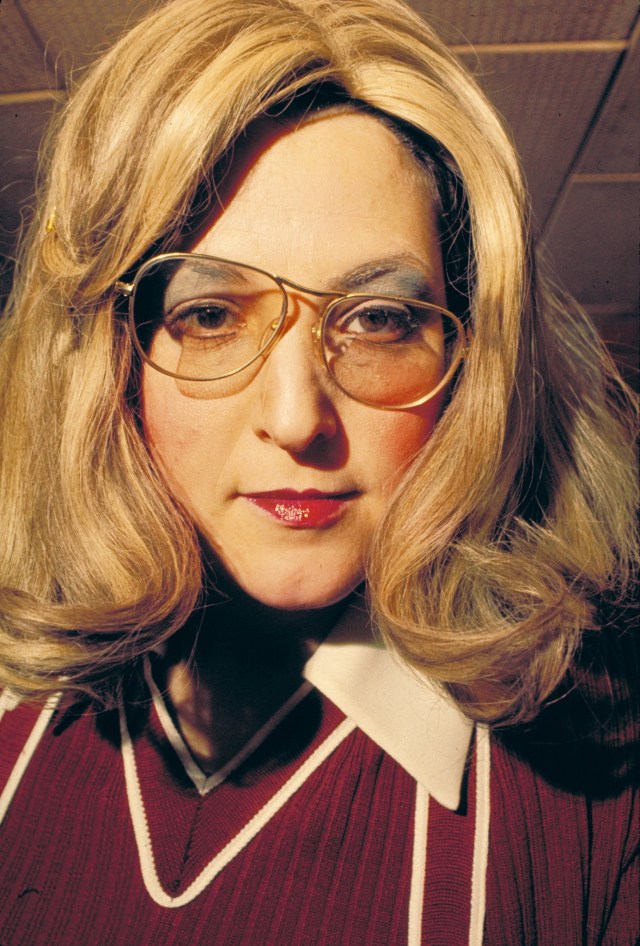
Lynn Hershman Leeson’s “Roberta Getting Ready to Go to Work” (1976) portrays Roberta Breitmore, Ms. Leeson’s alter ego[,] in a multiyear performance piece that lasted throughout the ‘70s. Lynn Hershman Leeson and Bridget Donahue, New York.

“… [Lynn Hershman Leeson’s] alter ego, Roberta Breitmore, was a very living thing. She had a public life, she had a P.O. Box and Social Security number and I think even a passport. But she didn’t exist.” (Tilda Swinton)

(Ted Loos, “Inspired by Virginia Woolf, Curated by Tilda Swinton,” NYTimes, 5-22-19)

My experience of “Roberta Breitmore” begins and ends with this article. In the photo she has an appealing zaniness conveyed on several fronts: the big hair, the skewed spectacles, the quizzical stare, the title-driven context (“getting ready to go to work”), the studiously applied lipstick. Knowledge that she’s a meticulously contrived fiction boosted the wry kick I got from the image.

Whatever fizz both pictures generated was heightened, for me, by revelation from outside the picture space.

(c) 2019 JMN
Posted in Commentary | Tagged , , , | Leave a comment

“Strangeness”

gell-mann

Murray Gell-Mann, recipient of the 1969 Nobel Prize in Physics, in 2003. Credit Jane Bernard/Associated Press.

Science, art and language collide a lot in the field of theoretical physics, it seems. There are appealing language touches in the work of Nobel laureate Murray Gell-Mann profiled in this article.

He “mischievously” named his theory of elementary particles “The Eightfold Way” after a Buddhist doctrine of liberation.

He named formerly unobserved particles “quarks” after a term encountered in Joyce’s “Finnegan’s Wake.” He called force-carrying particles that hold quarks together “gluons.”

“He proposed a physical quantity — “strangeness” — that would explain why some particles lasted longer than others.”

Gell-Mann helped found the Santa Fe Institute, which is today “the world’s leading research center on complexity.” Novelist Cormac McCarthy is a Fellow in that institute.

Last but not least: “His final research program was an expansive project to study the evolution of human languages.”

He was the kind of language maven who would correct people on the pronunciation of their own names, and complain to servers at French and Spanish restaurants about misspellings on their menus.

(Sean Carroll, “The Physicist Who Made Sense of the Universe,” NYTimes, 5-28-19)

Only a consummate theoretician who was also a “wide-ranging polymath, well-versed in archaeology, history and ornithology” could pull off such majestic effrontery.

(c) 2019 JMN

Posted in Commentary | Tagged , , | Leave a comment

Parting Looks — Jack Moore

[Transcription] The Civil War battle scenes made in the oak forest on the Anita Baldwin ranch were made for stock use in any Civil War battle sequence for M.G.M. In the eighteen days of battle scenes on the “set” more … Continue reading

More Galleries | Tagged , , , , , | 1 Comment