In the languages I can navigate, here are various translations. All but “Cortés” are from here:
English settle your affairs (Dr. Mustafa Khattab, The Clear Quran) and set your relations right (T. Usmani) and make things right between you (M.A.S. Abdel Haleem) and set things right between you (A. Maududi (Tafhim commentary)) and adjust the matter of your difference (M. Pickthall) and keep straight the relations between yourselves (A. Yusuf Ali) and adjust all matters of difference among you (Al-Hilali & Khan) and amend that which is between you (Saheeh International)
Spanish ¡Manteneos en paz! (Cortés) solucionad vuestros conflictos (Sheikh Isa Garcia [sic]) y arreglen las diferencias entre ustedes (Noor International Center) y arreglad las diferencias entre vosotros (Montada Islamic Foundation)
French Mettez un terme à vos différends (Rashid Maash) arrangez-vous à l’amiable dans vos rapports (Montada Islamic Foundation) Maintenez la concorde entre vous (Muhammad Hamidullah)
For the casual reader keen on registering a quick “like”: “Work things out between yourselves.” Or: “Stop your squabbling.” The translations agree more or less that this is the message. It’s a wonderful admonition for constructive disagreement converging on concerted, positive action. Democrats traditionally never learn the lesson. Politically, they’re a flotilla of sloops tacking to shifting winds as the Republican dreadnaught steams past them into elected office. But I’ve other fish to fry.
For the committed reader in for the long haul: What do the words wa-‘aṣliḥū ḏāt(a) bain(i)-kum actually say? As a reader of poetry and translator, I tread the contentious knife edge of a notional distinction between what words “say” and what they “mean.” I dwell continually on the saying side, where intimate grammatical relationships unfold, wagering that therein may lie less obvious, more revelatory meaning.
To grasp the passage fully, I thought I had to better understand how ḏū (pronounced THOO with the voiced “th” of “that”) works. It’s a species of particle that acts as a noun, declined for case, number and gender, but which is always paired with a following word in genitive case to create a descriptive compound. Wehr lists the meanings of ḏū as: possessor, owner, holder or master of, endowed or provided with, embodying or comprising something. Example: ḏū māl(in) (possessor of goods = wealthy)…
But wait! The feminine form of ḏū is ḏāt, also subject of a lengthy Wehr entry. Clearly, ḏāt (pronounced THAHT) has staked out its own lexical terrain. The meanings listed include: being, essence, nature; self; person, personality; the same, the selfsame; -self. Lo and behold, the first example of a ḏāt construction that Wehr cites is the one we’re examining: ḏāt al-bain. Meanings listed for the phrase are: disagreement, dissension, disunion, discord, enmity; friendship [!]. So the phrase means what the translations have captured in various wordings: Put paid to your discord. Case closed? Nope.
The words wa-‘aṣliḥū ḏāt(a) bain(i)-kum don’t actually say what any of the above translations register. The phrase’s approximate grammatical description is conjunction+imperative verb+direct object+genitive noun+possessive pronoun. What its words might say is: Put in order the essence of your difference. Or perhaps: Repair the nature of your separation.
In many respects we’re in the realm of idiom, a cousin of metaphor. The languages I know are riddled with idiomatic expressions whose purport is other than the literal sense of their wording. “To get a leg up” on someone is to gain advantage over him — nothing to do (now) with wrestling.
I want to keep chasing what the words say, not mean, because it leads to my title.
What induced me to dive into the ḏū lagoon was partly a misreading: I mistook the noun bain (separation, interval, difference) for the preposition baina (between, among). It made me think I was seeing a novel pairing of ḏū, which is usually annexed to a substantive. This is plumb loco! I said to myself. As it happened, the loco one was me.
I can’t conclude without sharing what I learned from Lane. The Lexicon’s article on ḏū contains the following statement and examples: … In these instances… that which is contained is made to be as though it were the possessor (ṣāḥib) of that which contains. (I think of this as akin to quantum matter existing in multiple states.) Examples:
waḍa^at(i)-l-mar’aẗ(u) ḏā baṭn(i)-hā. The words say: “The woman dropped the possessor of her belly.” Lane’s translation: The woman brought forth [her child]. ‘alqat(i)-d-dujājaẗ(u) ḏā baṭn(i)-hā. The words say: “The hen dropped the possessor of her belly.” Lane’s translation: The hen laid her egg, or eggs. ‘alqā-r-rajul(u) ḏā baṭn(i)-hi. The words say: “The man dropped the possessor of his belly.” Lane’s translation: The man ejected his excrement, or ordure.
In each case, that which is contained — child, egg, excrement — is conceived as being possessor (owner, holder, etc.) of what contains it (belly).
Committed reader, you’ve weathered a grueling dilation. Thank you, and happy trails until we meet again.
Really, I should draw, paint and read more, write less. It’s a constant struggle to pipe down.
Poetry, for one thing, triggers me. Intending to read a bait of versifying, before I know it I’m a keyboard Roman candle ejaculating dubious sparkle. Spurious expatiation is my calling card, if not what I was minted for. Meanwhile, the unconsumed verses lie belly up like stranded beetles flailing to be righted. (I’m testing the simile aloud, wondering if it should see service.)
Blessedly, most of my spew goes unmissed and unmourned to a delete-marked grave. What survives the cull undergoes savage trimming. Self-reference goes packing — a ragout of moi has a pitiable shelf life. If I can’t see past the white of my eyes, where are we? Indeed, you’re entitled to marvel why this selfsame sad-sack sally isn’t slumbering on Boot Hill. (Does this need an exclamation point?)
A euphemism I retain from immersion in spy thriller fiction is the term “wet work.” In the genre it means killing people, and torturing them as a form of information retrieval. There were spooks in the fictions whose job description included performing wet work; others who delegated the nastiness to specialists.
Art imitates life in so many ways. War is delegated nastiness on an industrial scale. Our woebegone world is awash in wet work, wasted by a wanton welter of wizard weaponry. It makes you puke your weltanschauung.
Wet work deemed “holy” is interesting. In ancient writings a Maker cheerleads the killing of certain of His creatures by others of His creatures. Some, after dying in this dimension, are consigned to a sempiternal state of agony in another dimension. This mode of operation is so… ungodly… for lack of a better word. Faith only knows. It says Maker calls the shots, come what may.
Religion and AI share at least one trait: Both have the potential for bringing good things to life, but we must protect ourselves from the power of each to hurt us. Silicon doesn’t have nerve endings. A capacity for suffering is the franchise of homo sapiens, not machina sapiens. Religion knows this in its bones. That’s why textbook Hell is being burned alive, not rendered stupid.
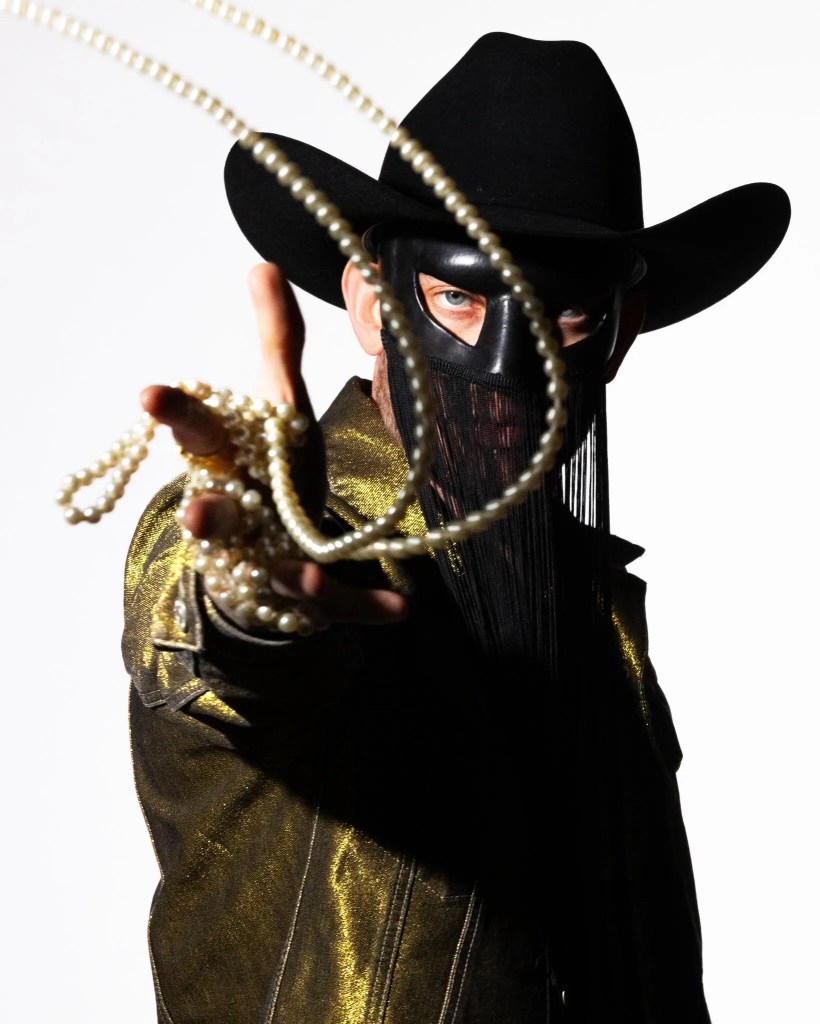
After making a name for himself in the country-music world with his dramatic masks, Orville Peck will be (mostIy) barefaced in his Broadway debut — eye shadow notwithstanding. “I’m here to play this role and to bring respect and integrity and hopefully a good performance to it,” he said in a recent interview. “It’s not about me.” Credit…Thea Traff for The New York Times. [New York Times caption and illustration]
The Lone Ranger rides again! That was my first take on the photo. Then it stirred my childish you-haven’t-earned-your-Stetson attitude. I was sure the article would nudge me toward curdled cowboy hat bête noire-ism. But wait:
As he cavorted across the makeshift stage, Mr. Peck flexed his muscles, narrowed his eyes and sang in a booming baritone — he looked rascally, menacing, in heat. But then he extended a leg, lifted his opposite heel and, lickety-split, stuck out his buns. The butch-femme push-pull that defines his country persona was there, even if his mask was not.
When I finished the article, I was grinning pleasantly. Sometimes it’s best to resist an attitude. (Who knew?) Art, with a hefty pinch of cheek and dash, can do wonders for a tired stereotype. You go, masked dude!
“The irony is that if I put my mask on, I’m suddenly not anonymous anymore… I just take my mask off and walk around like normal and then no one knows who I am.”
(Orville Peck)
(Erik Piepenburg, “Orville Peck Confirms He Will Perform Unmasked in ‘Cabaret’ [Orville Peck Takes His Face Out for a Spin].” New York Times, 3-17-25)
Amanda Williams, “She May Well Have Invented Herself,” 2024, a painting with Williams’s Innovation Blue pigment, Alabama red clay gesso on wood panel[.] Credit… Amanda Williams; via Casey Kaplan, New York; Photo by Dan Bradica Studio [New York Times caption and illustration]
“There is something anthropomorphic about this work… I didn’t force it. That’s what made it powerful.”
In her studio, Williams experimented with her Prussian blue, layering, diluting and pouring the paint, letting it crack, pool and bleed across the canvas. The apparition on the first canvas was the only full human form to materialize… The rest of the resulting paintings — such as the evocatively titled “Historical Elisions, Gap for Blue” and “Blue Smells Like We Been Outside” — produced their own ghosts, neither fully figurative nor entirely abstract. Some suggest torsos, while others allude to landscapes, rivers, or veins.
[… A] wall installation titled “Run Together and Look Ugly After the First Rain,” 2025; center, “I Don’t Sing If I Don’t Mean It,” 2025; right, “Blue Smells Like We Been Outside,” 2025. Letting Prussian blue crack, pool and bleed across the canvas created apparitions that suggest torsos, landscapes or rivers. Credit… Elias Williams for The New York Times. [New York Times caption and illustration]
The blue originated in the workshop of George Washington Carver, the Tuskegee food scientist known mainly for his research on peanuts. Carver was an amateur painter who developed and patented his own pigments, including a Prussian blue, from the Alabama soil Black farmers worked at the turn of the 20th century.
Williams discovered in her research that Carver registered a patent in 1927 which described refining red clay soil into paint and dye.
Her works seem to evoke a topography of water and land. Center: “And My Arms Thrown Wide in It, As if for Flight,” 2025. Right: “The Dream Is the Truth. Then You Act and Do Things Accordingly,” feels spectral, 2025. Credit… Elias Williams for The New York Times. [New York Times caption and illustration]
Williams, a Cornell-trained architect, has a deep understanding of color… Williams uses color to alchemize fraught histories into expressions of joy and resilience… For her 2015 project “Color(ed) Theory,” Williams coated eight homes scheduled for demolition on Chicago’s South Side in bold colors — “Currency Exchange yellow,” “Flamin’ Hot orange,” “Crown Royal purple” — referring to consumer products associated with Black life in America… “Amanda understands color tactically, strategically, and historically,” said Michelle Kuo, the chief curator at large and publisher at MoMA. “She’s not just using it for its visual impact, but to map out ideas of place, memory and Black culture. That really is her superpower.”
A wall installation, “Run Together and Look Ugly After the First Rain.” Credit…Elias Williams for The New York Times. [New York Times caption and illustration]
“I want to make sure that the work… stands on its own… It doesn’t have to just carry the baggage of history.”
“If you don’t like country music, get outta the way! Cause we’re KBUCK and we’re gonna keep comin’ atcha!”
(A radio station, name disguised)
In Arabic, ignorance is expressed with a verb, not a predication. It’s not a state you are in, but an act you perform. The root is j-h-l and “I am ignorant” is ‘ajhal(u). A closer translation might be “I do ignorance.”
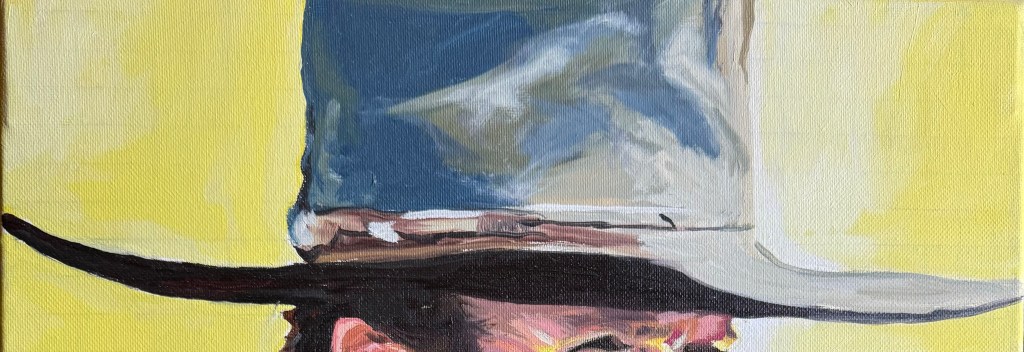
Detail, oil on canvas (JMN 2017).
A perspective emerges in which a state of unknowing is achieved by an act of avoidance; it’s not a condition foisted upon a supine recipient.
Detail, oil on canvas (JMN 2018).
That small meditation on language sparked what follows, which coheres, if at all, by the sheerest of threads.
Detail, oil on canvas (JMN 2022).
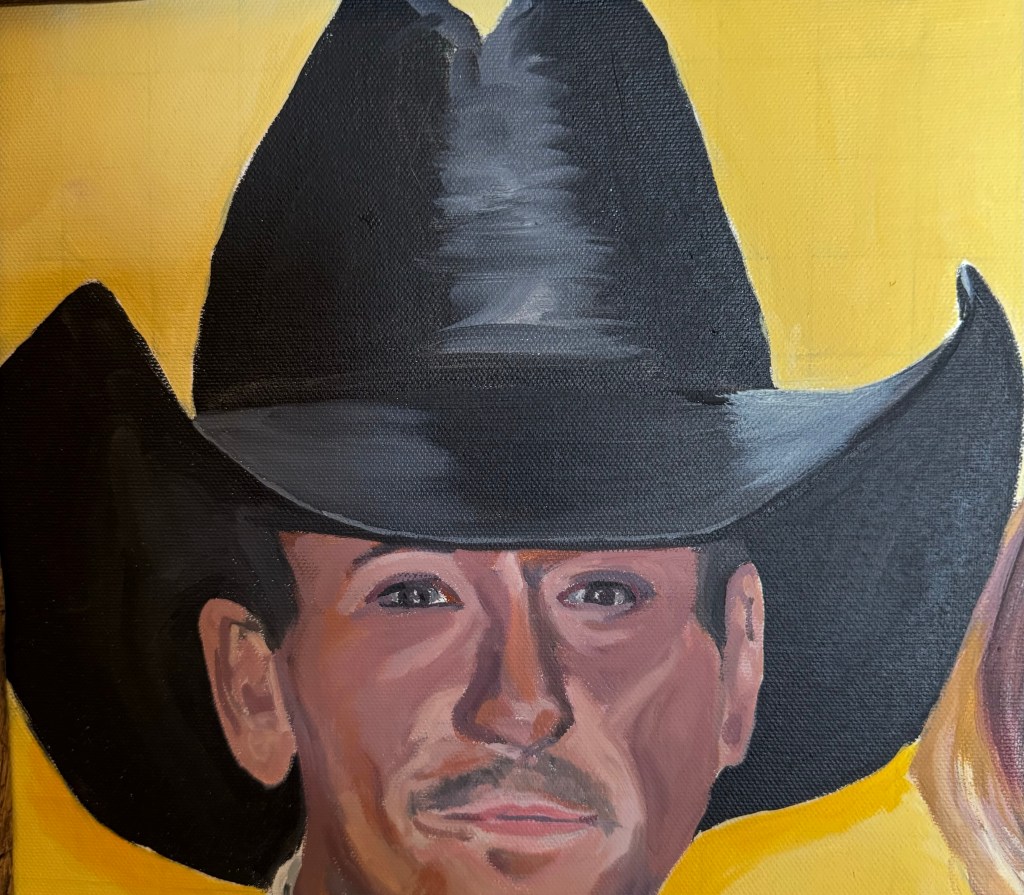
Truly I have done ignorance, for I fear men in Stetson hats. In my little boy brain they waft a profile of aggressive callousness, a hankering for dismissive swagger.
Detail, oil on canvas (JMN 2021).
It’s phobic, not objective, and has caused me to ignore country-western music.
Detail, oil on canvas (JMN 2017).
By shunning an art form embedded in my culture, I’ve cold shouldered an ethos that recoils from things I hold dear, but also exults in postures that feel elemental to me.
Detail, oil on canvas (JMN 2022).
Hey, KBUCK, I’m gettin’ in your way now. Come at me! I’m listening on the radio in my car. Yours truly, JMN.
Detail, oil on canvas (JMN 2017).
“I feel like a stone that you’ve picked up and thrown to the hard rock bottom of your heart.”
(Refrain on the radio)
Mel at 15 months.
On my walks in Fairview Cemetery one day I found a puppy hanging out there. Took him home, named him Mel. When the vet examined Mel, he found a festering bullet wound. The projectile had passed through the pup’s neck, narrowly missing his trachea. Mel lived with me to be a grizzled old sweetheart. On our many walks in the small town, he would always sit down abruptly and refuse to move whenever he spied a man in a Stetson hat. You’re probably imagining the same thing I did: The man that shot him wore a hat. I would always let the dog lead us in a different direction.
Nearly every work from Kiefer takes up a wall or a room. Credit… Ilvy Njiokiktjien for The New York Times. [New York Times caption and illustration]
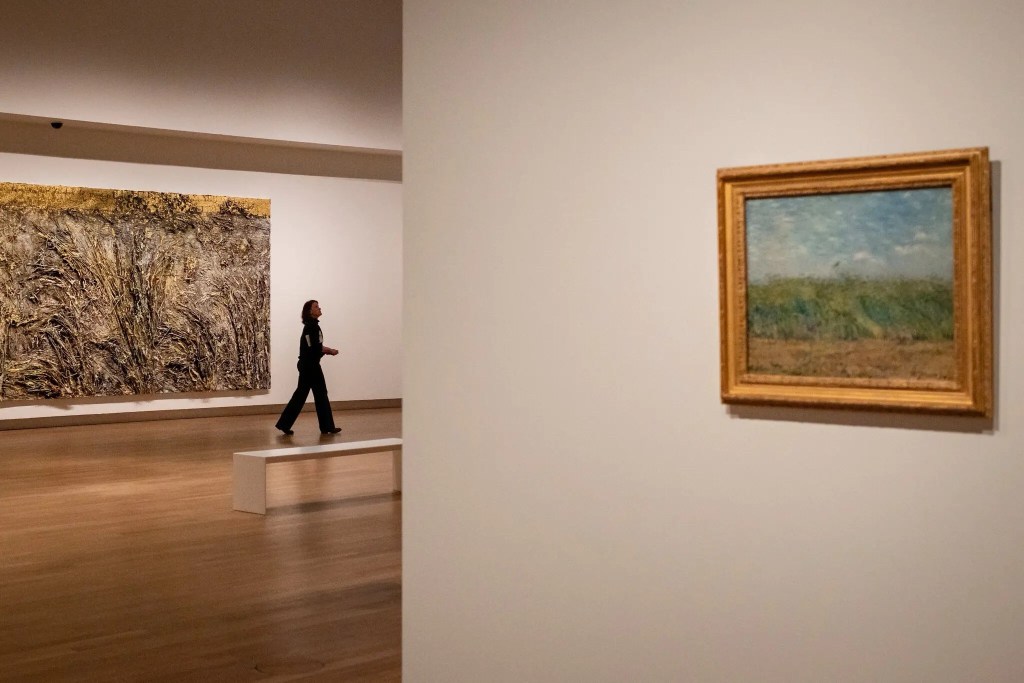
His layers of paint, a mudlike impasto, oil and acrylic paints mixed with raw materials like soil, iron, straw and dead leaves, form deep furrows on the canvas. These landscapes, with van Gogh’s high horizon lines, all seem to be ruins, shot through with blood and shrapnel.
Kiefer’s “Under the Lime Tree on the Heather” and Vincent van Gogh’s “Wheatfield With Partridge” at the Van Gogh Museum in Amsterdam, which juxtaposes Kiefer’s landscape paintings with van Gogh works. Credit… Ilvy Njiokiktjien for The New York Times. [New York Times caption and illustration]
(Nina Siegal, “Anselm Kiefer Wonders If We’ll Ever Learn,” New York Times, 3-7-2025)
The family must have had a matriarchal streak, for I was grandly mothered.
Grandmother had a choir-dominating soprano voice in the native stone church. She knew her way around the hymnal. Could coax some harmony from the ivories of an upright piano. Reveled in a good singin’ in the living room: Rock of Ages, The Old Rugged Cross, Bringing in the Sheaves.
When Elvis reached the West Texas scene, she sniffed that she couldn’t fathom how anyone could find his music pretty. In its way her assessment was accurate. It wasn’t.
Oh, she could curse, and kept a shotgun in her kitchen in the day — it was a wild, lonely place and lean times. But her nature was sweet. She was a placid, benevolent, stalwart, indulgent, inquisitive, supportive, gregarious, voluble presence. A loyal correspondent in a strong cursive hand.
I never knew her as “granny” or “nana” or the like. She was Grandmother.
Only once before have I presumed to “write a song.” I use scare quotes because I’ve really no idea how it’s done. This latest go-round involves new lyrics for an existing tune. I posted the first version here, and have since added a coda. The last line of the posted version is changed to:
Old roan horse, she’ll lead me to you. (versus Old roan horse, she’ll know what to do.)
I had rejected the “lead me” line earlier, feeling it was implausible on top of sentimental, too close to Disney. Horses return to where they’re fed, and they don’t play Lassie. But here’s the thing: Whereas sentimentality pollutes poetry, it sits pretty in songs. Songs are not poems, nor poems songs (in my view).
The coda is a fourth stanza with a diverging rhyme scheme (AABB) sung with melodic variation. Reprising certain imagery, then invoking redundantly the bondedness of the humans to each other and to the beast, makes the story arc feel more complete:
We’ll tarry a spell where the shadows grow long, Lay us down softly in mourning dove song, Then the old roan horse will carry us two, The two of us home on her back, me and you.
An interesting trait of songs is their affinity with nonstandard grammar. She don’t, he don’t or it don’t often fits a country-western song’s rhythm and spirit better than “doesn’t.” The same is true with “ain’t” versus “isn’t” or “aren’t.” Songs are amenable to nonstandard or antiquated usage. I was aware of using beat-driven idiom in previous stanzas of the “Roan” lyrics:
A sip of sweet water is nought but her due … The ranchwoman gazes where last she did see Her good man a-mounted set out for Old Blue
We embrace old-timey, emotive, even mawdlin language in minstrelsy and balladry which we would find distracting in other contexts.
So in my lyrics, the cattleman’s horse has wandered home riderless. The ranchwoman mounts it and rides to where her husband lies in some disabled state. Maybe she splints his injured ankle and the two return home double mounted. Maybe she finds him dead from a rattler’s bite, and returns with his body draped across the saddle. Perhaps, in grieving over his corpse in cottonwood umbrage at creekside, enveloped in the lonesome plaint of mourning doves, she herself expires, plumb heartbroke, and the two of them go dearly departed, spirit-wise, into the cosmic by-and-by, transported on the back of an astral roan. It could happen — it’s a song!












 EthicalDative
What’s in YOUR Belly?
The Arabic phrase under examination is this (with my transliteration):
وَأَصْلِحُوا۟ ذَاتَ بَيْنِكُمْ ۖ
wa-‘aṣliḥū ḏāt(a) bain(i)-kum
In the languages I can navigate, here are various translations. All but “Cortés” are from here:
English
settle your affairs (Dr. Mustafa Khattab, The Clear Quran)
and set your relations right (T. Usmani)
and make things right between you (M.A.S. Abdel Haleem)
and set things right between you (A. Maududi (Tafhim commentary))
and adjust the matter of your difference (M. Pickthall)
and keep straight the relations between yourselves (A. Yusuf Ali)
and adjust all matters of difference among you (Al-Hilali & Khan)
and amend that which is between you (Saheeh International)
Spanish
¡Manteneos en paz! (Cortés)
solucionad vuestros conflictos (Sheikh Isa Garcia [sic])
y arreglen las diferencias entre ustedes (Noor International Center)
y arreglad las diferencias entre vosotros (Montada Islamic Foundation)
French
Mettez un terme à vos différends (Rashid Maash)
arrangez-vous à l’amiable dans vos rapports (Montada Islamic Foundation)
Maintenez la concorde entre vous (Muhammad Hamidullah)
For the casual reader keen on registering a quick “like”:
“Work things out between yourselves.” Or: “Stop your squabbling.” The translations agree more or less that this is the message. It’s a wonderful admonition for constructive disagreement converging on concerted, positive action. Democrats traditionally never learn the lesson. Politically, they’re a flotilla of sloops tacking to shifting winds as the Republican dreadnaught steams past them into elected office. But I’ve other fish to fry.
For the committed reader in for the long haul:
What do the words wa-‘aṣliḥū ḏāt(a) bain(i)-kum actually say? As a reader of poetry and translator, I tread the contentious knife edge of a notional distinction between what words “say” and what they “mean.” I dwell continually on the saying side, where intimate grammatical relationships unfold, wagering that therein may lie less obvious, more revelatory meaning.
To grasp the passage fully, I thought I had to better understand how ḏū (pronounced THOO with the voiced “th” of “that”) works. It’s a species of particle that acts as a noun, declined for case, number and gender, but which is always paired with a following word in genitive case to create a descriptive compound. Wehr lists the meanings of ḏū as: possessor, owner, holder or master of, endowed or provided with, embodying or comprising something. Example: ḏū māl(in) (possessor of goods = wealthy)…
But wait! The feminine form of ḏū is ḏāt, also subject of a lengthy Wehr entry. Clearly, ḏāt (pronounced THAHT) has staked out its own lexical terrain. The meanings listed include: being, essence, nature; self; person, personality; the same, the selfsame; -self. Lo and behold, the first example of a ḏāt construction that Wehr cites is the one we’re examining: ḏāt al-bain. Meanings listed for the phrase are: disagreement, dissension, disunion, discord, enmity; friendship [!]. So the phrase means what the translations have captured in various wordings: Put paid to your discord. Case closed? Nope.
The words wa-‘aṣliḥū ḏāt(a) bain(i)-kum don’t actually say what any of the above translations register. The phrase’s approximate grammatical description is conjunction+imperative verb+direct object+genitive noun+possessive pronoun. What its words might say is: Put in order the essence of your difference. Or perhaps: Repair the nature of your separation.
In many respects we’re in the realm of idiom, a cousin of metaphor. The languages I know are riddled with idiomatic expressions whose purport is other than the literal sense of their wording. “To get a leg up” on someone is to gain advantage over him — nothing to do (now) with wrestling.
I want to keep chasing what the words say, not mean, because it leads to my title.
What induced me to dive into the ḏū lagoon was partly a misreading: I mistook the noun bain (separation, interval, difference) for the preposition baina (between, among). It made me think I was seeing a novel pairing of ḏū, which is usually annexed to a substantive. This is plumb loco! I said to myself. As it happened, the loco one was me.
I can’t conclude without sharing what I learned from Lane. The Lexicon’s article on ḏū contains the following statement and examples: … In these instances… that which is contained is made to be as though it were the possessor (ṣāḥib) of that which contains. (I think of this as akin to quantum matter existing in multiple states.) Examples:
waḍa^at(i)-l-mar’aẗ(u) ḏā baṭn(i)-hā. The words say: “The woman dropped the possessor of her belly.” Lane’s translation: The woman brought forth [her child].
‘alqat(i)-d-dujājaẗ(u) ḏā baṭn(i)-hā. The words say: “The hen dropped the possessor of her belly.” Lane’s translation: The hen laid her egg, or eggs.
‘alqā-r-rajul(u) ḏā baṭn(i)-hi. The words say: “The man dropped the possessor of his belly.” Lane’s translation: The man ejected his excrement, or ordure.
In each case, that which is contained — child, egg, excrement — is conceived as being possessor (owner, holder, etc.) of what contains it (belly).
Committed reader, you’ve weathered a grueling dilation. Thank you, and happy trails until we meet again.
(c) 2025 JMN — EthicalDative. All rights reserved