

Child Pointing. JMN, photo.
“But here’s the thing: Knowledge is objectively better than ignorance.”
(Paul Krugman, “For Whom the Economy Grows,” NYTimes, 8-31-18)
Child Pointing. JMN, photo.
“But here’s the thing: Knowledge is objectively better than ignorance.”
(Paul Krugman, “For Whom the Economy Grows,” NYTimes, 8-31-18)
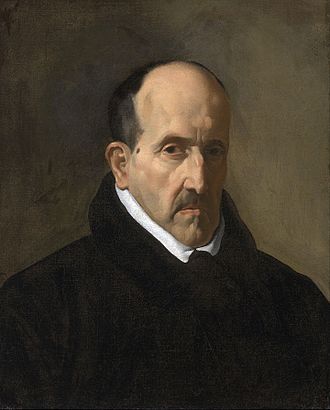
Luis de Góngora y Argote by Diego Rodríguez de Silva y Velázquez, Google_Art_Project
It’s said a sure way to lose friends is to correct their grammar. A man of few friends already, I would be radically friendless if I piped up every time I heard or read “lay” used for “lie.”
I’ve told my dog Bess more than once that “lay” needs a direct object and an adverbial phrase: You “lay” <something> <somewhere>: the book on the table, the knife down, the fork on the left. When I “lay me down to sleep,” I’m not “laying” down to sleep, I’m reflexively laying an object called “me” down to sleep. Otherwise I “lie” down to sleep. “Lie” can take an adverb but not a direct object. I can lie down, lie quietly, or lie like a dog (the verb has different meanings), but I can’t “lie” the book, the knife or the fork anywhere.
Etc., etc. Bess stares at me attentively but I don’t think she cares. As who should?
Substituting “grammar” for “poetry” in the following passage from Auden’s elegy to Yeats drives home a certain perspective:
For *grammar* makes nothing happen: it survives
In the valley of its making where executives
Would never want to tamper, flows on south
From ranches of isolation and the busy griefs,
Raw towns that we believe and die in; it survives,
A way of happening, a mouth.
A mouth, indeed, as in “He has a mouth on him!” Nevertheless, I hold certain periodicals to higher standards than others, and so from my ranch of isolation I grieve busily if ineffectually over a passage such as the following:
Also that year, Ms. Leigh had a solo exhibition at the Hammer. “Her approach to social practice — which insists that institutions expand their purview to create more space for a diversity of representations of black women,” said Ann Philbin, the museum’s director, “have encouraged museums to be more attentive to the needs of these audiences.” (Robin Pogrebin and Hilairie M. Sheets, “An Artist Ascendant: Simone Leigh Moves Into the Mainstream,” NYTimes, 8-29-18)
Because of her lengthy intercalation, rife with plurals, Ms. Philbin simply lost track of the singular subject of her sentence: “approach.” It happens, especially under deadlines. (The article was last updated at 3 AM Central Time, which is the middle of the night on my clock.) If I were an editor at the Times, I would at least have inserted “[sic]” after “have,” or else replaced it with “[has].”
The deal breaker on “lie” is that its past tense is “lay”: Yesterday at 3 pm I lay down and took a good nap. English has dealt us a bum hand with this verb. In a related matter, I told a colleague I was late for work because I got waylaid as I left home. He said he hoped it was way good.
[Copyright (c) 2018 James Mansfield Nichols. All rights reserved.]

Oliver Sacks’ copy of “Cartesian Linguistics,” by Noam Chomsky. Credit Bill Hayes
“The most we can do is to write — intelligently, creatively, critically, evocatively — about what it is like living in the world at this time.”
(Oliver Sacks, quoted by Bill Hayes, “Swimming in Words With Oliver Sacks,” NYTimes, 8-30-18)
[Copyright (c) 2018 James Mansfield Nichols. All rights reserved.]

Wayne Shorter by Robert Ashcroft / Courtesy of the Artist
A Florida white man running for office against a black man has said voters shouldn’t “monkey this up.”
I’ve been listening nonstop to Wayne Shorter for three days. Mr. Shorter doesn’t monkey up the music scene. He towers among his many towering peers in the pantheon of jazz greats.
Not that the candidate against a black man intended to offend, one is sure — he could just as well have said “don’t lynch this up” or “don’t trump this up.” Simian slang that could ricochet negatively in a racially inflamed moment is as guileless as apple pie, perhaps.
I surmise, though, that the man who doesn’t want the election monkeyed up isn’t a jazz fan. I extend to him this bit of good-natured ribbing based on an old joke of Bob Newhart’s:
I love jazz, but I don’t denigrate people who don’t. And for those who don’t, “denigrate” means “put down.”
[Copyright (c) 2018 James Mansfield Nichols. All rights reserved.]
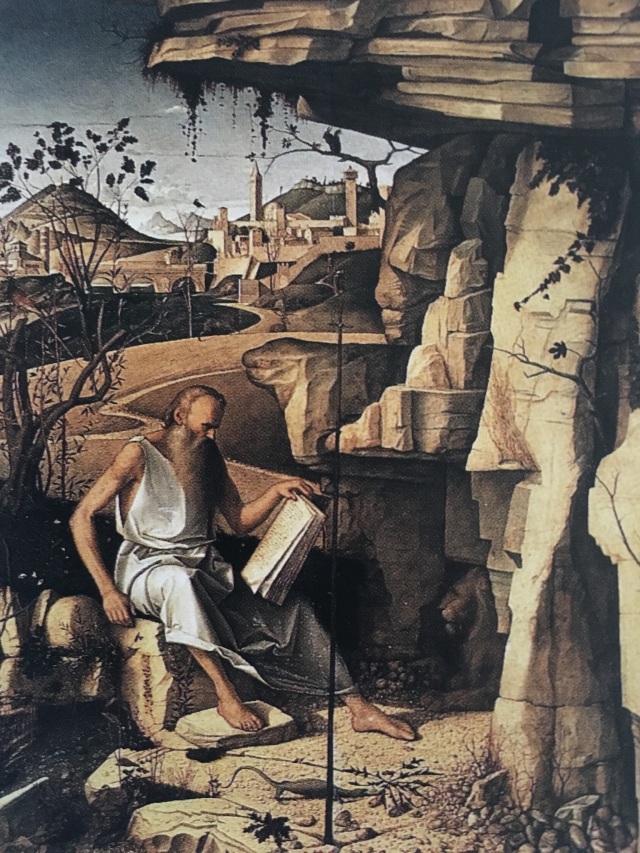
Saint Jerome, patron saint of translators, by Bellini
A Prayer for My Daughter by W.B. Yeats
(Spanish translation by James Mansfield Nichols)
https://www.poetryfoundation.org/poetrymagazine/poems/14635/a-prayer-for-my-daughter
A Prayer for My Daughter (6)
May she become a flourishing hidden tree,
That all her thoughts may like the linnet be,
And have no business but dispensing round
Their magnanimities of sound;
Nor but in merriment begin a chase,
Nor but in merriment a quarrel.
Oh, may she live like some green laurel
Rooted in one dear perpetual place.
Una Oración para mi Hija (6)
Que ella llegue a ser un árbol floreciente y escondido,
Para que todos sus pensamientos sean como el pardillo,
Y no tengan más propósito que repartir
Su canto magnánimo;
Ni lanzarse a correr si no es con regocijo,
Ni a reñir tampoco si no es con regocijo.
Ay, que ella permanezca igual que un laurel verde
Arraigada contínuamente en un solo lugar querido.
[Copyright (c) 2018 James Mansfield Nichols. All rights reserved.]

JMN2016 Man With Guitar, Oil on canvas.
I experience a jolt of sad satisfaction in catching myself being two-faced about something.
I’ve listened to many of the classic crooners at one time, but not much to Frank Sinatra now. I think it’s because I stumble a bit in my effort to isolate art from persona. I wonder if it’s easier to do this with painters than with singers.
His reputation as vocalist and actor is towering. I know the voice immediately when I hear it. Maybe I’m intimidated by his reputed association with the organized crime community and with the Rat Pack.
Why the Rat Pack? Not sure. It summons for me a whiff of strutting male chauvinism that feels retrograde, but is still very much around. Sinatra was a product of his time and place, of course. Aren’t we all? That unoriginal assertion often acts as a placeholder for some kind of disclaimer, a sop to Cerberus tossed by an apologist or a waffling critic.
Still, the Chairman of the Board, Old Blue Eyes, would have been surrounded by manipulators who glom on to talent and ride it like barnacles. Who knows how much ill-considered advice he had to blow through with his morning coffee? It’s comforting to know that he’s serenely impervious to my spot of bother. If I had ever come face-to-face with the man, cheek would have given way to mute awe in spite of me.
This narrative has grown rubbery legs and risks going now from trivial to rambling. To wit: There are factions squared off currently over the question of whether or not character and behavior matter in politics. To summarize the debate cogently: Some say one thing, some say the other, and some now say the other thing who used to say the one.
Can a citizen in good conscience embrace elected officials’ public actions — policies, pronouncements, tergiversations — while ignoring their private actions, whether these be culpable or merely feckless?
[Copyright (c) 2018 James Mansfield Nichols. All rights reserved.]

Classroom. JMN, photo.
In my high school Spanish classes I tried to prepare my students to be aware of stressed syllables. They knew about haiku — more than I did — from their English teachers. They knew of its 5-7-5 syllable count. I told them that Spanish verse also counted syllables. English poetry counts stresses, not syllables, I told them. Then I would ease into the stress rules of Spanish words, leading to when and why accent marks were written.
All this transpired over considerable time, alternating with fruitless efforts to impart rudimentary “conversation skills” to children who left Spanish behind each day as soon as the bell rang. To keep my spirits up I would concoct ruses that intersected deviously with my own interests. Here’s one:
Let’s invent an English version of haiku that includes a pattern of stresses, which is the English way! We’ll think up an arbitrary pattern and create a template for it. Then we’ll see if we can write verses conforming to the pattern.
Here’s a template — let’s call it the “malibu.”
Dewdrop panjandrum vavavavoom
Here are some malibus:
Mishaps befall us. What can you do?
Darling, move over. Give me some room!
Flooding predicted. Run for the hills!
Syndrome avoidance — not what we need.
Little by little, take what you can.
Mortar bombardment going kaboom.
Mildew is fatal — keep it away!
Here’s another template — shall we call it the “kazoo”?
Eschew rudderless befuddlement
Here’s a kazoo:
Beware simpering ambassadors.
Now, students, pair up with a classmate for the last twenty minutes and have fun making up your own malibus and kazoos. On Monday bring to class an original template of your own with some examples for extra credit!
It would be nice to report that this scheme was wildly successful, but it wasn’t. I had more fun than the students did. I never achieved the success in teaching that Robin Williams achieved in “Dead Poets Society” or Edward James Olmos in “Stand and Deliver.” Life didn’t imitate art — drat the luck.
[Copyright (c) 2018 James Mansfield Nichols. All rights reserved.]
Saint Jerome, patron saint of translators, by Bellini
A Prayer for My Daughter by W. B. Yeats
(Spanish translation by James Mansfield Nichols)
https://www.poetryfoundation.org/poetrymagazine/poems/14635/a-prayer-for-my-daughter
A Prayer for My Daughter (5)
In courtesy I’d have her chiefly learned;
Hearts are not had as a gift, but hearts are earned
By those that are not entirely beautiful.
Yet many, that have played the fool
For beauty’s very self, has charm made wise;
And many a poor man that has roved,
Loved and thought himself beloved,
From a glad kindness cannot take his eyes.
Una Oración para mi Hija (5)
Quisiera que ella aprenda sobre todo la cortesía;
Los corazones no son regalados sino ganados
Por aquéllas que no sean del todo bellas.
A muchos que han hecho el tonto
Por la belleza en sí, la gracia ha hecho sabio.
Y tanto pobre hay que ha recorrido mundo,
Sentido amor y pensado que era amado,
Que de una bondad alegre no puede quitar la mirada.
[Copyright (c) 2018 James Mansfield Nichols. All rights reserved.]

Lubaina Himid, photographed at home in Preston Lancashire. Photograph Antonio Olmos for the Observer
Is there a certain type of artwork that you keep in your bedroom?
Strangely, there are works of mine in the bedroom, but they’re not works that I’ve shown. They’re experiments with painting, plants and patterns, very quiet things. I don’t get too agitated about them because they were never intended for something. Otherwise I’m full of doubt: are they good or not? [laughs] It’s that “big ego, low self‑esteem” thing that artists have.
(Lubaina Himid, quoted by Killian Fox, “Home is where the art is: what Paula Rego, Lubaina Himid and other artists hang on their walls,” Tim Adams, interviews by Imogen Carter and Killian Fox, The Guardian, 8-26-18)
[Copyright (c) 2018 James Mansfield Nichols. All rights reserved.]
 EthicalDative
“In this world in which we live in” (Beatles)
JMN — in this world in which
He added, “Look to whom the government is reportedly giving immunity to.” (NYTimes)
[Copyright (c) 2018 James Mansfield Nichols. All rights reserved.]