“Soria” by Antonio Machado, Spanish poet, 1875-1939
From “Campos de Castilla,” Antonio Machado, Biblioteca Anaya, Edición de José Luis Cano, 1964.
(English translation by James Mansfield Nichols)
The shield of Soria has the following heraldic description: [3]
In a field of gules (red), a castle, of argent, crenellated with three battlements, lined up and marbled with sabre, rinsed with azure (blue) and a king’s bust crowned with gold and with its attributes coming out of his homage, in its colour; silver embroidery loaded with the following legend: “Soria Pura Cabeza de Estremadura”, written in saber letters. (Wikipedia)
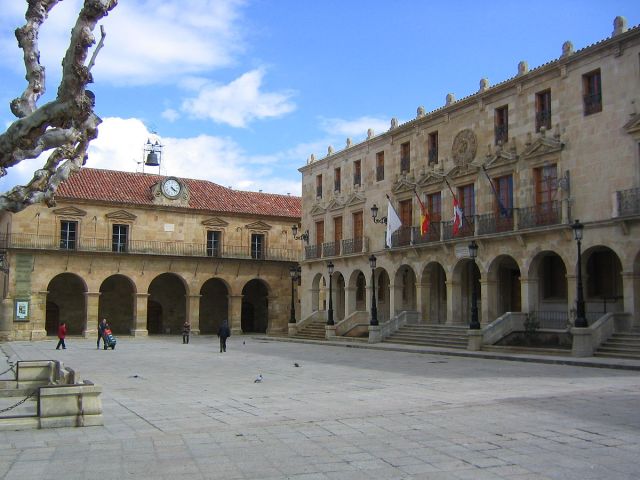
The poem “Soria” is a sequence of exclamations. (I reproduce the punctuation of my printed text.) The speaker evokes the somber beauty on a cold, moonlit night of an ancient provincial city fallen from its former glory. The details he describes aren’t beautiful in themselves — indeed, they depict decrepitude, decay and impoverished neglect of which the marauding, starving Spanish greyhounds (galgos) are an emblem. However, embellished by moonlight and the late hour, the scene adds up to loveliness for the
speaker, as he asserts in the ending twist: ¡Tan bella bajo la luna!
Note: Soria today is at a considerable remove from Extremadura. A footnote in my Spanish edition says (I translate): Here “Extremadura” is used in a broad sense referring to ancient Extremadura.
Draft literal translation:
¡Soria fría, Soria pura,
Soria cold, Soria pure,
cabeza de Extremadura,
head of Extremadura,
con su castillo guerrero
with its warlike castle
arruinado, sobre el Duero;
in ruins, upon the Douro;
con sus murallas roídas
with its walls eaten away
y sus casas denegridas!
and its blackened houses!
¡Muerta ciudad de señores,
Dead city of gentry,
soldados o cazadores;
soldiers or hunters;
de portales con escudos
of doorways with the shields
de cien linajes hidalgos,
of a hundred landed lineages,
de galgos flacos y agudos,
of sharp and skinny greyhounds,
y de famélicos galgos,
and of famished greyhounds,
que pululan
that swarm
por las sórdidas callejas,
through the squalid byways,
y a la medianoche ululan,
and at midnight howl,
cuando graznan las cornejas!
when the crows caw!
¡Soria fría! La campana
Cold Soria! The bell
de la Audiencia da la una.
of the Courthouse strikes one.
Soria, ciudad castellana
Soria, Castilian city
¡tan bella! bajo la luna.
so lovely! under the moon.
[Copyright (c) 2018 James Mansfield Nichols. All rights reserved.]






This Is Akin to That: Scoping Language
Law West of the Pecos, Tom Jones drawing.
“Gun rights groups have vowed to fight such moves [to limit the unfettered sale of bullets]: ‘Raising taxes on bullets to offset the cost of gun violence is akin to putting a levy on prescription drugs to pay for the price of heroin addiction,’ one critic said.”
(“Your Monday News Briefing…”, NYTimes, 9- 10-18)
Certain analogies, in my cautious opinion, can be disingenuous. They may possibly deploy a rhetorical sleight-of-hand that reminds me of a magician who dexterously draws the viewer’s eye away from where the trick is actually being pulled off.
The formula is akin to putting something made essentially for one purpose on an apparent equal footing with something else made essentially for a different purpose — guns with pencils, bullets with antibiotics, for example — then to proclaim (or imply) an ostensible absurdity deriving from similar treatment accorded the two things.
Here’s a rough paraphrase of two samples:
A. Disparate items joined in shotgun marriage: Guns [made to launch projectiles that make holes on impact] are like pencils [made for marking on various surfaces].
B. Ostensible absurdity: Saying guns kill people is like saying pencils make spelling errors.
C. Simplistic conclusion: It makes no more sense to impose controls on guns than to impose them on pencils! People are the problem!
A. Disparate items joined in shotgun marriage: Bullets [made to explode from a tube in order to deliver a hole-making payload] are like antibiotics [made to fight infection in people and animals].
B. Ostensible absurdity: Taxing bullets in order to offset the illicit harm they inflict is like taxing medicinal drugs in order to offset the harm inflicted by illicit drugs.
C. Simplistic conclusion: It makes no more sense to tax bullets than to tax penicillin! People are the problem!
Maybe it’s simply true after all that people are the problem behind all our problems. That, to almost quote Winston Churchill, is a proposition up with which I shall not fuck.
I’d like to try my own hand at the this-is-akin-to-that type of argument, though:
—> Proposition: Taxing sugar because it can contribute to diabetes is akin to taxing baby toys because they can get thrown out of the cradle.
—> Proposition: Imposing term limits on congressmen is akin to slapping governors on Ferrari engines.
—> Proposition: ‘i’ before ‘e’ except after ‘c.’
Aw hey, it’s all in good fun. This mouse doesn’t roar.
[Copyright (c) 2018 James Mansfield Nichols. All rights reserved.]