Programming code as I understand it is language that tells a computer what to do. It has customarily been written by humans. I’ve written it.
Code has to be very literal and deliberate.The machine, traditionally, is clueless as a stump.
Of late, however, it’s being jiggered to look smart with generative AI. Among other things it can spout bull with the worst of us. It can screw you up and rip you off and create many blessings. The prospect makes a man nervous, and a little watchful.
My Java code involved a lot of string handling because I was modeling natural language to create interactive learning tools for high school Spanish students. Before that I had worked on other projects involving English, Spanish and Arabic.
I once felt the need for an algorithm that would generate random words to test for certain traits. I set out to write such a routine — a randomizer. Every approach I tried involved foisting some kind of pattern on the program logic. I could only simulate randomness, if at all.
I wonder if even a God could create true randomness? Would that be chaos? Lacking good answers, I have to believe there’s an insensible pattern to everything. Should that be comforting?
I taught in a country high school in deep rural Texas. I was rubbish at it for 9 out of 10 years — mine is the discredit, I make no excuses. Teaching still gives me bad dreams: A roomful of disdainful students refuse to repeat the phrases I model for them. “Tell me why you’re not repeating!” I plead. They ignore me and chat among themselves.
I never aimed to teach, I’m just a learner, a simple man; I wanted to be a scholar. Throughout my own education my heroes were 19th-century philologists, lexicographers and translators.
The high school gig was conversational Spanish, strictly tangential to the “core curriculum” and the athletic calendar. I was known as sen-YORE. (My mother visited the class several times and she was referred to as “Senyore’s mother.”) Guitar perennially around my neck, I taught dozens of songs — Mexican, Cuban and Spanish ones. I flogged culture. I taught the battle cry of Father Hidalgo as I remembered it: ¡Viva nuestra señora de Guadalupe y mueran los gachupines! I explained that the “gachupines” were the descendants of Spaniards in Mexico who oppressed the native population. Death to the gachupines!
Carlos, a charismatic senior with a bright smile, asked me several times to model its pronunciation. I did so with clarion emphasis: gah-choo-PEEN-ace. He would echo what sounded like gotcha penis. We went through several iterations of this call-and-response until I noticed a ripple of merriment coursing through the classroom.
Snap. Gotcha penis.
It’s a good memory and makes me smile even today. You haven’t been properly set up and taken for a ride until you’ve been had by a clever adolescent.
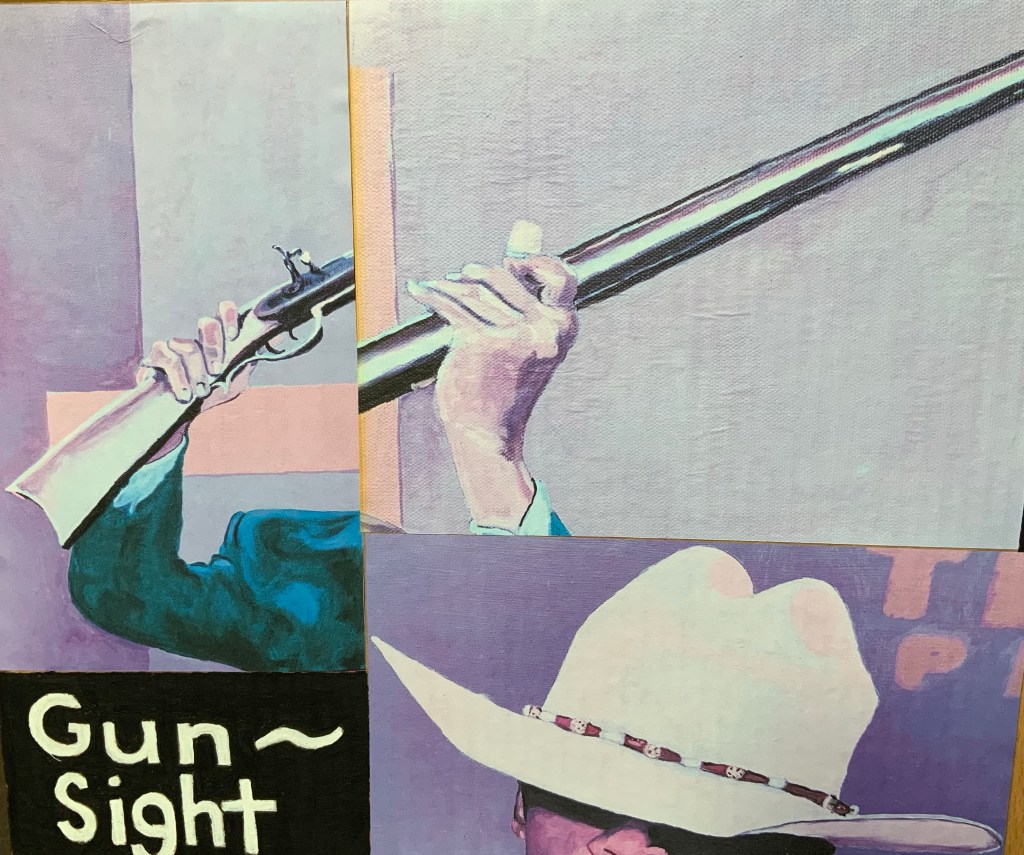
Detail, two untitled oils on canvas, 16×20 (JMN 2018).
“I will defend my Second Amendment right to use my musket to defend my Third Amendment right to never, ever allow a British soldier to live in my house.”
(Mark Russell, 1932-2023)
(Robert D. McFadden, “Mark Russell, Piano-Playing Political Satirist, Dies at 90,” New York Times, 3-30-23)
Me gusta vivir donde se celebran fiestas de esta índole. ¡Viva la raza humana! ¡Viva la harmonía! ¡Viva la compaginación de los pueblos! ¡Vivan los tamales hechos en casa!
San Luis Catholic Church in Yorktown will host its annual Jamaica April 23 at San Luis, 502 E. 2nd St. It will begin with Mass at 8 a.m. in the church. Mariachi music will be provided during the Mass. Breakfast items and menudo will be available after Mass.
A meal of carne guisada with rice and beans will be served from 11 a.m. to 2 p.m. Plates, to-go or dine-in, will be $14 each. Hamburgers and homemade tamales will also be sold.
At noon, the Ballet Folklorico de Goliad will perform in the hall. Live entertainment will include Vertigo at 12:30 p.m., El Grupo Sensacion at 1:45 p.m., DJ David Guerrero at 2 p.m., Lone Pistolero at 4 p.m. and Fantazzia at 5:30 p.m. Also planned throughout the day are live and silent auctions, a generous raffle, bingo, country store, vendor booths, cake walk, children’s activities, horseshoes and cornhole tournaments.
(“San Luis Catholic Church plans annual Jamaica,” Victoria Advocate, late March 2023)
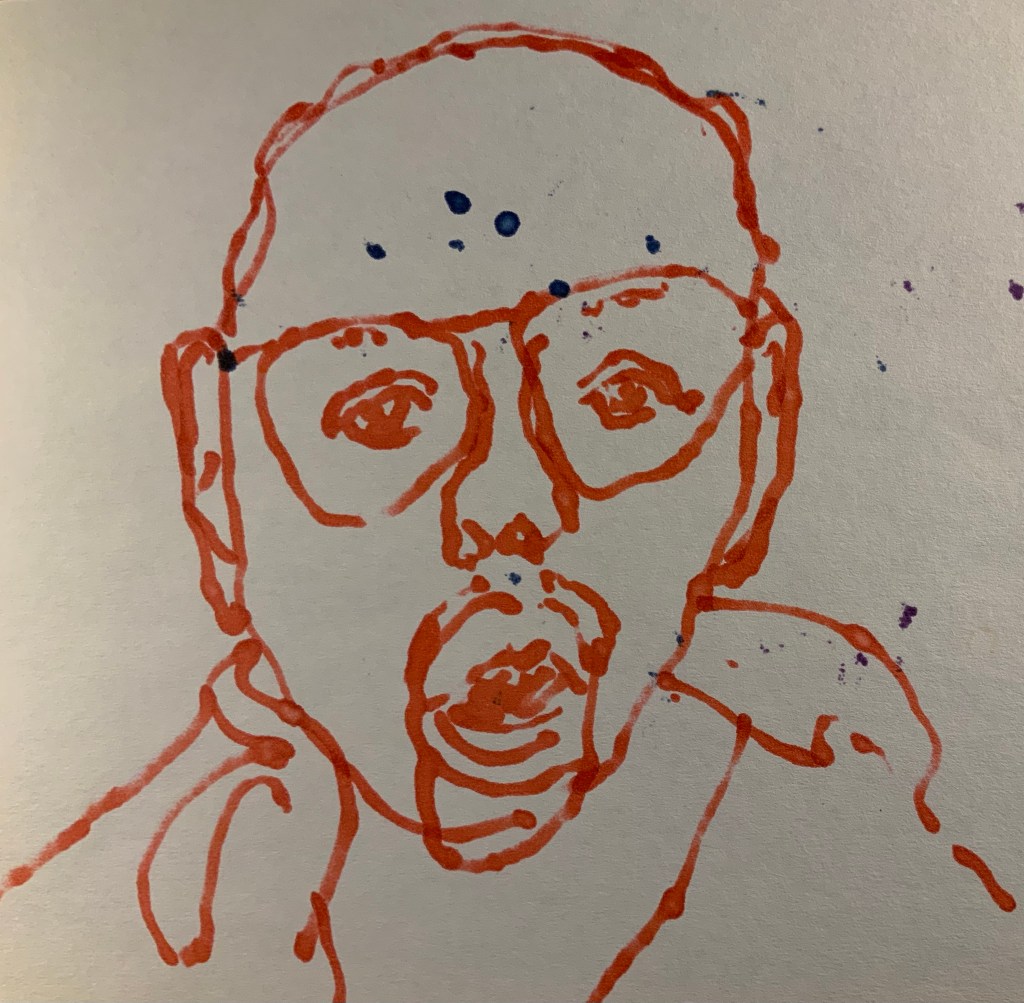
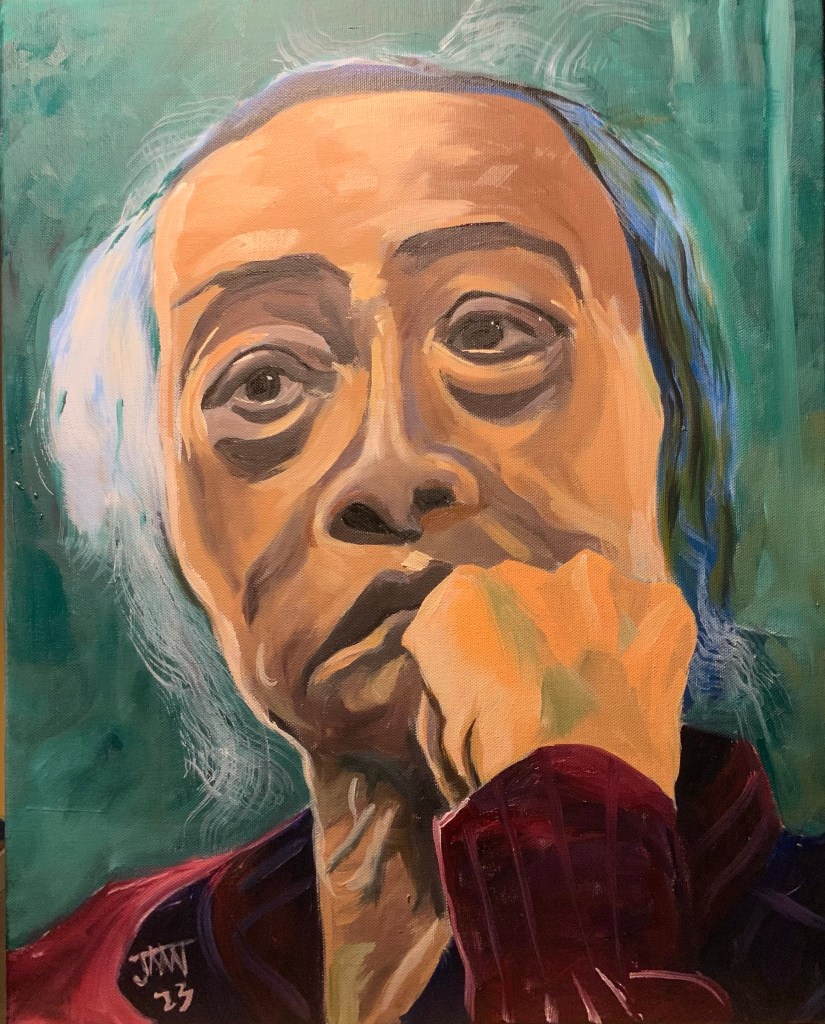
Duong Tuong (1932-2023), oil on canvas, 16×20 in. (JMN 2023). Poet and translator Duong Tuong translated nearly 60 foreign works into Vietnamese. They include works by Proust, Emily Brontë, Nabokov, Camus, Sartre, Céline, Chekhov, Murakami, Günter Grass and Tolstoy. Mr. Tuong said his most often quoted line, which could be used as his epitaph, was, “I am on the side of tears.” … The phrase represented his belief that it is the duty of all people to address the suffering, weakness and oppression in the world, and to “make the tears stop flowing.” (Seth Mydans, “Duong Tuong, Who Opened Western Works to Vietnamese Readers, Dies at 90,” New York Times, 3-9-23)
“All we can do now is pray.” Famous last words. Prayer is the recourse of the desperate when there’s no recourse. It’s the last croak from the isthmus of the fauces before humanity lies facedown in the mud.
(Margaret Renkl, “An Open Letter to Governor Lee on the Slaughter of Our Children,” New York Times, 3-29-23)
Religion hangs decorator drapes in the recreation room of despair and discreetly draws them against the flames outside the window. Religion helps us go all dimpled and dappled like a Gerard Manley Hopkins epiphany while tots absorb bullets from the magazines of Hell.
“We can’t control what [wrongdoers] do,” [Tennessee governor] Bill Lee said.
(Mike Baker et al., “After Mass Shootings, Republicans Expand Access to Guns, New York Times, 3-30-23)
My Catalan grandson works for a company that makes flight simulator software. He’s experiencing the headaches of integrating C++ enhancements into decades-old legacy code written in Fortran. He complains of the lack of notes in the old code whereby programmers are supposed to document their thinking. I promised him I would share with him, as a memento, some of the code I wrote in Java to make interactive learning and practicing software for my high school Spanish classes. I took reasonable care to leave a trail of logic breadcrumbs in it.
I called my program LALO as an acronym for “LAnguage Learning Operation.” “Lalo” is also a HIspanic nickname I heard growing up. I didn’t realize until now that, according to the internet, it can stand for Eduardo, Eladio, Gerardo, Wenceslao, or Gonzalo!
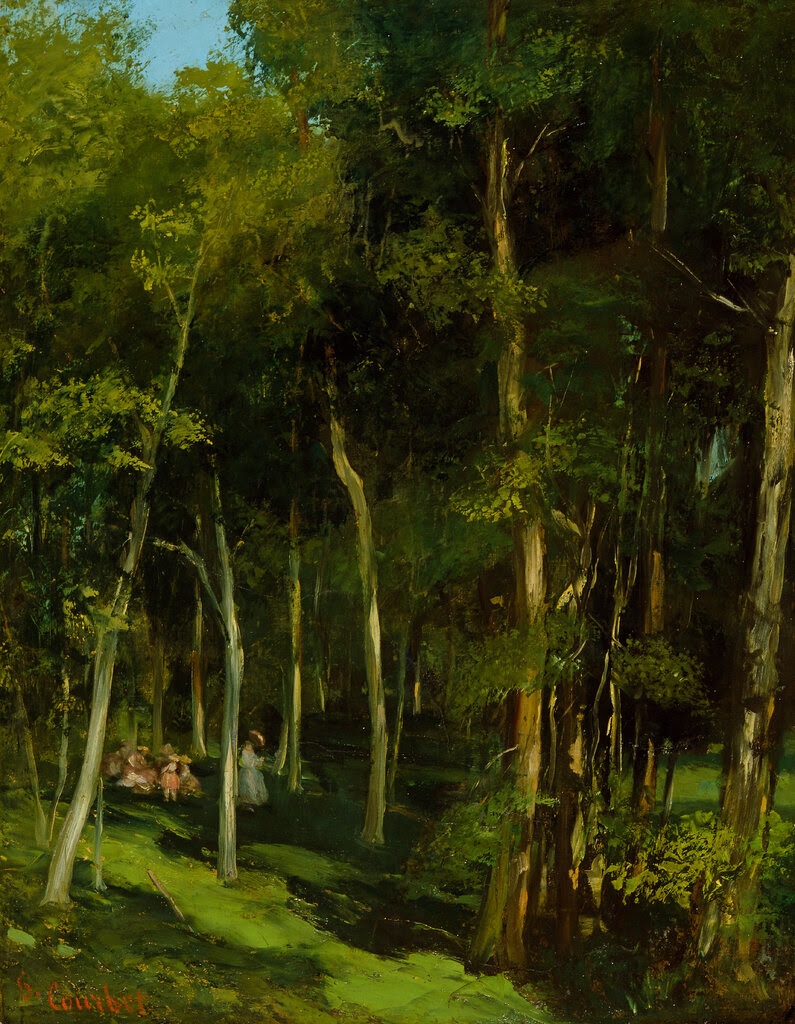
A government panel in Britain has recommended that the Fitzwilliam Museum return Gustave Courbet’s “La Ronde Enfantine,” painted circa 1862, to the heirs of a man who fled the Nazis. Credit… The Fitzwilliam Museum, Cambridge.
I savor the deep dark greeniness and people-dwarfing scale of the forest in this painting by Courbet. The syrupy light on the tree trunks is eyeball lickable.
(Julia Jacobs, “He Lost a Courbet Fleeing the Nazis. His Heirs Are Getting It Back,” New York Times, 3-28-23)
The obligatory cancels its strophe. Let me get a grip, and begin in this other patch where the air is.
“I caught a whiff of poem on the wind straightaway, which is an exceedingly rare smell for one who snorts at verse that doesn’t knock him down. ‘Blue Door’ opened me up like a can of whatever I contain, emptied me out and started filling me with itself. In my dispensable estimation, Ann Lauterbach earns her MacArthur with this construct. It’s piercing and full of sass, tempered in pitch, beyond explicable, so breathable it literally makes me cry.”
The above were my first words after reading “The Blue Door.” What got me in its grip was a sustained sequence of complete sentences. I don’t deny that some of “The Blue Door” is inscrutable (to me), but could that be where verse leaps to poem after all, when it defeats scrutiny yet sweeps me up?
Too many questions spoil the poem.
The poem-as-poem cannot reply. Which is why we need more voices, even
as we know what happens when there are more voices. Noise, argument, rupture.
Why not a single voice, one that represents everyone? Poem? Are you listening? … If only the field could retract into a new beginning, intact, complex,
the geography of the many seeding the plural world with accord,
good replicating good; evil, singular, kept to its barren agenda.
Prayers and wishes could then speed our recovery from the uninhabitable
scald of the venal market…
Speech this hard wrought oxygenates the soul in a peculiar moment: Many humans chafe now at being arguably binary, yet Silicon Valley is handing keys to the voices between our ears over to the binary machine that is (de)generative AI. Spook language is foisted upon a world already strangling in babble, and the gods are ROFL-ing at the mess.
Not to be hysterical or polemical. Not to
confuse personal anxiety with the future…
Meanwhile.
The poem surges over the end-stopped “meanwhile” as if breaching a levee.
I have begun to wish I had done things differently, never to have begun with such sad disclosures.
Absent the stanza, the difficult vocabulary…
… These
discrepancies confuse the grammatical
police. They do not know what to arrest.
Touché! I’m a grammar cop — it’s the vocation talking. If the poem taunts my ilk, I will wear the shoe.
The southern sky has turned peachy…
If you listen carefully, you can hear the thrum
of insomniac wings pulsating between episodes of cloud.
By quoting selectively I doubtless profane the poem and pulverize Ann Lauterbach’s unity of conception, but I don’t grasp that unity myself; I experience her poem as patches of excitement interspersed with bitter-sweet tickle of cognitive predicament. The poem has enlisted me somehow not to fight the tickle, to accept that it states the incomprehensible between bouts of the peachy. Is that the same is saying that it enlists trust in its seriousness? Look at how the blue door “opens the night sky” in a strange way of putting itself to rest:
Is writing a way of stalling for time, to delay the tasks in the next room…? Poem is too busy to answer. Words are like small magnets, pulling other words toward them, one by one, so the singles gather and as they gather they attest to an alignment that will become meaning. What was it you said about naming? It makes a way between unbeing and being, the definite flowing into the circulating infinite, the blue door opening the night sky.
I say writing is a way to delay extinction of voices like this we hope are ours.
I’ve looked into what the exaggerated gaps between words or phrases in lines of verse are all about, curious whether or not they should affect my reading and, if so, how. A writer named Emilia Phillips calls them visual caesuras — a term I find slightly absurd — and says they could as well be line breaks.
A turgid article about white space at POFO quotes John Cage from his “Lecture on Nothing.” Its black space (!) is so engaging that I captured several screenfuls of it and transcribed some of the words to my notes, discarding the unruly white bits fractiously separating them.
Here’s what Cage wrote:
The text is printed in four columns to facilitate a rhythmic reading. Each line is to be read across the page from left to right, not down the columns in sequence. This should not be done in an artificial manner (which might result from an attempt to be too strictly faithful to the position of the words on the page), but with the rubato which one uses in everyday speech.
Cage’s advice for reading his text seems applicable to verse: ignore eccentric spacing and read in your own voice. I confess to feeling bullied, distracted and interfered with by writers who over-curate their verses with ruptured typography. If your conceit is too ethereal for candid representation, re-think it!
I’m attracted, however, to Etel Adnan’s conception of the purpose served by the leporello, the fanfold device mentioned in a previous post here: The basic idea is about slowing down the way we look at things, about intensifying our experience.






If You Believe in ‘Random’ Words, Reconsider
Programming code as I understand it is language that tells a computer what to do. It has customarily been written by humans. I’ve written it.
Code has to be very literal and deliberate.The machine, traditionally, is clueless as a stump.
Of late, however, it’s being jiggered to look smart with generative AI. Among other things it can spout bull with the worst of us. It can screw you up and rip you off and create many blessings. The prospect makes a man nervous, and a little watchful.
My Java code involved a lot of string handling because I was modeling natural language to create interactive learning tools for high school Spanish students. Before that I had worked on other projects involving English, Spanish and Arabic.
I once felt the need for an algorithm that would generate random words to test for certain traits. I set out to write such a routine — a randomizer. Every approach I tried involved foisting some kind of pattern on the program logic. I could only simulate randomness, if at all.
I wonder if even a God could create true randomness? Would that be chaos? Lacking good answers, I have to believe there’s an insensible pattern to everything. Should that be comforting?
(c) 2023 JMN — EthicalDative. All rights reserved