Allez-y, Braves Gens! — French Lesson

British LBC radio presenter Nick Abbott explains the Tory lock on governance in the UK like this: During elections, factions on the Left wrestle each other to the ground in feuds over ideological purity. Meanwhile, the monolithic Right, comprised of a minority bent only on retaining power, steps nimbly over them into office time and again. It evokes Will Rogers’ famous quip: I am not a member of any organized political party. I am a Democrat.

The French may be challenging this paradigm.

For the first time since 1997, France’s major left-wing parties put aside their differences and ran a single slate of candidates. The coalition, known as NUPES, for Nouvelle Union Populaire Écologique et Sociale, soared last week… Shrewdness and an instinct for self-preservation are two of the biggest factors making unity possible… The coalition needs its base to turn out in much greater numbers than it did in the first round — which featured historically low participation across the board — but especially among low-income voters and young people. If these groups do deliver a majority to NUPES, the effects would be truly seismic.

(Cole Stangler, “Something Extraordinary Is Happening in France,” NYTimes, 6-16-22)

Allez-y in Texas dialect is “Get after it!”

(c) 2022 JMN — Ethical Dative. All rights reserved

Posted in Quotations | Tagged , , | Leave a comment

‘It’s This Old, Fatal Love for the Landscape’

A bucolic landscape – with barbed wire … Chalk Paths, by Eric Ravilious. Photograph: foxtrotfilms.com.

The quotation in my title is from nature writer Robert Macfarlane. His book The Old Ways featured British war artist Eric Ravilious, killed in a plane crash in 1942. In the book, Macfarlane “points to the way the artist would frame bucolic watercolours of the rolling southern English countryside with strands of barbed wire.” Chinese artist Ai Weiwei states that, although Ravilious’ paintings “seem like an understatement, they are profound, rigorous and meticulous.” (All these citations are from the Guardian article echoed here.)

Two Women in a Garden, by Eric Ravilious. Photograph: Fry Art Gallery/foxtrotfilms.com.

Words that are powerful with understatement were written by Ravilious’ widow Tirzah Garwood, herself an artist, in her autobiography, Long Live Great Bardfield. Marooned in a dank Essex farmhouse with her three young children in the hell of war, she typed out her book after putting them to bed, and bequeathed it to posterity “should it have survived”:

“… All I ask of you is that you love the country as I do, and when you come into a room, discreetly observe its pictures and its furnishings, and sympathise with painters and craftsmen.”

(Claire Armitstead, “‘He died in his 30s living the life he had dreamed of’: artist Eric Ravilious,” theguardian.com, 6-24-22)

Ravilious’s work and Garwood’s words evoke for me the art of two blogs that I admire:

Sue Grey-Smith (https://suegreysmithartist.wordpress.com) and Outside Authority (https://outsideauthor.wordpress.com)

(c) 2022 JMN — EthicalDative. All rights reserved

Posted in Commentary, Quotations | Tagged , , , , , , , , | 9 Comments

‘Telescope’ by Louise Glück

Occasionally a poem is so frictionless it stabs without hurting. My second reading of “Telescope” by Louise Glück was to someone far away over FaceTime. You’ve gotta hear this! I chirped.

There is a moment after you move your eye away / when you forget where you are / because you’ve been living, it seems, /somewhere else, in the silence of the night sky.

The speaker describes how you lose yourself in contemplation of the indifferent.

You’ve stopped being here in the world./ You’re in a different place, / a place where human life has no meaning. // You’re not a creature in a body. / You exist as the stars exist, / participating in their stillness, their immensity.

I read the poem slowly to my distant friend. The slowness is counterintuitive, because Glück favors workaday diction in her poems, as opposed to words like “incarnadine”; she has said so in an essay. Her contractions convey casualness. She chisels her lines with scrupulous attention to capitals and punctuation. The marked rests, as in music, let the verses and the reader breathe.

Then you’re in the world again. / At night, on a cold hill, / taking the telescope apart.

Here, suddenly, I wept, taken apart myself. The terrible beauty of simple words about emptiness and distance, the lack of distortion, made unbearable sense. I’ve looked at the sky through a scope on dark nights, haven’t I? — feeling closer to the constellations than to any person.

You realize afterward, / not that the image is false, / but the relation is false. // You see again how far away / each thing is from every other thing.

The ending has a weightless purity that makes you cry. Glück is never sappy, and doesn’t try to be uplifting — thank God! The speaker in “Telescope” trains a gaze cold as interstellar space on glittering delusions of nearness, consigning facile pieties to stardust.

(c) 2022 JMN — EthicalDative. All rights reserved
Posted in Anthology | Tagged , | 5 Comments

A Lash of Good Tongue

“Bucked,” oil on canvas, 24 x 36 in. (JMN 2020)

“To sit fast badly is better than to be thrown easily.”
(Wright, A Grammar of the Arabic Language, p. 124)

[sū’(u)-l-istimāk(i) ẖair(un) min ḥusn(i)-ṣ-ṣirƸaẗ(i)]

Wright cites the phrase to illustrate the formation of the [ism(u)-n-nūƸ(i)], noun of kind, aka nomina speciei in the abounding Latin of fin de siècle philology boffins.

[ism(u)-n-nūƸ(i)] noun of kind

[The noun of kind] “indicates the manner of doing what is expressed by the verb… [It may] be used in a passive sense, as [ṣirƸaẗ(un)], way of being thrown (from horseback)….”

[ṣirƸaẗ(un)], way of being thrown (from horseback)….”

The literal translation of Wright’s phrase is: “Badness of the clinging is better than goodness of the being thrown down.”

It has the ring of a homily anomaly that sounds almost wise. One thinks of the daring young fools of the American rodeo who try to park their asses, pardon the language, on an exploding beast for eight seconds.

(c) 2022 JMN — EthicalDative. All rights reserved
Posted in Anthology, Commentary | Tagged , , , , | Leave a comment

‘To Translate Is to Look into a Mirror…’

“To translate is to look into a mirror and see someone other than oneself,” Lahiri writes. Credit… Liana Miuccio.

Benjamin Moser reviews Jhumpa Lahiri’s book “Translating Myself and Others.” The book deals with her decision at age 45 to begin writing in Italian, which for her was an entirely learned language.

“Art is not — should not — be an instrument for change of any kind,” she writes. “Once art weds itself to a social or political purpose it is bled of its true purpose, which is not to change the world but to explore the phenomenon and the consequences of change itself.” The book, instead, is about the consequences of the apparently simple act of choosing one’s own words.

(Benjamin Moser, “Jhumpa Lahiri Leaves Her Comfort Zone,” NYTimes, 5-17-22)

Lahiri’s first sentence would better read: “Art is not — and should not be — an instrument for change of any kind.”

One ponders what it means to “explore the phenomenon and the consequences of change” while not being wedded to a social or political purpose. The phrase from Auden’s elegy to Yeats comes to mind: For poetry makes nothing happen…. But the verse continues: it survives / In the valley of its making…etc.

Poetry survives! At least some of it does. Undoubtedly much (most?) of what aspires to be poetry (and art) does not.

Wallace Stevens, in the 1940s, sounded a note similar to Lahiri’s :

… He told one interviewer, the poet could not “allow himself to be absorbed as the politician was” in the moment, for to do so would sabotage the poet’s freedom to write anything of real significance.

(Paul Mariani, “The Whole Harmonium”)

Poets, when called upon, want to rise grandly and memorably to a tragedy or a celebration, but their verses must punch through the circumstance somehow, or else remain occasional. That’s what I hear Lahiri and Stevens implying.

An undying instance of punching through the occasion with language that is terse, torqued, and true, soaring beyond its moment, is the Gettysburg Address:

https://www.abrahamlincolnonline.org/lincoln/speeches/gettysburg.htm

Four score and seven years ago our fathers brought forth on this continent, a new nation…
Now we are engaged in a great civil war, testing whether that nation… can long endure…
… In a larger sense, we can not… consecrate… this ground. The brave men… who struggled here, have consecrated it… The world will little note, nor long remember what we say here, but it can never forget what they did here…

(Lincoln, 1863)

(c) 2022 JMN — EthicalDative. All rights reserved
Posted in Commentary, Quotations | Tagged , , , , | Leave a comment

The American Week

Guadalupe River [Credit: Victoria Advocate]

Monday: A law is born in the House of Representatives
Tuesday: The law dies in the Senate
Wednesday: A mass shooting occurs
Thursday: The scene is taped off and sealed
Friday: Thoughts and prayers
WEEKEND!

Monday: A law is born in the House… etc.

(c) 2022 JMN — EthicalDative. All rights reserved

Posted in Commentary | Tagged , | 4 Comments

Bah-BOOM-BOOM Riff Ripped

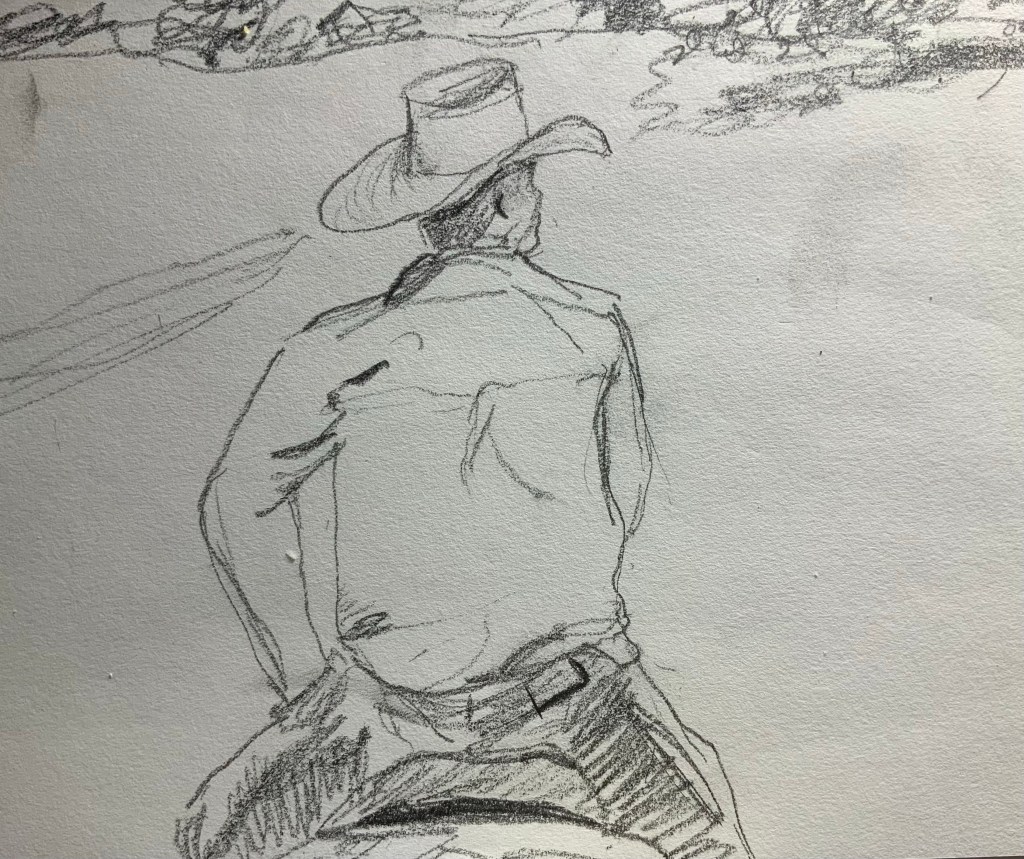
Sketch by James Thomas “Tom” Jones (1920-2000), born in San Antonio, Texas.

First published as https://ethicaldative.com/2022/05/22/bah-boom-boom-riff/ .

To Her, Still

One’s home is her castle,
a refuge from hustle
and bustle, the jostle of mobs;
nest in which refuge to seek
from the insults that bristle
in digital wallows
and rants of apostles of doom,
by the wherry that’s painted on wood
on a wall of the room.

Kitchen to mortar and pestle
the herbs for the grub
that she rustles,
remove all the gristle,
leave only the muscle
of meats she imagines she eats.

A nook where to nestle
in comfort and wrestle with issues,
indite her epistles,
ensconced at the trestle desk
cunningly made from a door,
delight in the whistle
of blackbirds, bristle of brushes,
the thistle-and-mistletoe theme
of the rug on the floor.

(c) 2022 JMN — EthicalDative. All rights reserved
Posted in Anthology | Tagged , , , | 2 Comments

Two Centered Voices in the Din

After an illustration by Anne Anderson.

Bret Stephens, conservative columnist:

Imagine a TV ad from a moderate Democrat like Ohio’s Tim Ryan or Virginia’s Abigail Spanberger that goes something like this:

“I believe in the Second Amendment. But not for this guy,” followed by a picture of the Tucson, Ariz., mass murderer Jared Lee Loughner, “or this guy” — a picture of Aurora, Colo., mass murderer James Holmes, “or this guy” — a picture of Newtown, Conn., mass murderer Adam Lanza.

It would continue: “I also believe in the right to own firearms responsibly for hunting and self-defense. But not for this” — a picture of the scene outside the Uvalde school, “or this” — a picture of the scene from the Buffalo grocery store, “or this” — scenes from the Parkland massacre.

And it could conclude: “Justice Robert Jackson once told us that the Bill of Rights cannot become a suicide pact. That includes the Second Amendment. We can protect your guns while keeping them out of the hands of crazy and dangerous people by using common-sense background checks, 21-years-of-age purchasing requirements, three-day waiting periods and mental-health exams. It’s not about denying your constitutional rights. It’s so your children come home from school alive.

(The Conversation: “There Has to Be a Tipping Point on Guns, Right?” NYTimes, 6-6-22)

Matthew McConaughey, actor and Uvalde native:

(White House press briefing, YouTube, 6-7-22)

(c) 2022 JMN — EthicalDative. All rights reserved

Posted in Commentary, Quotations | Tagged , | Leave a comment

To Whom It Concerns on the Morrow

‘anta (you masc.), ‘anti (you fem.) — Arabic

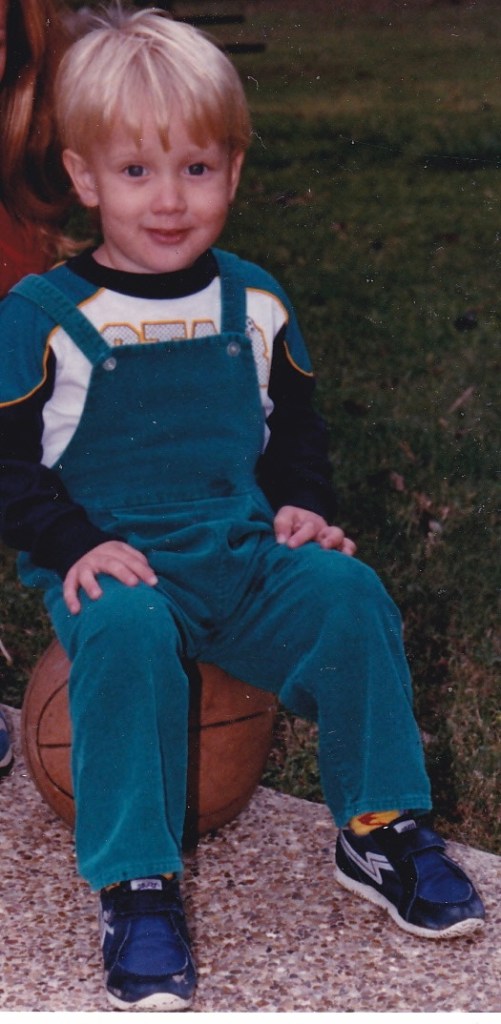
Hey, U 2 + 3!

June 8 and Jan 9 are two dates written in bright lights for us who love you. Your penultimate mission in Oki is to celebrate the dickens out of that day which will have arrived in your longitude at this writing (June 7).

Aunt N and I will do same tomorrow. I have a made-in-store, 4-cheese pizza from HEB to cook in the oven. I’ll prepare a tapenade to enhance it with (or with which to) consisting of baby bella mushrooms (chopped), spinach, green and black olives, and roasted red bell pepper. A tres-leches cake (also from HEB) crowns the commemorative collation. Sparkling goblets of recently-delivered, chilled Ozarka water will be raised and quaffed in honor of the honorable honoree. Yessiree. It seems only years ago he was in diapers.

Your ever devoted you-know-what,

JMN

(c) 2022 JMN — EthicalDative. All rights reserved
Posted in Commentary | Tagged , , | Leave a comment

‘There’s a Future…’

Soulshine Industries employees [sic] work on caskets donated to victims of the Uvalde shooting. [victoriaadvocate.com]

A comment to a recent post here (https://ethicaldative.com/2022/06/01/pledge-of-resistance/) states:

“People kill people. Not guns, cars or anything else. People need help and they don’t get it. Our society decided that inclusion is more important than helping people and/ or making others safe from them.”

The comment alludes to a grave weakness of Texas government. It’s true that mental illness and weapons of mass destruction are a bad mix. After the Uvalde massacre on May 24, 2022, Texas governor Greg Abbot spoke about the importance of dealing with mental illness. Less than two months before that, however, he cut more than $200 million from the Texas commission that oversees mental health services in the state. According to the 2022 State of Mental Health in America report, Texas ranks fourth in the U.S. for prevalence of mental illness, but last for access to mental health care. At a press conference a day after the massacre, Abbott conceded that authorities were unaware of any criminal record or history of mental illness that could have flagged the 18-year-old Uvalde killer as a potential threat.

Nearly 10 years before Uvalde, in late 2012, 16 first graders at Sandy Hook Elementary School in Newtown, Connecticut hid in their class bathroom. A 20-year-old male fired more than 80 rounds from a Bushmaster semiautomatic rifle into the 4½ by 3½-foot space, killing 15 of the children. The killer murdered 28 people at the school in all. One encounters variants of the argument that blaming guns for killing people is like blaming pencils for spelling errors. In this dismissive analogy the “errors” are human corpses.

A more reasonable conservative voice offers a glimmer of hope for reaching a modest middle ground:

There’s a future where America’s gun-ownership rate is as high as ever, where our schools still look like schools rather than airport security lines and where 18-year-olds under a demoniac shadow face meaningful obstacles to arming themselves for terrorism. Let’s try living there, and see what happens next. [Ross Douthat]

Sources:

Kyle R. Cotton, “Trey Ganem’s Edna shop donates custom caskets to Uvalde shooting victims,” victoriaadvocate.com, 6-1-22.
Frank Bruni, “Gov. Greg Abbott Has a Lot of Nerve,” NYTimes, 6-2-22.
Zach Despart, “This Time Gov. Greg Abbott has few suggestions on how the state might prevent future mass shootings,” www.texastribune.org, 5-25-22.
Elizabeth Williamson, “From Sandy Hook to Uvalde, the Violent Images Never Seen,” NYTimes, 5-30-22.
Ross Douthat, “The Simplest Response to School Shootings,” NYTimes, 6-1-2022.

(c) 2022 JMN — EthicalDative. All rights reserved

Posted in Commentary, Quotations | Tagged , | 2 Comments