Pronoun Rebellion (1)

“Crow Shadow,” 11 x 14 in. oil on canvas (JMN 2022)

It’s apparent that contributors to Poetry magazine compose their own biographical snapshots, which allows for a gamut of voicings and modes of self-assertion. A grammar nerd notices how these established and establishing technicians of the word mold language to their purposes. A lively mobilization against “he-she” is observable in recent issues I’ve read. To give it a name, I’ll call it “genderflecting” when gendered pronouns are used in the conventional way.

In non-genderflected reference a singular person talks about themselves in the plural. Jennifer Huang’s profile is one of the best examples I’ve seen:

Jennifer Huang* is a Taiwanese-American writer… They received their MFA from… They live in Michigan, where they are working on a novel. [May 2021]

Here are other instances:

Jinhao Xie* is a UK-based poet… Their poetry, inspired by… [September 2021]
Xandria Phillips* is a Whiting Award-winning poet… They are the author of… [July/August 2021]
Kemi Alabi* is coeditor of… They live in Chicago. [December 2020]
Aubrey King’s* poem is inspired by… They teach at the Jack Kerouac School of Disembodied Poetics. [October 2021]
Kitchen McKeown* won… Their debut chapbook is forthcoming… [October 2021]
Miriam Karraker* is a writer… Their writing has appeared… [November 2021]
Marlanda Dekine Sapient-Soul* (she/her/they/them) is a poet… She is the author… [June 2021]

Gender identity and ethnicity often enter the picture:

Ever Jones* is a queer/trans writer… They are the author of the transliberatory lyric… [November 2020]
Tarik Dobbs* is an Arab American, queer writer… They are an MFA candidate… Their chapbook… [May 2021]
Aurielle Marie* is a Black and queer poet… Their debut collection… [December 2021]

The student of Spanish notes how adopted ethnic adjectives can be purged of genderflection with “x,” and sometimes not:

V. Ruiz* is a Queer, Xicana bruja [witch]… Their debut is… [February 2021]
Elena Ramirez-Gorski* is a Chicanx writer… They are an MFA candidate at… [May 2021]
Isabella Borgeson* is a queer, white and Filipina poet… She is cofounder of… [December 2020]
Ina Carino* is a Filipinx American poet… [September 2021]

TC Tolbert flies a larkish banner that snaps in its own breeze. I’ve seen “s/he” before, but “they” seems to be winning.

TC Tolbert* (he/him/hey grrrl) is a trans and gender-queer monkey-goat who never ceases to experience a simultaneous grief and deep love any time s/he pays attention to the world. [July/August 2021]

It’s noteworthy that every contributor in this sampling of profiles is marked by an asterisk, which is Poetry’s way of flagging first-timers to the magazine. I take it to signal an opening up to undersung constituencies which are richly represented by LGBTQ+, minority ethnic, Native American, and incarcerated writers.

(c) 2022 JMN — EthicalDative. All rights reserved

Posted in Anthology, Commentary, Quotations | Tagged , , , , , , | 1 Comment

Art Tickle: Mixing Your Blacks

George Etheredge for The New York Times.

Is there a better definition of art than the effort, the ache, to explain one’s inner experience and be understood?… I was starting out as a painter, and [Chuck Close] supported and encouraged me. He bought me my first proper oil paint — the exact brands and colors he used (particular brands for particular colors) — and taught me to set up my palette just like his. He showed me how to mix beautiful blacks without using black. He instructed me to treat every area of the canvas equally, not to paint the hair differently from the skin just because it was hair, not to paint the background with less attention than to the subject, to erase hierarchy.

(Ali Silverstein, “I Once Loved Chuck Close. That’s Why I Want to Tell My Story,” NYTimes, 12-27-21)

(c) 2021 JMN — EthicalDative. All rights reserved
Posted in Quotations | Tagged | Leave a comment

A Confounding Clarity

Poetry, October 2020. Cover by Edra Soto.

Proliferation of phrases: — A turn of speech makes my point vividly — I’ll use it. But this other phrase is pungent — I’ll use it too. Yet another is incisive; and one is innovative; and one wry; this one has shock effect; they’re coming to me like hotcakes, I’ll use them all! It’s a rhetorical strategy that can shade from festive elaboration into prolixity. Where the line is crossed may fluctuate according to a given reader’s tolerances. Poet and scholar heidi andrea restrepo rhodes (sic — her LC) is testing mine in an expansive essay on aphasia and poetry published in the eponymous magazine’s watershed October 2020 issue. I haven’t got to the bottom of it yet.

There are homely words and hoity toity words. I too often practice self-abuse here, opting for the latter and piling on verbiage in hopes of camouflaging a humdrum thought. But take a word like “movable.” It’s ordinary and colorless, unlike “mobile” or “portable,” or better yet “itinerant.” “Movable” gets interesting, however, in an unlikely pairing, such as with “feast.” “Movable feast” lands a certain punch that took root and became a trope. It requires discretion and a good ear to invigorate humble words by pairing them unexpectedly. I don’t claim to have those qualities, but Louise Glück does.

What I admire about Glück’s art even when I don’t understand it is its icy concision. Her language is spare, precise, incised, lean; every word, every inflection, every punctuation symbol is rigorously pondered and intentional. She has an ear for pairing ordinary words like “cotton mouth” (a poisonous snake common where I live) and “roughhouse” (rowdy behavior) unexpectedly. Movable feast, moving target. Her poems remind me of the pools of water I puzzled over as a kid when touring the Carlsbad Caverns. Way down in the cold earth they had a preternatural limpidity that made the bottom seem an elbow’s length distant, yet the water was a dozen feet deep. Pennies tossed there were crystalline yet remote. It was haunting and incomprehensible to the naive senses. I simply couldn’t fathom it or get over marveling.

(c) 2021 JMN — EthicalDative. All rights reserved
Posted in Anthology, Commentary | Tagged , , , , , | Leave a comment

Broken, Dejected Reader of Poems

“What was it somebody said that the only thing God could not do was to make a two year old mule in a minute.” (Gertrude Stein) Thanks to OutsideAuthority for the quotation and photo.

<p. 137> “World Breaking Apart” by Louise Glück (“Poems 1962-2012,” 2012)

I don’t care if this post is preposterously long. It’s a barbaric yawp anyway. My original title for a comment about “World Breaking Apart” was “Inconclusive Antecedence.” It was another glib title masking with gobbledygook how puny I feel up against poetry like Louise Glück’s. I was going to dwell on how her poem pivots on an ambiguity of reference for the pronoun “them” when it says “I saw them come apart,.” leaving me in a perplexed limbo of sorts. Yes, that’s me, gasping for sense with words.

I try to affect a certain erudition here. The truth is I know a little about a few things that matter to fewer persons, but where poetry is concerned I feel unfit for it, not up to it, stranded by it, uncertain and afraid of not getting it as I sit, not in a dive, but in my shed on a floodplain of the Guadalupe. There, you see? I’ve signaled obliquely and as if casually that I’ve read a poem by W. H. Auden — it’s part of the pose I adopt. I can say truthfully that I have liked that poem enough to commit it to memory for a time, along with a few others. But as it happens, all my loves are by poets who antedate me by lifetimes, and all, as it happens, have been canonized already, if that word means endorsed by the reading establishment that broadcasts from academies and congresses.

Faced with poetry written by people who are alive now (January 14, 2022), I’m mostly lost at so many levels. And Louise Glück is a living breathing eminence! She teaches in the finest schools and is crowned with every title known to American poetry, most recently the Nobel. If I’m lost by a distinguished voice of my own time and place, I must be truly unfindable. Thomas Lux broke my spirit last night when he introduced her in a recorded reading I stumbled upon. He called her uncompromising and full of mystery, saying mystery is what he wants in poetry. He was a poet himself (rest in peace) and must know, but I’m swamped by mystery at the moment. I could do with some dots that connect without my impotently busting a gut over them.

I’m a proud man. I’d like my poetic lostness to sound sophisticated and serenely cocky, as if the genre somehow owes me something, but in plain terms I simply don’t know what her poems mean. I don’t know what they say. I don’t know what their intention is. I don’t know what I should feel or what heightened awareness I should possess after reading them. I don’t understand them. What I do feel is cowed and whipped, guilty and ashamed at not experiencing the kind of pleasure meant to be gained from the reading of them. The poems help me feel helpless and inferior intellectually, culturally, emotionally, and whatever more freight train of adverbs can be appended to bellyaching. Have you noticed how I didn’t mention the title of Auden’s poem above? It’s a trick of dismissive nonchalance I’m learning from reading poetry: if you have to ask, you can’t afford the question, you’re not an insider to the allusion. I’m forever grateful to Auden for using two words — uncertain and afraid — that mean what they goddamn say. The swear word and disobliging sarcasm I end with here are a sign of how angry I am at Louise Glück (not personally) and at myself for reading her so ineffectually.

(c) 2022 JMN — EthicalDative. All rights reserved

Posted in Commentary | Tagged , , , | Leave a comment

Wayne Thiebaud: ‘Deadpan Style of Figuration’

“Untitled (Mountain and Clouds),” circa 1965. Credit… Wayne Thiebaud/Licensed by VAGA at ARS, New York [New York Times].

Wayne Thiebaud (1920-2021) is said to have painted daily to the end. He described himself as driven by “this almost neurotic fixation of trying to learn to paint.”

“It has never ceased to thrill and amaze me,” he said, “the magic of what happens when you put one bit of paint next to another… I wake up every morning and paint… I’ll be damned but I just can’t stop.”

“Flatland River,” 1997. Credit… Wayne Thiebaud/Licensed by VAGA at ARS, NY [New York Times].

Thiebaud called himself a painter. Saying you’re an artist, he said, is “like a priest referring to himself as a saint.” That was for someone else to decide.

[Thiebaud’s] real subject, many critics said, was paint and the act of painting itself: the shimmering color and sensuous texture of thickly applied paint. He laid on paint so heavily that he often carved his signature instead of putting it on with the brush.

“Tulip Sundaes,” 2010. Credit… Wayne Thiebaud/Licensed by VAGA at Artists Rights Society (ARS), NY [New York Times].

Artists whose influence Thiebaud, a lifelong teacher himself, acknowledged include: Thomas Eakins, John James Audubon, Jean-Siméon Chardin, Giorgio Morandi, Edward Hopper, Joaquín Sorolla, and Willem de Kooning. The statement that Thiebaud’s art was “grounded in slow, hard-earned craftsmanship” points to “perspiration” as a factor in making art.

Mr. Thiebaud, with his painting “Swimsuit Figures,” was honored in 2017 at an event held by the American Academy of Arts and Letters. Credit… Jill Krementz [New York Times].

Sources: Associated Press, “Wayne Thiebaud, painter of cakes and San Francisco cityscapes, dies at 101,” theguardian.com, 12-26-21. Michael Kimmelmann, “Wayne Thiebaud, Playful Painter of the Everyday, Dies at 101,” NYTimes, 12-26-21.

(c) 2021 JMN — EthicalDative. All rights reserved

Posted in Commentary, Quotations | Tagged , , | Leave a comment

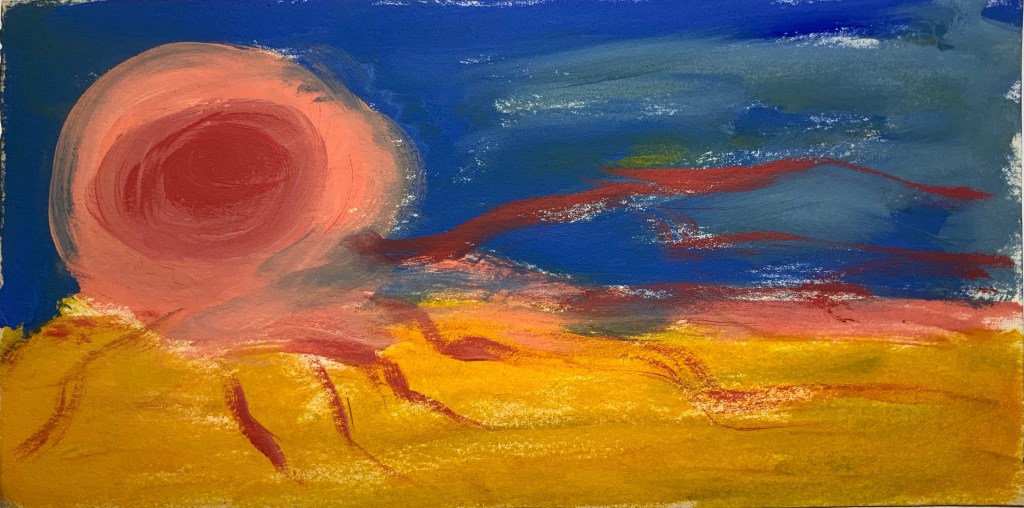
Minefield of Rabbit Holes

In my Arabic grammar I encounter the preposition fiy- illustrated in a “relationship of comparison” (rapport de comparaison).

mA HayAtu-d-dunyA fiY-l-Akhirati illA maTA(un: La vie de ce monde, par rapport à l’autre, n’est que jouissance précaire. [“The life of this world, compared to the next, is but precarious enjoyment.”] R. Blachère et M. Gaudefroy-Demombynes, “Grammaire de l’Arabe Classique,” 1952).

Blachere’s jouissance is matA( from root m-t-( meaning “to carry away” and, in derived forms, “to enjoy.” Its usages meander through enjoyment, property, and stuff. The notion of “precarious” is absent; however, the syntax example is one of many Blachère takes from the Koran. Julio Cortés points out that the immense corpus of commentary crucially supplements how Koranic terms are understood. The delights of this life are deemed ephemeral by common consent.

Here’s the exploding rabbit hole: My dictionary defines the idiom matA(u-l-mar’a, whose second word means “woman,” as cunnus. It’s tagged anat. for “anatomical.”

There’s an ancient English word for cunnus that’s cognate with French con and Spanish coño. I once mocked Western scholars born in Victorian times who resorted to Latin in citing salty medieval verses (especially those composed by women). I’m less exercised now about Roman empire slang. I confess my mother-tongue’s alternative to cunnus grates on my ear. I’m content to let sleeping Latin lie.

(c) 2022 JMN — EthicalDative. All rights reserved
Posted in Anthology, Commentary | Tagged , , | Leave a comment

Rewarded With Provocations

[shA(ir] knowing (by instinctive perception), endowed with deeper insight, with intuition… poet. (Hans Wehr, “A Dictionary of Modern Written Arabic,” ed. J Milton Cowan, 1962).

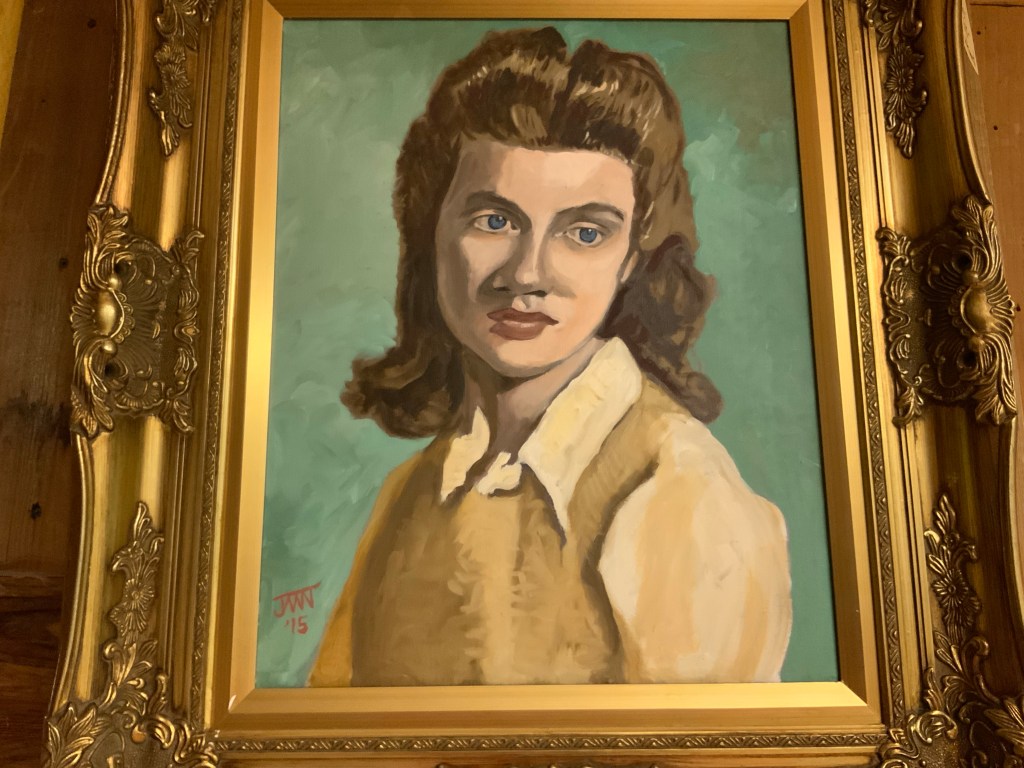
It helps me read contemporary poetry to conjure the mindset of an athlete in the elite sport of pole vaulting. The bar sits there at a distanced height. I summon latency, coil with icy focus, charge the standards, launch myself on the flexing pole, soar contortedly… On a good day I clear the poem and land flushed with endorphins.

When I was half of who I am your voice came along / rewarding me with provocations. It was a fulgor as / beautiful as treasons on the outer banks on another / night. There were horses, wild ones whose thunder / abandoned earth for lattices of successive hoofbeats.

(From “Abraham Lake” by Nathan Spoon, Poetry, October 2020)

Language redolent of fulgors, beautiful treasons, and lattices of hoofbeats can be repulsive or propulsive according to the reader’s readiness and conditioning. I choose my task to be that of honing a sensibility able to submit to being reached by knowers who are worth their salt. I want good verse to affect me, and complacent satisfactions don’t go with the territory.

“As with other great poets, [Louise] Glück does not invite paraphrase.” (Robert Boyers)

“[The reader] may not get it at once but, if he is sufficiently interested, he invariably gets it. (Wallace Stevens)

Editora Nacional, Madrid, 1979.

The best cue may come from my Arabic teacher’s preface to his Spanish translation of the Koran:

“Although it’s true that to translate is to interpret, we separate clearly what’s commonly called interpretation from translation, distinguishing what the Koran ‘says’ from what it ‘seems to mean.’ ”

(Julio Cortés, rest in peace — un saludo, Profesor)

Let translation follow Nathan Spoon, then, where paraphrase fears to tread:

Cuando era la mitad de quien soy llegó tu voz / premiándome con provocaciones. Era un fulgor tan / bello como traiciones en las riberas alejadas de otra / noche. Había caballos, salvajes cuyo trueno / abandonaba la tierra buscando enrejados de cascos ruidosos.

JMN

(c) 2022 JMN — EthicalDative. All rights reserved
Posted in Anthology, Commentary, Quotations | Tagged , , , | 4 Comments

The Camera Has Spoken. It’s My Turn

This gallery contains 1 photo.

And out comes a tenderly belabored prospect of dilapidation. Looking at a photograph I didn’t take, I painted a quaint tranche of unleveled-up Britain from the plein air of the shed I inhabit. Painting my two-bit canvases from photos lets … Continue reading

More Galleries | Tagged , , , , | Leave a comment

‘The Past Stretched Before Us’

I encountered the following expression in my Arabic reference grammar: May you be ransomed by my soul!

[fudiyta bi-nafsiy] puisse-tu être racheté par mon âme! (formule de politesse à l’époque classique) — “Grammaire de l’Arabe Classique,” R. Blachère et M. Gaudefroy-Demombynes, 1952, p. 333.

Arabic can be sublimely terse and florid in the same breath. Blachere’s example shows optative use of the perfect tense instancing how the preposition bi- can introduce the real subject of a passive verb; it’s said to be a formula of courtesy from the classical era. As I checked dictionary meanings for the root f-d-y used in the phrase, my eye passed over phrases illustrating meanings for a different root f-D-D. One of them was the following:

[faDDa bakArata-hA] to deflower a girl — “Hans Wehr: A Dictionary of Modern Written Arabic,” ed. J Milton Cowan, 1966.

Boom — discordance blossoms. The polyvalence of root f-D-D starts at break open and passes through pry, force, undo, pierce. Its complement, from root b-k-r, means virginity.

Dictionaries preserve words somewhat like sediments preserve fossils. Both teach a lot about what has gone before. Deflower may give way to rape in future dictionaries, but that’s contingent on woman’s lot improving outside language, and the past weighs heavily against it.

In her poem “The Garden” Louise Glück writes: … the past, as always, stretched before us, / still, complex, impenetrable.

The comma after still makes it describe the antecedent past; the past is still, i.e., static, unmoving, intransigent. Also complex and impenetrable.

She continues: How long did we lie there / as, arm and arm in their cloaks of feathers, / the gods walked down / from the mountains we built for them?

The verse asserts correlations that elude me; it hints perhaps at the speaker’s rueing in hindsight a supine cluelessness in respect to a vital mystery; interrogating reverence lavished on dashed idols; voicing disillusionment over a failure to perceive cynical affectation, regret at being duped by feigned camaraderie. The possibilities for misperception of the poet’s intention are boundless, but what dwells immutable for now is deflowered girls staring us in the face.

(c) 2022 JMN — EthicalDative. All rights reserved
Posted in Anthology, Commentary | Tagged , , , | Leave a comment

The Struggle to Lose Control

Cover by Damon Locks.

To All a Good New Year!

Audrey Petty describes her first one-on-one conference with her poetry teacher Agha Shahid Ali at the University of Massachusetts. After she read her draft to him, he reviewed it and said, “What if you turned this poem around?” She proceeded to invert the lines.

Reading my writing backward felt like abracadabra as the poem revealed something stranger, truer, more distilled in reverse. Language alchemized as the words loosened themselves from my intention. The poem became more of a poem.

From her essay “Revolving in Your Hand,” Poetry, February 2021.

Petty helps me see how I may hobble myself — in words and in pictures — by oversteering toward wished-for outcomes or banal conceits. Maybe my creations would travel further if I could loosen the media (and self) from my intention.

As the calendar flips over, resolution is on the verge of being made: Dare to see more backwards and upside down.

(c) 2021 JMN — EthicalDative. All rights reserved

Posted in Anthology, Commentary | Tagged , , , | Leave a comment