Here’s something called a triolet from Poetry, May 2025. The form is new to me and strikes a chord: concision, repetition, the discipline imposed.
Triolet with a Line by Sylvia Plath by Brittany Perham
We take the N out to the turnaround. The only thing to come now is the sea. The ice plants make the pink world loud. We take the N out to the turnaround. The fog fades in with its foggy sound. The end is here. Everyone can see. We take the N out to the turnaround. The only thing to come now is the sea.
Quoted whole because how do you vivisect a poem consisting of 8 tightly wound lines without wounding it? Also, what’s to say, above and beyond, that doesn’t murder with a grave truth?
If you want to see a tedious triolet explicated to death, glance here. I favor one that makes the pink world loud. Chow, bébé.
They say: A man who can’t tell shoe polish from shinola is fit to be tied by time and the tide. It’s one of those old sayings they say is never insufficient to the day thereof.
They say: A stitch in time is a penny earned. Penny for your thoughts. Pennies from Heaven. Common sense.
Many timeless zingers they say come from faith baseness: Trespass not, brethren, lest ye commit foulness one upon the other. This is the core takeaway of a legendary decalogue. Two other takeaways are the ones that go don’t steal and don’t adulterate.
A florilegium of eternal verities they say blooms as well from the Great Reading Lists: They also serve who only stand and deliver. There’s scads of these things they say. A horde of populous wisdom, believe you me, as true now as it more than ever was.
Make American English Great Again Now — MAEGAN — is a sweet hotrod of a movement, a screaming dragster with four-barrel carburetor smoking the shithole competition wherever jalopies duke it out. The Nineteen-Fifties burn rubber in the Twenty-Twenties like there’s no tomorrow. The Eighteen-Fifties bray:
Go West, inseminating Dude, East, North and South, mad Monoglot! From Greenland to the Doomsday Floe, Yours is the Earth and all that can be got, And — which is more — you’ll be a ‘Garch, my bro!*
*Sloganeering assembled from aftermarket Kipling and busted jingo blab. Don’t knock it, old son. It runs.
Where the living language is concerned, which let’s face it. So.
Can you spot the tuber posing as a goober? What about a dangled thought left to? Hip to messaging that carries false report? Words happening metaphorically, knot in real time? Factitious takeaways?
Can you tell a genuine non sequitur from a contrived segue? Objurgation that minces?
Pinpoint aggrieved pseudo-nostalgia that feels achingly autonomic and you’re dialed in. Possibly over your head, but respect. Heads up in the ensuing fog:
Lie with darkness, wake with fleece. You been served. Got damn! You got to know when to fold. So what? is the question. Some words are spelled with different letters. Fake it ‘til you fyck it. The party is pooped, my peeps. Denizenship is a privilege, not a right. If you’re bitching, you’re bombing. Back to your beginnings. Return to where you lost — this space is taken, pardner. In the name of God, make yourself scarce.
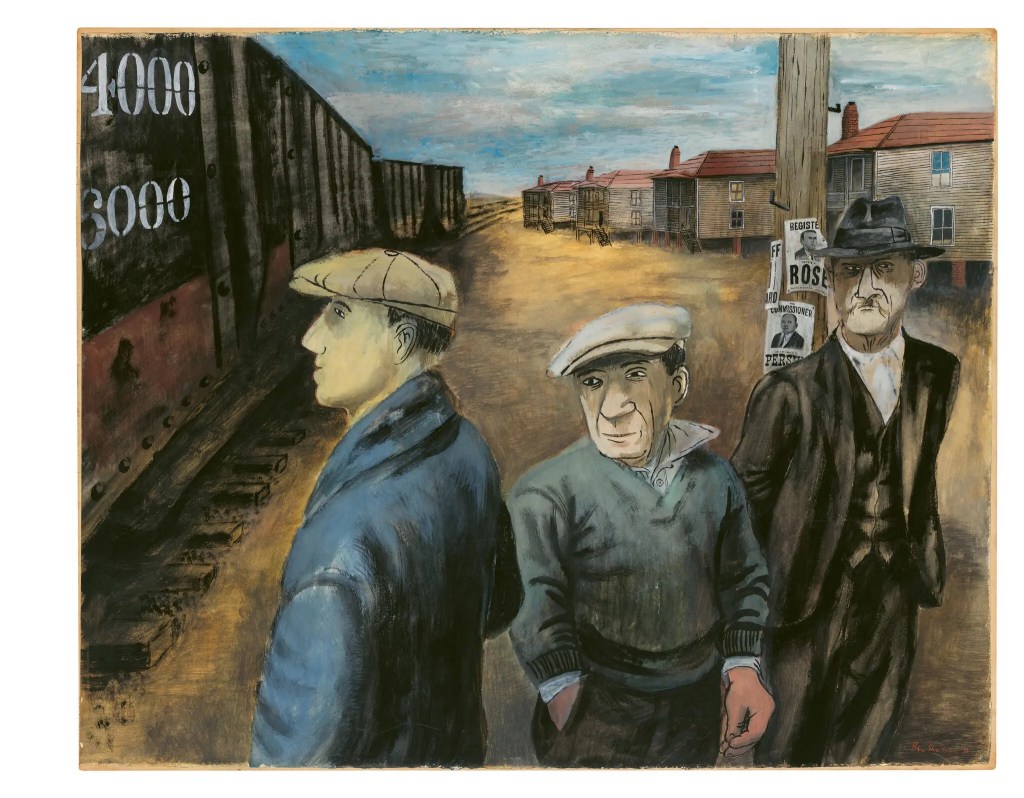
Ben Shahn, “Scotts Run, West Virginia,” 1937. During the Great Depression, Shahn felt sympathy for Americans suffering the deprivations he grew up with. (This painting was based on a photograph he took.) Credit… Estate of Ben Shahn/Licensed by VAGA at Artists Rights Society (ARS), NY; via The Jewish Museum. [New York Times caption and illustration]
If the images in the survey feel more like news than comment, that’s partly because we can sense the press photos Shahn used as his sources. Though his paintings themselves aren’t close to photorealistic — his technique can be potently slapdash — their subjects have the verve of seeming caught on the fly.
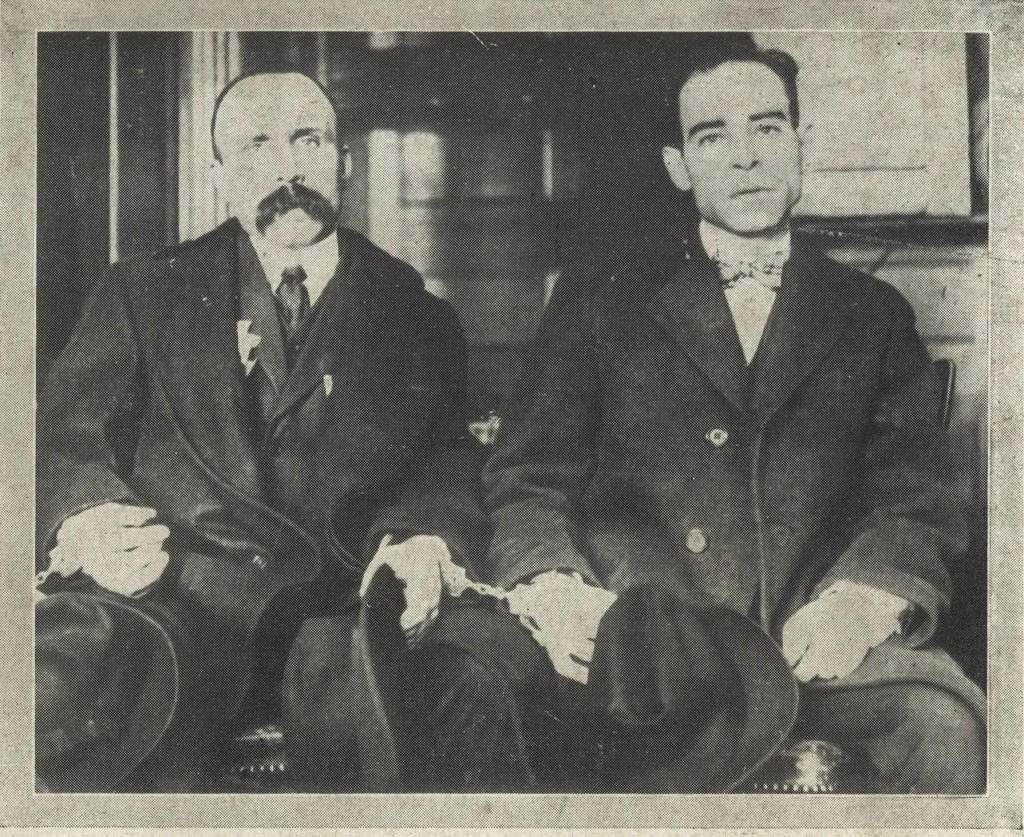
A 1923 news photograph showing Bartolomeo Vanzetti (left) handcuffed to Nicola Sacco, in a courthouse in Dedham, Mass. Shahn used it as his source for a painting in the Jewish Museum show. Credit… via Boston Public Library. [New York Times caption and illustration]
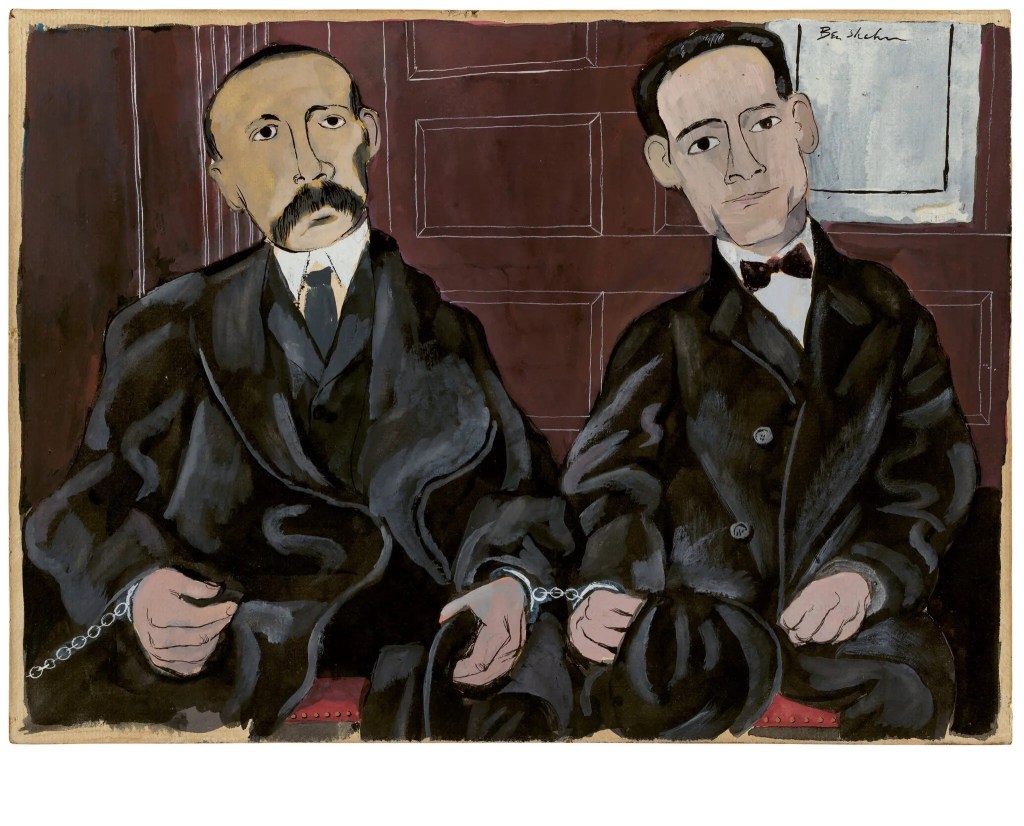
The exhibition includes an earlier series on the controversial 1921 trial of Nicola Sacco and Bartolomeo Vanzetti, Italian immigrants executed for murder despite flimsy evidence. Shahn’s painting of the two handcuffed men is cropped weirdly tight; we see that it echoes a source photo that had been cropped the same way, to save space on the printed page. Shahn borrows the feel of a photograph’s direct observation to make his painted subjects seem more directly observed by us.
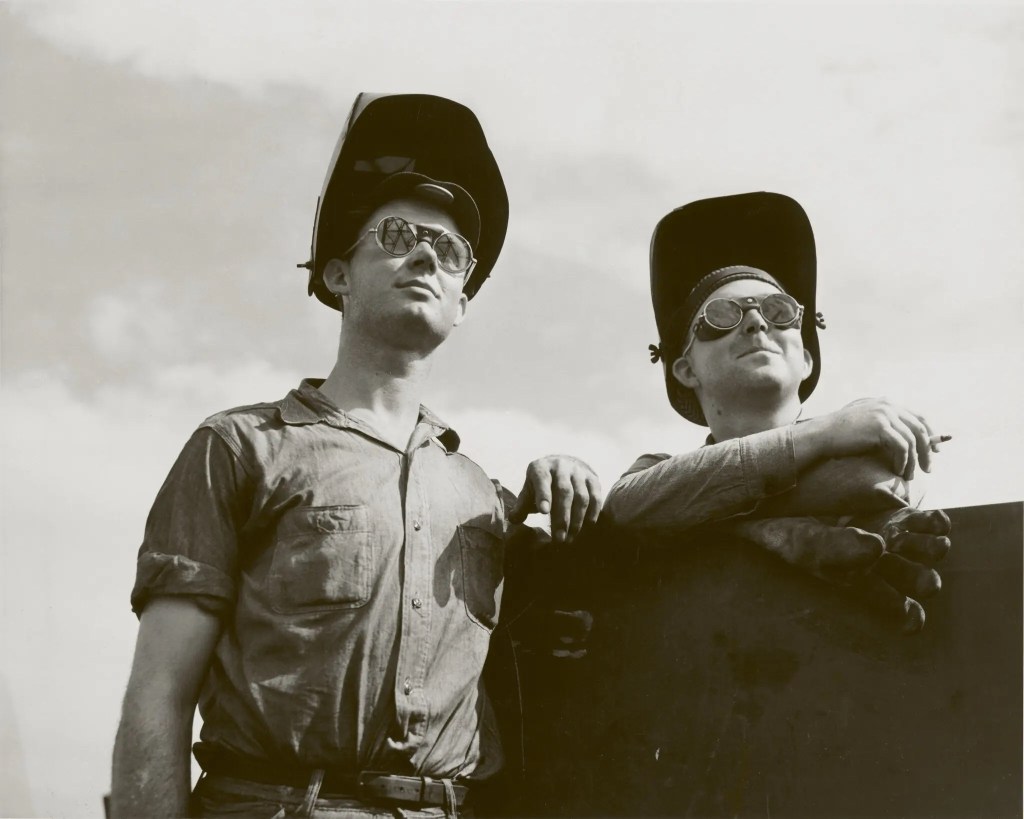
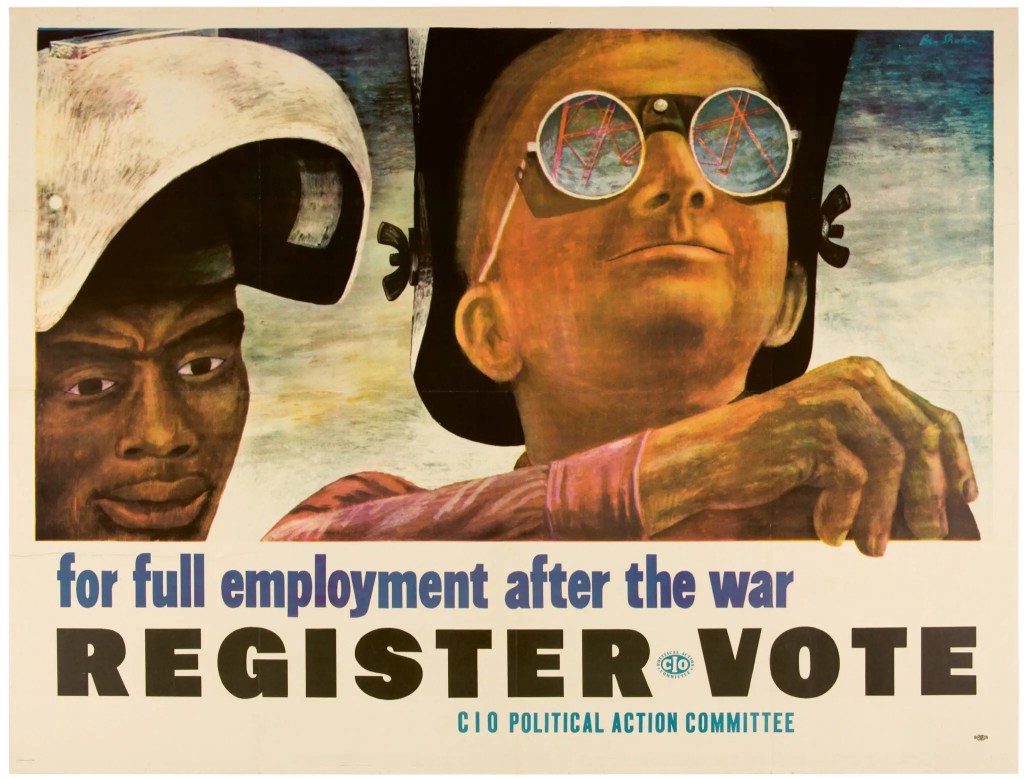
Ben Shahn, “Bartolomeo Vanzetti and Nicola Sacco,” 1931-32, gouache on paper. This painting retains the tight cropping of its source photograph. Credit… Estate of Ben Shahn/Licensed by VAGA at Artists Rights Society (ARS), NY; via Museum of Modern Art. [New York Times caption and illustration] A photograph by Alfred T. Palmer, showing two welders, October 1941. Shahn used this photograph as the source of a poster, changing the race of one of the welders to Black. Credit… The Jewish Museum. [New York Times caption and illustration] Ben Shahn, “For Full Employment After the War, Register, Vote,” 1944. Credit… Estate of Ben Shahn/Licensed by VAGA at Artists Rights Society (ARS), NY; via The Jewish Museum. [New York Times caption and illustration]
… And prosecutions that can seem to serve politics, not justice.
… In the decade or so before his death in 1969, Shahn could seem more interested in modern aesthetics than in modern people and their plights. His pictures became palimpsests of allusive symbols, reheating modern styles from Paul Klee and Pablo Picasso… We miss the immediacy of Shahn’s earlier pictures, with their close ties to an observed world… What Shahn couldn’t have realized, as he turned away from his potent visions of the 1930s and 40s, was that they would find new purchase almost a century later, when once again we face issues of racial injustice, and what our nation might do about it, and prosecutions that can seem to serve politics, not justice.
(Blake Gopnik, “Ben Shahn’s Social Realist Art Feels Relevant Again in Landmark Survey,” New York Times, 5-29-25)
As a kid studying high school French, I read with delight Mark Twain’s depiction of an American’s attempt to converse with a Frenchman. Twain wickedly renders the Frenchman’s remarks in literal English, alongside his own fractured French, to comic effect. Their exchange has something to do with bananas — bananes. Of course it does!
Investing the mundane with eventfulness: the Twain approach to humor, the Eliot approach to poetry, the Hopper approach to painting, the Gilles Labruyère approach to cartooning. Gilles’s fluent bilingual captions nourish my French. I succumb here to the impulse to subject one of them to a Twaining. With pleas for indulgence to the artist, here goes my impertinence:
A genial gent sitting on a train hears the announcement:
Vous avez pris place à bord du train à destination de Toulouse. You have taken place aboard of the train to destination of Toulouse.
The gentleman says to his companion sitting opposite:
Ça tombe bien. C’est là que j’vais. That falls well. It is there that I go.
For all that the literal English is cracked, it hits the mark, plus ou moins.
Next is Gary Larson. Let me set it up for you: A microbiologist working late nights is being mugged at slide point by a microbe. Staring into the eyepiece, what can he do but surrender his wallet and hope not to get hurt? Here’s the cartoon. [BULLETIN: Quel dommage! When I tested the link for the Larson cartoon it gets this message now: Egad! That cartoon is no longer available. Try one of these instead.]
Lastly I’ve but two words: Liana Fincke. The New Yorker has introduced me to this indescribable cartoonist, for which I’m grateful. To understand why I have no words, see her Wife of Valor. It kills.
“Congregation,” 2023, with three figures who seem to be gossiping or complaining, has a camp humor that sometimes pops up in Ojih Odutola’s work. Credit… Toyin Ojih Odutola, via Jack Shainman Gallery, New York; Photo by Dan Bradica Studio. [New York Times caption and illustration]
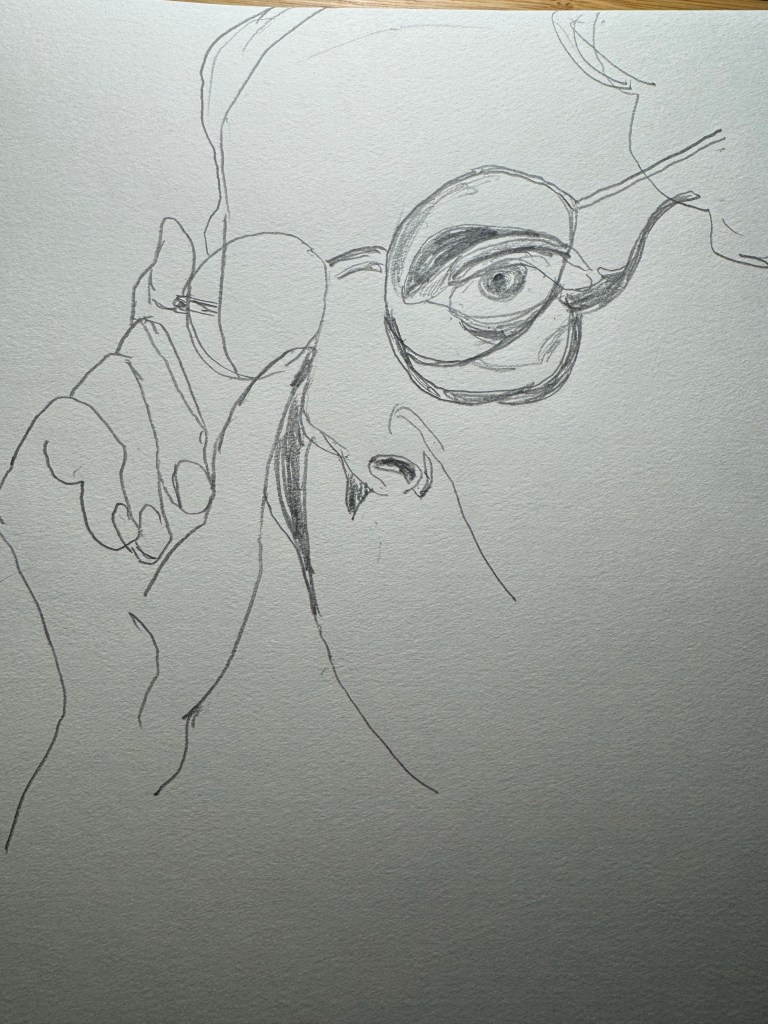
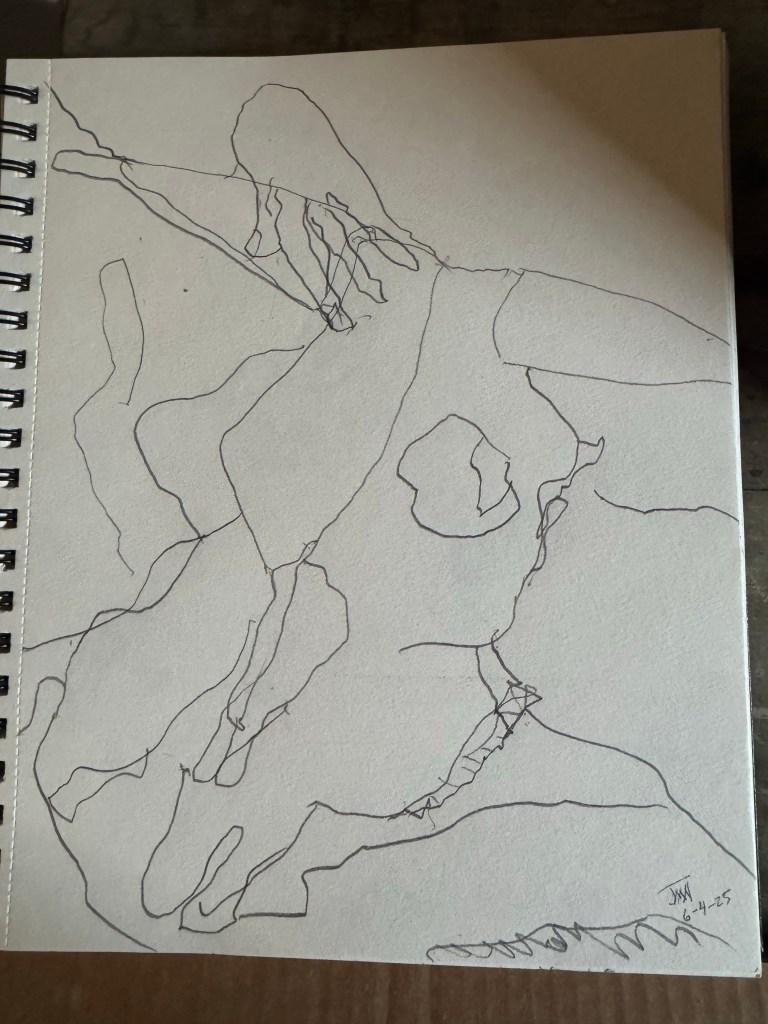
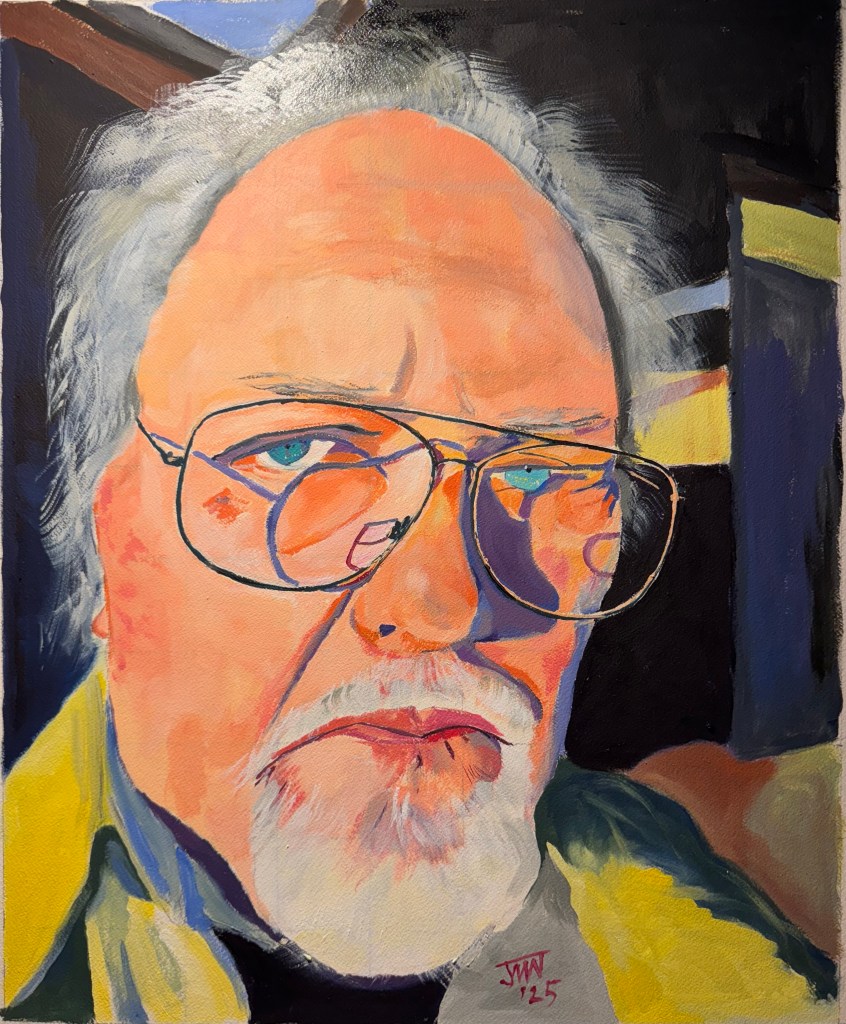
I like how Toyin Ojih Odutola assembles faces from facets, a treatment I strive increasingly, if feebly, to approximate. I describe it to myself in personal shorthand as “envisaging”: implementing visage as a sort of ‘scape rather than anatomical likeness mask. This deep fissure radiating from beside the “nose” is a crevice near the shadow of a promontory, etc. One talks to self, trying to deprogram the brainwashed eye not to “see” what it expects. It exacts a keen and studied form of looking coupled with patient and nuanced handling of media.
Ojih Odutola makes very large drawings — some more than 6 feet high — with charcoal, pastel, graphite and colored pencil. I’d like to know what paper or other surface she uses. The journalist, Siddhartha Mitter, remarks that “her drawings often look like paintings from afar.”
My treatment of Mitchell Glazier’s “The Gazing Ball” (Poetry, May 2025) wasn’t fit for purpose because it came across as testy and dismissive. I’m not equipped nor disposed to be a poetry critic, only a consumer with thoughts. And my thoughts were unruly.
A standard I try to uphold if I’m to sound off is to take a writer seriously. Doing so entails allowing myself to be roiled and provoked by what’s pleased to call itself a poem, having cleared the bar of editors pleased to call themselves poets. It’s not my remit to mock or satirize or deride a text which I find inscrutable.
Approaching a poem confrontationally is to mount resistance to ostensibly impervious utterance. Trying to articulate to myself how or why it gets under my skin implements a working assumption that getting under a consenting reader’s skin is what poetry’s meant to do. It’s easy to lose sight of this premise, because reading aggressively is strenuous and time-consuming. You and I have only the precious moments allotted to us.
Negativity is indifference, not indignation. I have found that sometimes, when I’ve incurred the sunken cost of wrestling with an infuriating text, I’ve begun willynilly to internalize one or more aspects of it, to reach what I call an accommodation, paying it at least a grudging respect.
Just to revisit Glazier’s poem for a moment, I uphold the potential of these utterances to linger in my head, perhaps become memorable:
Absence roughs up / My dead dog in the blood / Of babysitters Little porcelain / Poppet, hand / The tureen of blood / Now to papa I’m a gentleman / Dressed in pink paper / Ballooned assless chaps
“Assless chaps,” by the way, are an accoutrement of the working cowboy. The following line is “Float the violet quarry,” which I let stand subjunctively on the model of “Cry the beloved country,” exercising reader’s discretion when the text itself isn’t dispositive.
What I have still failed to do is extrapolate a framework in which the elements of “The Gazing Ball” cohere in the service of a unitary message. That may not be an expectation the writer intends to meet or which I’m entitled to have.
I’m stuck with the bias that reading what I call “verse objects” when they’re refractory and I don’t know (or care) if they’re poems or not sharpens my faculty for recognizing, processing and assimilating newness. The only person who need care what I make of the objects is me. Anyone else who does is surpassing kind and someone I want to know.
“Gray Isn’t a Black-and-White Proposition: Ivory Black Mixed With Phthalo Green Light (Vert Anglais Clair, Englisches Grün Hell, Verde Cromo Claro) Cut to Varying Values With Titanium White,” oil on watercolor paper, 24×30 in., (JMN 2025).
What the hell is going on in “The Gazing Ball”? I had to lock horns with Mitchell Glazier’s poem (Poetry, May 2025) and break it down robustly in order to reach a fragile accommodation. I’ve come to expect having to do this with much verse filtered through Poetry’s reading committee. My approach is to fall back on the godliness of syntax. If the writer respects language half as much as I do, chaos is dodged. If the writer doesn’t, we never met.
Fortunately, what scans as jabberwocky in “The Gazing Ball” does have structure once you look below the bizarro surfaces and cracked lines.
Consider the first 18 words of the poem:
Queenly swans nudge eternity figs Yellow rose fire
Lit by a ghost breath I’ve eaten you someplace before […]
Wrap your mind around the base assertion that “swans nudge figs.” An obvious-enough adjective describes the swans: “queenly.” A curious adjective describes the nudged figs: “eternity” A flagrant metaphor placed in apposition to those nudged figs further characterizes them: “yellow rose fire lit by a ghost breath.” (The reader must intuit a full stop here.) Figs whose hue is like the fire of a yellow rose — radiance blasted by a fastuous flower — is rather pretty. Go figure what kind of illumination “a ghost breath” casts upon that fire, but the expression’s metaphysicality gives it a certain staying power. In the next assertion, a speaker apostrophizes (talks to) the swan-nudged eternity figs: “I’ve eaten you someplace before.”
Let me go straight to paraphrase in order to save you and me time. Next, several unlikely subjects conjointly “nip” something and “curtsy” to something else. The subjects (actors, agents) are “venom,” “chops” (lamb? pork?), “novels” and “peacocks.” The venom is that of a “terrapin” (a freshwater turtle); the chops are “heart-shaped”; the novels are “beautiful [and] rare”; and the peacocks are “bedlam,” denoting uproar and confusion. The terrapin venom is making a mess on someone’s clothing, “sopping cream suits.” What these several creatures and objects functioning as subjects of the sentence engage in nipping are “limbs”; indeed, “nip limbs a-rosy” is what they do. Leaving them pink? The thing venom, chops, novels and peacocks curtsy to is “the apricot cross.”
Terrapin venom Sopping cream suits
Heart-shaped chops Beautiful, rare novels
Bedlam peacocks Nip limbs a-rosy
Curtsy The apricot cross […]
There’s more than half the poem yet to parse and construe. You take it from here (the link’s up top). Dozens of other new poems await my grappling and I’m out of time for this one. I’ll only remark that the “The Gazing Ball”’s last line is stated so baldly, in contradistinction to what precedes, that it fluoresces:
The poets who offed themselves Have formed a small country
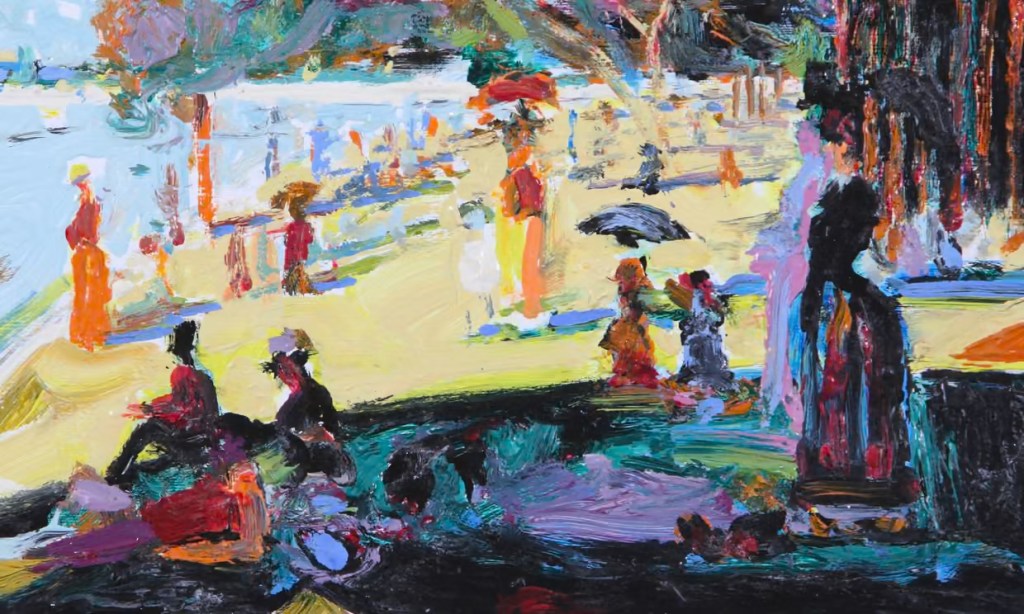
Wayne Thiebaud – A Sunday on La Grande Jatte (after Georges Seurat), 2000. Photograph: Wayne Thiebaud Foundation. [Guardian caption and illustration]
This copying work helped Thiebaud figure out his own solutions to artistic problems.
I blush to own it, but I was never keen on pointillism. For all that it purported to be scintillating, it has a diffuseness that feels static. It did show how not to use line to delineate boundaries, which was helpful, but then I liked Degas and Toulouse Lautrec, who outlined deliciously. Thiebaud’s Seurat thrills more than Seurat. Does that make me a frivolous person?
Supper at Emmaus, (after Rembrandt van Rijn), by Wayne Thiebaud. Photograph: Wayne Thiebaud Foundation. [Guardian caption and illustration]
The following quotation is about Thiebaud’s own paintings:
Speaking of light, there is so much glorious negative space in these paintings, largely taken up by whites as thick and delicious as a wedding cake, ranging across so many subtle differences in hue and texture as to be an exhibition within an exhibition. “It’s a symphony of whites,” Burgard enthused again and again as we walked the show’s galleries, pointing out the radiant greens, yellows, blues and reds that Thiebaud subtly layered into the ostensibly “empty” space in his paintings, making his trademark halo effect. “It’s every single white known to humankind is practically how it feels,” Burgard said. “It’s a sea of white that you could fall into…”
Wayne Thiebaud – Three Machines, 1963. Photograph: Wayne Thiebaud Foundation. [Guardian caption and illustration]
(Veronica Esposito, “‘A self-described art thief’: how Wayne Thiebaud channeled other artists,” The Guardian, 4-16-25)





 EthicalDative
‘That Falls Well’: Cartoon Paean Times Three
As a kid studying high school French, I read with delight Mark Twain’s depiction of an American’s attempt to converse with a Frenchman. Twain wickedly renders the Frenchman’s remarks in literal English, alongside his own fractured French, to comic effect. Their exchange has something to do with bananas — bananes. Of course it does!
Investing the mundane with eventfulness: the Twain approach to humor, the Eliot approach to poetry, the Hopper approach to painting, the Gilles Labruyère approach to cartooning. Gilles’s fluent bilingual captions nourish my French. I succumb here to the impulse to subject one of them to a Twaining. With pleas for indulgence to the artist, here goes my impertinence:
A genial gent sitting on a train hears the announcement:
Vous avez pris place à bord du train à destination de Toulouse.
You have taken place aboard of the train to destination of Toulouse.
The gentleman says to his companion sitting opposite:
Ça tombe bien. C’est là que j’vais.
That falls well. It is there that I go.
For all that the literal English is cracked, it hits the mark, plus ou moins.
Next is Gary Larson. Let me set it up for you: A microbiologist working late nights is being mugged at slide point by a microbe. Staring into the eyepiece, what can he do but surrender his wallet and hope not to get hurt? Here’s the cartoon. [BULLETIN: Quel dommage! When I tested the link for the Larson cartoon it gets this message now: Egad! That cartoon is no longer available. Try one of these instead.]
Lastly I’ve but two words: Liana Fincke. The New Yorker has introduced me to this indescribable cartoonist, for which I’m grateful. To understand why I have no words, see her Wife of Valor. It kills.
(c) 2025 JMN — EthicalDative. All rights reserved