[Photo July 19, 2015. Copyright 2015 The New York Times Company]. City of Asylum’s first exiled writer-in-residence was Huang Xiang. He wrote: “‘In China I was like a fossil… When I came to the United States and people discovered me, they dug me out of the earth and I became alive’… Mr. Huang painted calligraphy of his poetry on the facade of his City of Asylum rowhouse, which has become a neighborhood icon.”
… Like a scene from Mr. Rushdie’s novel “Shalimar the Clown,” a knife-wielding man rushed onto the stage and began to stab him. Immediately audience members ran to the stage to defend him. It was a remarkable response. That rush of people leaping from their seats was the opposite of the so-called “bystander effect,” when individuals do nothing, relying on others to help. I would call it “the reader effect.” Reading creates empathy… The intuitive response of an empathetic community is to help.
(Henry Reese, “I Was Onstage With Salman Rushdie That Day, and What I Saw Was Remarkable,” NYTimes, 9-2-22)
In 1997, Henry Reese and his wife, Diane Samuels, founded Pittsburgh: City of Asylum, which provides a safe haven for persecuted writers, artists and journalists. Their program includes: “a rent-free home for two years or more if necessary, a stipend, legal counsel, medical benefits and access to professional development opportunities.”
As Mr. Rushdie said in 1997, it’s not just about his right to write; it’s also about our right to read.
Translated from the Arabic by John Glenday and Ghareeb Iskander.
Ghareeb Iskander is an Iraqi writer who lives in London. HIs book of poems in Arabic, “Gilgamesh’s Snake and Other Poems,” was published by Syracuse University Press in 2016. The English translations are the work of Scottish poet John Glenday and Iskander himself. Their versions command distinct authority, of course. Mine are dictionary-driven and meant to be literal for study purposes (akin to a trot).
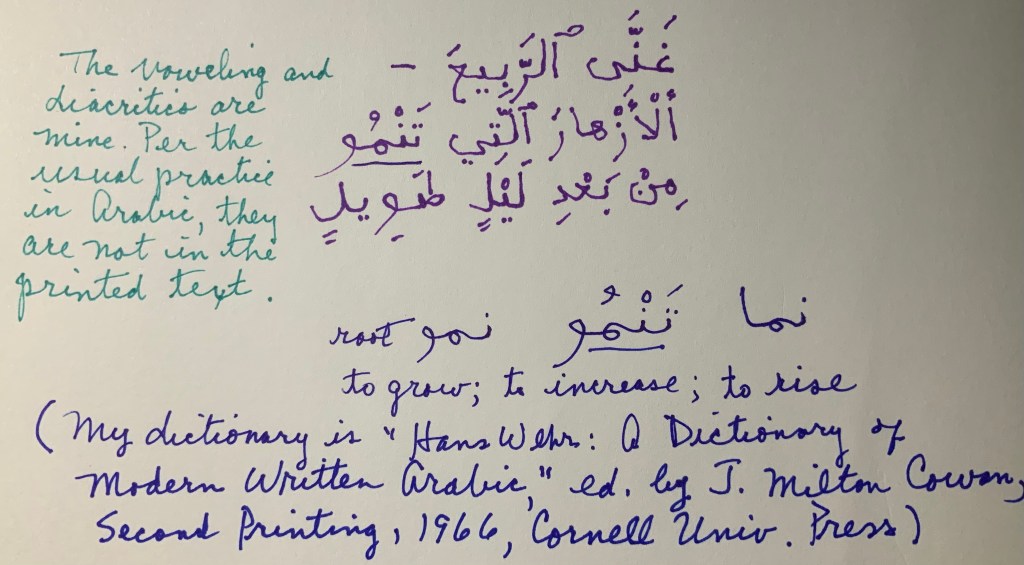
Here’s a snippet reflecting the dialog I hope to have with the book. It’s from “Song,” the book’s first poem (my bolding):
My reading in English and Spanish: … He sang the spring — / the flowers that grow / after a long night. / Sang the streets, / did not sing the walls. [Cantaba la primavera — / las flores que crecen / después de una noche larga. / Cantaba las calles, / no cantaba las murallas.]
Published text: … He sang springtime — / the flowers that open themselves / after a long night. / He sang the streets / but he wouldn’t sing the hindering walls.
Amplification flows from the instincts and cultural grounding of the translators. It may capture a nuance of the Arabic that escapes me, or that’s missed by my dictionary. Is that the case with open themselves versus grow?
In other cases, certain phrasing may be deemed better suited to English cadence, or else to express what’s tacit in the Arabic. Consider “but he wouldn’t sing the hindering walls.” “Wouldn’t” injects a hint of willfulness into the Arabic’s unmodulated past tense. A wall can protect as well as hinder. Perhaps the connotation contributed by “hindering” foreshadows a context that lies ahead.
David Remnick has written that comparing two translations of The Brothers Karamazov “is to alight on hundreds of subtle differences in tone, word choice, word order, and rhythm.” (“The Translation Wars,” The New Yorker, 10-30-05). What’s worthy of sharing here, now and in future, is the unexpected, where a tyro’s cluelessness collides with inborn savvy. When the poet collaborates in the translation, he serves as a native informant validating shadings and phrasings whose justification may not be immediately discernible, and which readily hold up to sturdy query.
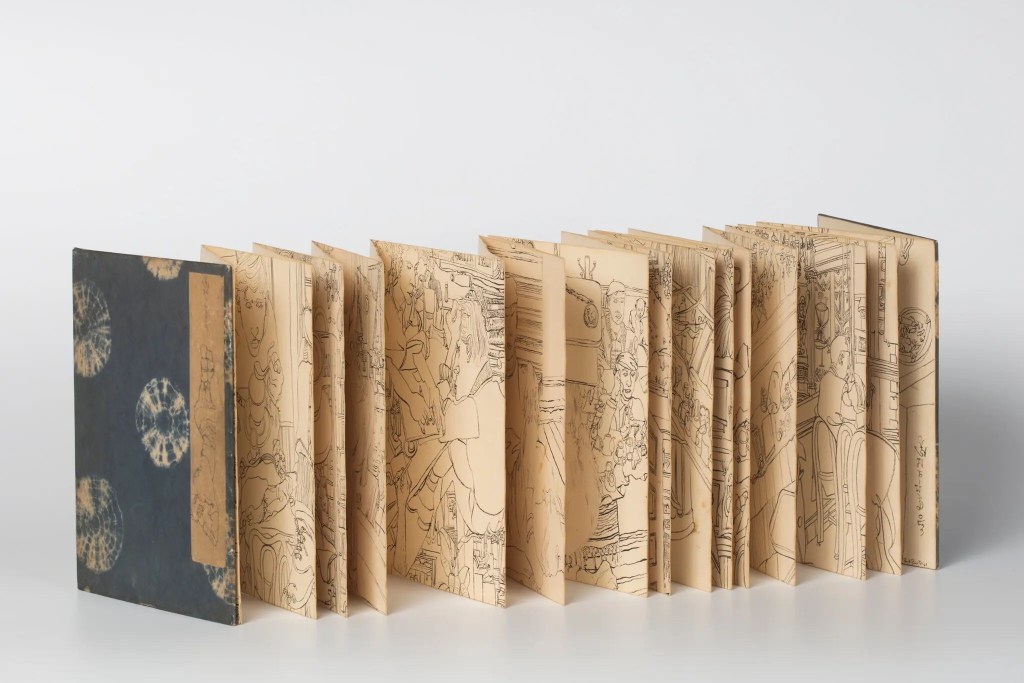
Rick Barton, “Untitled Sketchbook,” 1961. “… A workaday recluse who sought self-knowledge by way of a monastic and unquestioned creative ethic.” Credit… Northwestern University Libraries; Tom O’Connell.
On scrolls of Japanese paper each 19 feet in length, Barton documented the underbelly of San Francisco’s North Beach neighborhood before the hippies showed up… A friend and fellow artist recalled that Barton began a portrait with the sitter’s fingernail… (The show’s title comes from a boy who, as he passed Barton hard at work in Peking’s main square in 1960, observed to his father, “Look, he is writing a chrysanthemum.”) …
(Walker Mimms)
“Untitled [Facade of Barcelona Cathedral],” September 1962, pen and ink with graphite. Credit… UCLA Library Special Collections.
Classical music, not jazz, was Barton’s thing. When he briefly ran a gay nightclub near the Oakland Bay Bridge, he stocked its jukebox with Bach fugues… His clear devotion to the traditional line drawing of China (where the Navy brought him) and of Japan (he used the ultrafine yatate brush) explains his occasionally stunning compositional unity.
(Walker Mimms)
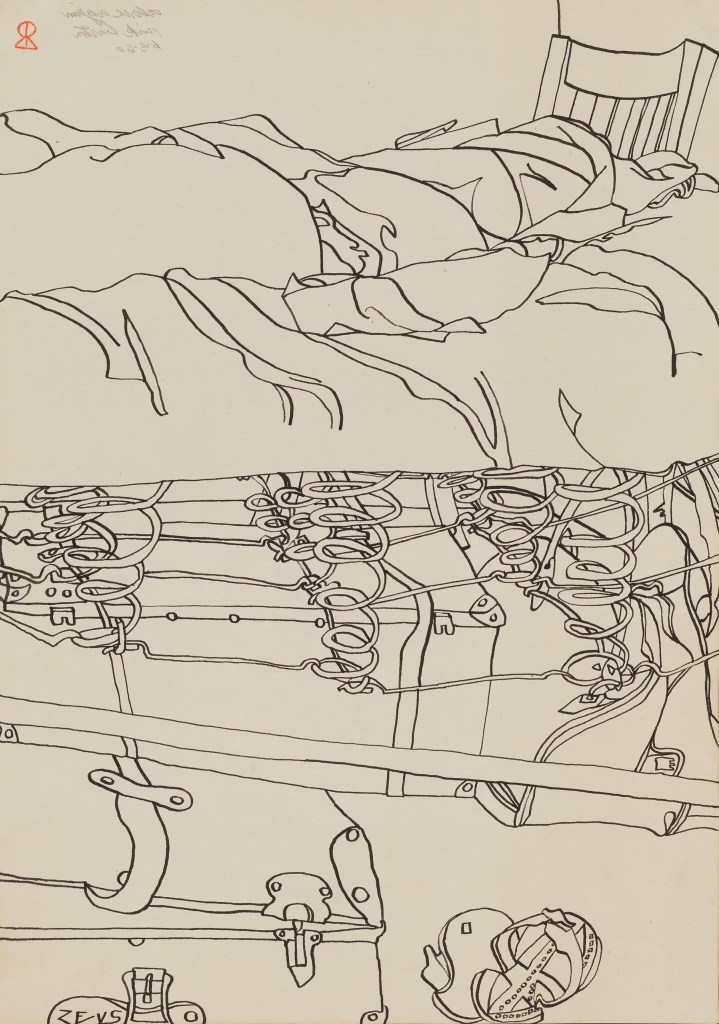
“Alone Again,” June 3, 1960, pen and ink. A bedspring as an unwieldy hunk of architecture. Credit… UCLA Library Special Collections.
“The artist is still alive,” Evans warned the curators in 1971, “but he is crazy as a bedbug and impossible to cope with.”
(Henry Evans, friend and patron who rescued Barton’s abandoned drawings and donated them to UCLA. Quoted by Walker Mimms.)
(Walker Mimms, “Unearthing Rick Barton, A Boho Bard of North Beach,” NYTimes, 8-22-22)
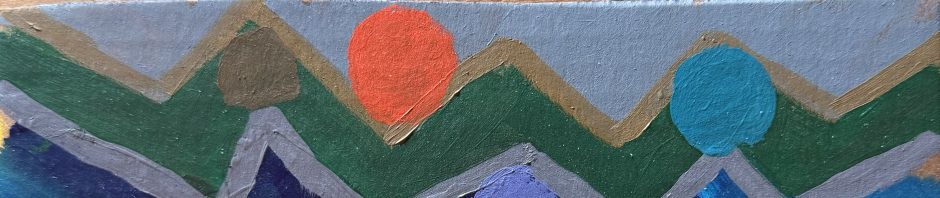
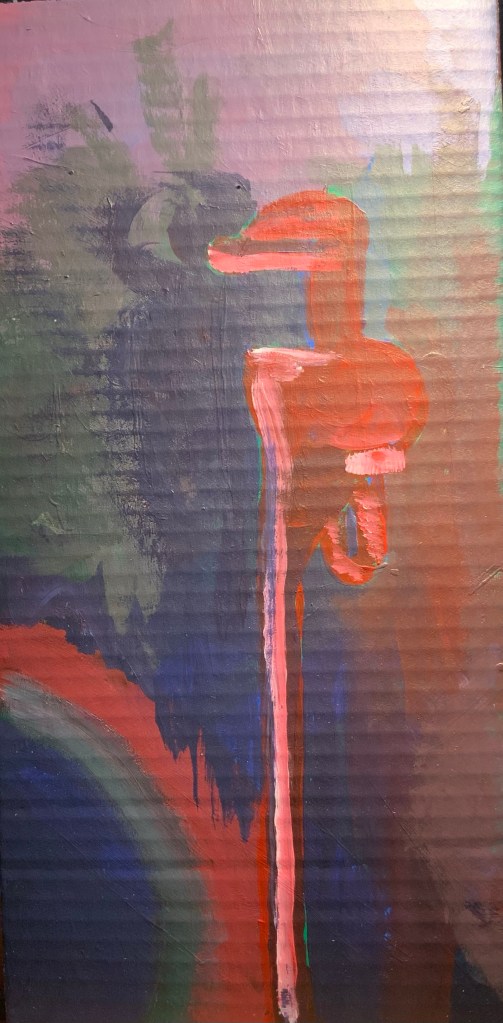
(Acrylic brushed on wrinkled paper glued to cardboard scrap.) Joan Didion’s novel introduced me long ago to the reigning English solecism. I’m not a golfer, why am I attracted to Play it as it lies? Didion, a rigorous stylist, knew what she was doing. Her choice of the phrase’s version lends it the undermining force she needed. — JMN
The comment about the unsmiling lion is attributed to the 10th-century Arabic poet al-Mutanabbi (915 – 965). I heard it on a podcast called “Arabic Qahwa.” The line has a zesty zing to it that marks it as an old saying to be handed down indefinitely on the tongues of hoary elders, delivered with narrowed eyes and sagacious nods.
Old “Chinese” sayings abound in English. I’m not sure they’re all Chinese, or old, or even much said, but I have a favorite:
Wisdom consists in getting the names of things right.
Chinese Saying?
Whatever its origin, the saying bucks me up by validating a penchant for being ruled by grammar. The fewest words that are right can say enough barely, and leave the rest clearly understood. Excepting poetry, that’s good speech.
I wonder if a translation of a poem can be compared to a sketch of a painting? The sketcher recreates aspects of an original art work in a different medium, say pencil. Words are the translator’s medium. She uses those of one language to depict an object made with those of a different language. Both sketcher and translator do something akin to copying. The outcome may do a certain justice to the original, or not, but won’t be confused with it. We’re not talking about forgery or plagiarism.
What’s the point of sketching another art work? Take your answer to that question, I’ll take mine, and let’s see if they apply to translation: What’s the point of it?
Suppose the sketches were made from a painting that has disappeared? Whatever inspired it, say the rape of the Sabine women, is known to us only via the exertions of a sketcher. Pursuing the analogy, a poem may as well not exist for the reader who doesn’t know the language it’s written in. When a translator says, It looks somewhat like this, the reader gains a modicum of access to it, an awareness of it.
Scrupulous fidelity isn’t in the cards in either case. Both actions, sketching and translating, are drenched in subjectivity, contingent on the eye, the tastes, the skill of the renderer. Each is a form of imitation; an homage, perhaps; or an exercise; or an exploration; even an idle amusement. Secondary and derivative, yes, but each possessing a life of its own.
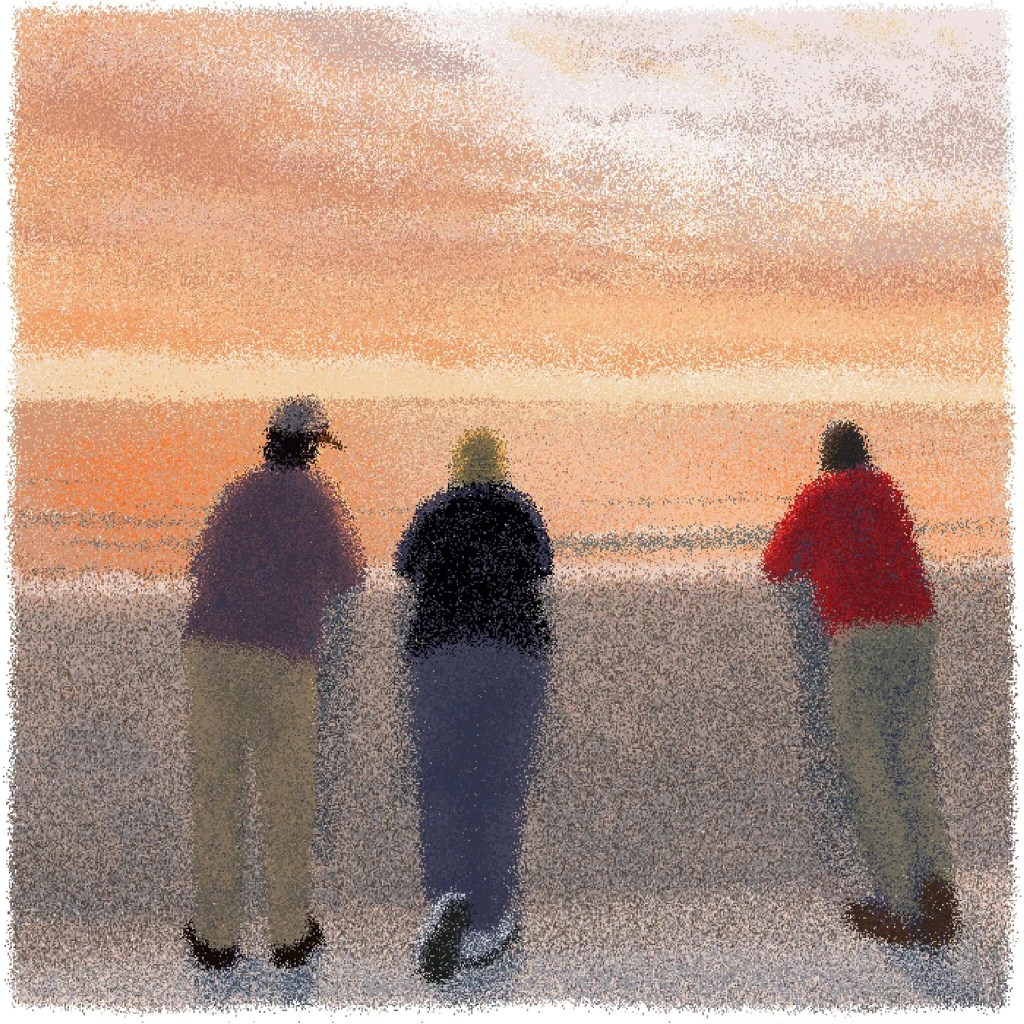
Matija Medved [The pointillism of its striking illustration evokes a key phrase in the article: “There are no bright lines here,” in this context: “It’s not always clear when we are honestly explaining how our heartfelt convictions play out in the public square and when we are ‘taking God’s name in vain.’”— JMN]
Tish Harrison Warren, an Anglican priest, describes a recent baptismal service:
Baptisms at our church are a mixture of solemnity and unbridled glee, often full of laughter and tears of joy. Those who were being baptized, or in the case of infants, their parents, took vows to put their trust in God’s grace and love and to renounce spiritual darkness, evil and “all sinful desires that draw” us from the love of God.
(Tish Harrison Warren, “The God I Know Is Not a Culture Warrior,” NYTimes, 8-14-22)
An old hymn’s chorus goes like this: “Onward Christian soldiers, marching as to war, with the cross of Jesus going on before….”
Warren’s essay exalts something different: piety nurtured by a radiant inwardness around two poles of behavior: affirmation, in the form of trust, and renunciation of… something or other. The “sinful desires” quandary is rotten fruit of the patristic tree. Humans can renounce harmful acts; thoughts, not so much. Warren’s strategic quote-marking of the phrase not only sets it off as liturgical cant, but lets her finesse the clash of theology with human nature by limelighting a joyful and forbearing style of devotion.
Warren’s oasis of psalmody shades us for a moment from truculent evangelism and religionist politics. For the last word of her refreshing homily, she quotes an ancient Christian soldier, Diadochos, the fifth-century bishop of Photiki: “… The soul, in its desire to say many things, dissipates its remembrance of God through the door of speech.”
Those are stay-big-picture days: paint, write, read, think about language. If gender is fluent, so are the other language markers which assert us. What if I don’t always identify as a first person? I may feel like a you, for example, besotted with empathy for us. How many I am can also be in flux, neither singular nor plural quite doing the job, leaving me like a numberless child, forsaken by the grammar that traps me.
This isn’t one of those days. I flaunt a tenuous Scottish heritage today because of this news: Period products are now free in that country to anyone who needs them. My mother’s husband’s forebears’ home was Scotland, saving contrary evidence. If men in skirts be fable as some claim, / long live of fabled men in skirts the fame! (It’s hard to talk of Scotland without metre.)
The initiative makes Scotland the first country in the world to provide free sanitary products, part of a global effort to end “period poverty” — or a lack of access to tampons or sanitary pads because of prohibitively high costs.
(Remy Tumin, “Scotland Makes Period Products Free,” 8-15-22)
Northern Ireland is considering a similar measure; New Zealand and South Korea offer free menstrual products in schools. I was deprived of a girlhood by the fact of my birth, but if I could have one, I know where I would choose to be born: Edinburgh, Belfast, Wellington or Seoul.
Wrath of Thrones
Thee 8TH of Henrys did decree
bad wyves &&& Thomases must meet
their Heav’nly Fodder sharpishly,
ahead of shedjewel, toote sweet.
*****
Thee Archfellowe of Hi Kirk
For proper fayth
Thee others bee
Beelzebubbish,
don’t ye see?
****
Saint Peete
Monarkee & Papacee
a-sittin’ in a tree,
kay, eye, ess, ess,
eye, inn, gee.
*****
Tory Pun Ditty Tree
Lordies & theyr Laidesses
a-puttin’ on the Ritz,
knaveree & wokeree
a’throwin’ hissy fits.
*****
The physics of a tiny bead driven by a puff of air towards a miracle on airy wing guarantees that a kid plinking at dragonflies with his BB-gun will never bag one. That’s the comfort built into the action. So it goes with translating poetry — done because it can’t be done. The lost cause fallacy cushions the effrontery.
I’m not a poet but gravitate to poems for translation practice and vocabulary acquisition. A decent poem’s language is economical, concrete, precise and uninflated. If it’s flowery or obscure — and there’s plenty of that — it may suffer qua poetry but is still fit for purpose as long as it can be held in the mind and on the tongue, and interrogated at word level
Carmen Giménez, Graywolf Press’s new executive editor, has said she became a poet and not a fiction writer because she is “attracted to the granular level of language” Me too. My view of translation will be myopic in the sense of being literal-minded.
Here are the two poles of the dialog:
How literal must a literary translation be? Nabokov, who was fluent in three languages and wrote in two of them, believed that “the clumsiest literal translation is a thousand times more useful than the prettiest paraphrase.” Borges, on the other hand, maintained that a translator should seek not to copy a text but to transform and enrich it. “Translation is a more advanced stage of civilization,” Borges insisted—or, depending on the translation you come across, “a more advanced stage of writing.” (He wrote the line in French, one of several languages he knew.)
(Jiayang Fan, “Han Kang and the Complexity of Translation,” The New Yorker, 1-8-18)
If I had to pick a side, heaven forbid, I’d have to call myself of the Nabokovian persuasion, but not as proud or thunderous.
With Arabic, I can’t profit from having rubbed elbows with the culture such as I’ve done with Spanish and, to some extent, French. Tant pis. I won’t be denied a gander at the sources in company with my dictionary and grammars. Most fascinating is when other translators depart from the literal sense of texts as I’m able to glean it. The how and why are paramount, with due respect to whatever “spirit” and authorial intention they presume to have captured floating outside the rude language matchups that can be established.
In 2013, 52 Atlantic spotted dolphins migrated from the northern Bahamas to Bimini, 100 miles south, where a community of 120 of their species already lived. The encounter could have gone badly.
When groups of social mammals meet, things can get tense. Run-ins between chimpanzee communities, for instance, are known for their violence. Adult male mammals, especially, are keen to defend territory and access to females.
(Carolyn Wilke, “Dolphin Strangers Met in the Bahamas. Things Went Swimmingly,” NYTimes, 8-6-22)
As it happened, for reasons that included lots of steamy dolphin sex, the newcomers were assimilated with relative ease.
What’s arresting for this reflection is mention of the general propensity of man-males to defend access to femme-males. In tribal contexts, the integrity and purity of the son-bearing pool are paramount. Womb-men are a brood stock managed by male-men like any vital resource — such as a watering hole, a salt deposit, a grove of pippins. Post-Roe, a purdah-torial direction of travel is discernible in America, where resurgent he-men tighten the reproductive and behavioral screws on non-men. The tribe is on the move.





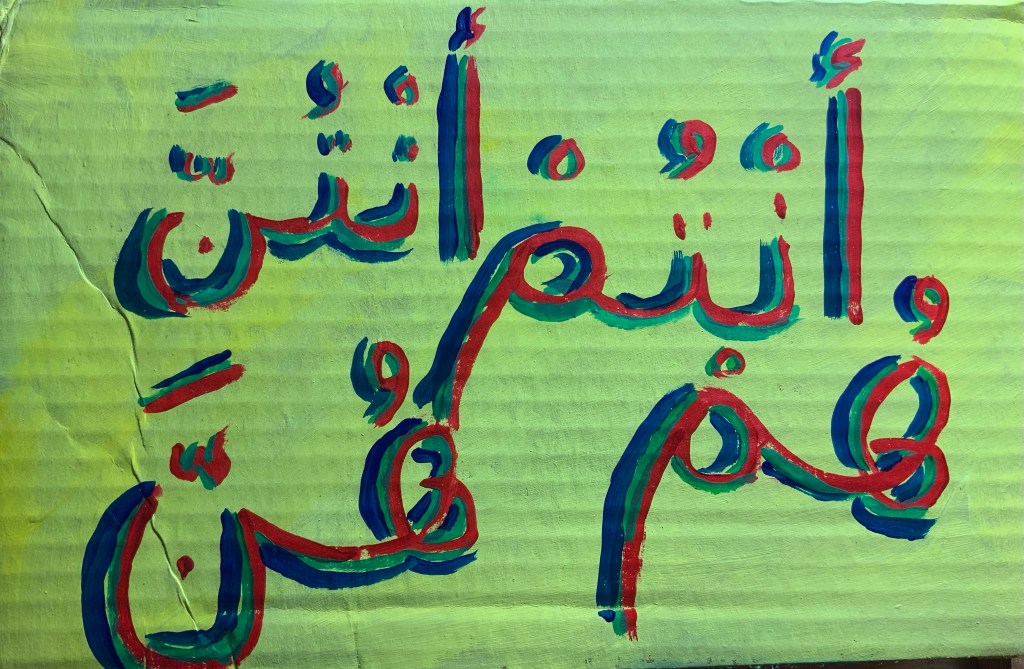



‘Because You See His Teeth, Don’t Assume the Lion Is Smiling’
The comment about the unsmiling lion is attributed to the 10th-century Arabic poet al-Mutanabbi (915 – 965). I heard it on a podcast called “Arabic Qahwa.” The line has a zesty zing to it that marks it as an old saying to be handed down indefinitely on the tongues of hoary elders, delivered with narrowed eyes and sagacious nods.
Old “Chinese” sayings abound in English. I’m not sure they’re all Chinese, or old, or even much said, but I have a favorite:
Whatever its origin, the saying bucks me up by validating a penchant for being ruled by grammar. The fewest words that are right can say enough barely, and leave the rest clearly understood. Excepting poetry, that’s good speech.
(c) 2022 JMN — EthicalDative. All rights reserved