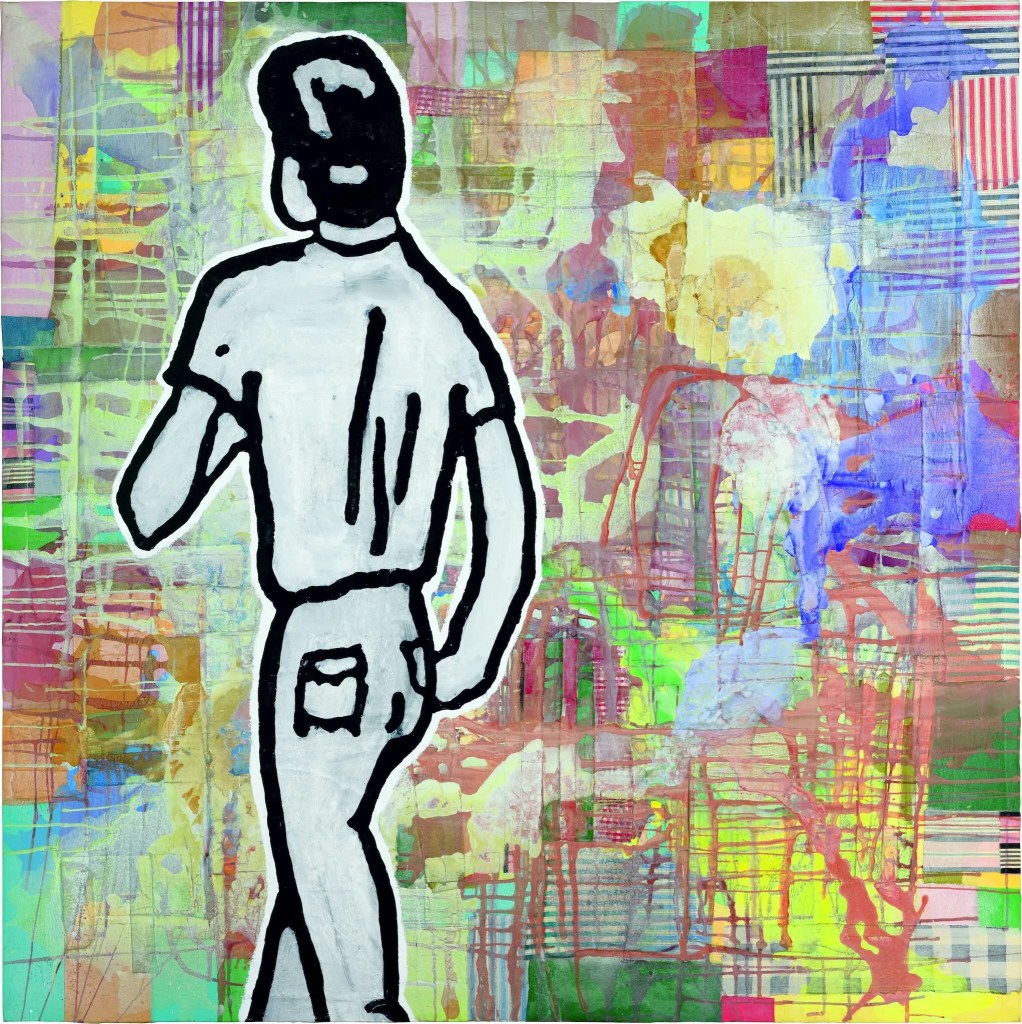
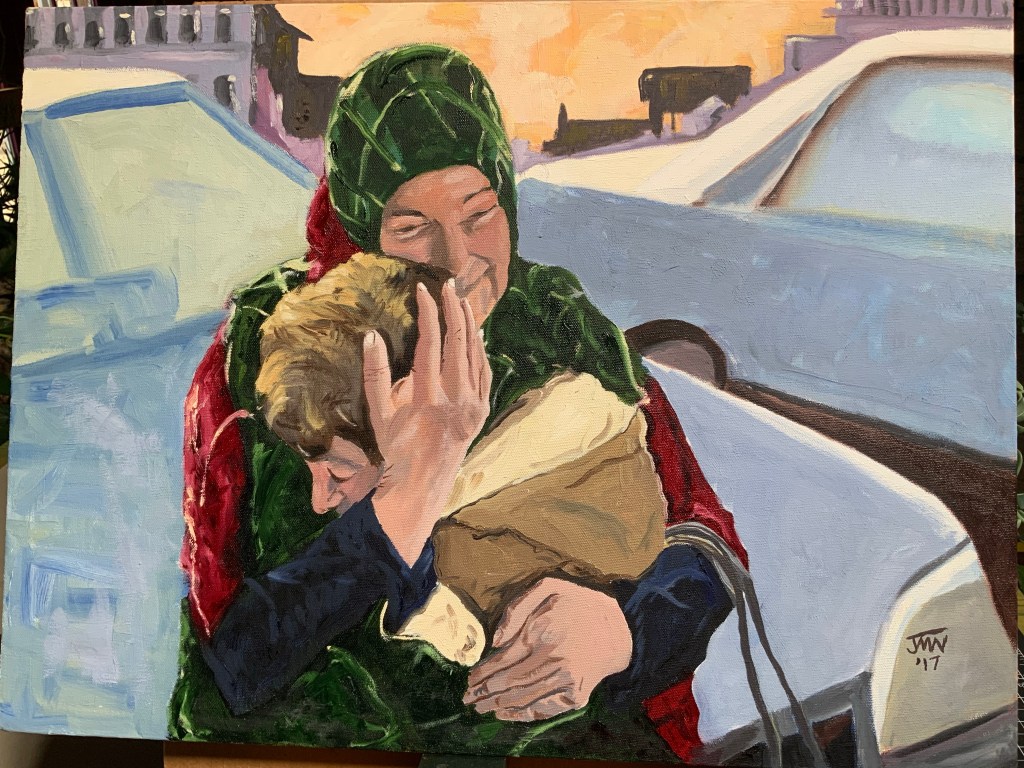
“The Ordinary Song,” 2017. Credit…via Chiem & Read.
Artist Donald Baechler (1956-2022) is remembered in the New York Times by Roberta Smith.
Among [Baechler’s] holdings of New York artists was a neon-light wall piece by Joseph Kosuth, a leading Conceptual artist and one of Mr. Baechler’s art school heroes. Mr. Baechler [said]… that he admired Mr. Kosuth for “his wonderful pictorial sense,” adding that his wall pieces “provoke a visceral sense that is undeniable.”
“He always used to tell me that I would be a really good artist if I just stopped painting,” Mr. Baechler said. “I never knew what to do with that statement.”
(Roberta Smith, “Donald Baechler, Painter of Cartoonish Collages, Is Dead at 65,” NYTimes, 4-26-22)
“Mandible Wishbone Solvent,” by Asiya Wadud (Poetry, March 2022)
roped in incremental ghost tens / future tens clairvoyant tens home tens // blue slips beneath the exposed wing / tilt then seam then an angle spent all inside / the distance between thumb and thimble and fingerprint // height exceeds then brims / makes a solvent of it // …
To process this first portion of text beyond an impression of “something doing this thing and another thing, then that thing,” I fall back on applying markers that help me speculate what propositions it may hold.
Roped in incremental ghost tens, future tens, clairvoyant tens, home tens, blue slips beneath the exposed wing tilt, then seam, then an angle spent all inside the distance between thumb and thimble and fingerprint. Height exceeds, then brims, makes a solvent of it.
There are two sentences. The subject of the first sentence is “blue.”
The blue is “roped in” — somehow contained, if not restrained — by the decimal unit “tens.” Tens is ticking upwards, perhaps measuring the extent of blue’s “slips” delineated in the predicate. Tens, like an exoplanet, has four moon-like attributes: “ghost,” “future,” “clairvoyant” and “home.” Each orbits the arithmetic substantive darkly, exerting an imprecise gravity on its cryptic mass. A wan light travels from modifier “clairvoyant,” whose extrasensory vibe chimes with the stanza’s delphic nebulosity.
Blue “slips,” conveying a motion more angular and eccentric than frontal. The predicate details three orientations of blue, relative to locations on the “exposed wing,” which pinpoint progressive degrees of slippage: first to the wing’s “tilt,” which would afford a visual of its underside; then to the “seam” — perhaps a bone such as the ulna (mentioned later in the poem); finally, to a tiny angle somehow “spent all inside” the micro-span between a thumb touching the thimble worn on a middle finger, or between the finger itself and the fingerprint of the digit that wears it.
The subject of the second sentence is “height.”
Height “exceeds” something not specified; perhaps the verb is used intransitively, in the sense of increasing self-referentially, surpassing only itself. Whereupon this height of which we speak reaches an unspecified edge, a plenitude verging on overtopping, and in the course of brimming “makes a solvent of it.” Something referenced by “it” is converted to a dissolving agent by soaring height; but what is “it”? I venture that “it” is “blue”: height makes a solvent of blue. Blue is the color of distance, after all. Distance, in the fullness of altitude, goes colorless and ungraspable.
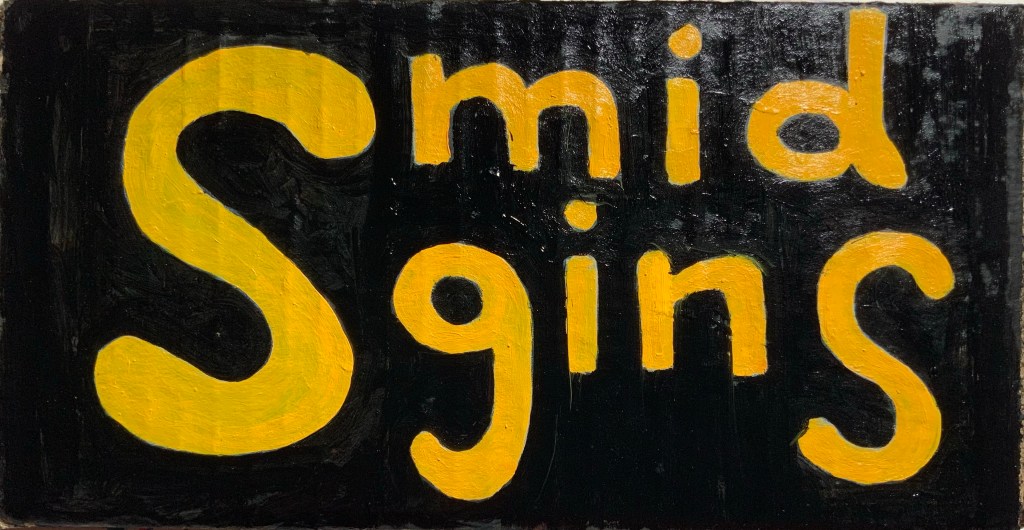
A “smidgin” is an imprecise, tiny amount of something, a modest dollop. As a poem title, the jocular word is self-effacing but also coyly assertive, like a humble-brag.
I got dirt under my nails the other day with Rae Armantrout’s poem “Smidgins” (https://ethicaldative.com/2022/04/12/how-poetry-feels-about-itself/). Did I soil a blithe lyric with the pale cast of thought? I mustn’t trouble the poem any further here except to mention a quibble with the latter part of this stanza:
Poetry hates itself / the way a child / pretends to fall / and looks around / to see who notices. // As much as any / single smidgin / wants to disappear. * …
The phrase As much as any single smidgin wants to disappear feels too arch by half, and leaves me stranded. I replace it mentally with “As much as any parabola wants to be analgesic” and am no less illumined.
Leaving a written record of joy and vexation over poems is a ritual roughly akin to that of the math student who shows his work. The testament of blunders, false starts and illusory breakthroughs is useful, if at all, for what it says about the problem and the student; the answer is the least of it.
(Source: Rae Armantrout, “Smidgins,” newyorker.com, 3-28-22.)
I tried to get my dad to teach me dominos once during the last months of his life. He was in hospital and listless. I thought it might raise his spirits. When I dumped the shiny pieces out on the … Continue reading →
Rae Armantrout’s poem “Smidgins” fulfills an imperative of lyric, which is “Don’t be gassy.” Also another imperative, which is “Talk in riddles.”
My crumpled, wrinkled / blurt / of flesh. // “Let’s face it,” / it says. * …
Ravaged matter expressed as living tissue — flesh — incarnates an impromptu utterance triggered by strong affect expressed as sound — a blurt — in order to urge its startled reflection, glimpsed in a shiny surface, to put a brave face on decline.
Poetry hates itself / the way a child / pretends to fall / and looks around / to see who notices. // As much as any / single smidgin / wants to disappear. * …
The pratfalls a child stages in order to be fussed over and soothed constitute a form of “self-hatred” comparable to that of poetry’s, which confects naughty “accidents” such as talking tissue and bashful smidgins to seek attention and validation while fulfilling its writ to fabricate outré parallels.
Poetry loves itself / the way a baby / loves pleasure, / shadows tickling / its skin. / As a swallowtail, / like a folded note, / sways / on a long / blossom.
A crib-bound infant’s undifferentiated sensory delight in the play on skin of sunlight slicing through the blinds of a darkened room is a form of self-love comparable to how poetry swoons over its own rapture at comparing a splay-tailed kite with a swooshy name at rest on a sweet phrase to what could well be a billet-doux.
Poetry dines on tropes. Make something voiceless talk. Or take an abstraction, endow it with sentience, and declare it to have feelings about itself that are radically opposed. The only way to seek buy-in for such gambits is hair of the dog, i.e., more cowbell, more daring associative swoops.
If Armantrout’s lyric succeeds, its oblique shenanigans speak louder than my fussy extrapolations. I don’t say it’s true, but I’m finding that to engage with a poem entails taking possession of it; once handed off by the poet, the poem belongs to me and whoever else wants it. The reading of it is our affair, and includes license to talk back to the poem, to get in its face.
(Rae Armantrout, “Smidgins,” newyorker.com, 3-28-22. The entire poem is quoted.)
I’m intrigued by the tension in Jake Skeet’s [sic] poem: Its title juxtaposes love with death, and its rhythms press against the nettle-like images. The first stanza’s images are scarred and rough with “burr and sage,” “bottles” and the “cirrhosis moon,” yet the lines sound like a nursery rhyme (the first two lines are perfectly trochaic and the third is iambic). Many other lines in this poem are also iambic or trochaic, yet the subject matter is troubled. And the heavy use of monosyllabic words (the entire first line is monosyllabic, as are several others) creates a kind of hammering, unembellished tone.
“Poem: Love Letter to a Dead Body,” Selected by Victoria Chang, NYTimes, 3-24-22.
Victoria Chang’s tight focus leaves room for the reader to negotiate with Jake Skeets’ poem for insight into its thematics. Who can remain in a state of mute contemplation around “scarred” images which monosyllabic trochees and iambs “press against” nursery-rhymishly? Mouthfeel wants substance as well.
on our backs in burr and sage / bottles jangle us awake / cirrhosis moon for eye // fists coughed up / we set ourselves on fire / copy our cousins / did up in black smoke / pillar dark in June // …
“fists coughed up”
“Fists coughed up” unleashes utterance that wanders in a rugged syntactic Badlands where self-immolating voices “copy our cousins / did up in black smoke.” Is “did up” a demotic participle slur for “done up,” meaning “adorned” by black smoke — cremated, massacred, puffed, ritualized? Does the setting afire of self evoke intoxicated exultation or a corybantic ceremony? There may be hints of alcohol decimating a community; jaundiced self-destruction; a canoodling couple nursing a twelve-pack among tossed empties in a forlorn boot hill at town’s edge. In jangled, booze-addled dream, does the desert cough up defiant corpses in a place envisaged as a disrespected ossuary?
Interpretation feels like a game of why not? A poem’s story space is where words are urged to disgorge a lexical cargo in parsable sequence so as to image forth assertions or perceptions — whether in lean cuts or in extravaganzas. That space can matter to a certain stripe of reader; it’s one the poet-practitioner appears loath to mediate except circumspectly: Skeets’ subject matter is “troubled,”per Chang. Full stop.
“names lost to bone”
Drunktown rakes up the letters in their names / lost to bone / horses graze where their remains are found // and you kiss me to shut me up / my breath bruise dark in the deep // leaves replace themselves with meadowlarks / cockshut in larkspur // ghosts rattle bottle dark and white eyed / horses still hungry / there in the weeds
Beside what could be vexed tribute paid to relations wasted and laid waste, there is twilight among flowers — “cockshut in larkspur” is a lilting embellishment; and there is a sere, haunted “deep” with shapeshifting, avian leaves where horses snuffle in the goathead and sparse grasses.
Little closure otherwise; rather a sense of being ghosted by words, of grasping at shades conjured by the speaker’s kissed breath. Their evasiveness troubles me. Perhaps it’s trouble the poem wishes to cause. The image I carry away keenly is that of the famished nags, “still hungry / there in the weeds.”
A bilateral agreement such as the one proposed between China and Solomon Islands undermines that sentiment and shows a limited appreciation for security of the region as a whole by whomever was the leaked draft’s initial author.
There’s more muddle in Anglophonia than you can shake a stick at: who vs. whom; lie vs. lay; disinterested vs. uninterested; effect vs. affect; capital vs. capitol; principle vs. principal; pedal vs. petal; nauseous vs. nauseated; literally vs. virtually; true fact vs. free gift; Google vs. knowledge; and so on vs. etcetera.
In casual speech and cyber-jabber the slips are throwaway, no one cares. But until the now wrong, under prolonged abuse, becomes the new right, the grammar-ticklish observer takes note when the solecisms crop up even in literate journals.
I’ve acquiesced to much of what I can’t quite fathom in Louise Glück’s poetry. Enough reaches me to defeat surliness. I feel surprisingly addressed at times:
… You are like me whether or not you admit it. / Unsatisfied. Meticulous. And your hunger is not for experience / but for understanding, as though it could be had in the abstract…
(“Moonbeam,” The Seven Ages, 2001)
From “Descent to the Valley.”
I’ve found a Glück poem that does not take a downbeat swerve. It’s so atypically buoyant that I’ve vowed to share the ending with someone I know who gives a rat’s ass about poetry:
How sweet my life now / in its descent to the valley, / the valley itself not mist-covered / but fertile and tranquil. / So that for the first time I find myself / able to look ahead, able to look at the world, / even to move toward it.
(“Descent to the Valley,” Vita Nova, 1999)
From “Vita Nova.”
Another poem, “Vita Nova,” features a saucy anti-crescendo. In the oneiric story-space of a “splitting-up dream,” the central character is an odd dog named Blizzard. The speaker interrogates the dream. Why is Blizzard a dog? Could Blizzard be “my child-self, unconsolable because / completely pre-verbal? With anorexia!” (The ironic exclamation point belongs to the poem. The “dog” “barely touched / the hummus in his dogfood dish.”)
From “Vita Nova.”
Who will explain to Blizzard that “Daddy needs you: Daddy’s heart is empty, / not because he’s leaving Mommy but because / the kind of love he wants Mommy doesn’t have?” The domestic trauma evoked in dream-recall has the dream-weirdness of jump cuts, non sequiturs, inexplicable cameos: “Erica with her maracas, / like the sands of time / personified”; and sardonic humor: “Mommy’s / too ironic—Mommy wouldn’t do / the rhumba in the driveway.”
From “Vita Nova.”
The conclusion, italicized as if in quotation, holds a feint at melodrama, but only to land an edgy punchline containing possibly a wink:
“I thought my life was over and my heart was broken. / Then I moved to Cambridge.
“Vita Nova,” Vita Nova, 1999)
It’s all “material,” a canny double entendre from a writer who delights in wringing full range from common words.
It seems when I encounter a poem I start an argument with it; I approach it as a provocation. Why is it written this way? What is it trying to tell me? What should I feel or think after reading it? I almost never ask, Did this entertain me?
It doesn’t seem right to treat signals sent by writers labeled poet as hermetic scriptures to decode, sort out, translate into apprehensible utterance. Not constructive; doesn’t speak well of me as a well tuned — or even competent — receiver. To read this way is to adopt an offensive lineman’s crouch, ready to deck the blocker and concuss the QB.
Paul Mariani quotes Wallace Stevens: People read poetry nervously, afraid that something [will] “go wrong with the sentence after next.” In my experience, something goes wrong even sooner.
Poetry, January 2022.
I revel in non-figurative painting: line, stroke, color put to the pure purpose of expression, not just depiction. On the other hand, I’m afraid I read words for clarity, understanding, illumination. I have to say to many poets of my time and place whose art I strive to take on board: It’s not you, it’s me.
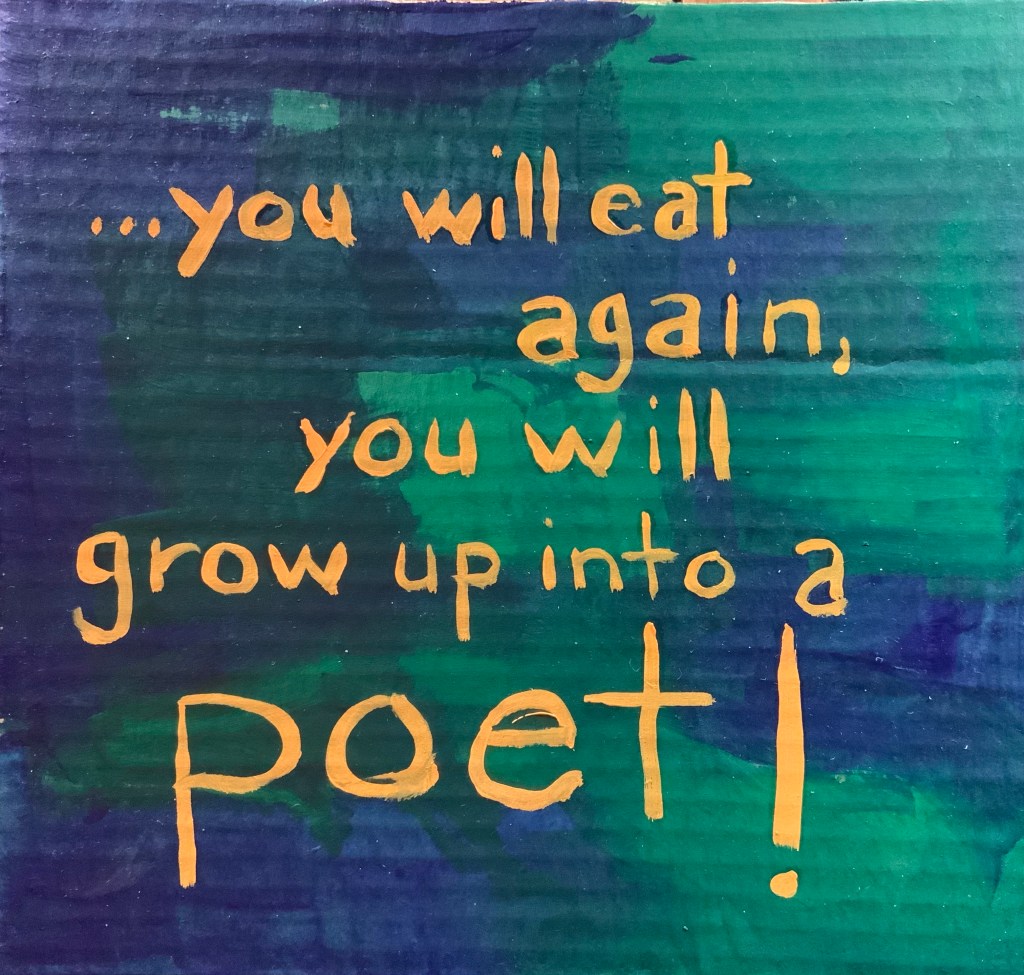
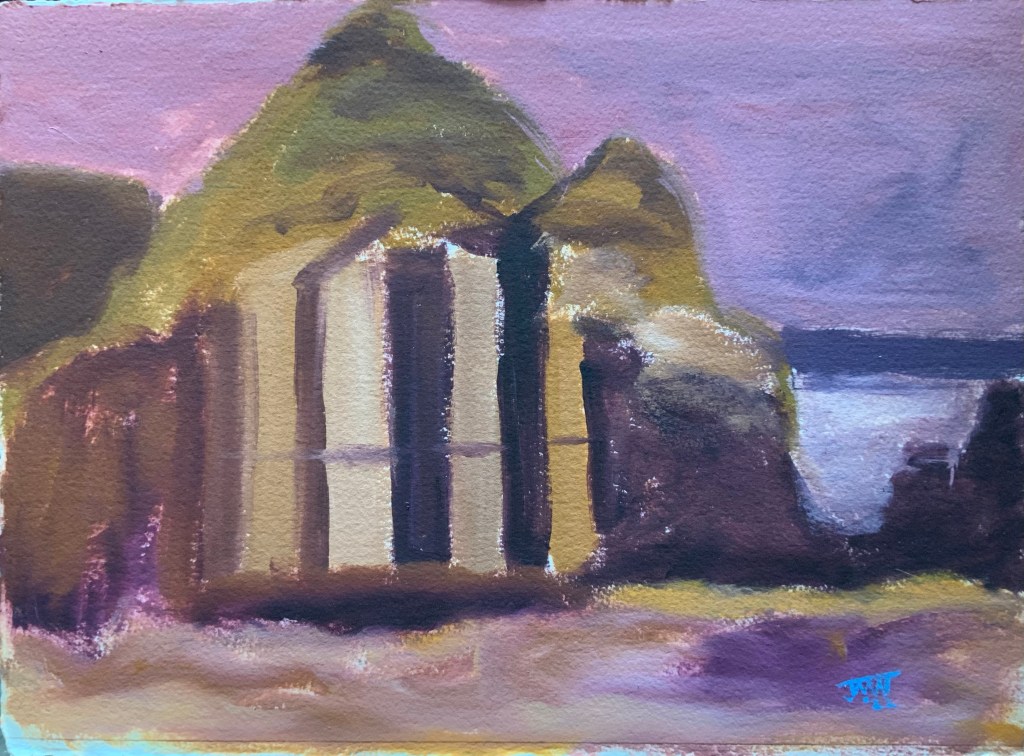
I must grow into poetry. Lately, as I take the dubious initiative to pepper my lucubrations with dabbles, it occurs to me to think of poetry more as painting with words than as hinged discourse. Let’s see where that goes.





 EthicalDative
‘Mandible Wishbone Solvent’ — Pass 1 of 3
“Mandible Wishbone Solvent,” by Asiya Wadud (Poetry, March 2022)
roped in incremental ghost tens / future tens clairvoyant tens home tens // blue slips beneath the exposed wing / tilt then seam then an angle spent all inside / the distance between thumb and thimble and fingerprint // height exceeds then brims / makes a solvent of it // …
To process this first portion of text beyond an impression of “something doing this thing and another thing, then that thing,” I fall back on applying markers that help me speculate what propositions it may hold.
Roped in incremental ghost tens, future tens, clairvoyant tens, home tens, blue slips beneath the exposed wing tilt, then seam, then an angle spent all inside the distance between thumb and thimble and fingerprint. Height exceeds, then brims, makes a solvent of it.
There are two sentences. The subject of the first sentence is “blue.”
The blue is “roped in” — somehow contained, if not restrained — by the decimal unit “tens.” Tens is ticking upwards, perhaps measuring the extent of blue’s “slips” delineated in the predicate. Tens, like an exoplanet, has four moon-like attributes: “ghost,” “future,” “clairvoyant” and “home.” Each orbits the arithmetic substantive darkly, exerting an imprecise gravity on its cryptic mass. A wan light travels from modifier “clairvoyant,” whose extrasensory vibe chimes with the stanza’s delphic nebulosity.
Blue “slips,” conveying a motion more angular and eccentric than frontal. The predicate details three orientations of blue, relative to locations on the “exposed wing,” which pinpoint progressive degrees of slippage: first to the wing’s “tilt,” which would afford a visual of its underside; then to the “seam” — perhaps a bone such as the ulna (mentioned later in the poem); finally, to a tiny angle somehow “spent all inside” the micro-span between a thumb touching the thimble worn on a middle finger, or between the finger itself and the fingerprint of the digit that wears it.
The subject of the second sentence is “height.”
Height “exceeds” something not specified; perhaps the verb is used intransitively, in the sense of increasing self-referentially, surpassing only itself. Whereupon this height of which we speak reaches an unspecified edge, a plenitude verging on overtopping, and in the course of brimming “makes a solvent of it.” Something referenced by “it” is converted to a dissolving agent by soaring height; but what is “it”? I venture that “it” is “blue”: height makes a solvent of blue. Blue is the color of distance, after all. Distance, in the fullness of altitude, goes colorless and ungraspable.
(To be continued…)
(c) 2022 JMN — EthicalDative. All rights reserved