Not Everything Is a Sonnet, Damn It

Carl Phillips

“I get pretty impatient with people who consider any fourteen-line poem to be a sonnet. The turns of thought are crucial, as is the number of turns.”

(Carl Phillips, interviewed by David Baker, www.kenyonreview.org)
Carl Phillips

The interview inspiring these illustrations is a pas de deux of metapoetics performed on campus by two massively degreed* panjandrums.

David Baker

Altisonant palaver among cognoscenti is devoutly to be shunned by the lay reader seeking insight into poetry’s mysteries. It graces me with what I get from the poetry itself: a sense of being kept on the outside of something that is cold, severe and not obviously enjoyable. (The words are those of Rob Doyle about Peter Handke’s work.)

David Baker

But here’s my own volta if not volte-face: Well into the interview, Phillips starts pushing back on Baker’s abstruse queries with some sensible responses. My irritable hot take ceded grudgingly to a recognition that Phillips was not blowing all gas.

Carl Phillips

Here’s the exchange where I glimpsed light:

David Baker: I mean to identify places where the voltas fall, where the poems turn, where and how they open, and where, in the final couple of lines, they recapture or recapitulate each narrative… But just as vivid here is the mysterious primary pronoun “it.” This little word may be easy to overlook, but it seems central to fully understanding the poem. What is “it”? Something grand, like myth? Or something tangible, like a real artifact? Inside “it” we find the whole narrative. Does it matter whether or not we can identify “it”?
Carl Phillips: I can honestly say I have no idea what the “it” is supposed to refer to.

His confession of cluelessness as to the referent of his own pronoun gives me hope that Carl Phillips may have something to teach me after all.

*Carl Phillips has an AB (Bachelor of Arts) degree in Greek and Latin from Harvard, an MAT (Master of Arts in Teaching) degree in Latin and classical humanities from the University of Massachusetts, and an MA (Master of Arts) degree in creative writing from Boston University. David Baker has a BSE (Bachelor of Science in Engineering) and MA (Master of Arts) degrees from Central Missouri State University and a PhD from the University of Utah.

(c) 2022 JMN — EthicalDative. All rights reserved

Posted in Anthology, Commentary, Quotations | Tagged , , , , , , | Leave a comment

A Modest Proposal Regarding Neutral Reference

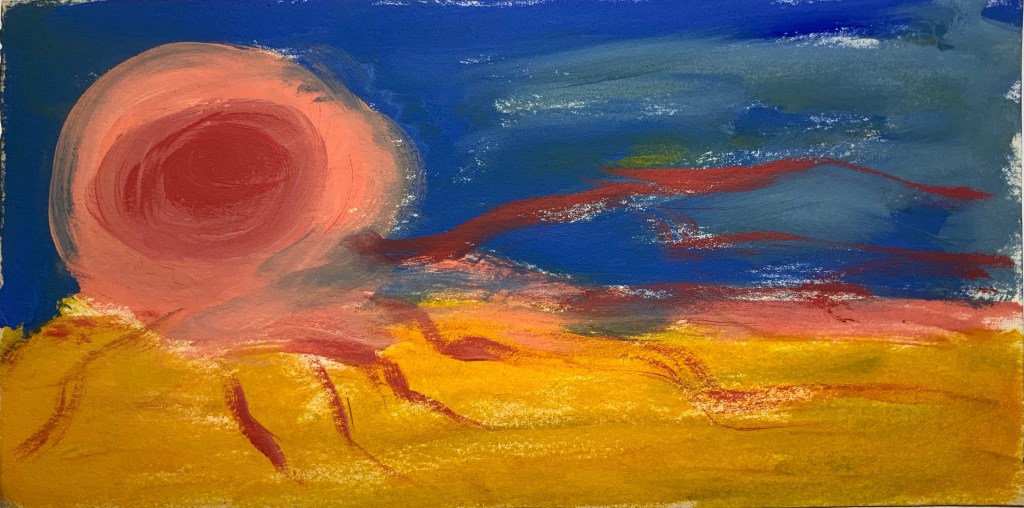
Campbell. Acrylic on cardboard.

They is owning he and she. Example:

An athlete knows that they must train rigorously to qualify for the Olympics.
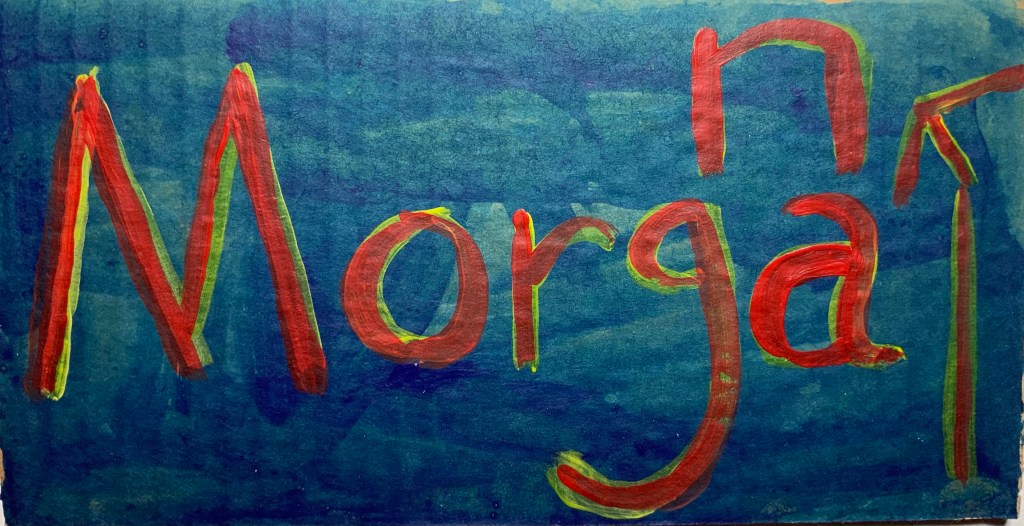
Morgan. Acrylic on cardboard.

It even happens when the antecedent is named and sexed. Example:

Jacob has a Master of Fine Arts from Iowa. They are working on a novel.
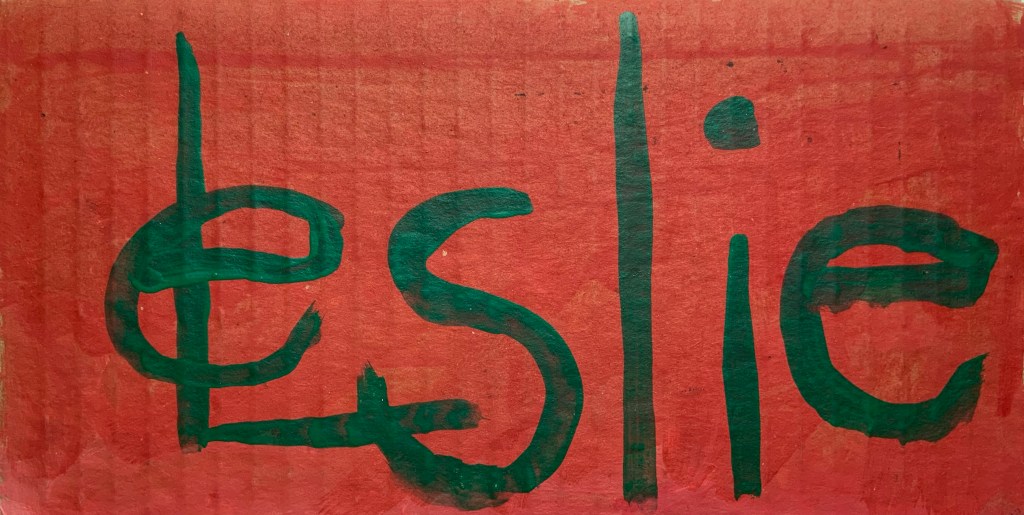
Leslie. Acrylic on cardboard.

The only thing that marks Jacob as masculine is the name. Baptismal names have long tended to be gender based. By weight of convention, Annunziata, Niamh, Saoirse and Siobhan are female; Jacob, Sixtus, Wulfric and Boniface are male. But nothing in the nature of names themselves precludes Mick Jagger from having been christened Siobhan, or Sinéad O’Connor Boniface.

Mackenzie. Acrylic on cardboard.

This is where opportunity may lie. Johnny Cash sang about “a boy named Sue.” Ye and Kim have a son named North; Elon and Grimes have a son named X Æ A-12; I’ve known a Daughter of the American Revolution named Campbell. A greater practice of untraditional naming over time may see future English speakers less constrained by involuntary gender reveals that contribute to canned presumptions..

Sutton. Acrylic on cardboard.

A linguist has a healthy respect for the features of sound syntax, and number agreement is one of them. Yet I’m mindful that thou, a singular second person, was ditched in favor of you, a plural second person which conveyed greater distinction. It didn’t happen in a day or without resistance. If third person he-she follows suit, giving way to a non-binary, plural they, it will be in the nature of inevitable change. Following where tested usage leads goes with the speakership.

(c) 2022 JMN — EthicalDative. All rights reserved
Posted in Commentary | Tagged , , , , , , , , | 2 Comments

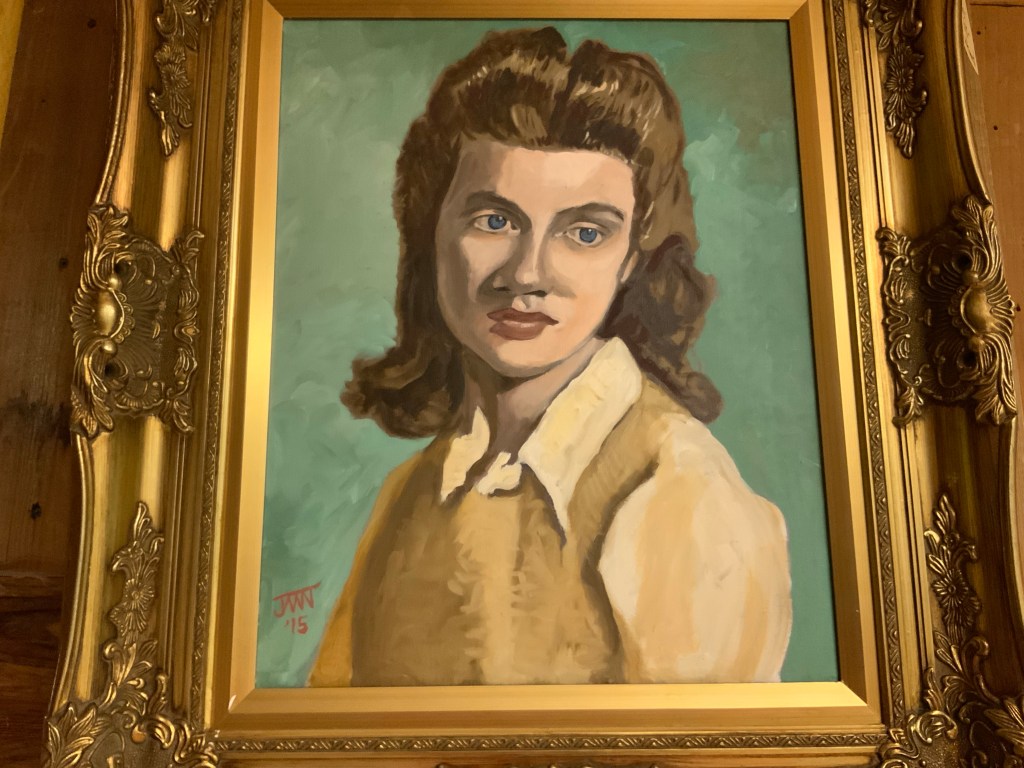
Cosmic Cheese

The world / was whole because / it shattered. When it shattered, / then we knew what it was.

“Formaggio” is Italian for “cheese.” The poem so titled is in Louise Glück’s book Vita Nova. On first reading I experienced the poem as an affront. The malaise it induces is apparent in its first lines (quoted above). I can climb out of my funk only through paraphrase

A thing — the very world — is affirmed intact because it broke apart, or perhaps was perceived whole in hindsight as a consequence of its disintegration. When it broke up, then we knew what it was. Those conjunctions — because, then — are consequential in the hands of a stylist as meticulous as Glück.

It never healed itself. / But in the deep fissures, smaller worlds appeared: / it was a good thing that human beings made them: / human beings know what they need, / better than any god.

In the cracks of a chronic lesion, aftermath of a cosmos splintered into unity, there appeared not shrapnel but mini-worlds created by us, and a good thing, too, for we know our needs better than any god. The theology rings true enough, but the rest is nonsense: the arc of Homo erectus’ spawn is short, and bends toward self-destruction, as current events attest.

My peevish commentary will sink of its own weight if pursued much further. Suffice it to say, the worlds we created became stores on Huron Avenue — a Chicago or Hamtramck of the mind where fish and cheese are sold — and they are visions of safety. Like a resting place, staffed by persons who could be parents, only kinder.

As tributaries feed a large river, the speaker had many lives, one or more of which were lived among flats of fruit fronting a flower shop run by one Hallie, perhaps. These life streams were absorbed into the great ocean; however, asks the speaker, If the self becomes invisible has it disappeared? A query not without interest.

The speaker thrived, lived alone, but not completely so: Strangers [were] surging around me. A strategic stanza leap punctuates a vault across poetry space to where we secretly exist; there, by apposition, is the definition of sea:

That’s what the sea is: / we exist in secret.

The speaker’s many former lives are summed in imagery as a beribboned spray of flowers held by a hand. Above the hand, stems terminate in blossoms of future; And the gripped fist — / that would be the self in the present. And that would be the poem’s conclusion.

I come to fathom poetry, not to mock it. This poem looks like a space where afflatus collides with metaphysics. Glück is one to achieve what she intends. By her own report she doesn’t rush to publish. In one poem, the speaker-poet prays not for happiness, but for another poem. Steep lyric is bracing when scalable. I didn’t summit on this one, but other peaks are still ahead.

(c) 2022 JMN — EthicalDative. All rights reserved
Posted in Anthology, Commentary | Tagged , , , , , , , | 2 Comments

We’re Ourselves in Spite of Us

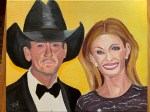
MMM on the verge of 20, 18×24 in., oil on canvas (JMN 2015).

Not the selves we ordered, but the ones received. So it went with those that got us — the trick of not caring for who you be is handed down. Each tiny burden of wiped snot is a pair of shoulders for forebears to die on, paying forward the fight to bury them.

Occasionally I vent a spate of verbiage, as above, which I fancy has a poetry-like intensity and rhythm. Any effort, however, to pad the text with meter or rhyme blights it as poesy straightaway. Likewise, passing it off as free verse drives home my cluelessness as to how real poets make the decisions to break their lines just so.

Here, for example, are snippets from Louise Glück’s Poems 1962-2021, in which I’m currently immersed:

A beautiful morning; nothing
died in the night.
(“Otis”)

On a small lake off
the map of the world, two
swans lived. As swans,…
(“Parable of the Swans”)

Nothing
was exactly difficult because
routines develop, compensations
for perceived
absences and omissions. My mother…
(“Telemachus’ Burden”)

I do perceive in the following verses a certain logic in how syntax makes the lines fall and flow:

Therefore it will cost me
bitterly to lie,
to prostrate myself
at the edge of a grave.

I say to the earth
be kind to my mother,
now and later.
Save, with your coldness,
the beauty we all envied.
(“The Open Grave”)

Evident everywhere is Glück’s exquisite scruple in the art of punctuation. Her work stirs me often enough to respect; when it connects, it has what I can only describe as the feel of poetry, not doggerel or gussied prose, yet I’m not sure why.

A friend’s mother shamed her child for the normal bouts of illness youngsters suffer. Being under the weather garnered censure. That disdain dogs the child’s self care in middle age. Guilty relief dogged me when my own long-lived parents were at length gone. Gone too were the appraising looks and silences for a son well advanced in his own decadence. Came the spates.

(c) 2022 JMN — EthicalDative. All rights reserved
Posted in Anthology, Commentary | Tagged , , , , | Leave a comment

‘That Damned Mania to Write’

This gallery contains 1 photo.

Once upon a time (Érase una vez…, they say in Spanish), I couldn’t conceive of settling for less than being a published poet. I was too callow and unstable, however, to give the project sustained hard work. I’m content now … Continue reading

More Galleries | Tagged , , , | 2 Comments

Nosegay of ‘Droit de Seigneur’

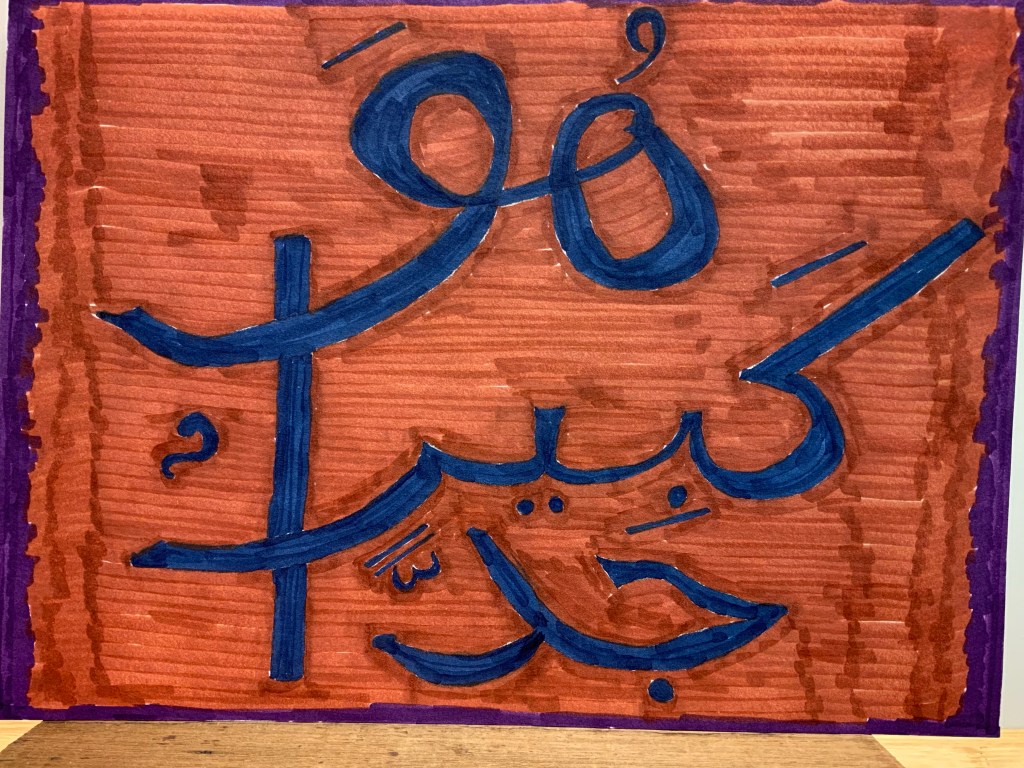
[fudīta bi-nafsī] puisses tu être racheté par mon âme ! (formule de politesse à l’époque classique) [“may you be redeemed by my soul!” (polite formula in the classical era)], Blachère, Grammaire de l’Arabe Classique, 1952.]

Consulting an Arabic dictionary involves looking up a word’s “root,” usually comprising three consonants. Words formed from the root are listed, with their translations, along with idioms in which the word occurs. What the root is may not be apparent on first blush, so lookup can entail a check of competing options. The roving linguist may glimpse, in passing, terminology that induces reflection. I wasn’t seeking it, for example, but I found [faDDa bakāra(t)a-hā], to deflower a girl.

[faDDa bakārata-hā]. to deflower a girl (Hans Wehr: A Dictionary of Modern Written Arabic, ed. J Milton Cowan, 2nd ed., 1966. It’s an “enlarged and improved version of Wehr’s Arabisches Wörterbuch für die Schriftsprache der Gegenwart published in 1952, including the author’s supplement.

The verb [faDDa] means to break or force open. The dictionary calls [bakāra(t)] virginity; other sources list maidenhead and hymen. As I see it, the phrase could be read as “to break the hymen.” The literal Arabic is plainspoken, at least, whereas the florid tropes of “deflowering” and “virginity” affixed to the phrase in Western culture (French défloration, Spanish desvirgar, etc.) are synonymous with despoilment — the sullying of purity. Compare it to the cliché in which a mature woman who initiates a bashful young male may be credited with “making a man of him.”

On the other hand, there are pleasant surprises such as [lā fuDDa fūka], how well you have spoken!

[lā fuDDa fūka] how well you have spoken!

It’s a passive use of [faDDa] which, depending on your choice of variant, might be translated literally: “your mouth [muzzle, orifice, aperture, hole, vent, embouchure, mouthpiece…] was not broken open [pried, forced, undone, snapped, scattered, dispersed, perforated, pierced…]. If pressed to provide a tonal equivalent for it, I might venture a Texan idiom such as “You ain’t just a-woofin’.” It would take a feel for Arabic which I don’t possess to know whether it struck the right note.

(c) 2022 JMN — EthicalDative. All rights reserved

Posted in Anthology, Commentary | Tagged , , , , , , , , , | Leave a comment

The Absolute Superlative

Detail, “Vexillophilia,” oil on canvas, 18 x 24 in. (JMN 2020)

Blachère (364) describes how Arabic expresses the “absolute superlative” — i.e., the uttermost degree of something, with no comparison:

Par des noms au cas direct indéterminé de valeur adverbiale dont le sens primitif est paroxysme, degré suprême, rendus en franç. par très, fort… [By certain nouns in undetermined accusative case with adverbial value whose primitive sense is paroxysm, supreme degree, rendered in French by “very,” “exceedingly”…]

“Grammaire de l’Arabe Classique (1952)
[jidd(an)] “seriously,” [gaAya-t(an)] “extremely,” and [nihaAya-t(an)] “finally.”

The three adverbs cited are: [jidd(an)] “seriously,” [gaAya-t(an)] “extremely,” and [nihaAya-t(an)] “finally.” Blachère’s example is: [huwa kabiYr(un) jidd(an)] il est fort gros [he is exceedingly big].

[huwa kabiYr(un) jidd(an)] il est fort gros [he is exceedingly big].

A variant could be: [kaAna gaAya-t(an) fiY-l-kibri], literally “he was of an extreme limit of bigness.”

[kaAna gaAya-t(an) fiY-l-kibri], literally “he was of an extreme limit of bigness.”

Since [gaAya-t(an)] shares a root with verb [gayyaY] meaning “to hoist a flag,” the barbarism “he was flag-hoistingly big” can be entertained, conveying a whiff of the affiliation between pushed limits and flags.

(c) 2022 JMN — EthicalDative. All rights reserved

Posted in Anthology, Commentary | Tagged , , , , | 2 Comments

Dogs or Cats?

[Author Olga Tokarczuk] Rebecca Clarke.

If you could meet any writer, dead or alive, who would it be? And what would you want to know?
It seems to me that the author plays a kind of secondary role in this whole business of literature. Authors are generally less interesting than their books. After attentively reading a book you shouldn’t really have any questions for the author, aside from the most banal: Do they write in pen or on a laptop? Do they write in the morning or the evening? Do they prefer coffee or tea? Dogs or cats?

Do books serve a moral function, in your view? How so?
I don’t know if I would call it a moral function, but literature definitely teaches empathy and compassion and how to see the world from other points of view. This is a great skill, and a gift that means those who read are smarter, more aware, more capable of understanding complicated matters than those who don’t read.

(Translated from the Polish by Jennifer Croft, “Why Olga Tokarczuk Likes to Read T.S. Eliot in Translation,” NYTimes, 2-10-22)

(c) 2021 JMN — EthicalDative. All rights reserved
Posted in Quotations | Tagged , , , , , | Leave a comment

Drawing Arabic With Plethoric Splotchification

This gallery contains 2 photos.

I’ve little practice handwriting Arabic. Even less am I schooled in the monastic rigors of calligraphy. I do confess to an effort to “draw” Arabic. My models are the characters as they appear in printed texts. I savor their swoops … Continue reading

More Galleries | Tagged , , , , , , , | Leave a comment

How Do Poems Be Interesting?

May you be redeemed by my soul! An Arabic formula of courtesy in the classical era. One of my efforts to “draw” Arabic.

A YouTube personality named Isla Rose candidly discusses her male-to-female transition experience, both the affective and the clinical sides. She remarks how the related hormone therapies can diminish responsiveness in intercourse; she must be “very interested” in what’s going on in order to have a peak experience. Implicit in the remark, I think, is that the other party to the encounter must be interesting.

Isla Rose’s remark lingers with me as I ponder how to improve my reading of poetry. As does a comment by painter Rochelle Feinstein that what she requires from a work of art is to learn something and to feel something.

I expect to be required to bring a high level of attention and focus to a good poem — to be interested. How does a poem meet the condition, for its part, of inciting interest? More precisely, what traits or behaviors must the poem bring to its encounter with one who neither writes nor teaches poetry in order to tempt me to invest in it and win through to a consummation, a discovery, a fulfillment of some sort? The question engages me deeply, but is it uppermost in the mind of the poet?

Poetry prizes are awarded by juries of “established” poets. Podcasts teem with conversations of adepts who hail from institutions, collectives, editorships, laureateships, residencies and the like. Poets introduce other poets with fulsome recitations of distinctions and publications; read their poems and other poets’ poems; talk among themselves about their wellsprings; quote other poets fluently, and agree how impressed they are with one another and with their peers. When the cordiality doesn’t cloy, the podcasts have their interest. But I’m wary of letting lore and evangelism intrude on my own solitary confrontation with the thing that poets are up to, which is the poem.

As a relative newcomer to the feast of contemporary poetry, I’m nagged by the suspicion that there are more poets than readers. I’d like to enlist in the latter cohort; I’m content to enjoy the company of few. I aspire to hitch an innate obsession with language to as much acumen as I can muster for the undertaking to chew on my contemporaries’ words and get at their juices. I’d like to discover for myself answers to the question posed in my title.

(c) 2022 JMN — EthicalDative. All rights reserved

Posted in Anthology, Commentary | Tagged , , , | 3 Comments