You. Be. Here. It’s an affirming imperative to exist, or be situate, in the speaker’s space-time. It’s addressed to “tilt” — twice “tender” now — and angled vertically to a plane christened “unearth,” or else one required to perform an act of unearth-ing, understood venturesomely as slipping Earth’s bond. The text pivots here as elsewhere on function-fluid diction in blurred contexts.
The reader has a blue-sky moment: A rocket breaking free of terrestrial gravity blazes its way towards a far trajectory. Gain of height thins blue atmosphere to a vanishing wake. Land and sea resolve into map-like features. It’s all a function of the “scant excess” of mad tilt, wrapped in whatever that “film” is. Such a sweet, severe angle would be “remiss in skies,” aeronautically delinquent for earthbound flight.
And to what end? “To wrest time.” Wresting is an act of forceful seizure. All life yanks itself from the jaws of death from one moment to the next, grabbing bits of time. Those “brimmed solvents,” the carbon syrups milked from ancient sediments on which futures for too long have been staked and stoked, are bested in promise by what “gives more” for snatching increments of futurity, which is …
And the reader’s meditation collapses. In the final analysis the text stands its ground, enclosed in its film, true only to its own designs. The reader has shaken his mind’s fist at it saying, You. Be. Clear. It has stayed frosty. It doesn’t give a shit for his demands. But when he averted his gaze in disgust, his eye had caught movement peripherally; the text made him look back. A loop was entered: attraction and repulsion went to war.
At length the reader exited the loop by ceding something — maybe a bit of complacency. Surrender feels not all good and not all bad. The reader makes a thing of his squabbles with the text. What you think isn’t what I wrote, says the poet. The reader responds, But you triggered a striving. You induced in me a commitment to be baffled for a time. And the reader is grateful for her text. He keeps whatever it wrested from him. It’s personal now.
I’ve admired artist Outside Authority’s (www.outsideauthor.wordpress.com) lyrical renderings of UK churches and churchyards for some time. It’s stimulating to see a similar devotion to these spaces reflected in this Guardian article.
Wildflowers among the graves at St Pancras church, Plymouth. Less frequent mowing of grass in churchyards improves biodiversity enormously.
“Eight hundred years ago, pagan sites – springs, wells or woodland glades – had Christian churches built on top of them… Around the church is an area – the litten – where people are buried. A couple of hundred years later, somebody decided that all churches should have a wall placed around them. Since then, they’ve never been ploughed, treated with chemicals or anything like that. So you have this amazing genetic bank, which originated in whatever that habitat was 800 years ago, just sat there – and it’s still there.”
David Curry of the “Living Churchyards” project
An old yew at the entrance to St Pancras church, Plymouth.
(Alexander Turner, “God’s own gardens: why churchyards are some of our wildest nature sites,” theguardian.com, 5-6-22)
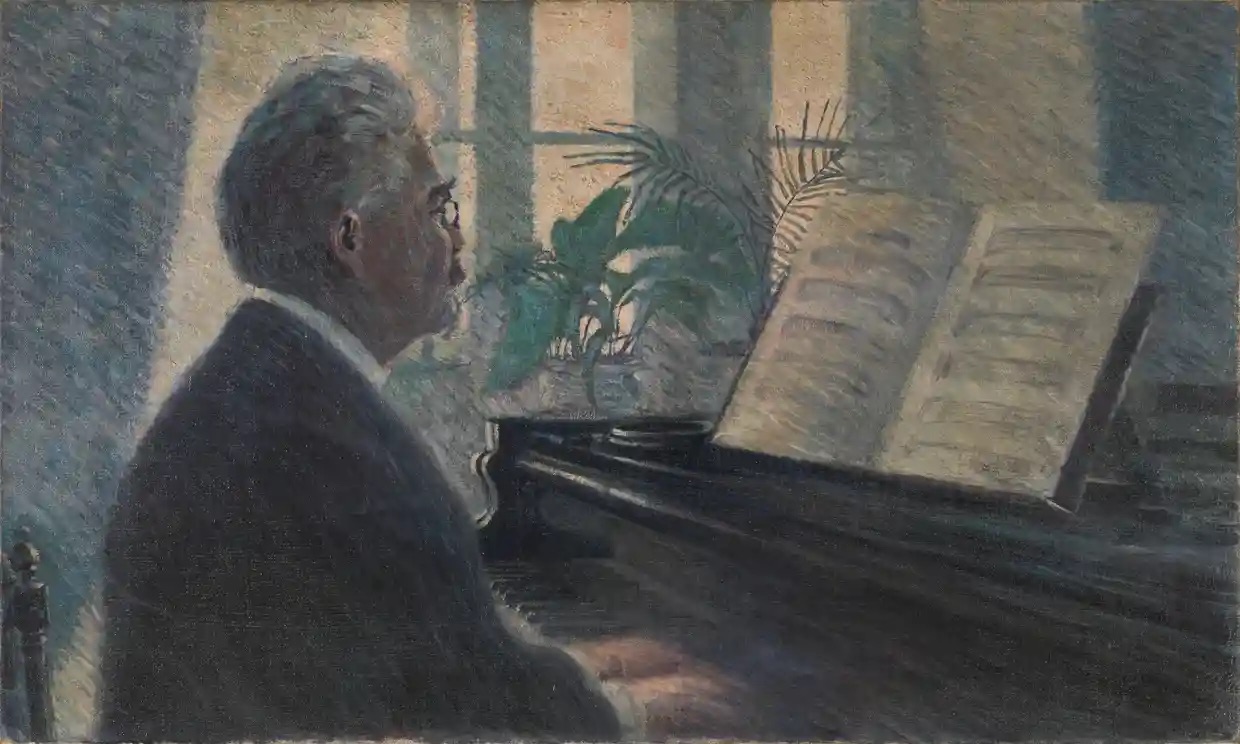
Leopold Czihaczek at the Piano (1907) was painted shortly before Schiele’s 17th birthday. Photograph: Leopold Museum.
I’m a fan of Schiele as well as of interiors. What’s interesting to me in this precocious painting is the backlighting of the subject and the skillful rendering of hazy, natural light suffusing the room. The uniform NW-to-SE directionality of the brushstrokes suggests the travel of the rays. Also noted: how the piano has clarity of detail at its far end and blurs as it approaches the viewer, somewhat the reverse of conventional perspective.
(Nadia Khomami, “Egon Schiele painting of his uncle rediscovered after over 90 years,” theguardian.com, 5-5-22)
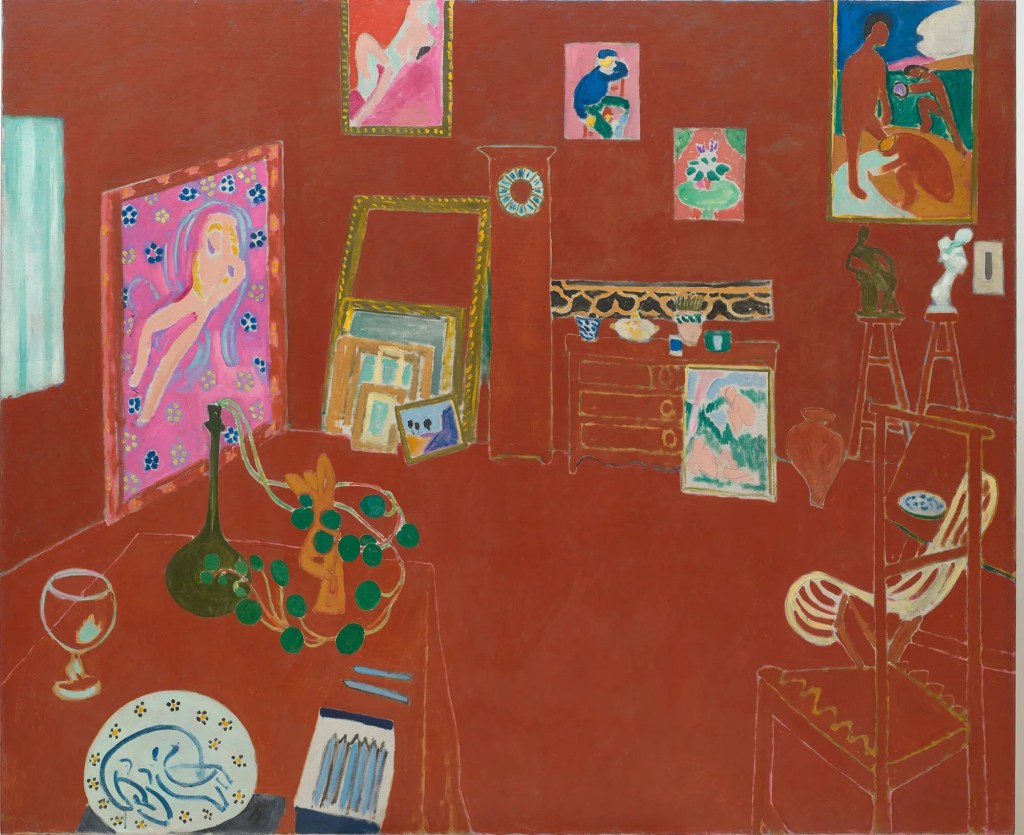
Henri Matisse, “The Red Studio” (1911), the star of the show. Credit… Succession H. Matisse/Artists Rights Society (ARS), NY.
For Matisse, the studio was the place where the real world receded, where magic could be made and art ruled. Once he absorbed what Fauvism had to teach him about natural light and pure color, Matisse didn’t get out much. He was essentially an artist of interiors and especially of the studio: the spaces where he lived and worked, where he painted portraits, worked from live models, sometimes including views out windows, sometimes simply portraying the rooms themselves.
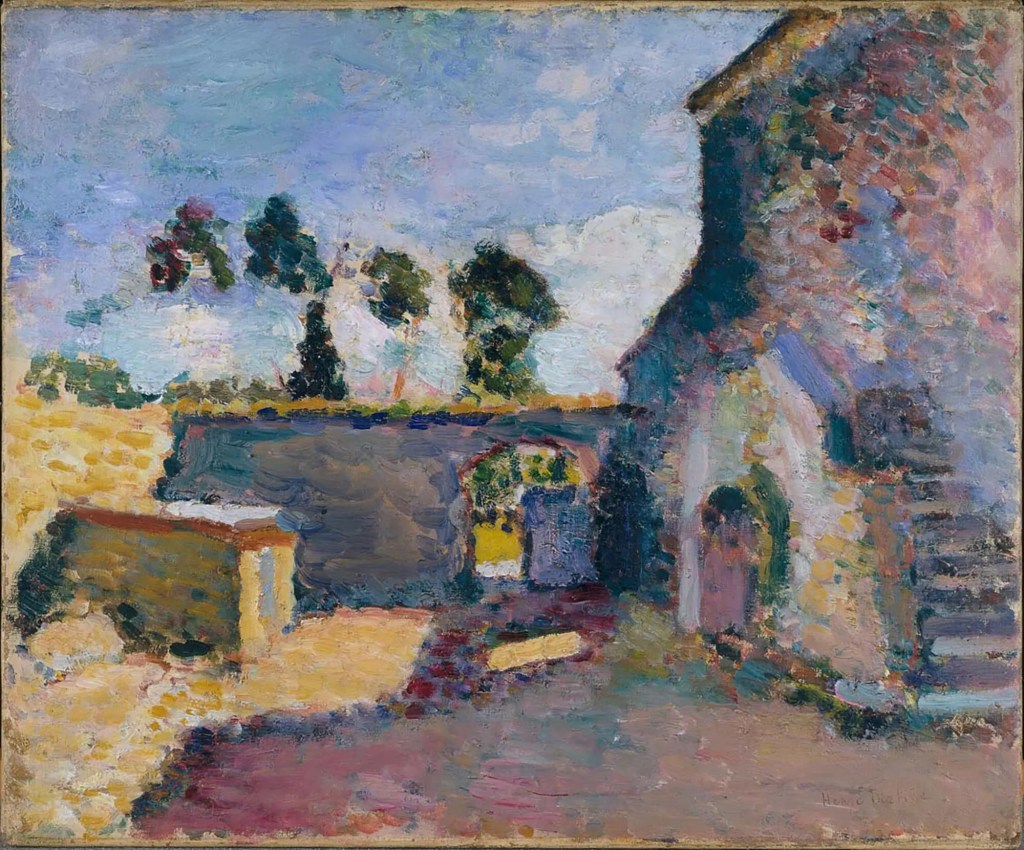
Matisse, “Corsica, The Old Mill” (1898), an early work that shows the influence of pointillism and the artist’s genius for color, from the exhibition at MoMA. Credit… Succession H. Matisse / Artists Rights Society (ARS), NY.
In “The Red Studio,” where this painting sits on the floor, the shadow is boiled down to a brushy purple shape.
(Roberta Smith, “‘The Red Studio,’ Matisse’s Masterpiece, Gets a Life All Its Own,” NYTimes, 4-29-22)
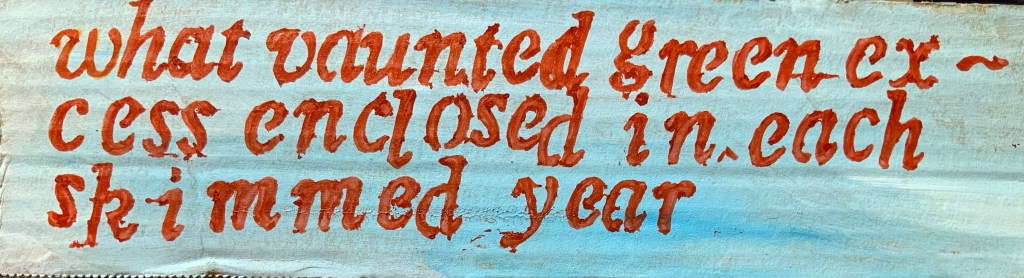
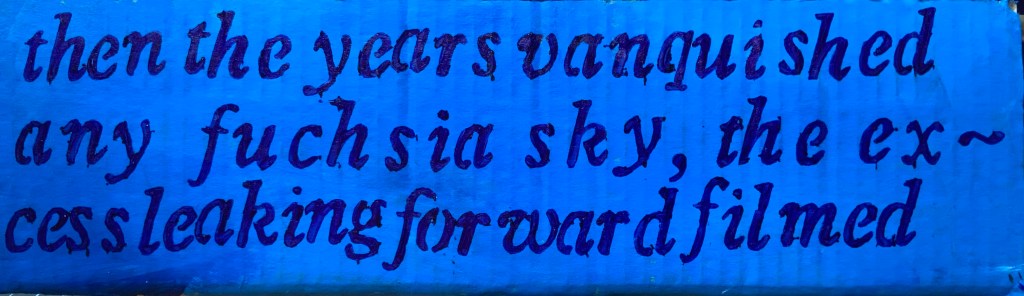
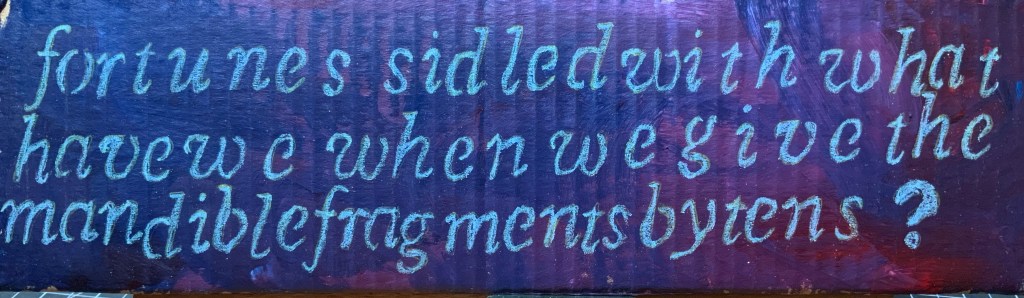
what vaunted green excess enclosed in each skimmed year then the years / vanquished any fuchsia sky / the excess leaking forward filmed aqua / filled aqua // fastened by ulna by increments of ten / fortunes sidled with / what have we when we give the mandible fragments by tens? / …
Here’s the text with one possible marking:
What vaunted green excess enclosed in each skimmed year! Then the years vanquished any fuchsia sky, the excess leaking forward filmed aqua, filled aqua, fastened by ulna by increments of ten. Fortunes sidled with what have we when we give the mandible fragments by tens?
The subject of the exclamation is “excess.” An over-abundant object of perception or state of matter has an annual cycle of occurrence. A “skimmed” year may be one traversed over time like a bird skims an expanse of water. The excessive entity is “green,” suggestive of verdant growth. It’s magnified by praise that has the hint of aggrandizement attaching to “vaunted.”
“Then,” an ordering and transitioning word, advances the narrative along a sequence. “Years,” agent of the independent clause, have overcome and defeated “any” sky tinted purple-pink, a cast of dawns and sunsets. The emphatic determiner “any” conveys finality, perhaps loss. Indeed, the excess is leaking “aqua,” which is green going blue, the hue of tropical seas. The leak is “forward,” with implications for the future. “Filmed” is unsettling. Is the leaked aqua enveloped in membrane? Captured on camera? “Filled” is even more daunting. The object of leakage is in a filled state? The poem shrugs off this line of query.
The “ulna” is a long thin bone in a bird’s wing, and in the human forearm. Absent a determiner, “ulna” could be something like the Roman name for Terpsichore. Proximity favors “aqua” as the thing “fastened” by ulna, though syntax allows “excess,” “sky” or “years.” The decimal unit that haunts the poem measures the progressive securing of something by a bone. In a bird’s wing, that bone would be a key enabler of flight.
A question mark, sole punctuation of the text, terminates this verse. “To sidle” is to walk sneakily sideways like Uriah Heep. Since it’s intransitive, it’s not fit in conventional parlance to be a verbal adjective as in “fortunes sidled (with).” Its semantics are stretched here beyond recognition and I want guiltily to read it as “saddled.” A “mandible” is a jawbone and either part of a bird’s beak. Giving vocal prominence to the question word causes this part of the text to coalesce around the phrase “what have we,” which draws me into the spirit, if not letter, of the verse.
To eye the text through a grammatical lens involves an act of assertion which may not be received with grace. Spare proper lyric your specious exegesis, murmurs my imaginary connoisseur. Note taken; I’m not equipped to disagree, only to flout. An element of je-m’en-foutisme must win through for one who improvises commentary. Does esthetic pleasure or spiritual gain compensate the expenditure of bandwidth? The answer to that belongs to the reader and not the poet.
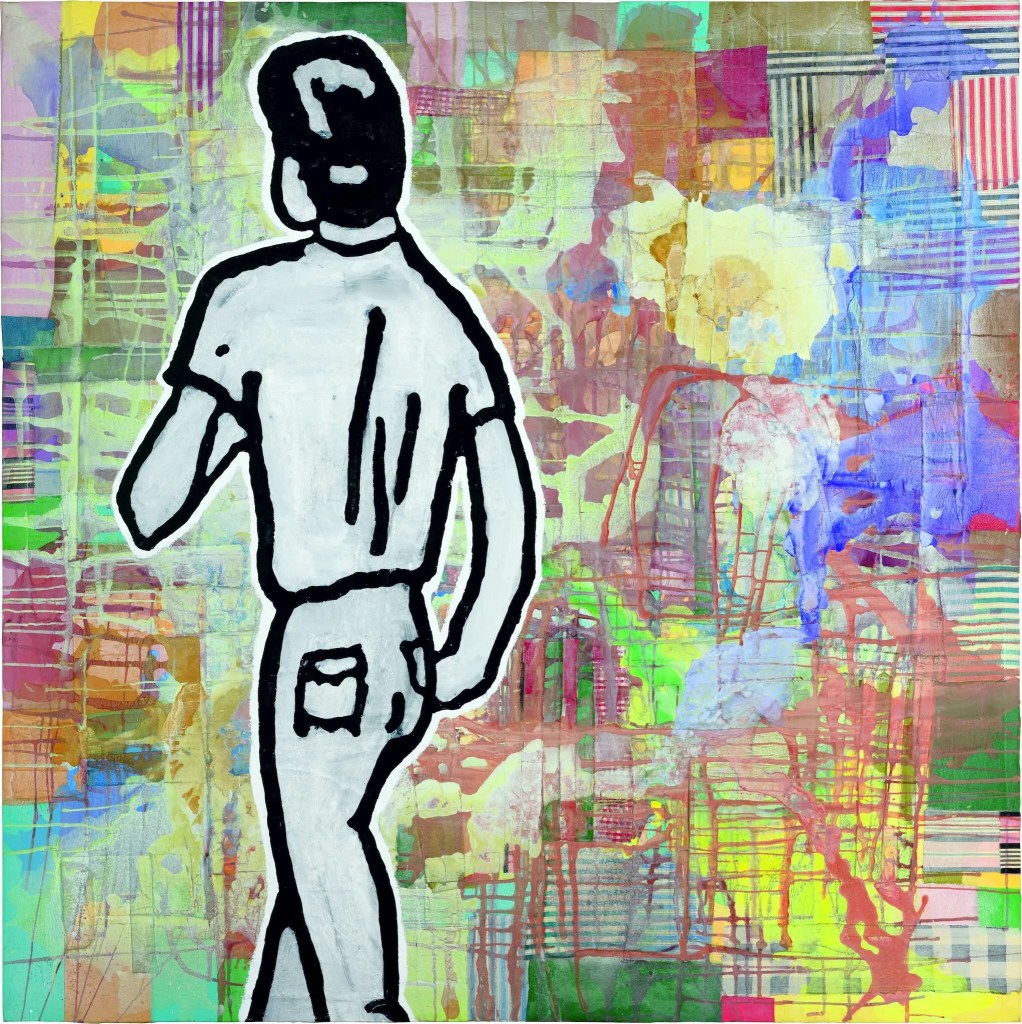
“The Ordinary Song,” 2017. Credit…via Chiem & Read.
Artist Donald Baechler (1956-2022) is remembered in the New York Times by Roberta Smith.
Among [Baechler’s] holdings of New York artists was a neon-light wall piece by Joseph Kosuth, a leading Conceptual artist and one of Mr. Baechler’s art school heroes. Mr. Baechler [said]… that he admired Mr. Kosuth for “his wonderful pictorial sense,” adding that his wall pieces “provoke a visceral sense that is undeniable.”
“He always used to tell me that I would be a really good artist if I just stopped painting,” Mr. Baechler said. “I never knew what to do with that statement.”
(Roberta Smith, “Donald Baechler, Painter of Cartoonish Collages, Is Dead at 65,” NYTimes, 4-26-22)
“Mandible Wishbone Solvent,” by Asiya Wadud (Poetry, March 2022)
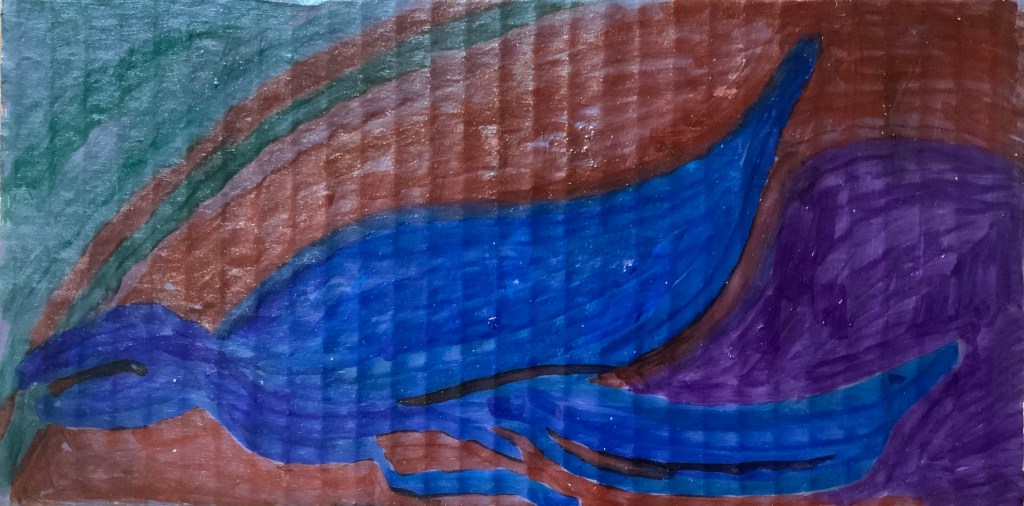
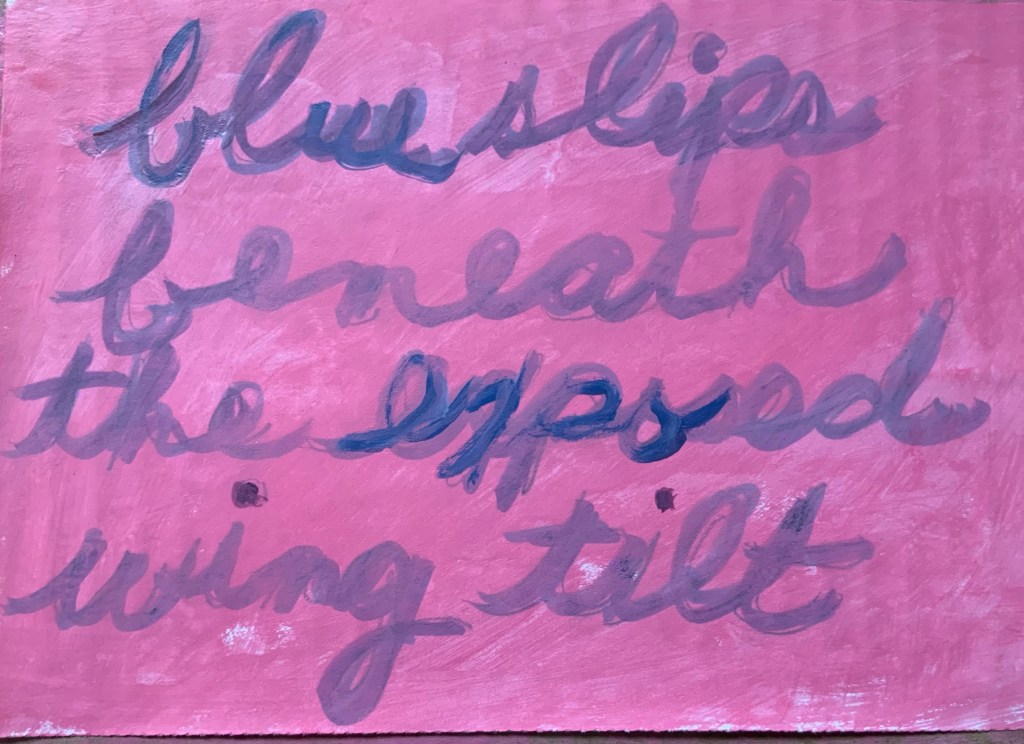
roped in incremental ghost tens / future tens clairvoyant tens home tens // blue slips beneath the exposed wing / tilt then seam then an angle spent all inside / the distance between thumb and thimble and fingerprint // height exceeds then brims / makes a solvent of it // …
To process this first portion of text beyond an impression of “something doing this thing and another thing, then that thing,” I fall back on applying markers that help me speculate what propositions it may hold.
Roped in incremental ghost tens, future tens, clairvoyant tens, home tens, blue slips beneath the exposed wing tilt, then seam, then an angle spent all inside the distance between thumb and thimble and fingerprint. Height exceeds, then brims, makes a solvent of it.
There are two sentences. The subject of the first sentence is “blue.”
The blue is “roped in” — somehow contained, if not restrained — by the decimal unit “tens.” Tens is ticking upwards, perhaps measuring the extent of blue’s “slips” delineated in the predicate. Tens, like an exoplanet, has four moon-like attributes: “ghost,” “future,” “clairvoyant” and “home.” Each orbits the arithmetic substantive darkly, exerting an imprecise gravity on its cryptic mass. A wan light travels from modifier “clairvoyant,” whose extrasensory vibe chimes with the stanza’s delphic nebulosity.
Blue “slips,” conveying a motion more angular and eccentric than frontal. The predicate details three orientations of blue, relative to locations on the “exposed wing,” which pinpoint progressive degrees of slippage: first to the wing’s “tilt,” which would afford a visual of its underside; then to the “seam” — perhaps a bone such as the ulna (mentioned later in the poem); finally, to a tiny angle somehow “spent all inside” the micro-span between a thumb touching the thimble worn on a middle finger, or between the finger itself and the fingerprint of the digit that wears it.
The subject of the second sentence is “height.”
Height “exceeds” something not specified; perhaps the verb is used intransitively, in the sense of increasing self-referentially, surpassing only itself. Whereupon this height of which we speak reaches an unspecified edge, a plenitude verging on overtopping, and in the course of brimming “makes a solvent of it.” Something referenced by “it” is converted to a dissolving agent by soaring height; but what is “it”? I venture that “it” is “blue”: height makes a solvent of blue. Blue is the color of distance, after all. Distance, in the fullness of altitude, goes colorless and ungraspable.
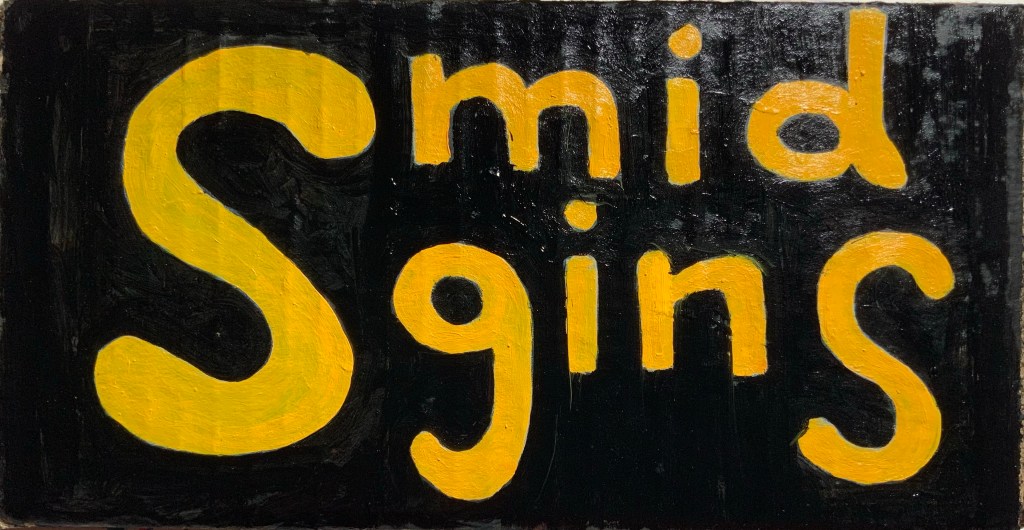
A “smidgin” is an imprecise, tiny amount of something, a modest dollop. As a poem title, the jocular word is self-effacing but also coyly assertive, like a humble-brag.
I got dirt under my nails the other day with Rae Armantrout’s poem “Smidgins” (https://ethicaldative.com/2022/04/12/how-poetry-feels-about-itself/). Did I soil a blithe lyric with the pale cast of thought? I mustn’t trouble the poem any further here except to mention a quibble with the latter part of this stanza:
Poetry hates itself / the way a child / pretends to fall / and looks around / to see who notices. // As much as any / single smidgin / wants to disappear. * …
The phrase As much as any single smidgin wants to disappear feels too arch by half, and leaves me stranded. I replace it mentally with “As much as any parabola wants to be analgesic” and am no less illumined.
Leaving a written record of joy and vexation over poems is a ritual roughly akin to that of the math student who shows his work. The testament of blunders, false starts and illusory breakthroughs is useful, if at all, for what it says about the problem and the student; the answer is the least of it.
(Source: Rae Armantrout, “Smidgins,” newyorker.com, 3-28-22.)
I tried to get my dad to teach me dominos once during the last months of his life. He was in hospital and listless. I thought it might raise his spirits. When I dumped the shiny pieces out on the … Continue reading →
Rae Armantrout’s poem “Smidgins” fulfills an imperative of lyric, which is “Don’t be gassy.” Also another imperative, which is “Talk in riddles.”
My crumpled, wrinkled / blurt / of flesh. // “Let’s face it,” / it says. * …
Ravaged matter expressed as living tissue — flesh — incarnates an impromptu utterance triggered by strong affect expressed as sound — a blurt — in order to urge its startled reflection, glimpsed in a shiny surface, to put a brave face on decline.
Poetry hates itself / the way a child / pretends to fall / and looks around / to see who notices. // As much as any / single smidgin / wants to disappear. * …
The pratfalls a child stages in order to be fussed over and soothed constitute a form of “self-hatred” comparable to that of poetry’s, which confects naughty “accidents” such as talking tissue and bashful smidgins to seek attention and validation while fulfilling its writ to fabricate outré parallels.
Poetry loves itself / the way a baby / loves pleasure, / shadows tickling / its skin. / As a swallowtail, / like a folded note, / sways / on a long / blossom.
A crib-bound infant’s undifferentiated sensory delight in the play on skin of sunlight slicing through the blinds of a darkened room is a form of self-love comparable to how poetry swoons over its own rapture at comparing a splay-tailed kite with a swooshy name at rest on a sweet phrase to what could well be a billet-doux.
Poetry dines on tropes. Make something voiceless talk. Or take an abstraction, endow it with sentience, and declare it to have feelings about itself that are radically opposed. The only way to seek buy-in for such gambits is hair of the dog, i.e., more cowbell, more daring associative swoops.
If Armantrout’s lyric succeeds, its oblique shenanigans speak louder than my fussy extrapolations. I don’t say it’s true, but I’m finding that to engage with a poem entails taking possession of it; once handed off by the poet, the poem belongs to me and whoever else wants it. The reading of it is our affair, and includes license to talk back to the poem, to get in its face.
(Rae Armantrout, “Smidgins,” newyorker.com, 3-28-22. The entire poem is quoted.)








 EthicalDative
Cry the Belovèd Reader
“Mandible Wishbone Solvent” by Asiya Wadud (Poetry, March 2022). Pass 3 of 3.
Previous comment:
https://ethicaldative.com/2022/04/25/mandible-wishbone-solvent-pass-1-of-3/
https://ethicaldative.com/2022/05/01/mandible-wishbone-solvent-pass-2-of-3/
You. Be. Here. It’s an affirming imperative to exist, or be situate, in the speaker’s space-time. It’s addressed to “tilt” — twice “tender” now — and angled vertically to a plane christened “unearth,” or else one required to perform an act of unearth-ing, understood venturesomely as slipping Earth’s bond. The text pivots here as elsewhere on function-fluid diction in blurred contexts.
The reader has a blue-sky moment: A rocket breaking free of terrestrial gravity blazes its way towards a far trajectory. Gain of height thins blue atmosphere to a vanishing wake. Land and sea resolve into map-like features. It’s all a function of the “scant excess” of mad tilt, wrapped in whatever that “film” is. Such a sweet, severe angle would be “remiss in skies,” aeronautically delinquent for earthbound flight.
And to what end? “To wrest time.” Wresting is an act of forceful seizure. All life yanks itself from the jaws of death from one moment to the next, grabbing bits of time. Those “brimmed solvents,” the carbon syrups milked from ancient sediments on which futures for too long have been staked and stoked, are bested in promise by what “gives more” for snatching increments of futurity, which is …
And the reader’s meditation collapses. In the final analysis the text stands its ground, enclosed in its film, true only to its own designs. The reader has shaken his mind’s fist at it saying, You. Be. Clear. It has stayed frosty. It doesn’t give a shit for his demands. But when he averted his gaze in disgust, his eye had caught movement peripherally; the text made him look back. A loop was entered: attraction and repulsion went to war.
At length the reader exited the loop by ceding something — maybe a bit of complacency. Surrender feels not all good and not all bad. The reader makes a thing of his squabbles with the text. What you think isn’t what I wrote, says the poet. The reader responds, But you triggered a striving. You induced in me a commitment to be baffled for a time. And the reader is grateful for her text. He keeps whatever it wrested from him. It’s personal now.
(c) 2022 JMN — EthicalDative. All rights reserved