This passage from a fellow blogger (cap doff to) caught my eye:
Reality? Well it starts to mock back at your face, you get surrounded by the clouds of regret, cry on the ashes of your pretentious bliss and feel agitated on being abandoned by the people you highly think of.
(Shubhi Rawat, “The City Dwellers,” Perception, shubhangirawat.wordpress.com, May 2, 2021)
The passage dances with an out-of-kilter vivacity that mocks back at my face. I like it, and it made me rise from the ashes of my pretentious bliss to ponder adverbs.
What’s exotic about “highly think of” versus “think highly of”? No obvious rule leaps to mind.
Most adverbs are flexible as to where they may occur in the sentence: “I think deeply about the problem”; “I think about the problem deeply”; etc.
What’s in play, as I see it, is that in the formula “think highly of” the adverb is a cloaked adjective. It confers the attribute of being estimable on the object of the preposition rather than commenting on the nature of the thinking. It says, sneakily, “In my thoughts I attribute to the following entity an elevated status.” That message is puckishly flustered in “highly think of.”
Where they’re actually being themselves, adverbs almost always weaken an argument. They’re the Angostura Bitters ™ of style; use them by the drop, if at all.
Quedo de Vds. S.S.S.Q.E.S.M.
~ “Write beautifully what people don’t want to hear.” (Frederick Seidel)
Use a semicolon to separate two independent clauses — i.e., two sentences that work on their own — which are closely sequential:
“I finished a painting today; it went better than I thought it would.”
Or in order to separate items in a series that would be particularly unwieldy with only commas, often because the items contain commas:
“Today I ate three desserts: a tiny cookie, which was free with my espresso; a bigger cookie, which was unfortunately a little dry; and a milkshake, which maybe took things too far.”
(Adapted from Lauren Oyler, “The Case for Semicolons,” NYTimes, 2-9-21)
“Write beautifully what people don’t want to hear.” (Frederick Seidel)
For fanfaronnish, pharaonic, peerlessly peeraged personnages kitted, kilted, severely coiffed and balconic in presence, shod and booted in besotted opulence, blackamoorian brooched, got up in splendid headgear, lorded lads and ladied dames garbed in emblazoned berobement, none…
For sherlockian, sherwoodian, agathonian, haddlepudlian, level-uppity, ‘ello gaffer, day at the races, should I make a cheeky bet, dear olde — you know — not to make a fuss about but, end of, if-I’m-being-honesty, none…
For acid, Mr. Speaker-ish, his-honourable-gentlemanly annunciatory promulgations, retortive denouncements huffed in receivedly syllabic oratory bespoken to bewigged and vested Etonians lounged and draped and clubbed in hoary, leathery chambers and halls amongst antique appurtenances and shafty lighting, none…
[Translator’s note: The blog of Andrés Cifuentes — Eco Social…Ojo Crítico (doff of cap to) led me to this poem by Miguel Hernández. It doesn’t soar as poetry, but it does register a raw and memorable cri de coeur. All translations fail, and mine does so by indulging in flights of paraphrase to offset the flatness of affect of the literal English. JMN]
Cowards Men I see who of manliness have none but what they flaunt, the look and the Marlboro, the britches and the beard.
At heart they are bunnies, chickens in their guts, hounds quick at crapping, barkers in peace time who in cannon season vanish from the map.
These macho cottontails, commissars of retreat, hearing miles away the thunder of bullets, like matchless heroes cut and run for the hills, shitting explosively, hair standing on end. Bravely they take cover, gallantly abandon the blast radius, these turds on the run who’ve kicked for ages my soul in the balls.
Where will you end up that’s not dead, paleface rabbits, untrustworthy curs with extra paws? Aren’t you ashamed to see to this extent in Spain so many steady women under so much threat? A bullet for every tooth is what your life deserves, cowards wearing coward hides with reeds for hearts. You tremble as if gripped by a century’s worth of frost and fade from sun to shadow quaking in your boots. For you a basement’s undefended by its house.
Your yellow streak begs everyone for battalions of walls and lead barriers rimming cliffs and trenches, saving our threadbare lives mired in gore and dread. Not enough for you, defense by showers of noble blood shed unstintingly abundant and warm day in, day out, onto Castilian clod. You’re senseless to the calling of the splattered lives. To keep your pelts intact burrows and dens won’t do, not rabbit holes, not toilets even, nothing will. You flinch and flee, which gives the people you turn tail on just cause to drill your disappearing backs with lead.
Only men alone remain in the heat of battle, and you, from far away, try to rouge your infamy, but the pallor of cowardice will not wipe off your faces.
Keep standing your pathetic posts over your pathetic cobwebs. Swap your weapon for a broom, and sweep with your ass cheeks the caca you leave behind wherever you set foot.
Wind of the People, 1937 Miguel Hernández English version by JMN
Los cobardes Hombres veo que de hombres solo tienen, solo gastan el parecer y el cigarro, el pantalón y la barba.
En el corazón son liebres, gallinas en las entrañas, galgos de rápido vientre, que en épocas de paz ladran y en épocas de cañones desaparecen del mapa.
Estos hombres, estas liebres, comisarios de la alarma, cuando escuchan a cien leguas el estruendo de las balas, con singular heroísmo a la carrera se lanzan, se les alborota el ano, el pelo se les espanta. Valientemente se esconden, gallardamente se escapan del campo de los peligros estas fugitivas cacas, que me duelen hace tiempo en los cojones del alma.
¿Dónde iréis que no vayáis a la muerte, liebres pálidas, podencos de poca fe y de demasiadas patas? ¿No os avergüenza mirar en tanto lugar de España a tanta mujer serena bajo tantas amenazas? Un tiro por cada diente vuestra existencia reclama, cobardes de piel cobarde y de corazón de caña. Tembláis como poseídos de todo un siglo de escarcha y vais del sol a la sombra llenos de desconfianza. Halláis los sótanos poco defendidos por las casas.
Vuestro miedo exige al mundo batallones de murallas, barreras de plomo a orillas de precipicios y zanjas para nuestra pobre vida, mezquina de sangre y ansias. No os basta estar defendidos por lluvias de sangre hidalga, que no cesa de caer, generosamente cálida, un día tras otro día a la gleba castellana. No sentís el llamamiento de las vidas derramadas. Para salvar vuestra piel las madrigueras no os bastan, no os bastan los agujeros, ni los retretes ni nada. Huis y huis, dando al pueblo, mientras bebéis la distancia, motivos para mataros por las corridas espaldas.
Solos se quedan los hombres al calor de las batallas, y vosotros, lejos de ellas, queréis ocultar la infamia, pero el color de cobardes no se os irá de la cara.
Ocupad los tristes puestos de la triste telaraña. Sustituid a la escoba, y barred con vuestras nalgas la mierda que vais dejando donde colocáis la planta.
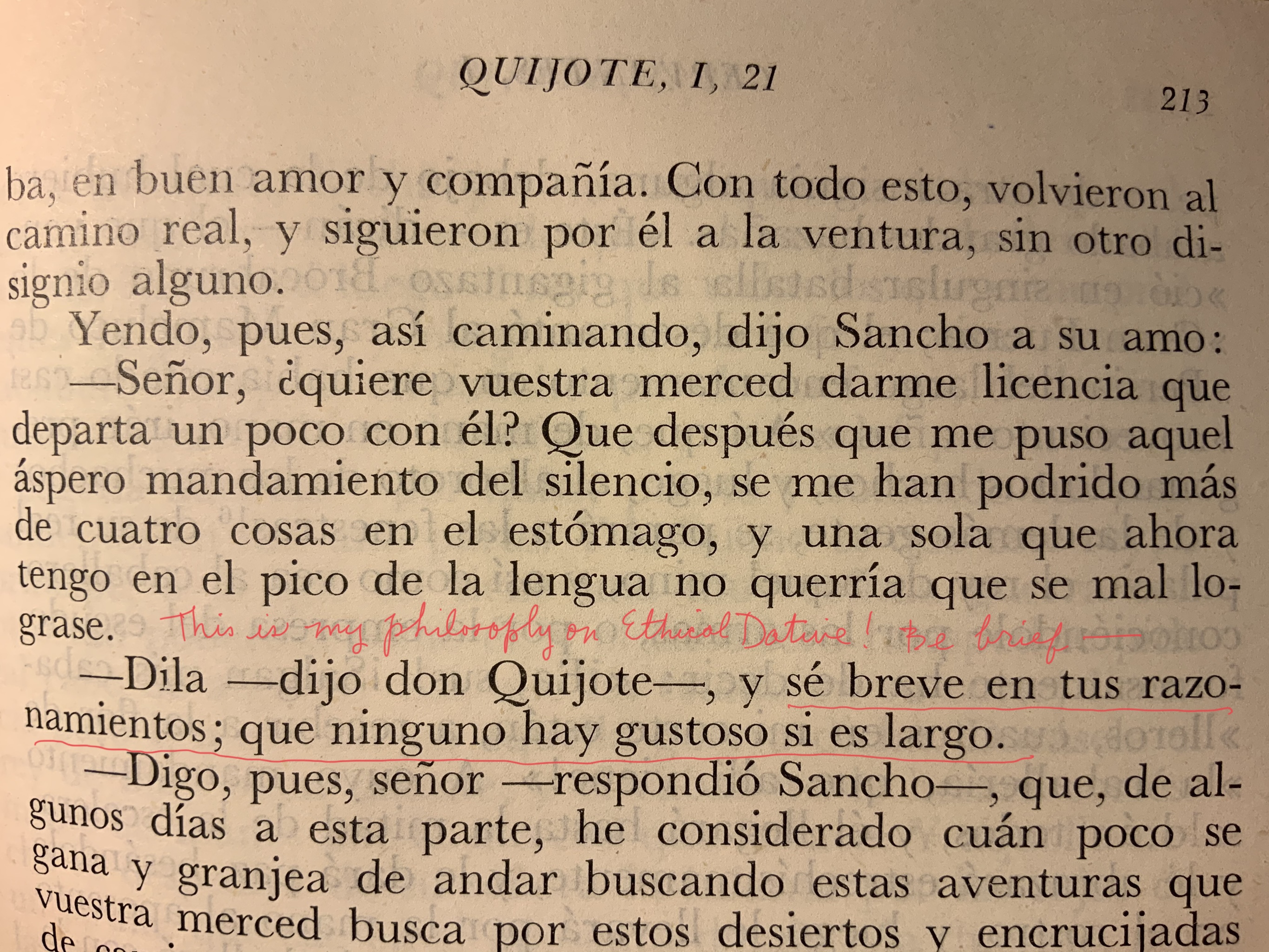
From my edition of “Don Quijote” edited by Martín de Riquer, first edition, Barcelona, 1962. I didn’t actually write in the book. The red comment is scribbled on the jpeg with an Apple Pen. The edition was a gift from the wonderful Tatjer family, who had me to dinner various evenings in their apartment. Their daughter Mercedes was my classmate in the Facultad de Filosofía y Letras. The book is inscribed by her and her brother Joan. (JMN)
Sé breve en tus razonamientos; que ninguno hay gustoso si es largo. Be brief in your remarks; none is pleasurable if it’s long. (Don Quijote)
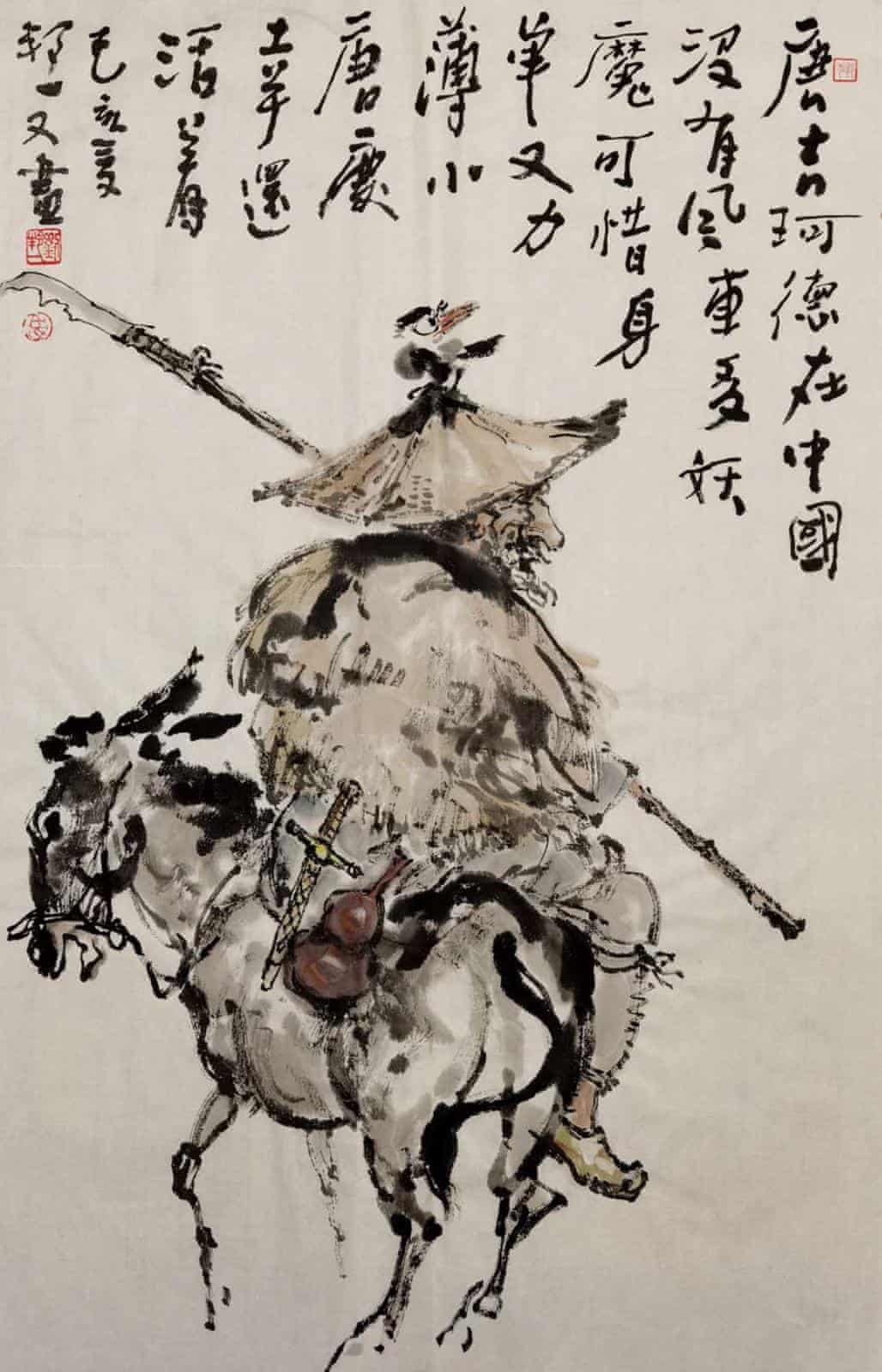
Don Quixote in Chinese translation. Photograph: Liu Bangyi.
In 1922, Lin Shu translated the first part of “Don Quixote” into classical Chinese. It was published as “The Story of the Enchanted Knight.”
Lin Shu knew no Spanish, nor any other western language. A friend who had read two or three English translations of Cervantes’s novel helped Lin make his version.
In that version, Don Quixote is more learned than crazy. Sancho Panza is his disciple. Dulcinea, the knight’s fair maiden, receives the epithet “Jade Lady.” All reference to God is excised. Rocinante is promoted from nag to “fast horse.”
Fast forward to today.
Alicia Relinque, professor of classical Chinese literature at the University of Granada, has translated Lin Shu’s Chinese version into Spanish for publication in China as a dual edition.
Relinque looks on her translation of Lin’s translation as the newest link in a long and ancient chain, and as a means to share a book that says as much about early 20th-century China as 17th-century Spain.
(Sam Jones, “Chinese Don Quixote is translated into Spanish after 100 years,” theguardian.com, 4-22-21)
I dream of translating Relinque’s Spanish version of Lin Shu’s Chinese version of several English versions of Cervante’s version into a Texas English version, furnishing yet a newer link in the long and ancient chain.
Las flores o árboles siempre son una buena opción cuando no tienes oportunidad de fotografíar otras cosas.
Besides being a lovely photo by Carmac, this caption merits your attention for the Spanish conversations we’re practicing about what you see in your garden.






 EthicalDative
E Pluribus Nihil
Archaeologists of the far future sifting through America’s plastic ashes will peg the collapse of its civilization to two insidious language events:
(1) When America dissolved “talking about problems” into “having conversations around issues.”
(2) When America demoted “national” security to “homeland” security.
***
~ “Write beautifully what people don’t want to hear.” (Frederick Seidel)
Quedo de Vds. S.S.S.Q.E.S.M.
(c) 2021 JMN — EthicalDative. All rights reserved