Richard Wright, who died in 1960, is the author of “Native Son” and “Black Boy.” When he submitted “The Man Who Lived Underground,” he said, “I have never written anything in my life that stemmed more from sheer inspiration.” Below: pages from a draft of “The Man Who Lived Underground.” Credit… Carl Van Vechten and Van Vechten Trust, via the Beinecke Rare Book and Manuscript Library, Yale University.
A chance juxtaposition of readings* has suggested to me the perennial nature of America’s brutish policing streak.
In 1941, Richard Wright’s manuscript novel “The Man Who Lived Underground” is rejected by publishers who are made queasy over scenes of violence:
[Black protagonist Fred Daniels]… is arrested without explanation, kicked, punched, slammed into walls and floors, and hung upside down by his shackled ankles. “You’re playing a game,” one of the policemen tells him, “but we’ll break you, even if we have to kill you!”
In 2020, a Virginia cop responds to the queries of a motorist subjected to a routine traffic stop, “What’s going on is you’re fixing to ride the lightning, son.” The “lightning” of truculent police talk can be the electric chair or a taser.
In Wright’s fiction an innocent non-white man is coerced into confessing to the killing of a white couple. In the Virginia incident, an innocent non-white man is stopped by mistake and brutalized without provocation.
A telltale addition to the enormity of the Virginia episode is the term “son” spat out by the cop. Much dark historic lightning is trapped in that jug of vile rhetoric.
*Readings: Noor Qasim, “Decades After His Death, Richard Wright Has a New Book Out,” NYTimes, 4-14-21 Matthew S. Schwartz, Emma Bowman, “Virginia Investigating Pepper-Spraying of Army Officer Caron Nazario,” http://www.npr.org, 4-13-21
Housman’s “To an Athlete Dying Young” ruefully ironizes over a lad clever enough to “slip betimes away / From fields where glory does not stay.” Novelists, though, get more mileage out of superannuated jocks — Updike’s Rabbit Angstrom, Malamud’s Roy Hobbs, Philip Roth’s Swede Levov, Leonard Gardner’s Billy Tully — who, like [Theroux’s protagonist] Sharkey, don’t share their creators’ erudition. Such protagonists, of course, appeal particularly to male writers; Theroux suggested why in a 1983 essay that amounts to a cry of pain, finding “the quest for manliness essentially right wing, puritanical, cowardly, neurotic and fueled largely by a fear of women. It is also certainly philistine. There is no book hater like a Little League coach. … For many years I found it impossible to admit to myself that I wanted to be a writer … because being a writer was incompatible with being a man.”
(David Gates, “Paul Theroux’s New Novel Takes on Life’s Crashing Waves,” NYTimes, 4-13-21)
My aim, superannuated betimes, was to be a philologist and translator, which, if conceivable, is beneath even writer.
Fra Angelico’s fresco on a wall in the Convent of San Marco depicts a familiar biblical narrative (Credit: Getty Images)
“Between feces and urine we are born,” said Augustine in the 4th century. The bishop of Hippo’s take on parturition was that our mothers effectively defecate us from their feculent crannies.
Doctrine on sex and love handed down by dour anchorites and prelates is enforced today by elderly bachelors in skullcaps. In the canonical telling, the consummate Mother was inseminated by annunciation. Cut to swaddled infant lying in a manger.
Thus come we apostolically to be flustered by our nethers. We humans are a slanging breed. We speak in tongues that have a thousand ways to go all wink-wink, nudge-nudge where major and minor waters debouch into the swamp of procreation.
In “Don Quijote,” Sancho Panza, seized while frozen in his tracks by the urgent need to do what no man can do for him, drops trouser in preparation. “… Alzó la camisa lo mejor que pudo, y echó al aire entrambas posaderas, que no eran muy pequeñas.”
My enhanced translation is: “… He hiked his shirt to the extent that he was able, and bared to the four winds a pair of haunches which did not err on the side of picayune.”
“Posaderas” is delicious, deriving from “posar,” meaning “to sit”; so it’s the “sitters,” the hind quarters that meet the seat.
A happy discovery is that German has “sitzfleisch,” meaning “seat flesh,” a term for the bee-you-double-tee that can can be emblematic of a certain endurance or ability to work long hours. Philip Roth was “king of sitzfleisch,” someone said recently, alluding to the novelist’s dogged writing routine.
Philologically speaking, I imagine “sitzfleisch” and “posaderas” to be jovial code words traded by German and Roman cousins sharing a bench in the shade of Babel’s tower as each pointed to his you know what.
The poet Edna St. Vincent Millay and her husband, Eugen Jan Boissevain, in front of their home at 75½ Bedford Street, which has been cited as the “narrowest house in New York,” c. 1923. Credit… Library of Congress. [Jeremy Allen, “In the Pandemic Present, a Literary Tour of Greenwich Village’s Past,” NYTimes, 3-17-21]
I am not resigned to the shutting away of loving hearts in the hard ground. No me resigno a que se recluyan corazones tiernos en el suelo duro. So it is, and so it will be, for so it has been, time out of mind: Así es, y así será, porque así ha sido desde siempre: Into the darkness they go, the wise and the lovely. Crowned Entrando en la oscuridad van, los sabios y los bellos. Coronados With lilies and with laurel they go; but I am not resigned. De lirios y de laurel van ellos; pero yo no me resigno.
Lovers and thinkers, into the earth with you. Amantes y pensadores, entregaos a la tierra. Be one with the dull, the indiscriminate dust. Uníos con el torpe polvo indiscriminado. A fragment of what you felt, of what you knew, Una pizca de lo que sentisteis, lo que supisteis, A formula, a phrase remains,—but the best is lost. Una fórmula, una frase se queda, — pero lo mejor está perdido.
The answers quick and keen, the honest look, the laughter, the love,— Las réplicas prontas y agudas, la mirada honesta, la risa, el amor, — They are gone. They are gone to feed the roses. Elegant and curled Desvanecidos. Se fueron ya para alimentar las rosas. Elegante y rizada Is the blossom. Fragrant is the blossom. I know. But I do not approve. Es la flor. La flor es perfumada. Ya lo sé. Pero no me conformo con ello. More precious was the light in your eyes than all the roses in the world. Me era más preciosa la luz de tus ojos que todas las rosas del mundo.
Down, down, down into the darkness of the grave Abajo, abajo, entrando en la noche de la tumba Gently they go, the beautiful, the tender, the kind; Suavemente van, los vistosos, los tiernos, los amables; Quietly they go, the intelligent, the witty, the brave. Silenciosos van, los inteligentes, los ingeniosos, los valientes. I know. But I do not approve. And I am not resigned. Ya lo sé. Pero no me conformo con ello. Y no estoy resignado.
… [Clement] Greenberg’s organizing idea was surprisingly simple: modern painting, having ceased to be illustrative, ought to be decorative. Once all the old jobs of painting—portraying the bank president, showing off the manor house, imagining the big battle—had been turned over to photography and the movies, what was left to painting was what painting still did well, and that was to be paint.
(Adam Gopnik, “Helen Frankenthaler and the Messy Art of Life,” http://www.newyorker.com, 4-12-21)
I’m as susceptible as the next person to sweeping statements that seem to capture the essence of a thing or a moment. I’m not versed nearly enough in art crit lit to slot pronouncements informedly into the historical flow of it. It’s likely that the trope of letting paint be paint is quaint now, set aside for something in the vein of performance art, or re-entry into a militant mode of depictivism, or who knows?
What snagged me in the quotation was the adjective “decorative” and the premise that certain “old jobs” of painting were considered to have been relinquished to other media. Interesting. Is that still held to be the case about painting?
By way of postscript: It perplexes me that an article such as this in The New Yorker isn’t illustrated by a single one of Frankenthaler’s paintings. Also, when I returned to the link I had saved initially, the article was re-titled “Fluid Dynamics.”
The worst way to defeat a social or cultural ill is to declare war on it. The U.S. declares war on problems it can’t or won’t solve.
The worst way to foster a social or cultural good is to declare a recurring calendar date for it. Doing so acknowledges a thing to be perennially moribund.
So this April is the 25th anniversary of National Poetry Month. Margaret Renkl writes:
Many Americans… feel they can get along just fine without poetry. But tragedy… can change their minds about that… The poets are forever telling us to look for this kind of peace, to stuff ourselves with sweetness, to fill ourselves up with loveliness.
(Margaret Renkl, “Thank God for the Poets,” NYTimes, 5-5-21)
Bless her heart, she means well, as we say in the South. I’m sure you remember exactly where you were and what you were doing when National Poetry Month was declared. I don’t.
Poetry is a curious hubbub kicked up by a tiny few, noticed if at all by a tiny few more. Oblivion is guaranteed, and have a nice minute. Poetry’s for that. “I am not resigned,” says Edna St. Vincent Millay from the grave. Good luck with that, Ms. Millay. This world will flame out by and by. Poetry’s for that.
I simply can’t express, other than with petulance, what a downer to the impulse towards poetry a pious paean to it such as Ms. Renkl’s well-intentioned one can be.
My conviction and hope is that, if poetry lands a blow at all, it’s as much to fuck me up in my complacent brine and set me back on my heels as to nurse me through my godawful present or penultimate moments. There’s no way anyone under the age of ancient will bother to look at it if it’s in order merely to gorge on putative gobs of goodness.
Amanda Gorman’s Inaugural poem did what it had to do, which was to put a scrappy, uplifting vibe on a happy occasion. Ms. Gorman, after all, intends to run for president. The launch will stand her in good stead failing some reversal of fortune. I hope to have a chance to vote for her. The last president-poet we had was Lincoln. Perhaps we could use another. Will my grandkids revere “The Hill We Climb” like I revere the Gettysburg Address? Doubt springs eternal.
But back to National Poetry Month: don’t forget to thank the Devil for it.
“The vast majority of MLMs [multi-level marketing companies like Amway and Ambit] are recruiting MLMs, in which participants must recruit aggressively to profit. Based on available data from the companies themselves, the loss rate for recruiting MLMs is approximately 99.9%; i.e., 99.9% of participants lose money after subtracting all expenses, including purchases from the company.”[64] (By comparison, skeptic Brian Dunning points out that “only 97.14% of Las Vegas gamblers lose money …. .”[65]) (Wikipedia, “Multi-level marketing”)
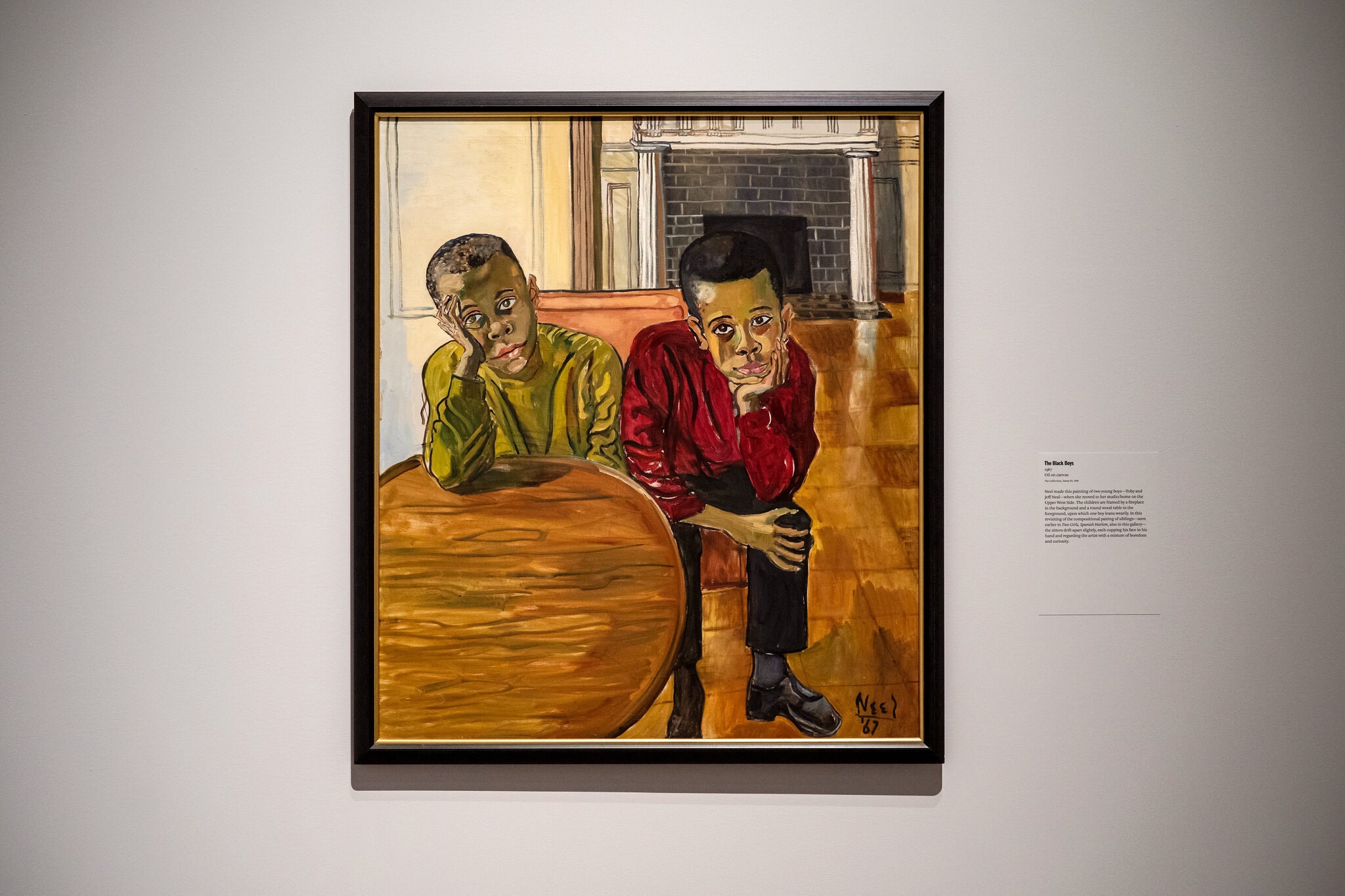
“The Black Boys” is part of a Neel exhibit at the Metropolitan Museum of Art until Aug. 1. The boys sat for the portrait but went through life never having seen it. Credit… Amr Alfiky/The New York Times.
“I would say she was looking at two ghetto children from uptown and bringing out the beauty in us.” [Jeff Neal, on left in the portrait with brother Toby.]
Ms. Neel in her studio in 1979. She called herself “a collector of souls.” Credit… Alfred Eisenstaedt/The LIFE Picture Collection, via Getty Images.
(John Leland, “Two Brothers Posed for a Portrait. One Lived to See It in the Met.” NYTimes, 4-2-21)
Natalie Diaz: ‘The things that I know are only considered knowledge if someone outside finds value in it.’ Photograph: Deanna Dent/ASU Now. [Photo from theguardian.com, 7-2-20, Sandeep Parmar, “Interview: ‘It’s an important and dangerous time for language’”]
If I Should Come Upon Your House Lonely in the West Texas Desert By Natalie Diaz. Selected by Reginald Dwayne Betts, NYTimes, 4-1-21.
[Translator’s note: The title’s ‘West Texas Desert’ is resonant and necessary. For my Spanish interpretation, however, the fact of the state’s desert lying solely west gives me pretext to skirt (nervously) the preposition wreck “el desierto del oeste de Tejas” with “el desierto de Tejas.” The alternative “el desierto de Tejas occidental” is comparably abject on top of risible. JMN]
Si anhelante me topo con tu casa en el desierto de Tejas
I will swing my lasso of headlights across your front porch, Echaré el lazo de mis faros a lo ancho de tu porche delantero,
let it drop like a rope of knotted light at your feet. dejándolo caer como reata de luz anudada a tus pies.
While I put the car in park, you will tie and tighten the loop Mientras pongo el coche en pare, vas a atar la lazada de luz
of light around your waist — and I will be there with the other end apretándola por tu cintura — y allí estaré yo con la otra punta
wrapped three times around my hips horned with loneliness. envolviéndome tres veces las caderas cornudas de anhelo.
Reel me in across the glow-throbbing sea of greenthread, bluestem prickly poppy, Sácame como pez enrollado del mar pálpito-luciente del té silvestre, el chicalote,
the white inflorescence of yucca bells, up the dust-lit stairs into your arms. la blanca inflorescencia de corolas de yuca, subida la escalera iluminada de polvo hasta tus brazos.
If you say to me, This is not your new house but I am your new home, Si tú me dices, Ésta no es tu nueva casa pero soy yo tu nuevo hogar,
I will enter the door of your throat, hang my last lariat in the hallway, entraré por la puerta de tu garganta, colgaré mi lazo último en el pasillo,
build my altar of best books on your bedside table, turn the lamp on and off, on and off, on and off. montaré mi altar de libros favoritos sobre tu mesita de noche, pondré la lámpara encendida y apagada, encendida y apagada, encendida y apagada.
I will lie down in you. Eat my meals at the red table of your heart. Me acostaré en ti. Me alimentaré en la mesa roja de tu corazón.
Each steaming bowl will be, Just right. I will eat it all up, Cada tazón humeante estará, En su punto. Me lo comeré todo,
break all your chairs to pieces. If I try running off into the deep-purpling scrub brush, haré pedazos de todas tus sillas. Si intento escabullirme al profundo matorral purpurante,
you will remind me, There is nowhere to go if you are already here, tú me recordarás, No hay donde irte si estás ya aquí,
and pat your hand on your lap lighted by the topazion lux of the moon through the window, y palmearás tu regazo iluminado por el lux lunar topacio que arroja la ventana,
say, Here, Love, sit here — when I do, I will say, And here I still am. diciendo, Aquí, Amor, siéntate aquí — cuando lo hago, yo diré, Y estoy aquí todavía yo.
Until then, Where are you? What is your address? I am hurting. I am riding the night Hasta entonces, ¿Dónde estás tú? ¿Cuál es tu dirección? Estoy sufriendo. Estoy montando la noche
on a full tank of gas and my headlights are reaching out for something. con un depósito lleno y mis faros se alargan en busca de algo.









 EthicalDative
Native ‘Son’
A chance juxtaposition of readings* has suggested to me the perennial nature of America’s brutish policing streak.
In 1941, Richard Wright’s manuscript novel “The Man Who Lived Underground” is rejected by publishers who are made queasy over scenes of violence:
[Black protagonist Fred Daniels]… is arrested without explanation, kicked, punched, slammed into walls and floors, and hung upside down by his shackled ankles. “You’re playing a game,” one of the policemen tells him, “but we’ll break you, even if we have to kill you!”
In 2020, a Virginia cop responds to the queries of a motorist subjected to a routine traffic stop, “What’s going on is you’re fixing to ride the lightning, son.” The “lightning” of truculent police talk can be the electric chair or a taser.
In Wright’s fiction an innocent non-white man is coerced into confessing to the killing of a white couple. In the Virginia incident, an innocent non-white man is stopped by mistake and brutalized without provocation.
A telltale addition to the enormity of the Virginia episode is the term “son” spat out by the cop. Much dark historic lightning is trapped in that jug of vile rhetoric.
*Readings:
Noor Qasim, “Decades After His Death, Richard Wright Has a New Book Out,” NYTimes, 4-14-21
Matthew S. Schwartz, Emma Bowman, “Virginia Investigating Pepper-Spraying of Army Officer Caron Nazario,” http://www.npr.org, 4-13-21
(c) 2021 JMN