A new study of Edward Hopper says that “Old Ice Pond at Nyack,” circa 1897, was the teenage artist’s copy of an earlier painting by Bruce Crane. Credit… Heirs of Josephine N. Hopper / Licensed by Artists Rights Society (ARS), NY.
It’s interesting to see instances of a teenage Edward Hopper’s copying of other artists, the more so as it touches on the reputation he cultivated “as an artist whose innate genius allowed him to emerge on the scene without a debt to others.”
Louis Shadwick found that Bruce Crane’s “A Winter Sunset,” circa 1880s, in The Art Interchange magazine, was an almost perfect match for Hopper’s later teenage work, right down to the horizontal streak of light. Credit… Bruce Crane.
Edward Hopper, “Ships,” circa 1898. A similar image appeared in the Art Interchange in 1886. A Hopper expert points out that 19th century artists almost always got their start by copying. Credit… Heirs of Josephine N. Hopper/Licensed by Artists Rights Society (ARS), NY.
Edward Moran, “A Marine,” c.1880s, was the source for Edward Hopper’s “Ships.” Credit… Edward Moran.
I’m not a critic or scholar, but I share their intrigue that, in his mature work, Hopper “allowed himself” to be awkward in a studied way.
Critics and scholars have always been intrigued by an awkwardness that Hopper allowed himself in many of his classic paintings…
… seas that look more painted than liquid in his famous “Ground Swell”…
Edward Hopper, “Ground Swell” (1939), Corcoran Collection (Museum Purchase, William A. Clark Fund).
… the awkward anatomy of his female nude in “Morning in a City”…
Edward Hopper, “Morning in a City” (1944), wikiart.org.
… or the stony faces of the diners in “Nighthawks.”
Edward Hopper, “Nighthawks (1942), Art Institute Chicago, Friends of American Art Collection.
A third point of interest for me in this article is Hopper’s perceived affinity with illustration.
In rendering his pioneering views of everyday life in average America… Hopper chose an everyday style that brings him closer to the modest commercial illustration of his era than to the certified old masters.
Gopnik caps his treatment of the Hopper copy revelation with something I marvel at in creative art critics: propositions that soar, like poetry, above interpretation.
Now that we know that Hopper was never a painting prodigy, we can think of his later paintings as deliberately revisiting the limitations of his adolescence, and finding virtue and power there… It’s as though, to be truly in and of their time and place, and fully “American,” paintings of a city’s simple shopfronts, or of plain women in plain rooms, had to be rendered in a plain manner worthy of their subjects, or as unworthy as them.
(Blake Gopnik, “Early Works by Edward Hopper Found to Be Copies of Other Artists,” NYTimes, 9-28-20)
I had a photograph of a forest. A Sherwood of a forest — florescent, bosky, a thing you can’t make up. And I made up a Mickey fantasia of a forest — florid, tumescent, burnt down with color and intricate … Continue reading →
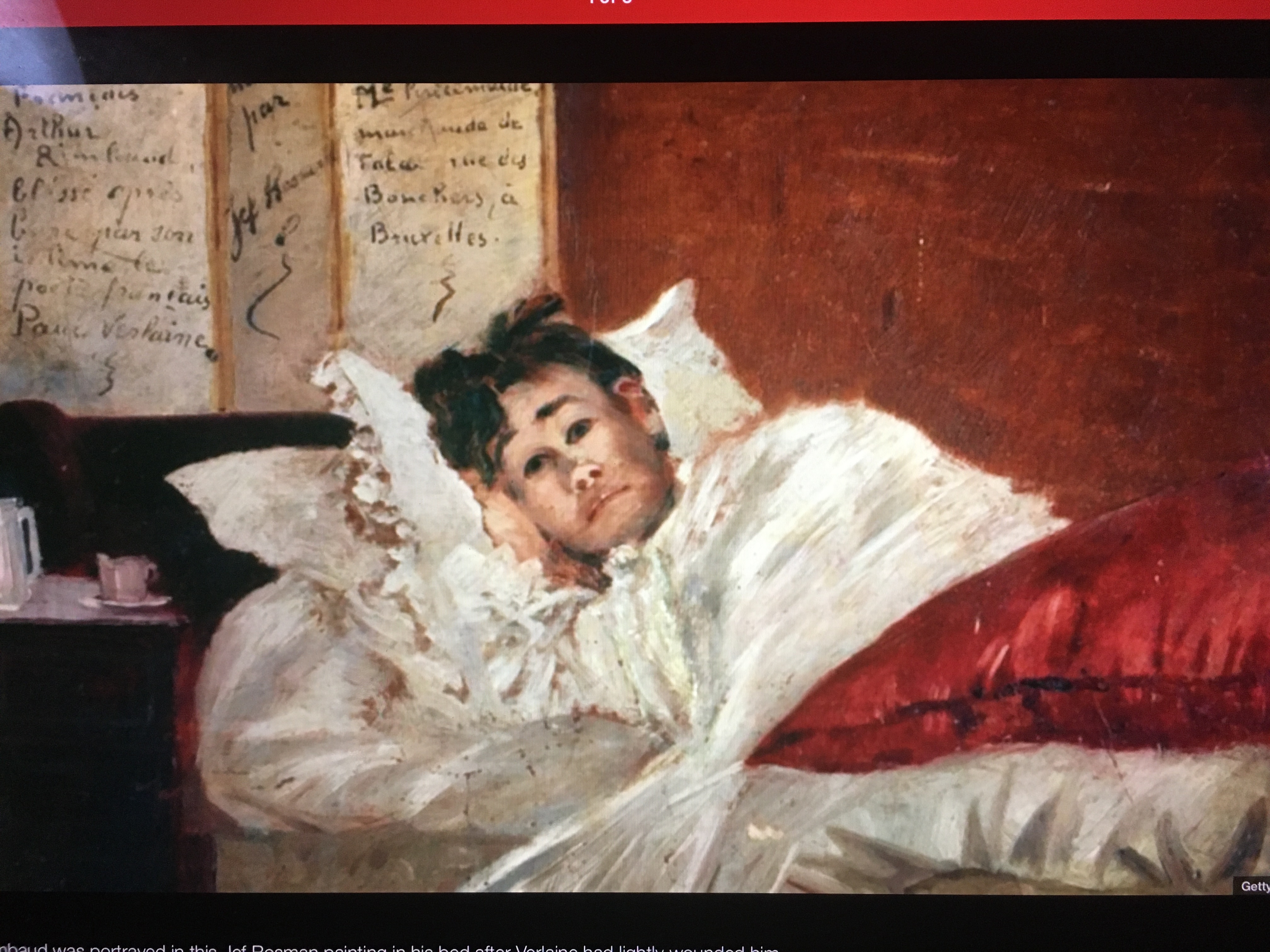
BBC. [Enid Starkie, in her book “Arthur Rimbaud” (1961), says this 1873 portrait of Rimbaud by the minor Belgian painter Jef Rosman, discovered by chance in 1947, is one of only two known likenesses of Rimbaud. The other is in the picture titled “Le Coin de Table” by Henri Fantin Latour (1872).]
Rimbaud is seated second from left. Fantin Latour’s painting exemplifies Van Gogh’s remark on how stilted so many portraits of writers are: men staring into space with papers in front of them.
The seventy-five persons interred in the French Pantheon include Voltaire, Rousseau, Dumas, Hugo and Malraux. None is there for poetry. (Victor Hugo was honored for his political attainments.) There is now a movement afoot to transfer the remains of Arthur Rimbaud and Paul Verlaine from their “unworthy” resting places to the Pantheon.
”Rimbaud and Verlaine: France agonises over digging up gay poets”: The BBC journalist’s vulgar title is misleading.
BBC. Over 120 years after Rimbaud’s death, letters are still sent to this letter box in the cemetery where he is buried.
Gayness is not the bone of contention. The controversy in France is about whether two revered poets who had a gay affair would even want their carcasses re-planted in a “patriotic Valhalla.” Opponents contend that to “pantheonize” Rimbaud and Verlaine would be a co-opting of the two artists by the society they disdained, making a mockery of what they actually stood for.
Everything about their lives, everything about their work shows them turning their back on society,” writer Étienne de Montety said in French newspaper Le Figaro. “They were passionate for liberty, to the point of making transgression an art form.”
Vive la France! The nation refreshes foremost for exalting poets as national treasures, but also for its ability to argue over which honorable distinction these particular two should symbolize: rebelliousness, or diversity of sexual orientation.
(Hugh Schofield, “Rimbaud and Verlaine: France agonises over digging up gay poets,” BBC News, Paris, 9-25-20)
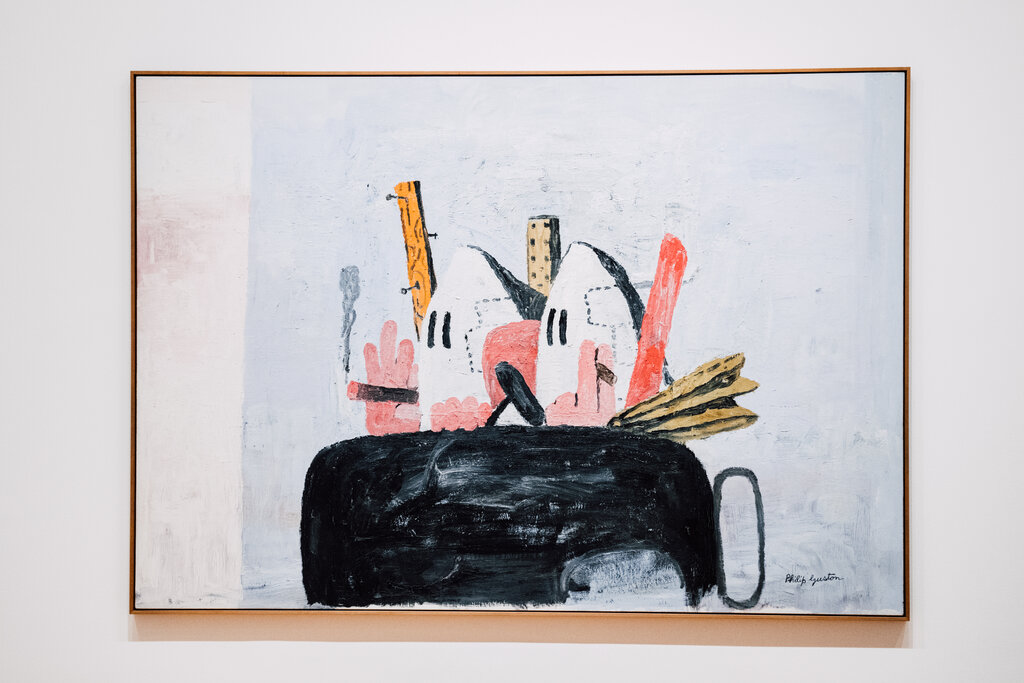
A Philip Guston retrospective has been postponed until 2024. The delay was rooted in concerns about works that show hooded Klansmen. Credit… The Estate of Philip Guston.
This week, the directors of [the National Gallery of Art in Washington, Museum of Fine Arts, Houston, Tate Modern in London, and Museum of Fine Arts, Boston] released a joint statement saying that they were “postponing the exhibition until a time at which we think that the powerful message of social and racial justice that is at the center of Philip Guston’s work can be more clearly interpreted.”
A Philip Guston retrospective has been postponed until 2024. The delay may have been rooted in concerns that trenchant works like “Edge of Town” (1969), which was shown at the Museum of Modern Art, show hooded Klansmen. Credit… Vincent Tullo for The New York Times.
We feel it is necessary to reframe our programming and, in this case, step back, and bring in additional perspectives and voices to shape how we present Guston’s work to our public,” the directors said… “That process will take time.”
(Julia Jacobs and Jason Farago, “Delay of Philip Guston Retrospective Divides the Art World,” NYTimes, 9-25-20) (Julia Jacobs, “Philip Guston Blockbuster Show Postponed by Four Museums,” NYTimes, 9-24-20)
I’m afraid the museums may be oversteering in the laudable cause of acknowledging and helping overcome societal injustices. Philip Guston (born in 1913) painted a different time and place. Should we shun looking at it, including its ugly side, now? Must viewing be mistaken for endorsing? These aren’t necessarily binary questions; however, the directors’ statement that it “will take time” to shape how they present Guston’s work to “their public” rings a bit high-handed.
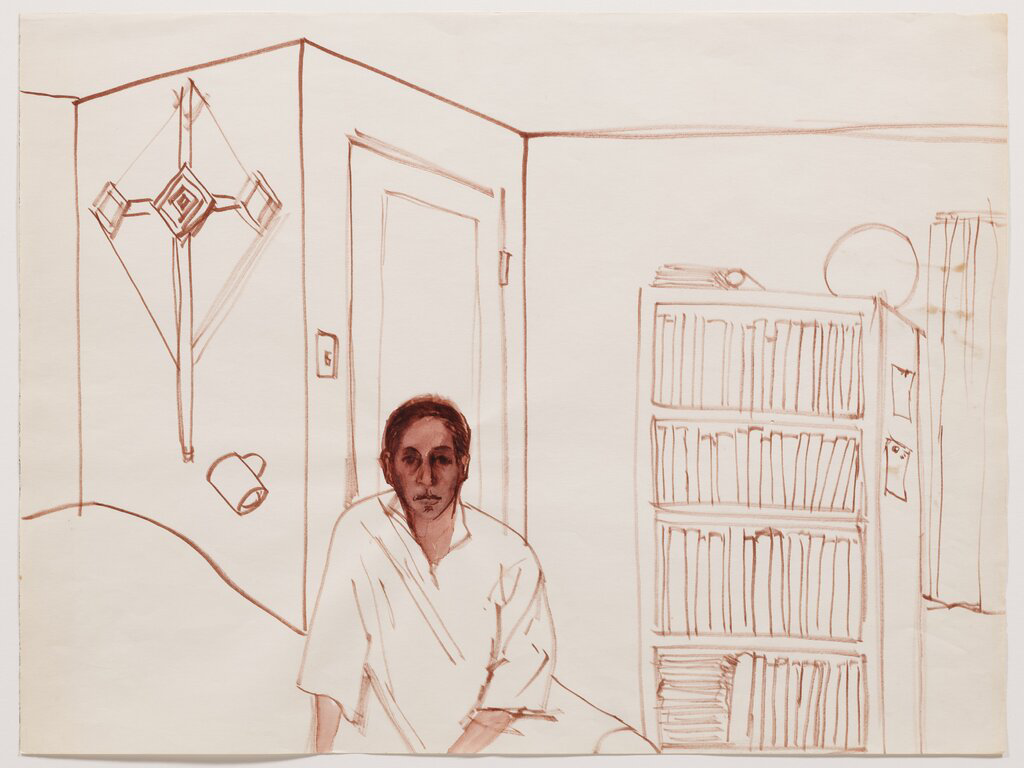
An untitled self-portrait from the 1970s by Luchita Hurtado in the exhibition “Together Forever” at Hauser & Wirth. Credit… Luchita Hurtado and Hauser & Wirth; Thomas Barratt.
Roberta Smith faults Hauser & Wirth for “an exhibition of mostly bland self-portrait drawings showing the artist [Luchita Hurtado] as a simple outline or silhouette… redeemed by too few of her more intense acrylic paintings from the last two years…”
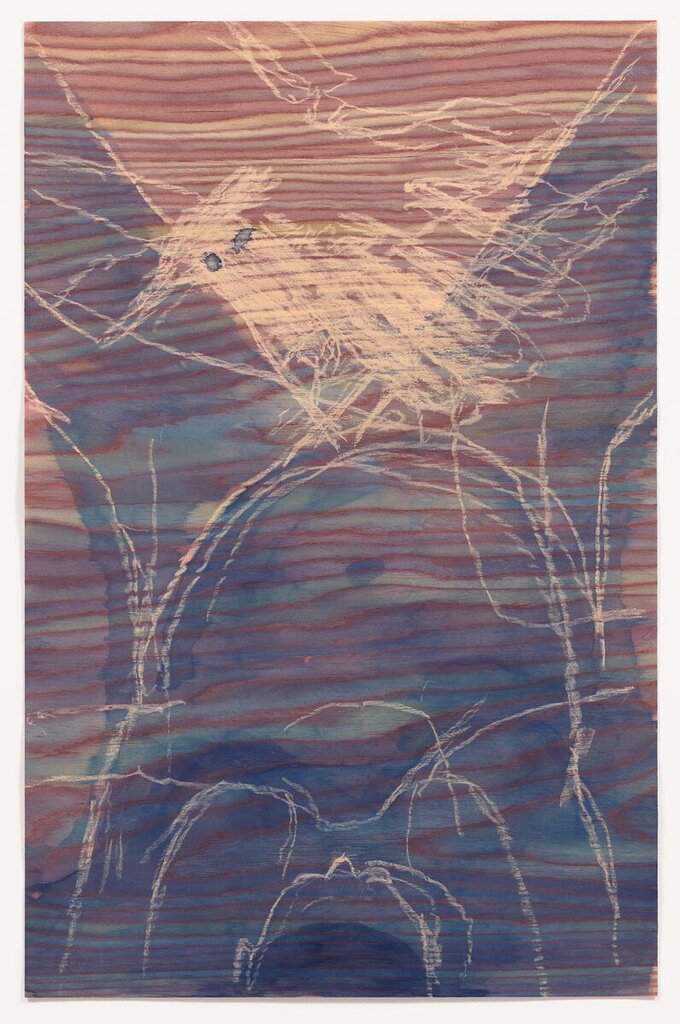
Luchita Hurtado’s “Birth” (2020), ink and crayon on wood. Credit… Luchita Hurtado and Hauser & Wirth; Thomas Barratt.
It is actually two shows, or more accurately, halves of two shows, neither sufficient. For one thing, Hurtado on paper is not always Hurtado at her best. She is a rather remote, cool-handed artist who needs color, canvas and the malleability of paint to shine.
Untitled, 2019, acrylic and ink on canvas. Credit… Luchita Hurtado and Hauser & Wirth; Jeff McLane.
The nine late works that form the show’s smaller second half — most in acrylic and maybe ink on wood, linen or canvas from 2018-2020 — are relatively powerful, even though their adamantine crudeness suggests waning artistic powers.
(Roberta Smith, “Luchita Hurtado: The Elusive Artist Portrays Herself,” NYTimes,
“Birth,” from 2019, acrylic on linen. Credit… Luchita Hurtado and Hauser & Wirth; Jeff McLane.
I’m glad to see more instances of Hurtado’s work. Her death at age 99 was commemorated in the NYTimes (and here) earlier this year. Also, I’m affected by Smith’s comment that Hurtado “needs color, canvas and the malleability of paint to shine.”
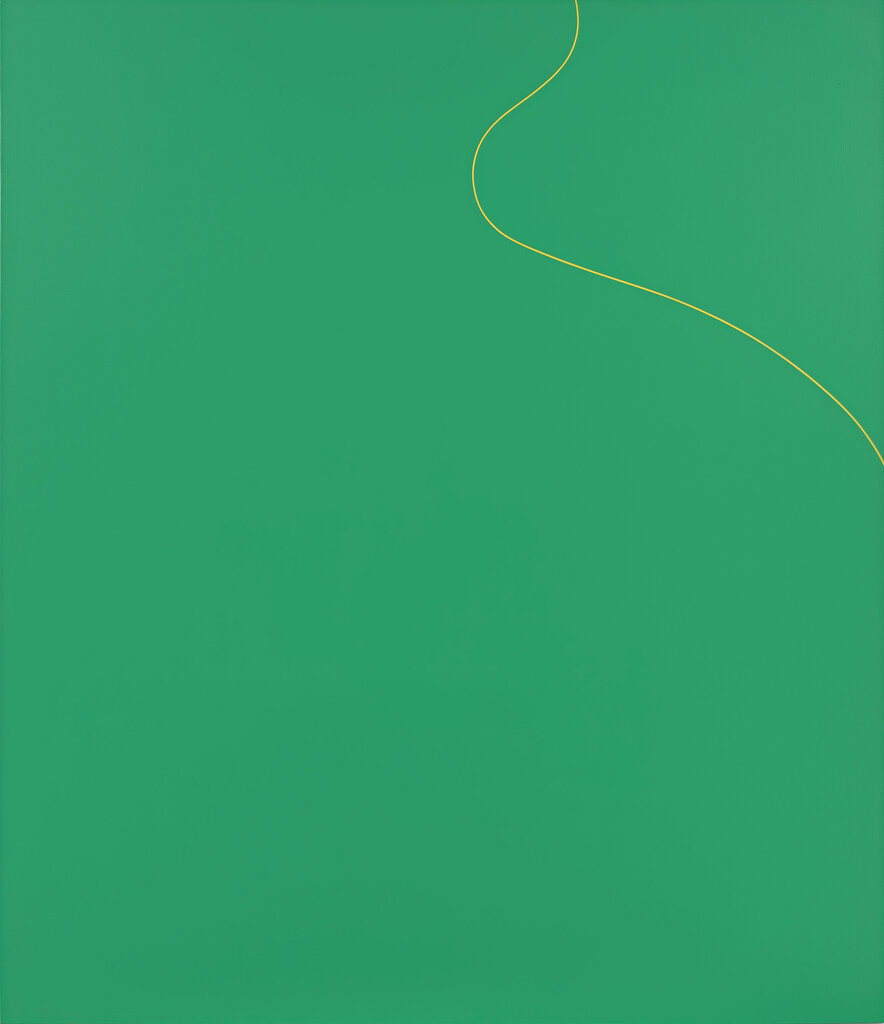
Virginia Jaramillo, “Green Dawn,” 1970, acrylic on canvas. Credit… Virginia Jaramillo and Hales, London and New.
Her art began as an experiment in color blocking, the pairing of contrasting tones, and it got even leaner as she went along. “I just kept simplifying, simplifying,” she said. “I dropped the form and kept the line.”
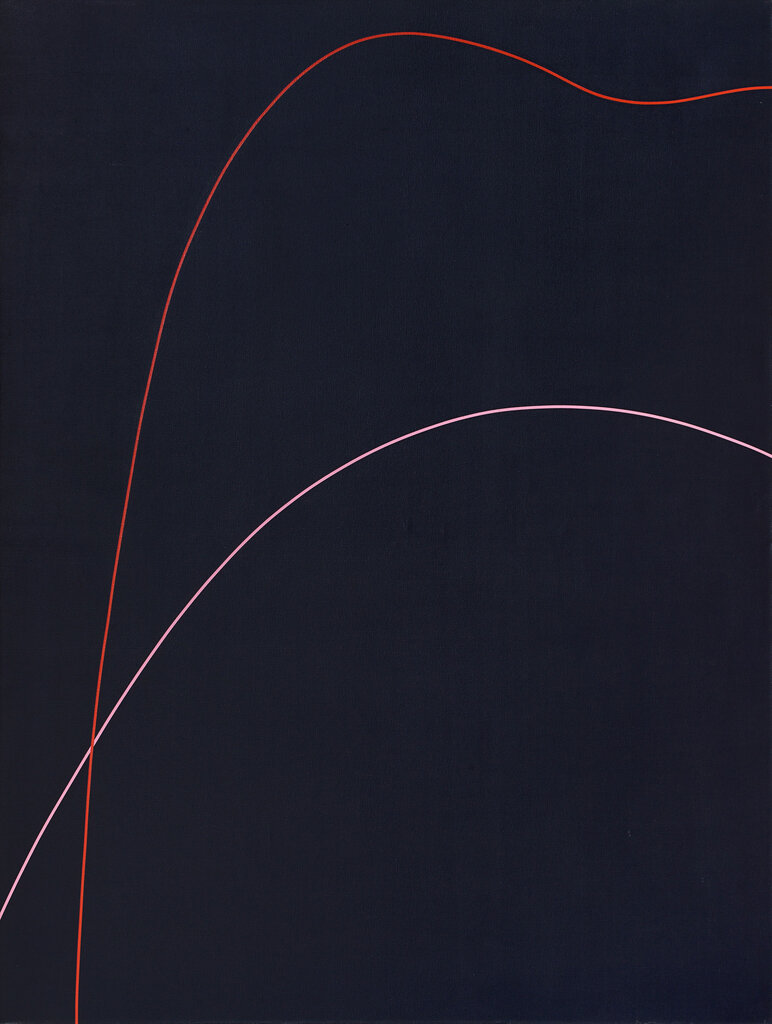
Virginia Jaramillo, “Untitled,” 1971. Credit… Virginia Jaramillo and Hales Gallery, London and New York.
“I’m working on five pieces now which are going to deal with brain waves, and using colors to show calmness, excitement and other activity, but in an abstract way,” she said. “When I hear some kind of scientific theory, I visualize it.”
(Ted Loos, “A Painter Who Puts It All on the Line,” NYTimes, 9-25-20)
Up to your no good — still? — are you, brass neck, hopped up gust, blur, bad vibe, heap of slag piled on top of hope? Make less way for the yacht caste. Put the god-blessed arms down, can tough talk, stuff a bung in the blurt hole that comes words. The folk are not a rant pot, not an up ramp for pricks and scamps of base ilk to scam. Stow it now. Just give it a break full stop.
Bone up on this one fact, Hunk-Ra: Not a be-best look, top-gun move, to sic goon-voys of NRA-gassed SUVs on we the peeps; deck cribs with gilt dreck, scarf down tubs of meat, egg white-might tribes on, hang with canned-tan pervs, cop feels from glam run-way dolls with boss racks; it’s a short putt to mud in that club, hoss.
This show has bombed. What say we vote you off, give a heave ho to the art of the dud, stud? If we don’t ditch this bum deal there’s no way: It’s thoughts and prayers time for the USA.
There’s more to Pauline Harmange, French author of I Hate Men, than met the eye of Ralph Zurmély, the gender equality ministry adviser who sought to prosecute her for incitement of gender-based violence. His ministry said “it appeared [he] had read only the title and the publishers’ description of I Hate Men, [and] had acted on his own initiative.
There’s at least one man whom the author counts as an “exception”: her husband Mathieu, 29.
In the thanks at the end of the book, she writes that he was “the first of us to believe in me”. She said: “He’s as astonished as I am about the reaction to the book, but he supports me and my writing. He just worries about me getting harassed online.”
I regret citing her as “Mlle” Harmange in my “Pen Pricks” post of 9-9-20. Where I live, people might think me a “sensitive” man, persnickety over a tick, and therefore nasty liberal. As a student and observer of writing style, however, I stick to my guns even in Texas.
A stark last name sounds brusque. To impress the francophile in me I titled Ms. Harmange “mademoiselle” without a thought. Was it complacent maleness assuming that a 25-year-old woman exploring the redemptive power of man-hating would not be married? Hard to be sure.
What is sure is that, like Ralph Zurmély, I haven’t read Pauline Harmange’s book — only two Guardian articles about it. But it seems that she expresses her emergent rationale for misandry with admirable sang-froid — I read that as composure and equanimity — as well as Gallic eloquence. Maybe a copy of “I Hate Men” can be spirited over my country’s man wall for me to read with a flashlight under the counterpane.
(Kim Willsher, ‘We should have the right not to like men’: the French writer at centre of literary storm,” 9-9-20)
In certain Victorian novels, female authors paint a bleak picture of limited options available to women lacking means or family status; of a lonely and loveless existence, yet one lacking privacy and subject to uninvited comment; of a life peopled by men who, as love interests or otherwise, are often cruel and domineering.
This species of novel came to mind as I read samples of Tamil poetry written by women in R. Parasarathy’s 2007 essay “Indian Poetry Today” (Poetry, September 2007).
In a scandal-causing poem, Kutty Revathi writes of breasts: “They swell, as if straining / to break free… like two teardrops that survived / an unhappy love.”
The poet Salma was confined in her home from the age of thirteen until her marriage nine years later, at which time she began to write.
This bed is my husband’s weapon: by reminding me of only pregnancies, it strikes terror in my heart. (From No Traces Remain)
I need more exposure to these poets’ work to form an appreciation of it. I had it present, however, in reading about a French essay in The Guardian. The story is a fruit tree sagging with Gallic plums.
Pauline Harmange, 25-year-old activist from Lille, pens an essay titled “I Hate Men.”
Small publisher Monstrograph prints a limited run. Ralph, special adviser to the ministry of gender equality, rises to the bait: the vile “ode to misandry” is criminally prosecutable, an incitement to hatred on the grounds of gender.
Mais non! Mlle Harmange says the pamphlet is really an invitation to rediscover the strength of female relationships; an exploration of anger towards men as an emancipatory path, a way of making room for sisterhood.
“A state official who has a power crisis facing an 80-page book released in 400 copies, I find that very problematic,” she said.
The little book’s editor asserts:
“The title is provocative but the purpose measured. It is an invitation not to force oneself to associate with men or to deal with them.“
So much inviting, so little hating! The book’s sales have soared on the controversy. A larger publisher is set to take the title on. Mlle Harmange counts it a “gigantic snub” to the man who wanted to ban her words.
I wish her well. The “I Hate Men” project appears to be enjoying a boost from Ralph’s pique. In her shoes I would include the man in the book’s credits.
(Alison Flood, “French book I Hate Men sees sales boom after government adviser calls for ban,” theguardian.com, 9-8-20)







 EthicalDative
A Hopper Reveal
It’s interesting to see instances of a teenage Edward Hopper’s copying of other artists, the more so as it touches on the reputation he cultivated “as an artist whose innate genius allowed him to emerge on the scene without a debt to others.”
I’m not a critic or scholar, but I share their intrigue that, in his mature work, Hopper “allowed himself” to be awkward in a studied way.
Critics and scholars have always been intrigued by an awkwardness that Hopper allowed himself in many of his classic paintings…
… seas that look more painted than liquid in his famous “Ground Swell”…
… the awkward anatomy of his female nude in “Morning in a City”…
… or the stony faces of the diners in “Nighthawks.”
A third point of interest for me in this article is Hopper’s perceived affinity with illustration.
In rendering his pioneering views of everyday life in average America… Hopper chose an everyday style that brings him closer to the modest commercial illustration of his era than to the certified old masters.
Gopnik caps his treatment of the Hopper copy revelation with something I marvel at in creative art critics: propositions that soar, like poetry, above interpretation.
Now that we know that Hopper was never a painting prodigy, we can think of his later paintings as deliberately revisiting the limitations of his adolescence, and finding virtue and power there… It’s as though, to be truly in and of their time and place, and fully “American,” paintings of a city’s simple shopfronts, or of plain women in plain rooms, had to be rendered in a plain manner worthy of their subjects, or as unworthy as them.
(Blake Gopnik, “Early Works by Edward Hopper Found to Be Copies of Other Artists,” NYTimes, 9-28-20)
(c) 2020 JMN