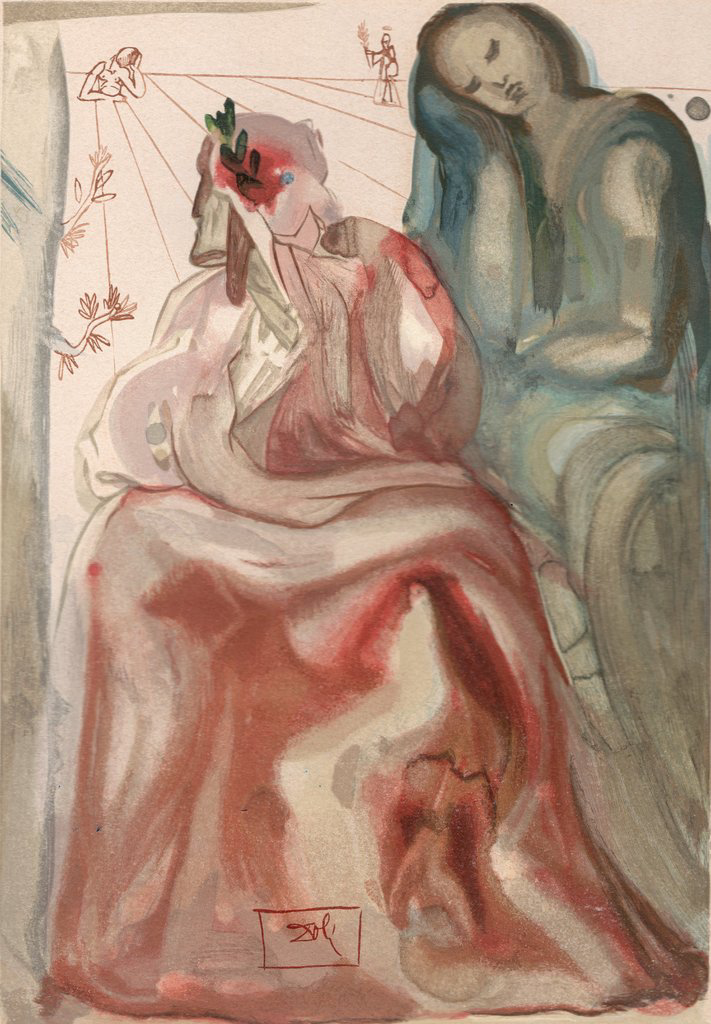
A wood block print based on a piece painted by the artist Salvador Dalí was discovered at a thrift shop in Kitty Hawk, N.C. Credit…via Seaside Art Gallery.
When Dalí, who died in 1989, finished the project [illustrating the “Divine Comedy”], he had completed 100 watercolors for the poem’s 14,233 lines: 34 illustrating Inferno, 33 illustrating Purgatory and 33 illustrating Paradise.
Then, over several years, artisans carved 3,500 wood blocks to make prints of the original watercolor illustrations for the book, which was published in the early 1960s. Some of those prints required up to 37 individual blocks to impress each of its colors of ink, one at a time.
(Christine Hauser, “Is That a Dalí Among the Tchotchkes?” NYTimes, 3-13-20)
Boris Johnson speaking to the BBC’s political editor Laura Kuenssberg:
“We didn’t understand (the virus) in the way that we would have liked in the first few weeks and months… The single thing that we didn’t see at the beginning was the extent to which it was being transmitted asymptomatically from person to person… I think it’s fair to say that there are things that we need to learn about how we handled it in the early stages… Maybe there were things we could have done differently and of course there will be time to understand what exactly we could have done, or done differently.” [My bolding]
(BBC online, 7-24-20)
Of course there will be time — the dead, especially, have plenty of it on their hands.
Tentative, highly cushioned, wordsmithed to a fault and grudgingly concessive, nevertheless it’s a beginning at approaching a start to a semblance of accountable candor from a putative leader in this hemisphere.
“The time frame from when you get a test to the time you get the results back is sometimes measured in a few days,” [Dr. Anthony] Fauci said Tuesday.
“If that’s the case, it kind of negates the purpose of the contract [sic] tracing because if you don’t know if that person gets the results back at a period of time that’s reasonable, 24 hours, 48 hours at the most … that kind of really mitigates against getting a good tracing and a good isolation.” [All bolding is mine]
(Christina Maxouris and Holly Yan, “1000 died of Covid-19 in 1 day. Now the US is on track to hit 1 million new cases in 2 weeks,” CNN, 7-22-10)
Flabby rhetoric kind of really mitigates against cogent messaging. In a healthier country, when you expound the fallacy of what was fallacious, to use John Stuart Mill’s phrase, you don’t beat around the screaming bush.
It would do America kind of good if the embattled Dr. Fauci, justly touted as our leading infectious disease expert, were granted immunity to lose the frog in his throat.
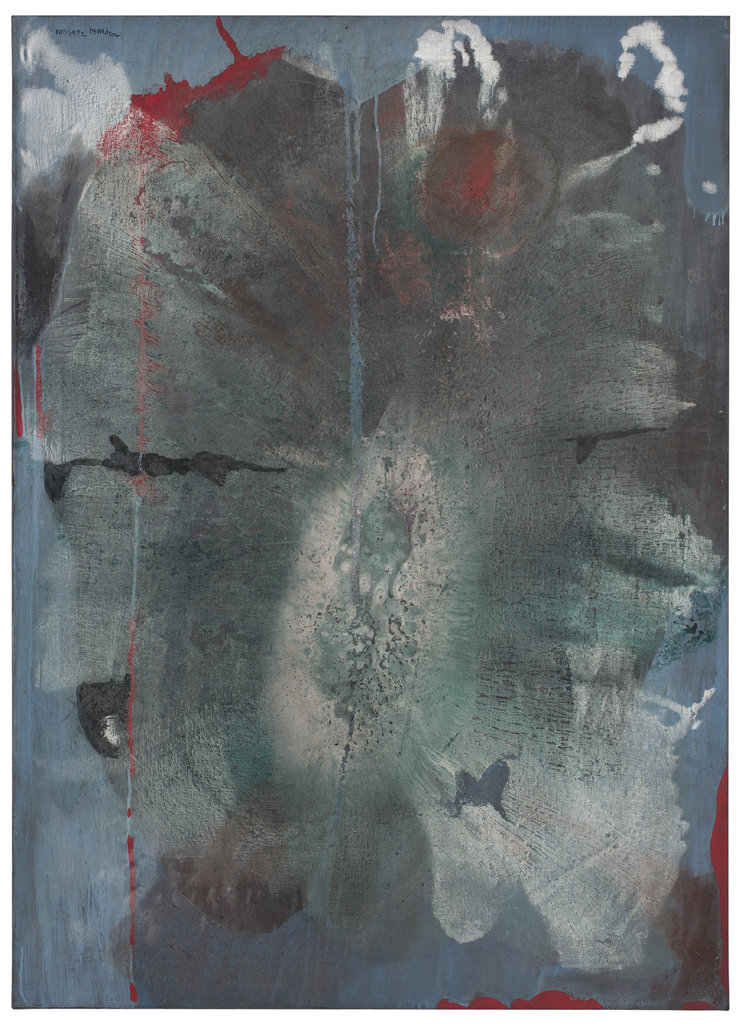
Romare Bearden’s “Wine Star,” from 1959, on view (and online) at DC Moore Gallery.Credit… Romare Bearden Foundation; via DC Moore Gallery.
Bearden (1911-88) is best known for his indelible figurative collage depictions of African-American life in all its quotidian richness, strength and struggle… Bearden’s far more obscure abstractions… have tended to be given short shrift in his biographies and retrospectives…
“Green Torches Welcome New Ghosts” (1961), “a field of pale green with faint intimations of a procession of beings of some sort,” our critic says. Credit… Romare Bearden Foundation;, via DC Moore Gallery.
While most stain painting technique in the 1950s and early ’60s derived from Helen Frankenthaler’s innovative “Mountains and Sea,” of 1952, Bearden developed his approach on his own… studying informally with a calligrapher he knew only as Mr. Wu, who had a bookshop on Bayard Street. Mr. Wu showed Bearden the often more delicate techniques of Chinese ink painting which Bearden soon adapted to oil paint by thinning it with turpentine (which all stain painters did). This way of working provided a new ease by bringing Bearden, who had never liked the thickness of oil paint, close to one of his favorite mediums, watercolor.
(Roberta Smith, “Romare Bearden’s Rarely Seen Abstract Side,” NYTimes, 3-?-20)
A story in one of his mother’s Vogue magazines, featuring models posed in front of a painterly Franz Kline-esque Abstract Expressionist backdrop, provided him with an early clue that art wasn’t only about figuration. At Phillips Academy in Andover, Mass., in the early ’50s, when European abstraction was a prevailing force in studio art, Stella was especially influenced by the work of Hans Hofmann, a kind of proto-Abstract Expressionist from the ’40s, and the Bauhaus color theorist Josef Albers. “I had no mimetic ability,” Stella tells me, “but I was never interested in finding one, or cultivating one. No, I worked directly with the materials, actually. The big deal in postwar American painting was ‘its materiality,’ and so that was heaven for me.”
(Megan O’Grady, “The Constellation of Frank Stella,” NYTimes, 3-18-20)
For me as an amateur painter the scariest prospect on the square feet of earth in front of my easel is to grope past mimesis and “work directly with the materials” as Stella puts it. That jump-off hovers just beyond my slogging daubs like the mirage where hot asphalt meets horizon on the highway between Balmorhea and Pecos.
William James, right, with his brother Henry James. Disavowing their Irish roots would be no easy thing. Credit…Bettmann Archive/Getty Images.
William James arrived penniless in Albany, NY from County Cavan, Ireland in the late 18th century. Over the next 30 years he created a fortune second only to that of the Astor family. His grandsons, novelist Henry and philosopher William, forcefully repudiated their mercantile Irish roots. William wrote to H.G. Wells:
“The moral flabbiness born of the exclusive worship of the bitch-goddess SUCCESS. That — with the squalid cash interpretation put on the word ‘success’ — is our national disease.”
Disavowing their Irishness would not be easy for the brothers, however. Henry crowed that his paternal grandmother, Catherine Barber, was purely English. “She represented… for us in our generation the only English blood — that of both her own parents — flowing in our veins.” He conveniently omitted that John Barber, Catherine’s father, came from Longford County, Ireland.
Henry James remained classist and anti-Irish. William, however, seemed to evolve.
In his Ingersoll Lectures… [William] James scolded his xenophobic audience, insisting that “each of these grotesque and even repulsive aliens is animated by an inner joy of living as hot or hotter than that which you feel beating in your private breast.”
The perception of immigrants as “grotesque and even repulsive aliens” is an ember in America’s private breast that malignant votaries of the bitch-goddess still blow on.
There are at least two types of moral “blindness” — the inability to see the inner lives of individuals unlike ourselves, and also the unwillingness to recognize those aspects of ourselves that quietly underwrite our histories. It is difficult but essential to remember that at one point in the not so distant past we were all trespassers and foreigners.
(John Kaag, “William James’s Varieties of Irish Experience,” NYTimes, 3-16-20)
The Columbia University campus in Manhattan. Credit… Hiroko Masuike/The New York Times.
Of the opinion writers I read regularly in the NYTimes, the one who uses the term “meritocracy” most by far, and with pronounced ambivalence, is Ross Douthat — himself a confessed meritocrat (Hamden Hall Country Day School, magna cum laude Harvard University 2002, Phi Beta Kappa).
And wouldn’t it be especially appealing if — and here I’m afraid I’m going to be very cynical — in the course of relaxing the demands of whiteness you could, just coincidentally, make your own family’s position a little bit more secure?… Not that anyone is consciously thinking like this. What I’m describing is a subtle and subconscious current, deep down in the progressive stream. [my bolding]
Douthat’s leap of intuition at describing “a subtle and subconscious current, deep down in the progressive stream” sounds almost extrasensory. He’s too canny a thinker, however, not to postposition a discrete “maybe” to his insight.
But deep currents can run strong. And if the avowed intention of the moment is to challenge “white fragility” and yet lots of white people seem strangely enthusiastic about the challenge, it’s worth considering that maybe a different kind of fragility is in play: The stress and unhappiness felt by meritocracy’s strivers, who may be open to a revolution that seems to promise more stability and less exhaustion, and asks them only to denounce the “whiteness” of a system that’s made even its most successful participants feel fragile and existentially depressed.
(Ross Douthat, “The Real White Fragility,” NYTimes, 7-18-20)
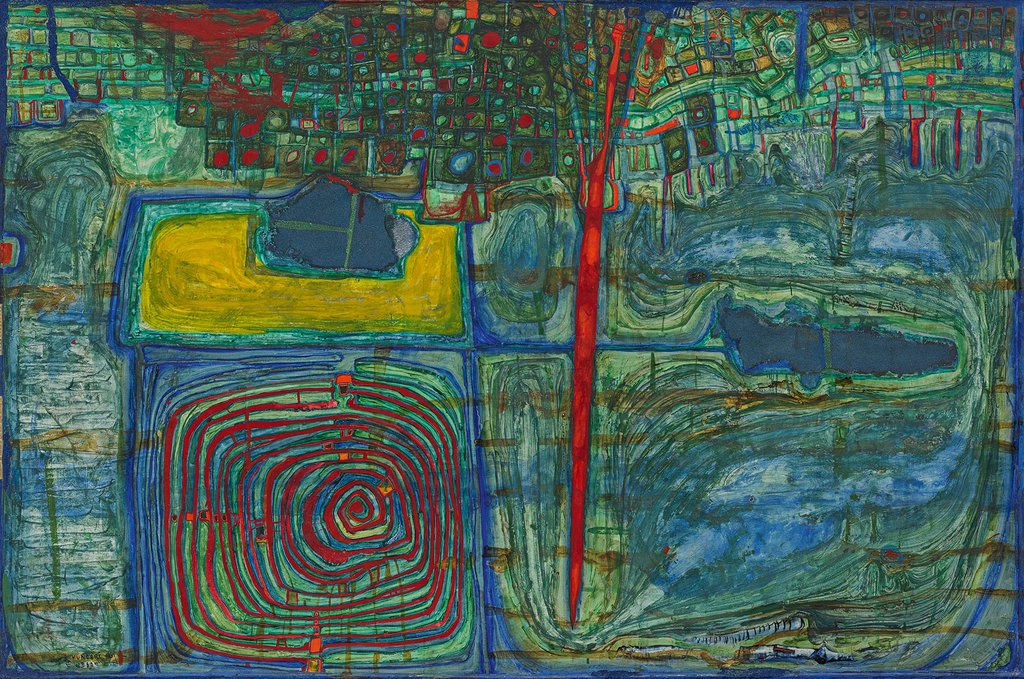
“Sun for Those Who Weep in the Country,” by Friedensriech Hundertwasser. The new Albertina Modern has a room dedicated to Hundertwasser’s work. Credit…NAMIDA AG, Glarus/Schweiz; The ESSL Collection.
I’m fond of the colorful, map-like painting by the Austrian Hundertwasser. Also, of the sun figure that recurs in his work.
Left, to right: Hundertwasser’s “City Seen From Beyond the Sun” (1955); “The Light Weight,” a sculpture by Oswald Oberhuber; and “Untitled” (1953-4) by Arnulf Rainer, in the Albertina Modern. Credit… David Payr for The New York Times.
“These artists have something in common: They all turned against the ideals of the Third Reich… I’m doing a kind of exorcism… Exactly here, where ‘degenerate art’ was shown, I’m showing artists who after 1945 declared war on the degeneracy of war.” (Klaus Albrecht Schröder, the Albertina’s general director)
(Kimberly Bradley, “A Big Idea and a Big Donor Bring a New Art Museum to Austria,” NYTimes, 3-11-20)
It’s hard to reach image and reference through muddy syntax. In narrative and exposition, context comes to the rescue; in poetry often not, because a poet revels in flare-gunning lap dance moon rocks nose hair close to congeries of quandary spelunkers.
Nothing is always obscure. Poetry-speak can be so unconditioned, stark and abrupt that it’s a syntaxing decoy duck which is a real duck hiding in plain sight.
The poem is “Sacrament I” by Robin Gow (Poetry, March 2020).
& all the faucets pour oil or milk. We fill father’s bottles, the brown and green; thick glass blood cells, a throat-slit pouring silk. When will the baptisms make me feel clean?
Is there a slit in a throat? And the slit is pouring silk? The hyphen makes it look descriptive, though, which begs for a described thing to follow: Has to be “silk.” Is it silk engaged in pouring, and the throat of that silk is slit? (Table for now the question of does it matter.)
We dig holes in the yard. They fill with mud. I go, I drop in all the shiny things, the necklaces clit-plucked, pink flower bud, my hole — amuck mess: gargling glint rings.
Little contest here syntax-wise. I resolve “glint rings” into “rings that sparkle,” left to admire the jolt delivered when drab enunciation — We dig.. they fill… I go, I drop… — leads to the creepy hole gargling gewgaws sourced from… clit-piercings? And that single pink “bud” bobbing in apposition!
Our dish soap is blue & so is mary. She’s plastic bottle, she’s soil bubble. It’s baby bath, she rubs me black cherry. We go digging for the pit, pair knuckle.
I can’t get close to lowercase mary’s “soil bubble,” but the quatrain sails past in toddler-patter voice like a toy boat in a bath tub. “Pair knuckle” neatly shoots the gap between “pair socks” and “bare knuckle.” The near-rhyme with “bubble” tickles me black cherry.
& so I repeat each morning again. Stain skin, sugary with original sin.
The ending couplet is a marvel: a dozen words stripped to the bone — including the sly “repeat… again” quasi-solecism stopped with a crucial period. What exactly is repeated (again)? Literally, “each morning.” A follow-on act, implied repetitive and itself clarified with a comma, is the staining — not of sugary skin — but of skin (his-her own? others’?) by one who is “sugary” — a devilishly inspired descriptor! — with the innate state of badness visited upon Christian humans by the insubordination episode in Eden.
Interrogations of syntax go only so far. This adroit sonnet with its clashing symbols and skillful management of tone appears to me to be a working through of trans-spiritual burden or trauma which chooses not to speak its name.
Texas City. The American Hydrological Sodality’s southeast chapter is circulating a white paper, “Petulant Sociopathy Limitations for Drainage Management in Elevated Swamp-Tick Infestation Ecologies,” for peer review pending September publication in the journal Waterworks.
The paper’s authors, Thom Smythe and Niamh Nighey, co-wrote the recent book “Flush! It Runs Downhill,” and will be guests on the Bull’s podcast this week. Don’t miss it!








 EthicalDative
Memo to U.S. — Sort of How to Speak English
Boris Johnson speaking to the BBC’s political editor Laura Kuenssberg:
“We didn’t understand (the virus) in the way that we would have liked in the first few weeks and months… The single thing that we didn’t see at the beginning was the extent to which it was being transmitted asymptomatically from person to person… I think it’s fair to say that there are things that we need to learn about how we handled it in the early stages… Maybe there were things we could have done differently and of course there will be time to understand what exactly we could have done, or done differently.” [My bolding]
(BBC online, 7-24-20)
Of course there will be time — the dead, especially, have plenty of it on their hands.
Tentative, highly cushioned, wordsmithed to a fault and grudgingly concessive, nevertheless it’s a beginning at approaching a start to a semblance of accountable candor from a putative leader in this hemisphere.
(c) 2020 JMN