Texas City. The American Hydrological Sodality’s southeast chapter is circulating a white paper, “Petulant Sociopathy Limitations for Drainage Management in Elevated Swamp-Tick Infestation Ecologies,” for peer review pending September publication in the journal Waterworks.
The paper’s authors, Thom Smythe and Niamh Nighey, co-wrote the recent book “Flush! It Runs Downhill,” and will be guests on the Bull’s podcast this week. Don’t miss it!
Professor Steven Pinker, in his office in Cambridge, Mass., in 2018. He has been accused of racial insensitivity by people he describes as “speech police.” Credit… Kayana Szymczak for The New York Times.
Half a thousand academics want Steven Pinker dropped from the list of “distinguished fellows” of the Linguistic Society of America for allegedly minimizing racial and sexist injustices.
Because this is a fight involving linguists, it features some expected elements: intense arguments about imprecise wording and sly intellectual put-downs. Professor Pinker may have inflamed matters when he suggested in response to the letter that its signers lacked stature. “I recognize only one name among the signatories,’’ he tweeted. That, said Byron T. Ahn, a linguistics professor at Princeton replied in a tweet of his own, amounted to “a kind of indirect ad hominem attack.”
(Michael Powell, “How a Famous Harvard Professor Became a Target Over His Tweets,” NYTimes, 7-15-20)
The consensus of testimony in the article is that Professor Pinker’s tenure, stature and good hair will see him through the kerfuffle. But avoid fights with linguists if you can. You may fall prey to “a kind of indirect ad hominem attack” — or worse, called out for imprecise wording.
Agnes Pelton’s “Orbits” (1934), at the Whitney Museum of American Art… Credit… Oakland Museum of California.
A few years ago, I interrupted a panel discussion at the Guggenheim as it moved toward the dead-horse question of whether painting was still viable. How, I asked, uninvited, from the audience, could people talk of the end of painting when so many women were just beginning to paint? With hindsight I should have added that we were also still learning about the female painters of the past whose newly recovered works could very well influence the medium. History had in a sense not yet happened to their achievements.
Agnes Pelton’s “Star Gazer” (1929)… Credit…via Whitney Museum of American Art.
Pelton and O’Keeffe, who was six years younger, had a surprising amount in common: Both studied with Arthur Wesley Dow (Pelton at the Pratt Institute; O’Keeffe at Columbia), who encouraged their interest in landscape non-Western art and thought. Both were affected by Kandinsky’s treatise “On the Spiritual in Art” and both were invited to visit Taos and Santa Fe by the saloniste and patron Mabel Dodge Luhan. (Pelton went first in 1919, for four months.) Each was profoundly changed by the desert, finding it to be her natural habitat.
(Roberta Smith, “‘Agnes of the Desert’ Joins Modernism’s Pantheon,” NYTimes, 3-12-20)
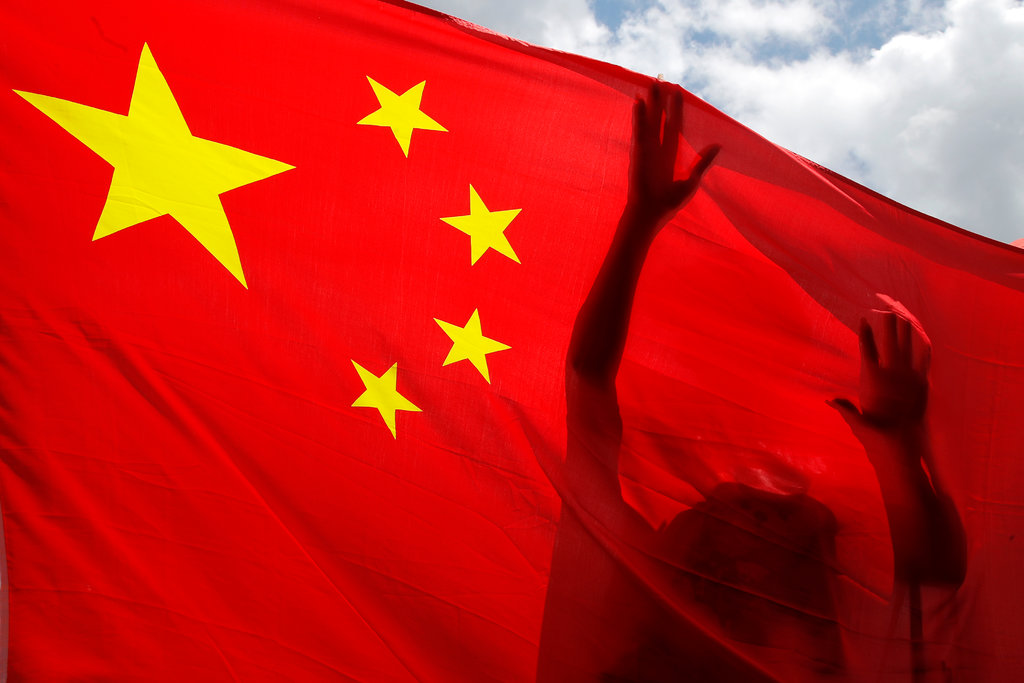
A pro-Chinese rally in Hong Kong in June. Credit… Kin Cheung/Associated Press.
But there was one small difficulty: This hawk was no Truman or Reagan, but rather a reality-television mountebank whose real attitude toward China policy was, basically, whatever gets me re-elected works.
Who has heard recently, or ever, the word “mountebank”? Ross Douthat uses it twice, and it’s not just a literate belch, it’s an exquisite choice for his context, stemming from 16th-century Italian “monta in banco!” — climb on the bench! — alluding to the tactic of attention-seeking charlatans.
… The odds of success [for Chinese goals] look better now than in the further future… But if we find a way to contain China for a decade, the Chinese century could be permanently postponed.
“Permanently postponed” is deft license, as apt for nuance and context as “further future.” Well played, Douthat. You have lofted me to a concluding ending:
We are ghosted by many tomorrows permanently postponed; it’s always just further now. The future is like a particle of cosmo-physics that can only be observed by where it was, not where it is. Or like my childhood fancy that there was a face watching me from the corner, and it hid from me as soon as I looked there.
(Ross Douthat, “The Chinese Decade,” NYTimes, 7-11-20)
Proposed Symbol: The Amperspace. Poets write an ampersand to abbreviate the last three letters of “ampersand.” That symbol compresses the conjunctive blast radius of those letters. The amperspace abbreviates the space that follows itself. Amperspacing in the hands of a good poet will buttress the juiced conjoining fostered by ampersanding. Written superscript like the dagger alif, the amperspace is pronounced the same as an unstressed syllable. (JMN)
The poem is “Sacrament I” by Robin Gow (Poetry, March 2020).
Excerpt, first stanza:
& all the faucets pour oil or milk. We fill father’s bottles, the brown and green; thick glass blood cells, a throat-slit pouring silk. When will the baptisms make me feel clean?
When a poet tenured in creative writing at Adelphi leads with an ampersanded sentence fragment, I suspect I’m in the middle of something; at the same time it shunts me somewhere else.
I heard Robert Creeley and Gregory Corso give a reading in Chapel Hill. It felt like discovering modern poetry. Corso’s pee-stained underwear made an appearance in one of his poems, and both men pulled steadily at a jug of Gallo Hearty Burgundy sitting between them on stage. The event was outrageous and enthralling.
A similar moment was when ampersanding poetry got my attention. It screamed “modern.” I knew I was supposed to say “and” each time I passed the old abbreviated Latin copulative tiddle, but I fell into the perverse habit of saying “ampersand” instead.
I read the first line of this poem as: “ampersand all the faucets pour oil or milk.” It has a ring of its own.
Paraphrasing a famous painter: What you read is what you read. And a tenet of drawing: Read what you see, not what you think you see. The goddamned ampersand points me in the same direction: Don’t try to stretch the poem’s words and symbols beyond themselves; let them sail free of their common cargo and mapped routes.
I’ve read several rationales behind ampersanding. One that moves the needle for me urges experiencing the poem as a made object. Something you look at more than construe? A cunning box made with words? Whatever it means, this mindset comports with my attraction to free jazz, which also drives me to abstraction. I’m striving to allow the language analog of such music to infiltrate me; to collude, not collide; to grow my proprioception in poetry space.
There’s more to write myself about Robin Gow’s poem, but not now; this jot would go too long. The ampersand deflected me from my original theme: What makes poetry ‘hard’? It almost always does.
Excerpts are from the poem “A Future History” by Suzi L. Garcia (Poetry, March 2020).
A muster of peacocks show off their tails, but instead of feathers, knives.
This line introduces me to “muster,” a collective noun applied to peacocks. It treats “muster” as plural: “a muster… show off their tails.” Going the American way by treating the collective as singular leads to “A muster of peacocks shows off its tails.” It has by-the-book rigor, but is slightly odd, suggesting a singular creature called a “muster of peacocks” (like “master of ceremonies”) that has multiple tails.
An enemy feints indifference and keeps their distance, places me on a fool’s throne. They underestimate me —
This line takes number fluidity further. A possible collective noun, “enemy,” is treated as singular (“feints,” “keeps,” “places”) and plural (“their”) in the same breath, then morphs full-on plural in the next sentence: “They underestimate.”
Number fluidity embraces gender fluidity under the covers here. Applying a consistent protocol to the collective noun could have two possible outcomes:
(1) “An enemy feints indifference and keeps (his/her/its) distance, places me on a fool’s throne. (He/She/It) underestimates me…”
(2) “An enemy feint indifference and keep their distance, place me on a fool’s throne. They underestimate me…”
The poem speaks by ear, not by book, and neither outcome is what it chose because stark clarity is not what it wants. The speaker wants to skirt the genderizing of his or her enemy, and fudging grammatical number is the expedient. Gender elision is the mother of number fluidity.
That leaves “feints” trying to be transitive in “feints indifference.” In my view this bit of rogue usage squanders license for questionable gain.
When noun “feint” moonlights as a verb it’s intransitive, meaning you don’t feint something (such as “indifference”), only somehow (such as “cunningly”). The case for going fluid here eludes me, and I long for “feigns indifference.” Even in a quarterback feint, the decoy move is “faked,” not “feinted.” And sonically, where poetry has much of its being, “feints” and “feigns” are almost joined at the hip.
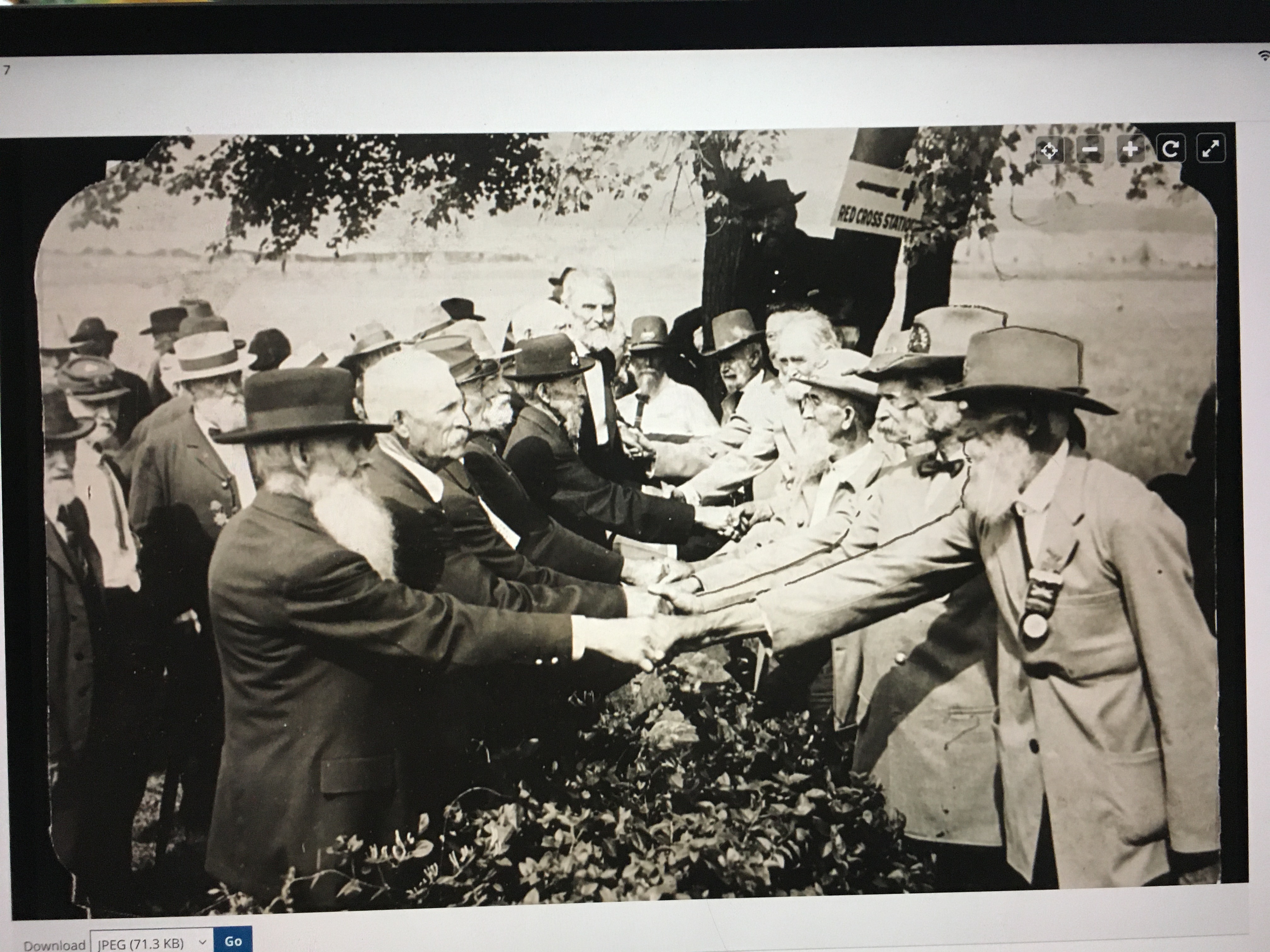
1913, Liljenquist Family collection, Library of Congress. Illustrates the NYTimes article.
This photo captures a moment when a ritual handshake marked a pause in our Civil War.
The Virginia Monument… marks the departure point of Pickett’s Charge, an ill-fated assault launched 157 years ago on July 3 on the final afternoon of that three-day battle. The monument, which depicts a mounted Robert E. Lee on a pedestal surrounded by seven Confederate soldiers, was started in 1913 to coincide with the 50th anniversary of the battle… On the afternoon of that July 3,… old Northern and Southern soldiers gathered at a low stone wall called the “Bloody Angle,” where Pickett lost 3,000 men. The soldiers shook hands across the wall…
Ackerman, author of this piece, is a veteran of combat service in Iraq. His conclusion seems to me to imply a useful distinction between history and hagiography.
A Confederate monument removal process that respects graveyards and battlefields and acknowledges them as monuments to the dead to be visited by the living, is the quickest way to eradicate painful Confederate symbolism from our public spaces and reconcile the country.
(Elliot Ackerman, “The Confederate Monuments We Shouldn’t Tear Down,” NYTimes, 6-7-20)
Mr. Anaya’s novel “Bless Me, Ultima,” published in 1972, was banned in many school districts for its profanity and what critics saw as an anti-Catholic message. The censorship efforts boosted both the book’s sales and Mr. Anaya’s reputation.
“Bless Me, Ultima” repeatedly drew the ire of censors, who cited what they viewed as foul language and anti-Catholic messaging… The book was banned in California, Colorado and… New Mexico. In 1981, the school board in Bloomfield, N.M., burned copies of “Bless Me, Ultima,” according to a news report in The Albuquerque Journal… In 2012, the state of Arizona forced teachers in Tucson to ban the book and dismantle Mexican-American studies programs, part of a nativist push to curb immigration and limit the influence of Latinos….
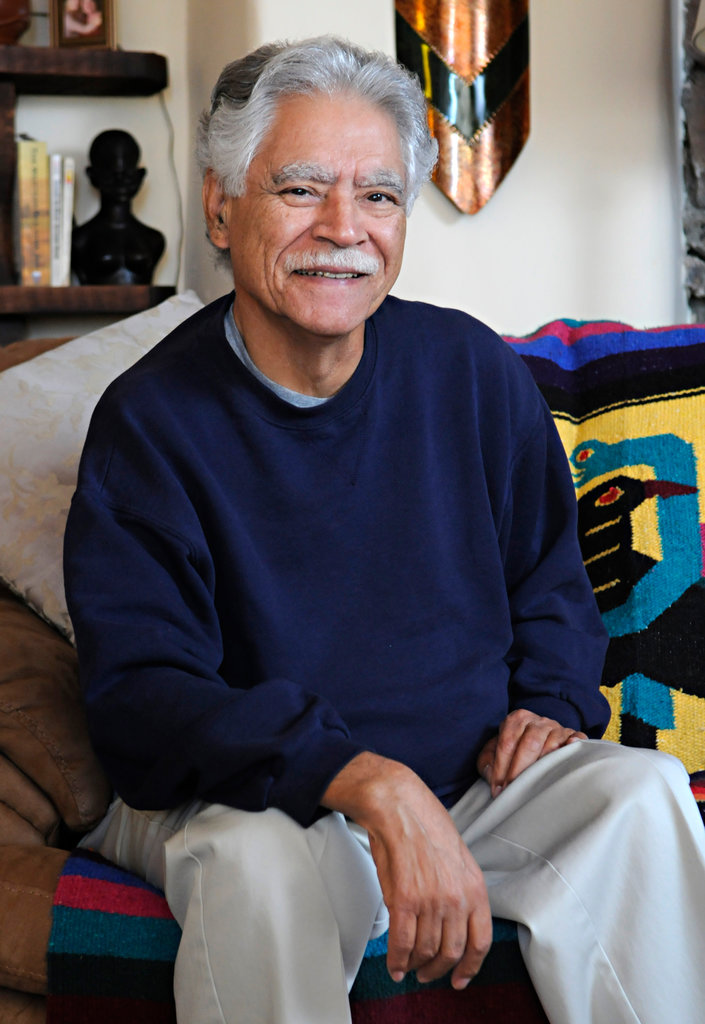
The author Rudolfo Anaya at his home in Albuquerque in 2011. He was a leading figure in the literary movement forged by Chicanos in the 1970s. Credit… Morgan Petroski/The Albuquerque Journal, via Associated Press.
… “Bless Me, Ultima” endured as Mr. Anaya’s best-known book, adapted into a play, an opera and a 2013 feature film… Mr. Anaya followed “Bless Me, Ultima” with “Heart of Aztlán” (1976) and “Tortuga” (1979), completing a trilogy about Chicano identity and empowerment.
He also wrote a mystery series featuring the Chicano detective Sonny Baca; children’s books including “Farolitos for Abuelo” (1998); travel chronicles like “A Chicano in China” (1986); and story collections including “The Silence of the Llano” (1982).
(Simon Romero, “Rudolfo Anaya, a Father of Chicano Literature, Dies at 82,” NYTimes, 7-3-20)







 EthicalDative
How It Gets Ugly
Half a thousand academics want Steven Pinker dropped from the list of “distinguished fellows” of the Linguistic Society of America for allegedly minimizing racial and sexist injustices.
Because this is a fight involving linguists, it features some expected elements: intense arguments about imprecise wording and sly intellectual put-downs. Professor Pinker may have inflamed matters when he suggested in response to the letter that its signers lacked stature. “I recognize only one name among the signatories,’’ he tweeted. That, said Byron T. Ahn, a linguistics professor at Princeton replied in a tweet of his own, amounted to “a kind of indirect ad hominem attack.”
(Michael Powell, “How a Famous Harvard Professor Became a Target Over His Tweets,” NYTimes, 7-15-20)
The consensus of testimony in the article is that Professor Pinker’s tenure, stature and good hair will see him through the kerfuffle. But avoid fights with linguists if you can. You may fall prey to “a kind of indirect ad hominem attack” — or worse, called out for imprecise wording.
(c) 2020 JMN