Up to your no good — still? — are you, brass neck, hopped up gust, blur, bad vibe, heap of slag piled on top of hope? Make less way for the yacht caste. Put the god-blessed arms down, can tough talk, stuff a bung in the blurt hole that comes words. The folk are not a rant pot, not an up ramp for pricks and scamps of base ilk to scam. Stow it now. Just give it a break full stop.
Bone up on this one fact, Hunk-Ra: Not a be-best look, top-gun move, to sic goon-voys of NRA-gassed SUVs on we the peeps; deck cribs with gilt dreck, scarf down tubs of meat, egg white-might tribes on, hang with canned-tan pervs, cop feels from glam run-way dolls with boss racks; it’s a short putt to mud in that club, hoss.
This show has bombed. What say we vote you off, give a heave ho to the art of the dud, stud? If we don’t ditch this bum deal there’s no way: It’s thoughts and prayers time for the USA.
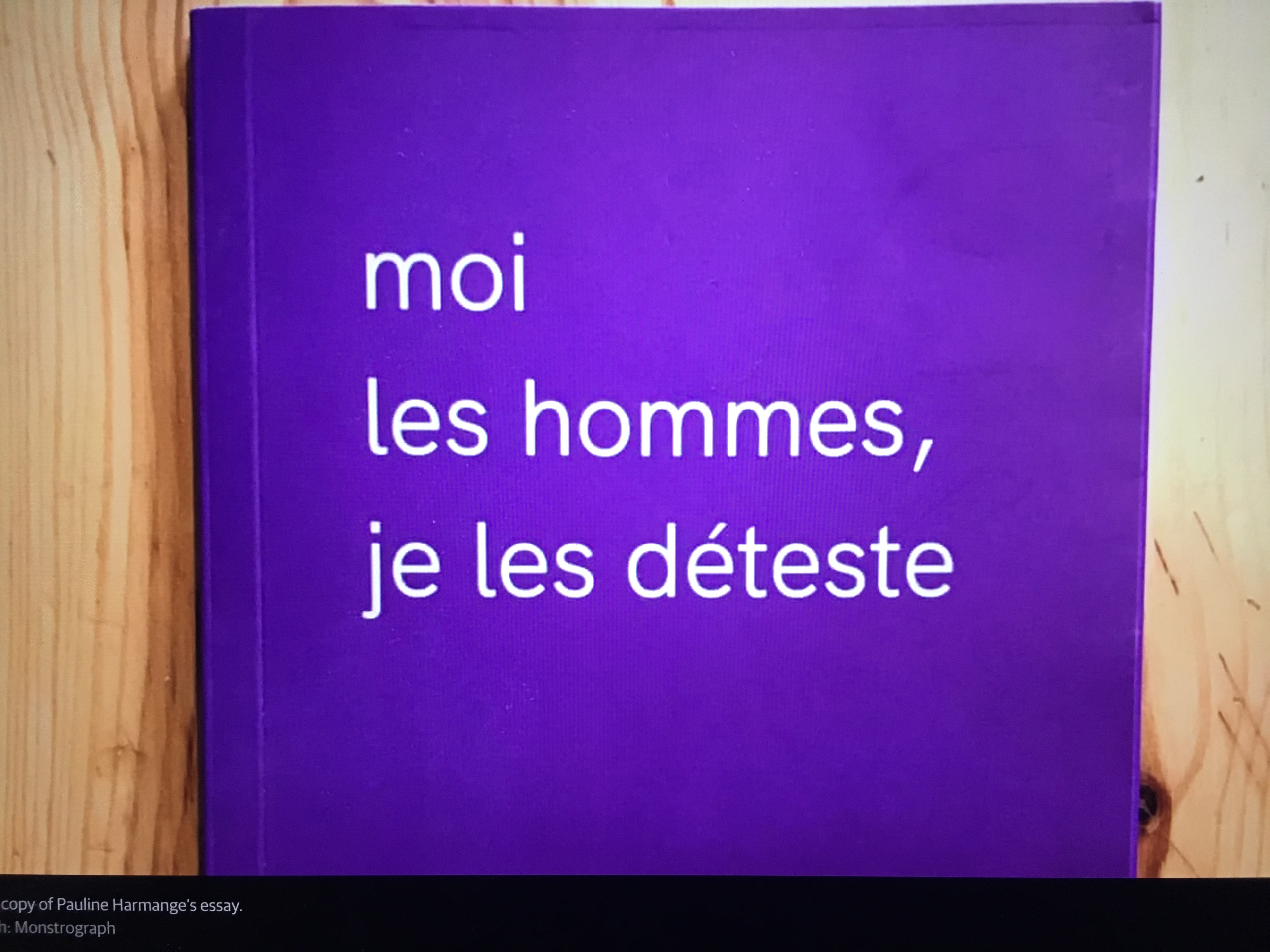
There’s more to Pauline Harmange, French author of I Hate Men, than met the eye of Ralph Zurmély, the gender equality ministry adviser who sought to prosecute her for incitement of gender-based violence. His ministry said “it appeared [he] had read only the title and the publishers’ description of I Hate Men, [and] had acted on his own initiative.
There’s at least one man whom the author counts as an “exception”: her husband Mathieu, 29.
In the thanks at the end of the book, she writes that he was “the first of us to believe in me”. She said: “He’s as astonished as I am about the reaction to the book, but he supports me and my writing. He just worries about me getting harassed online.”
I regret citing her as “Mlle” Harmange in my “Pen Pricks” post of 9-9-20. Where I live, people might think me a “sensitive” man, persnickety over a tick, and therefore nasty liberal. As a student and observer of writing style, however, I stick to my guns even in Texas.
A stark last name sounds brusque. To impress the francophile in me I titled Ms. Harmange “mademoiselle” without a thought. Was it complacent maleness assuming that a 25-year-old woman exploring the redemptive power of man-hating would not be married? Hard to be sure.
What is sure is that, like Ralph Zurmély, I haven’t read Pauline Harmange’s book — only two Guardian articles about it. But it seems that she expresses her emergent rationale for misandry with admirable sang-froid — I read that as composure and equanimity — as well as Gallic eloquence. Maybe a copy of “I Hate Men” can be spirited over my country’s man wall for me to read with a flashlight under the counterpane.
(Kim Willsher, ‘We should have the right not to like men’: the French writer at centre of literary storm,” 9-9-20)
In certain Victorian novels, female authors paint a bleak picture of limited options available to women lacking means or family status; of a lonely and loveless existence, yet one lacking privacy and subject to uninvited comment; of a life peopled by men who, as love interests or otherwise, are often cruel and domineering.
This species of novel came to mind as I read samples of Tamil poetry written by women in R. Parasarathy’s 2007 essay “Indian Poetry Today” (Poetry, September 2007).
In a scandal-causing poem, Kutty Revathi writes of breasts: “They swell, as if straining / to break free… like two teardrops that survived / an unhappy love.”
The poet Salma was confined in her home from the age of thirteen until her marriage nine years later, at which time she began to write.
This bed is my husband’s weapon: by reminding me of only pregnancies, it strikes terror in my heart. (From No Traces Remain)
I need more exposure to these poets’ work to form an appreciation of it. I had it present, however, in reading about a French essay in The Guardian. The story is a fruit tree sagging with Gallic plums.
Pauline Harmange, 25-year-old activist from Lille, pens an essay titled “I Hate Men.”
Small publisher Monstrograph prints a limited run. Ralph, special adviser to the ministry of gender equality, rises to the bait: the vile “ode to misandry” is criminally prosecutable, an incitement to hatred on the grounds of gender.
Mais non! Mlle Harmange says the pamphlet is really an invitation to rediscover the strength of female relationships; an exploration of anger towards men as an emancipatory path, a way of making room for sisterhood.
“A state official who has a power crisis facing an 80-page book released in 400 copies, I find that very problematic,” she said.
The little book’s editor asserts:
“The title is provocative but the purpose measured. It is an invitation not to force oneself to associate with men or to deal with them.“
So much inviting, so little hating! The book’s sales have soared on the controversy. A larger publisher is set to take the title on. Mlle Harmange counts it a “gigantic snub” to the man who wanted to ban her words.
I wish her well. The “I Hate Men” project appears to be enjoying a boost from Ralph’s pique. In her shoes I would include the man in the book’s credits.
(Alison Flood, “French book I Hate Men sees sales boom after government adviser calls for ban,” theguardian.com, 9-8-20)
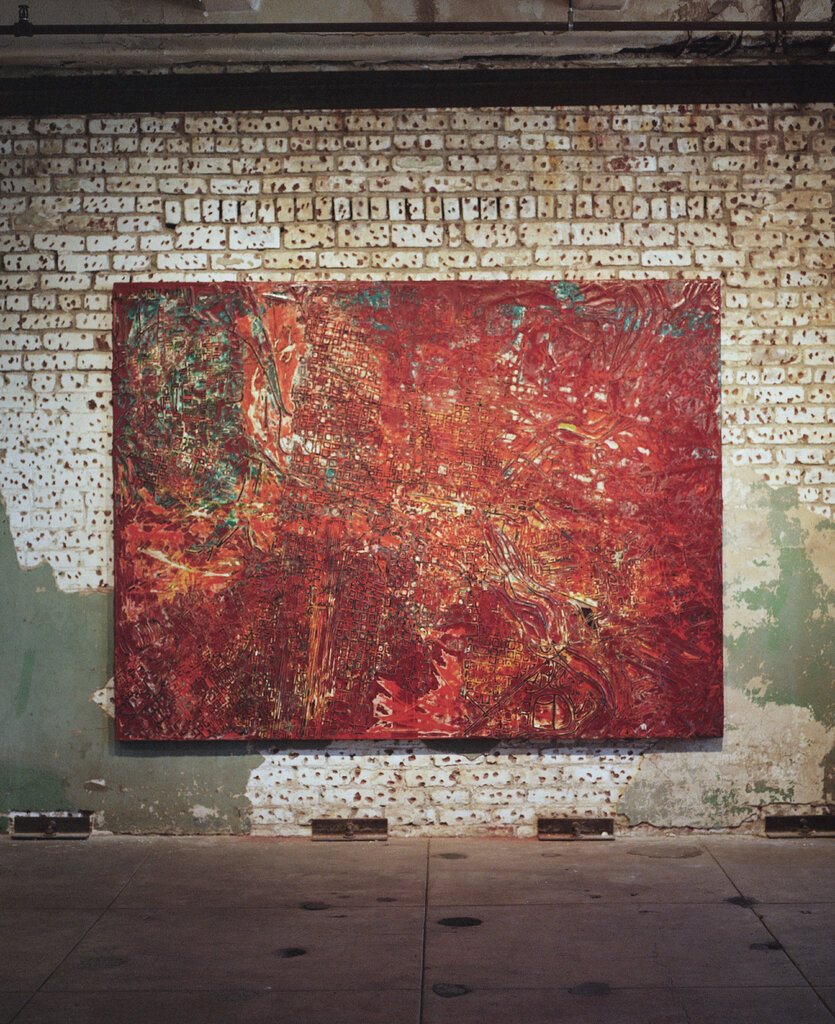
Mark Bradford’s “Q1,” 2020, mixed media on canvas — one of three new works made via the accretion and subsequent abrasion of layers of paint, paper and other media. He worked quickly, and without assistants. Credit… Mark Bradford and Hauser & Wirth; Erik Carter for The New York Times.
The locale in which these paintings hang reminds me of the shed I inhabit on a smaller scale.
The old grain tower retains “a wood, steel and rubber contraption ascending through a chute in the ceiling” with a sign reading: “NOTICE. ONLY MALE PILLSBURY EMPLOYEES MAY USE THIS MANLIFT.” It was so no one could see up female workers’ skirts.
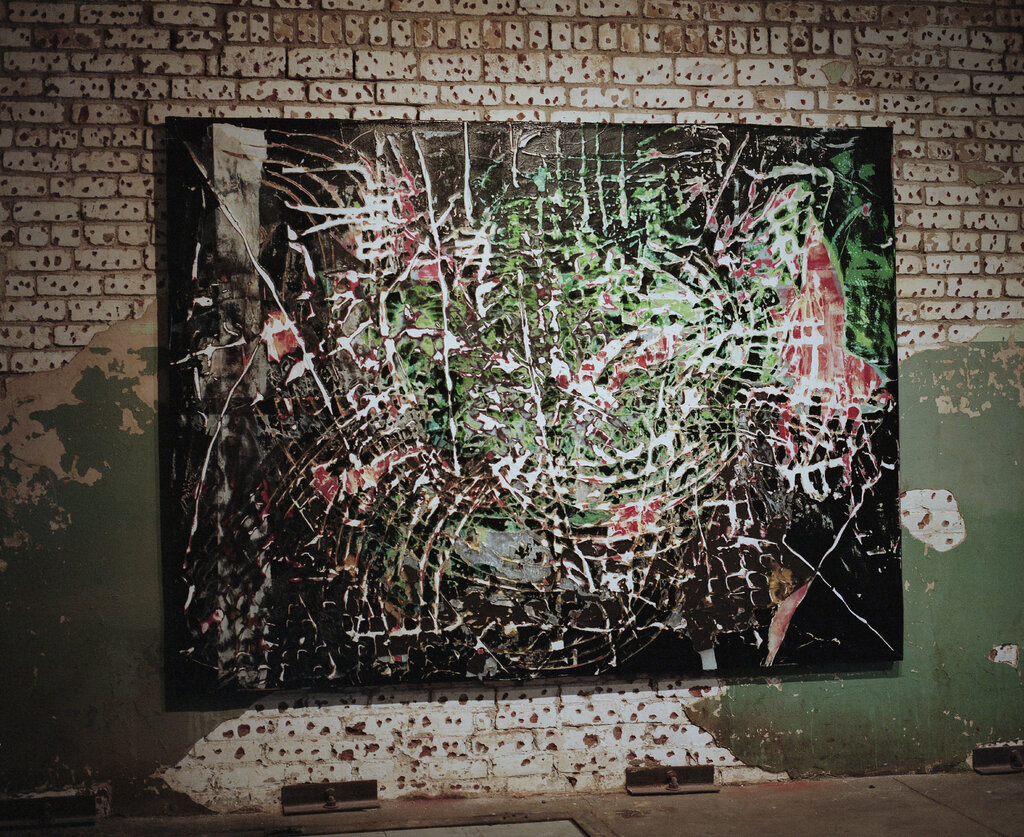
Mark Bradford’s “Q2,” 2020, shown inside a grain tower at Hauser & Wirth, Los Angeles. The abstract paintings hanging on the scarred walls have the artist’s melting grids that evoke the city’s erratic street plan. Credit… Erik Carter for The New York Times.
These paintings measure “only” 6 by 8 feet, smaller than usual for Mr. Bradford. For me, the uncanny resemblance to heightened aerial photographs is an attraction; that, and the critic’s mention of melting grids that evoke a city’s “sporadically erratic” street plan. It invites a contrast with plans that are methodically erratic.
Art works in the grain tower: Mr. Bradford sometimes works on the paintings side by side so his lines travel from one canvas to the next. Credit… Mark Bradford and Hauser & Wirth; Erik Carter for The New York Times.
(Jonathan Griffin, “Mark Bradford Reveals New Paintings Quarantined in a Grain Tower,” NYTimes, 9-8-20)
In part two of his 2007 essay about Indian poetry*, R. Parasarathy narrows his focus to contemporary poetry written in Tamil. He credits C. Subramania Bharati (1882-1921) with breaking free of received forms, notably in his Prose Poems, and inventing “the idiom and metric of twentieth-century Tamil poetry.”
He defamiliarized the current language of poetry, which was elitist and static, by exploiting the spoken language for lyric expression… For the first time, poetry was no longer the exclusive preserve of the elite. It flourished on the tongues of the illiterate and uneducated.
“Movie lyric” is a popular genre. Kannadasan (1927 – 1981) and R. Vairamuthu (b. 1953) are exemplars. Poets who compose lyrics for movies achieve elevated status, whereas those who don’t languish in obscurity.
In the case of the latter, their universe of discourse has come to be centered in the complexities of their own sexual, emotional, and psychological experiences.
Ka. Naa. Subramanyam (1912 – 1988) called for a new poetry in Tamil. It should have intellectual content “apart from the emotional”; use “recognizable conversational phrases” and hard images shorn of adjectives; and avoid “mysticism.”
N. Pichamurti (1900 – 1977) drew inspiration from the free verse of Whitman’s Leaves of Grass as well as Bharati’s Prose Poems.
The poetics of new poetry in Tamil has been shaped by three different traditions: classical Tamil, Sanskrit, and English.
Nakulan (b. 1922) represents the new Tamil poetry. He is said to “walk a tightrope between verse and prose,” and to deploy an unusual edginess of tone in spoken language that’s “uninflated by metaphor.”
Tamil Dalit poetry emerged only in the early nineteen-nineties. It calls attention “to both the plight of Dalits in a society riven by caste and the task of integrating them into the national mainstream.” N.T. Rajkumar (b. 1968) represents the genre.
One of the women poets “redrawing the map of sexual politics in Tamil Nadu,” Kutty Revathi (b. 1974), published a poem called Breasts in 2002 which “explores the ‘politics of breasts’ and dismisses their representation as ‘objects.’” Some men demanded that women writing explicit poems “be burned alive.”
Salma (b. 1968) is outspoken about the lives of Muslim women in purdah.
Male elephants socializing on the Boteti River in Botswana. Credit… Connie Allen.
“New research challenges the assumption that bulls become redundant in elephant society after breeding.”
New evidence suggests that male elephants do have social lives, and that older males may act as leaders for younger ones. … For example, from 1992 to 1997, young orphaned male elephants that had been introduced to Pilanesberg National Park in South Africa began coming into premature musth, a temporary state of heightened aggression and sexual activity. When females rejected the adolescents’ advances, the young males took their aggression out on white rhinos, killing more than 40. Seeking a solution, researchers introduced six older male elephants to the park. The younger males’ musth subsided, and the rhino killing stopped.
“Older males perhaps control aggressive behavior in younger ones,” Ms. Allen said. … In the absence of older bulls, younger ones would probably still be able to navigate a habitat by using well-worn paths to water… But older animals could be crucial to more critical knowledge, such as where to find water during a prolonged drought, or how to evade poachers.
(Rachel Nuwer, “Old Male Elephants: Don’t Count Them Out,” NYTimes, 9-4-20)
In the September 2007 edition of Poetry, R. Parthasarathy edited an “Indian Poetry Portfolio” accompanied by his essay titled “Indian Poetry Today.” I note salient points from that essay here.
India’s National Academy of Letters (Sahitya Akademi) recognizes twenty-four languages, including English. The poems showcased by Parthasarathy represent thirteen of them.
After Ghalib (1797 – 1869), there has not been an Indian poet comparable to the great European Moderns — Yeats, Mandelstam, Cavafy, and Pessoa.
The Partition of India in 1947 was a traumatic event for the nation. Conflict between Hindus and Muslims has persisted, including outbreaks of violence.
Poetry addresses these concerns; its healing power tends to the wounds festering in the national psyche and offers insights.
Dalit poetry is one of two significant recent developments. “Dalit is the name preferred by the former Untouchable caste.” The second significant development is that of feminist poetry.
Parthasarathy writes that contemporary Indian poetry awaits good translation. Available translations, he says, tend to be “in an English that is awkward.” (I’m reminded here of the tenet that the prerequisite for performing good translation is to write well in one’s own language.)
The first Indian poet published in Poetry was Rabindranath Tagore (1861 – 1941). Tagore himself translated his six poems, and Ezra Pound introduced them.
In 1959, the magazine published a special Indian number featuring thirty-seven poets in twelve languages, including English. Tambimuttu, “the legendary editor of Poetry London – New York,” was guest editor. With the exception of Tagore and Iqbal (1877 – 1938), those poets are unknown today.
Parthasarathy ends part one of his essay encouraging American poets to work with Bengali or Urdu scholars to produce poetry translations that are “a pleasure to read.” Until then, he writes, contemporary Indian poetry will remain a closed book.
The little Martin is a convenient lap guitar. I commissioned a local craftsman to build me the neat table, which arrived yesterday.
I’m struggling.
My remote interlocutor in life of the mind is keeping me afloat insofar as having a rational dialog with someone.
But that dialog is private. Of the muchness on my mind, I’m conflicted as to which of it matters much to say. However, as with the show, the blog must go on.
Language: My interlocutor and I are delving into the interesting topic of mass nouns versus count nouns and how they behave. The question sparking this exchange was whether or not the word “jam” ought to be plural. “Eggs and Jams” was written on a sign. The natives who know “less” versus “few” are the same as know “lie” versus “lay.”
Painting: On my easel is the second of two versions of a large man with a demented look pointing at his temple. MG, my studio manager, isn’t likely to expose these on the Shed’s FB page because the temple pointer is violently controversial. So one paints pointlessly the pointing man. (In pentameter, as it happens.)
Music: I’m working through the musical intervals — perfects, minors, majors — on the little Martin guitar. I’m trying to grok how intervals might help me know which notes my fingers are pressing. Also trying to read notation more fluently.
Poetry: I thought reading poetry again to figure out what purpose it serves would screen out scream culture. The “Scholls Ferry Rd.” disturbance put poof to the illusion. I had read Dickman’s poem before learning of Don Share’s abject resignation. The Daily Princetonian logs the opprobrium of offended readers at length.
Translation: My interlocutor asks if Spanish has nouns such as “jam” that straddle the mass-count continuum. I say yes. Nouns such as mermelada (jam), aceite (oil), and caridad (charity) lean toward quantity rather than number, but there can be many jams (flavors of) and “muchas mermeladas.”
“I feel that poetry has the power to pinch one’s heart to such an extent that the reader thinks twice and thrice before he or she interprets it.” (Sonam Tsering, Silent Songs of Sonsnow)
(Multivalence) STATIONS OF THE MASQUE
(Assertion) Dawnings oxygenate idées reçues. A shadow in the mind turns solid & appreciable, angled & degreed & weighty.
(Intrusion) — Blew me away, she said, I mean hell bent for leather spur-raked cayuse of affront
(Suspension) A plangent, evanescent naked swirl, dwindled to weather swindle, prosopopoeia in a pee cup —
(Disintegration) — Turn down the bed when it suits you. Louie is not himself tonight. I’ll be gone upstairs.
(Diminuendo) Pressure at sea level plateauing to millibaric norms. Ongoing going on platform crude tap offshore… going going going going going …






‘I Hate Men’ Two
There’s more to Pauline Harmange, French author of I Hate Men, than met the eye of Ralph Zurmély, the gender equality ministry adviser who sought to prosecute her for incitement of gender-based violence. His ministry said “it appeared [he] had read only the title and the publishers’ description of I Hate Men, [and] had acted on his own initiative.
There’s at least one man whom the author counts as an “exception”: her husband Mathieu, 29.
In the thanks at the end of the book, she writes that he was “the first of us to believe in me”. She said: “He’s as astonished as I am about the reaction to the book, but he supports me and my writing. He just worries about me getting harassed online.”
I regret citing her as “Mlle” Harmange in my “Pen Pricks” post of 9-9-20. Where I live, people might think me a “sensitive” man, persnickety over a tick, and therefore nasty liberal. As a student and observer of writing style, however, I stick to my guns even in Texas.
A stark last name sounds brusque. To impress the francophile in me I titled Ms. Harmange “mademoiselle” without a thought. Was it complacent maleness assuming that a 25-year-old woman exploring the redemptive power of man-hating would not be married? Hard to be sure.
What is sure is that, like Ralph Zurmély, I haven’t read Pauline Harmange’s book — only two Guardian articles about it. But it seems that she expresses her emergent rationale for misandry with admirable sang-froid — I read that as composure and equanimity — as well as Gallic eloquence. Maybe a copy of “I Hate Men” can be spirited over my country’s man wall for me to read with a flashlight under the counterpane.
(Kim Willsher, ‘We should have the right not to like men’: the French writer at centre of literary storm,” 9-9-20)
(c) 2020 JMN