The ending of a poem I’ve read recently goes thus:
On the plus, foods in hispanophone kitchens taste richer when spoken. zanahoria for carrot. melocotón names peach. many cubans say fruta bomba for papaya. mitt romney once claimed he loves papaya on miami cuban radio, unaware it means pussy. que clueless, que jokes, when we speak before we know.
(Kyle Carrero Lopez, “(slang)uage,” Poetry, May 2020).
In the contributor notes Kyle Carrero Lopez is listed as a Black Cuban-American born and raised in North Jersey, now living in Brooklyn.
His poem titled “(slang)uage” pokes two fingers in the peepholes of all the o’graphical niceties — typo-, ortho-, lexico-, pepsico, et al. — that you rode in on. And what Romney said he loved is Cuban slang for snatch!
The poem sends me back to my kid culture, where we dreamed of taking a girl’s cherry. It would have been awesome at 14 to hear an old guy say he loved cherries, unaware it means virginity. Pussy traps for pinche interlopers. ¡jajaja!
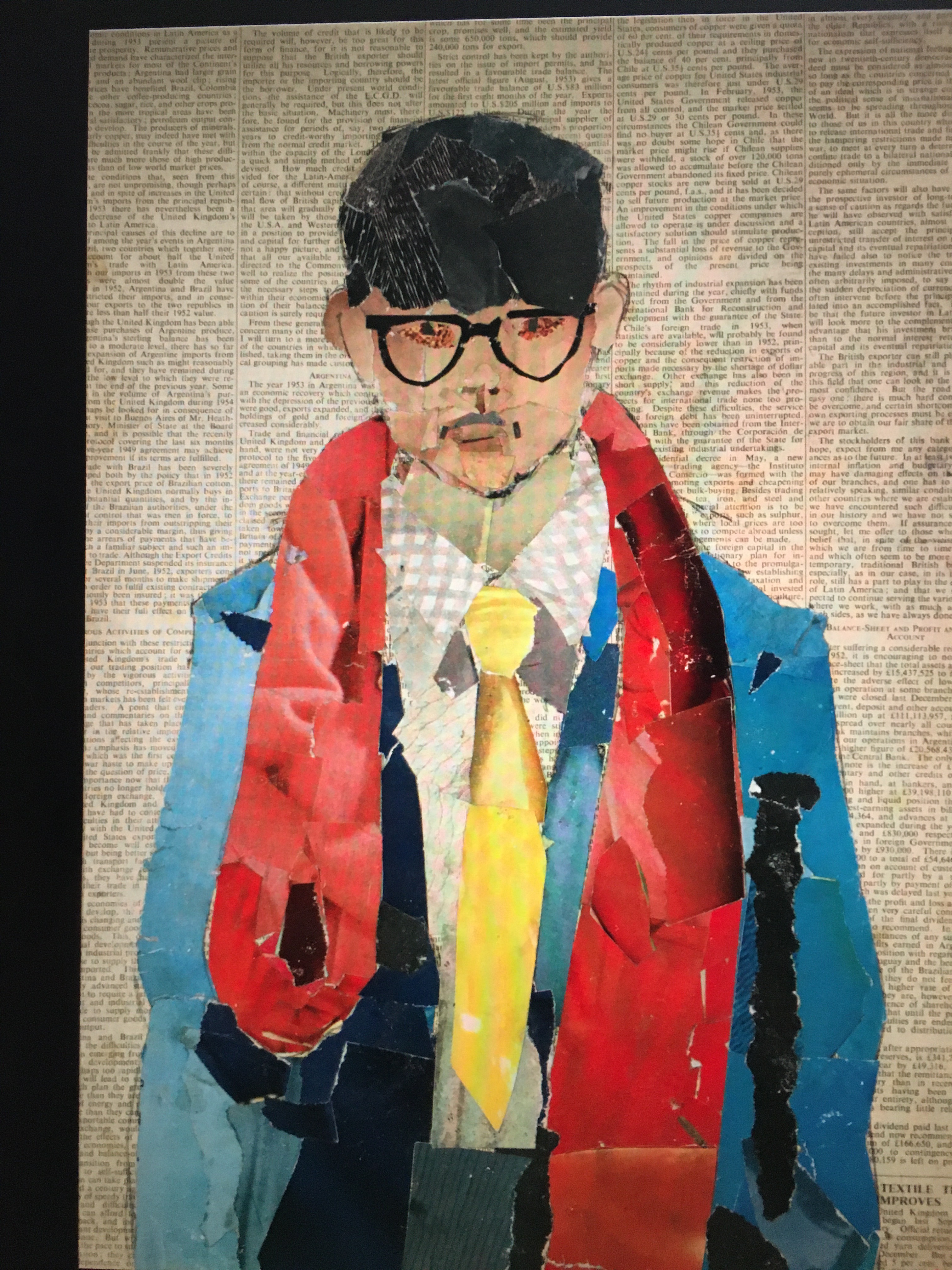
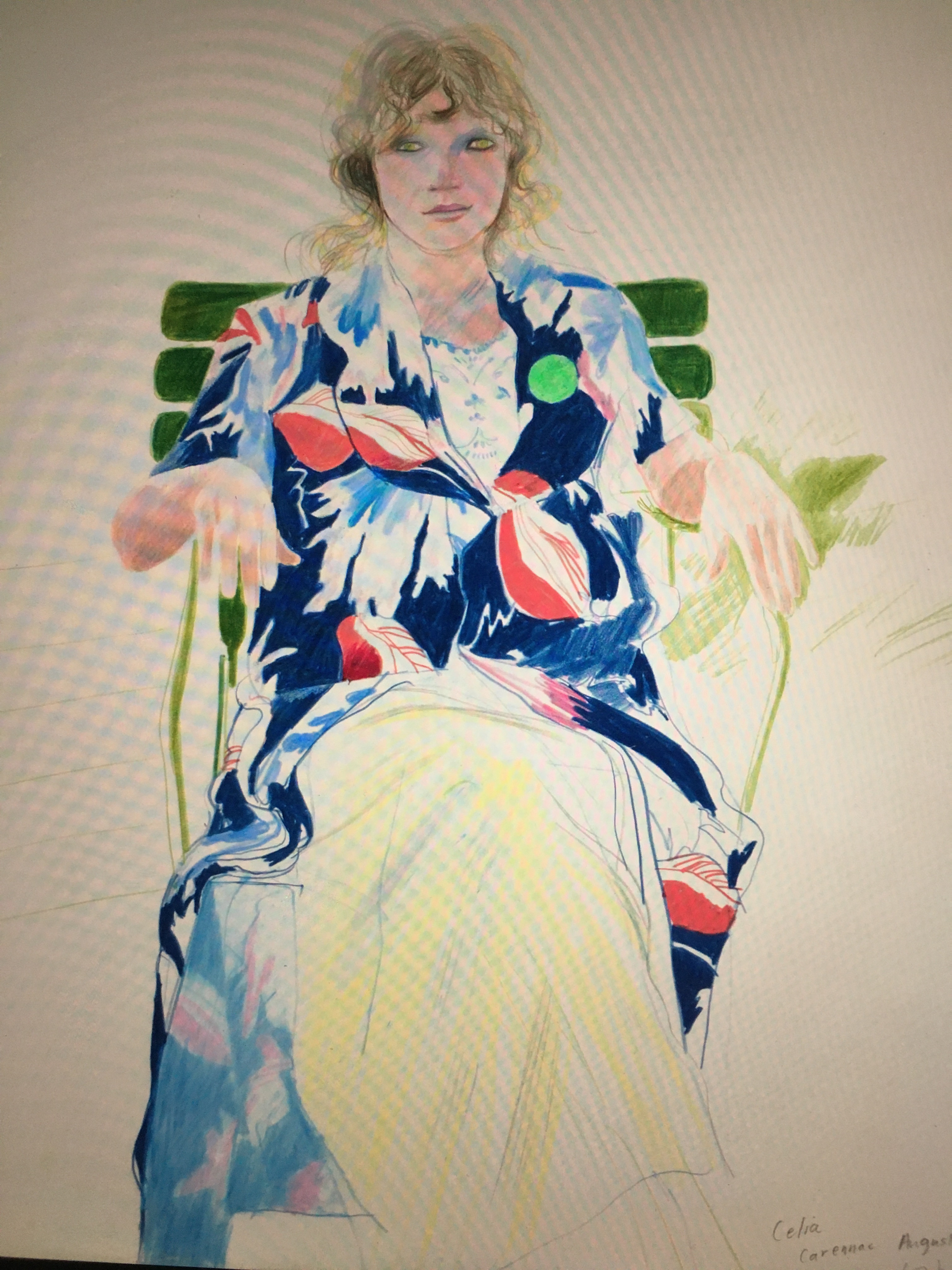
[Celia Birtwell] and Hockney have a fond and teasing relationship. She does a wonderful imitation of him and giggles at how he thinks he “discovered trees.”
(Hadley Freeman, “Hockney muse Celia Birtwell: ‘Nobody else has ever asked to draw me,’” theguardian.com, 2-25-20)
Nurses and National Health Service workers outside the Chelsea and Westminster Hospital in London last Thursday during the weekly “clap for carers” to honor their service during the pandemic. Credit… Andrew Testa for The New York Times.
Genesis Britons have… trusted in the N.H.S. since 1948, when it was created by a Labour government after World War II to forge a country that would eradicate the “five evils”: want, disease, squalor, ignorance and idleness.
Pantheon We all have respect for nurses, who are ‘angels,’ and doctors, who are ‘gods’ — that is the same as in lots of other countries… But here it is bound up with the institution they work for…”
Doctrine … While patients have little idea of the financial plumbing behind the scenes, they like the basic principle that “people who are ill should have access to high-quality care.”
Church “The N.H.S. is almost holy… It’s become the new Church of England.”
Hell … Most Britons tend to compare their system with America’s and recoil in alarm… “If you are not able to afford care in the U.S., you are often in a dire situation…”
(Stephen Castle, “‘The New Church of England’: Coronavirus Renews Pride in U.K.’s Health Service,” NYTimes, 5-12-20)
While I resist drawing lines between pornography and art, if forced to offer a distinction I might say that pornography, like propaganda, wants us to feel a single thing. Art is made of contraries, of ambivalence and ambiguity; it never wants us to feel a single thing. If I want the reader to be aroused by a particular scene, I also want them to be troubled by that arousal, to question or investigate it, to be moved by a more complicated pleasure.
(Garth Greenwell, “‘I wanted something 100% pornographic and 100% art’: the joy of writing about sex,” theguardian.com, 5-8-20)
Greenwell tickles me with gesturing at where porn and propaganda converge. Eschew not only obfuscation but also simplisticism. I like to echo him that porn and prop are univalent, and then to wonder why art, besides contrariety and ambiguity, isn’t made also of multivalence: multi- or “many,” after all, is more than ambi- or “both.”
However, ambivalence is an attribute of the observer — of his or her sentient or cognitive dimension — whereas multivalence is an attribute of the observed — of the sensed dimension. So which one makes art? It’s complicated — and there it is! — the troubling arousal.
Above, Hiroyoshi Chinzei, the owner and operator of Hidaka Washi, with the world’s thinnest paper. Credit… Kazuhiro Nogi/Agence France-Presse — Getty Images.
I’m glad to know about tengujo, the thinnest paper in the world, and to learn a bit about how it’s made. One of its numerous uses is in repairing and preserving old documents in places such as the Library of Congress, the Louvre, the British Museum and the Yale Center for British Art.
Paper deteriorates for many reasons: fungi, moisture, heat, light, atmospheric pollutants… With many Western writings before the 20th century, the ink itself was eating through the paper, in a process called iron gall ink corrosion.
Soyeon Choi is head paper conservator at the Yale Center for British Art, and has worked in the field for morel than 20 years.
Trying to aggressively mend a document is risky because long-term chemical and physical effects are highly variable and relatively unknown. “The more and more I am in this field, I feel that I should do less and less,” Ms. Choi said.
(Oliver Whang, “The Thinnest Paper in the World,” NYTimes, 5-5-20)
Ms. Choi’s comment evokes for me a kind of Hippocratic oath of conservatorship: First do no harm.
That’s the instruction that John McLaughlin recalls Miles Davis giving him. It was on the occasion of his being pressed precipitately into service to collaborate in Davis’s milestone album “Bitches Brew” recorded in August 1969.
“I just closed the score and started playing: no rhythm, no harmony, just playing the melody and casting my fate to the wind. He loved it… He would hit a couple of chords on the piano and say: ‘What do you hear? Do you hear a riff? A bass line?’
(Jim Farber, “‘It sounded like the future’: behind Miles Davis’s greatest album,” theguardian.com, 2-24-20)
Jim Farber’s article gives a taste of the bracing environment surrounding Davis’s project and of his interactions with fellow musicians. (I can say, ruefully, that I would be able to comply quite well with Mr. Davis’s instruction, but not as happily as John McLaughlin.)
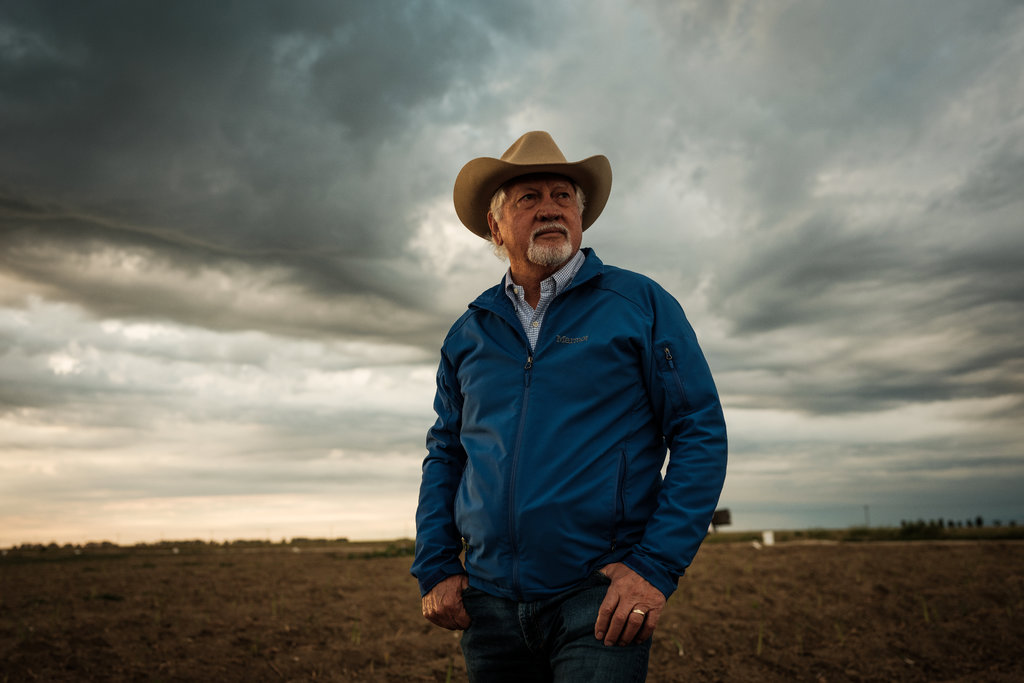
Joe Del Bosque employs about 300 people on hundreds of acres [in California]. Credit… Max Whittaker for The New York Times.
Along with other farmers, [Joe Del Bosque] has been pleading with Congress for the past few years to legalize farmworkers… because “you need these workers today, tomorrow and for a long time.”
The boys from Mexico worked so hard, Texas ranchers argued during one of America’s cyclical anti-immigrant periods, that the hiring of Mexicans should not be considered a felony. Thus, the Texas Proviso was adopted in 1952, stating that employing unauthorized workers would not constitute “harboring or concealing” them. This helps explain why Americans call immigrants “illegal” but not the businesses that hire them.
(Alfredo Corchado, “If They’re ‘Essential,’ They Can’t Be ‘Illegal’,” NYTimes, 5-6-20)
Some operators are not cut from Mr. Del Bosque’s cloth. The Proviso dutifully coughed up by the Lone Star State on their behalf provides a parable of how morbidity harbored in circles of self-interest can infect government with virulent sophistry and, from there, sicken the language (and the populace) at large.
Wayne Koestenbaum, whose new book of essays is “Figure It Out.” Credit… Tim Schutsky.
[Wayne Koestenbaum] valorizes the intellectual seriousness of Sontag, and of the poet and translator Richard Howard, but also confesses his attraction to idleness and lassitude. Books are fine and good, but have you tried sex, or doughnuts?
So this review introduces me to Koestenbaum.
Whatever his subject — favorites include porn, punctuation and the poetry of Frank O’Hara — the goal is always to jigger logic and language free of its moorings. “The writer’s obligation,” he states in his new essay collection, “Figure It Out,” “is to play with words and to keep playing with them, not to deracinate or deplete them, but to use them as vehicles for discovering history, recovering wounds, reciting damage and awakening conscience.”
So I would walk a mile for a word like “deracinate.” So I can relate to his perverse glee in not coming down on a single side of anything. So have I misconstrued it in myself as a stubborn failing all along? So I may have to read “Figure It Out” to lose the answer.
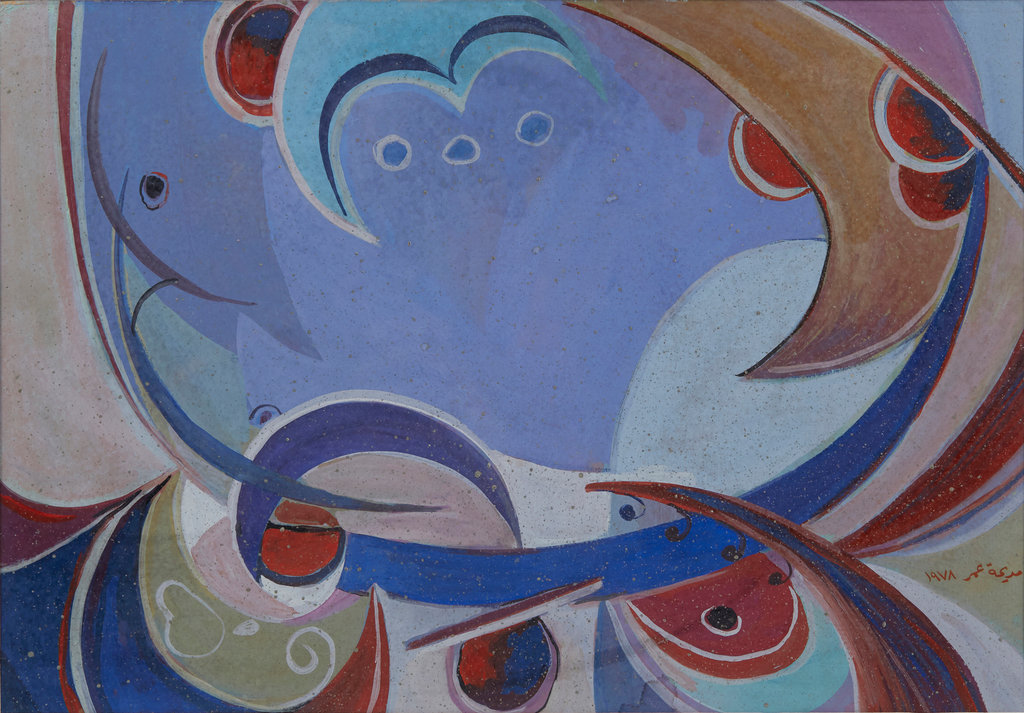
An untitled 1978 watercolor by Madiha Umar recalls Arabic letter forms as well as ancient Mesopotamian crescent moons. Credit… Barjeel Art Foundation.
I once had to choose Arabic or Greek, the sole elective, in a course of study. It made a lot of difference in what I did next. I enthuse time and again over instances of letters lateraled into graven imagery in whatever tongue.
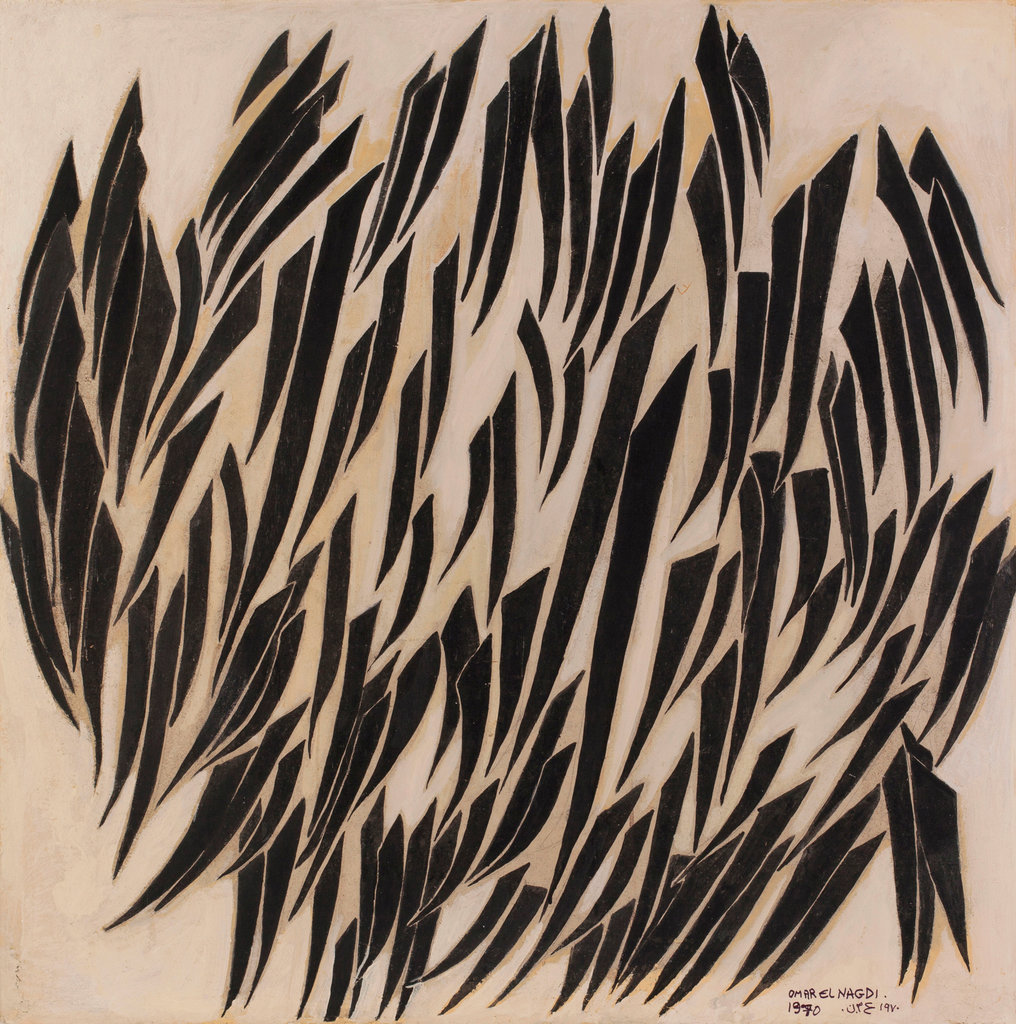
With its lacy interlocking and dotty swoopiness, Arabic script cries out to be pictured. A culture that scripturally abjures the human image has vented itself gloriously in calligraphic fashion. These artists take tradition to modern lengths.
An untitled piece by the Egyptian artist Omar el-Nagdi from 1970 shares its form with the first letter of the Arabic alphabet. Credit… Barjeel Art Foundation.
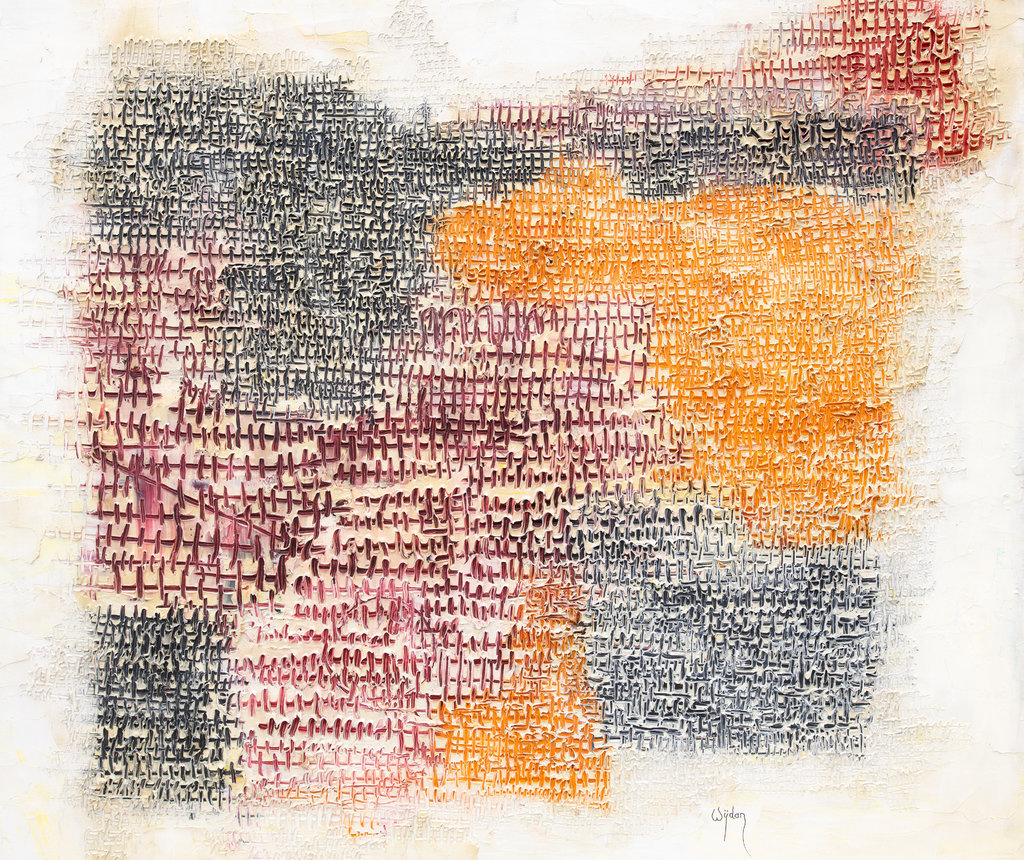
Most of these artists had some European or American training, and alongside unusual sandy palettes and a few unexpected details, you’ll see plenty of approaches that look familiar: lucid colors à la Josef Albers, crimson bursts of impasto similar to early Abstract Expressionism. But unlike European artists, they also have an alphabet with an ancient history in visual art — and this gives their abstraction a very different effect.
An untitled oil by Wijdan from 1970. “Each little dash, like a letter, insists on its granular distinctness, whatever their overall effect,” our critic says. Credit… Barjeel Art Foundation.






The Secret Life of Fruit
The ending of a poem I’ve read recently goes thus:
On the plus, foods in hispanophone kitchens taste richer when spoken. zanahoria for carrot. melocotón names peach. many cubans say fruta bomba for papaya. mitt romney once claimed he loves papaya on miami cuban radio, unaware it means pussy. que clueless, que jokes, when we speak before we know.
(Kyle Carrero Lopez, “(slang)uage,” Poetry, May 2020).
In the contributor notes Kyle Carrero Lopez is listed as a Black Cuban-American born and raised in North Jersey, now living in Brooklyn.
His poem titled “(slang)uage” pokes two fingers in the peepholes of all the o’graphical niceties — typo-, ortho-, lexico-, pepsico, et al. — that you rode in on. And what Romney said he loved is Cuban slang for snatch!
The poem sends me back to my kid culture, where we dreamed of taking a girl’s cherry. It would have been awesome at 14 to hear an old guy say he loved cherries, unaware it means virginity. Pussy traps for pinche interlopers. ¡jajaja!
(c) 2020 JMN