Vivian Browne

vivian browne little men

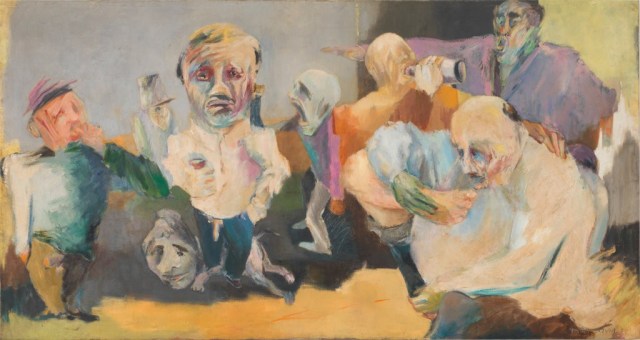
“Seven Deadly Sins” (circa 1968), the pièce de résistance of Vivian Browne’s show at Ryan Lee. Credit via Ryan Lee Gallery and Adobe Krow Archives.

In 1965, the artist, educator, and activist Vivian Browne (1929-1993) began a series titled Little Men. Considered her first major body of work, it consists of oil and acrylic paintings of white-collar middle-aged white men… They’re dressed in button-down shirts and ties, but they don’t act professionally; instead the men suck their fingers, touch themselves, dance and wail… She saw firsthand how such white men were powerful, common and utterly unexceptional. She knew they represented a societal problem beyond themselves. And she took up parody and painting to give it a form.

(Jillian Steinhauer, “New York Galleries: What to See Right Now [‘Vivian Browne’],” NYTimes, 3-14-19)

On the verge of posting this look at an appreciation of Vivian Browne’s work, I felt I should give Ms. Steinhauer’s commentary more air because something was bothering me. Here’s the commentary:

Ms. Browne’s work can look sketch-like, but it is carefully considered. As a member of the Black Emergency Cultural Coalition and the black women artists’ collective Where We At, she saw firsthand how such white men were powerful, common and utterly unexceptional. She knew they represented a societal problem beyond themselves. And she took up parody and painting to give it a form. It’s remarkable just how current this 50-year-old series feels today, as we continue to contend with “little men” who insist loudly that they are big.

Stylistically, I would have avoided using the term “pièce de résistance” (see caption above). It exudes an effete vibe, in my view, but that’s trivial. As to what Ms. Browne “saw firsthand,” what she “knew,” and why “she took up parody and painting,” I would like to have heard more of Ms. Browne’s own words in the matter.

But I agree that we white men are a huge problem in the world.

(c) 2019 JMN.
Posted in Anthology, Commentary, Quotations | Tagged , | Leave a comment

Yes, It’s in Focus, I Think

korea society

Suh Seung Won’s “Simultaneity 17-601” (2017), an acrylic on canvas. Credit Suh Seung Won.

Suh Seung Won, a pioneer of the process-based Korean painting movement known as Dansaekhwa, or monochrome, started out with hard-edge, translucent rhombuses that evoke unreal architectural spaces. In the large-scale recent canvases comprising most of “Suh Seung Won: Simultaneity” at the Korea Society, those rhombuses have become overlapping bursts of diaphanous yellow and pink. They’re too square to read as clouds, despite the unmistakable glints of blue peeking through, so the mood remains otherworldly.

(Will Heinrich, “The Buddhas, Gods and Emperors of Asia Week New York [‘The Korea Society’],” NYTimes, 3-14-19)

(c) 2019 JMN.

Posted in Commentary, Quotations | Tagged | Leave a comment

“The Birth of the World”

birth of the world by miro

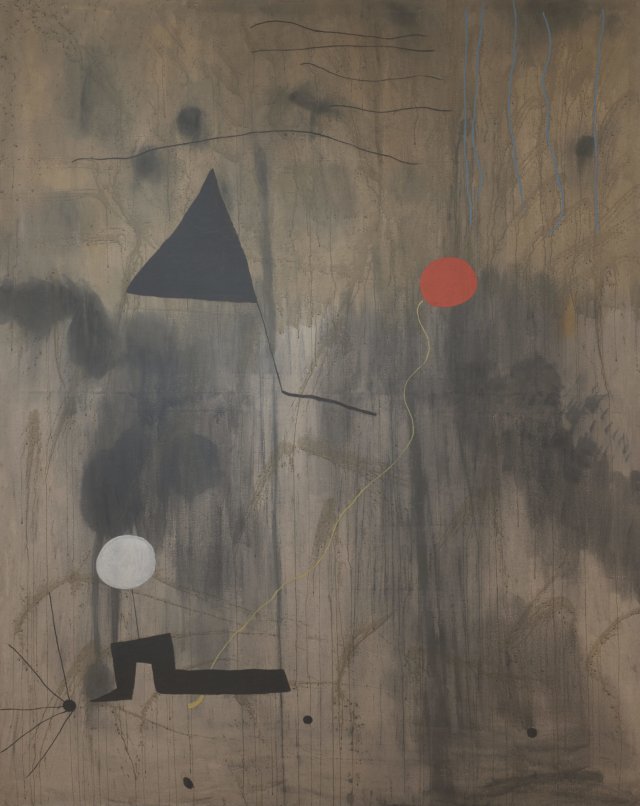
Miró’s “The Birth of the World,” from 1925. Credit Successió Miró/Artists Rights Society (ARS), New York/ADAGP, Paris; The Museum of Modern Art.

The artist André Masson once likened this large (8-by-6½ feet) canvas [“The Birth of the World” by Joan Miró] in its radicalness to Picasso’s “Les Demoiselles d’Avignon” of 1907. It is still startling that the two are only 18 years apart. But while “Demoiselles” enabled Cubism, which spread through Europe and beyond in a matter of years, “The Birth of the World” went almost immediately underground; it was too far ahead of its time to have an immediate effect. Its thin veils, splatters and rivulets of gray, ocher and blue wash and horizon-free space would find little echo outside of Miró’s work until around 1950, with the pouring techniques of Jackson Pollock and Helen Frankenthaler.

(Roberta Smith, “Miró’s Greatness? It Was There From the Start,” NYTimes, 3-14-19)

(c) 2019 JMN.

Posted in Anthology, Quotations | Tagged | Leave a comment

From Llandudno to Cromer

jay rayner

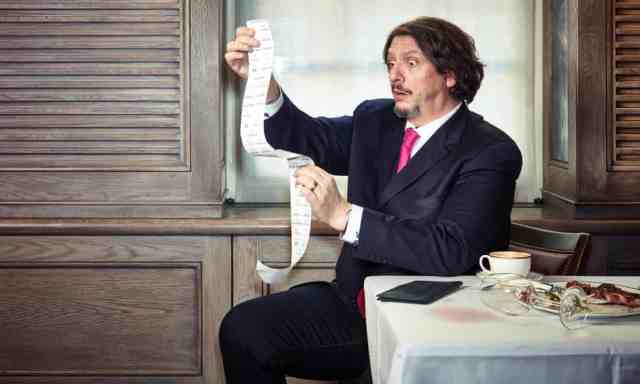
How much? Jay at 34 Mayfair, London Photograph: Levon Biss / The Observer.

I have a weakness for challenging place names. Mr. Rayner delivers handsomely in his article.

I have reviewed [restaurants] from Marazion and Porthleven at the tip of Cornwall to Stornoway and Drumbeg in Scotland’s furthest reaches; from Llandudno in the west of Wales to Cromer in the east of England… A few months after I started [as a food critic], I complained that it seemed impossible to eat out for less than £70 for two. Now, too many flash metropolitan places seem to glide effortlessly past £140. Happily, it has led to a flight away from the centres. Many of the most interesting, affordable restaurants in the UK are now to be found in once unlikely places: in shipping containers in Bristol or covered markets in Doncaster or Brixton.

(Jay Rayner, “… My 20 years as a restaurant critic,” The Guardian, 3-17-19)

(c) 2019 JMN.

Posted in Anthology, Quotations | Tagged | Leave a comment

Gurning Expressions and Good Craic

Saoirse-Monica Jackson

Saoirse-Monica Jackson: ‘There’s a real sense of generosity in Derry.’ Photograph: Suki Dhanda/The Observer.

I’ve recently locked into “Derry Girls” on Netflix, of which I’ve just encountered this enthusiastic review in The Guardian. For me, a dialect wonk, the series is a bracing dip into Irish brogue, besides good entertainment.

The world is ready for this now [“funny young women”], and happy days — because we’re not going anywhere.

(Saoirse-Monica Jackson, quoted by Holly Williams, “Derry Girl Saoirse-Monica Jackson: ‘Yes, we have a harsh sense of humour’,” The Guardian, 3-17-19)

(c) 2019 JMN.

Posted in Anthology, Quotations | Tagged , | Leave a comment

“Keeping Busy”

tree by sarah

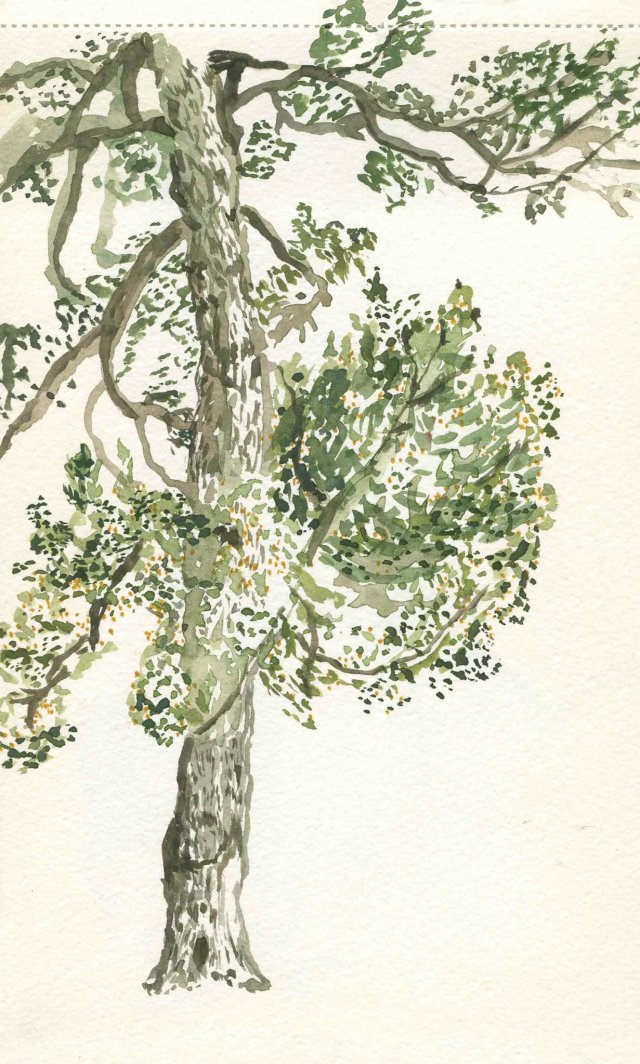
I remember … what my teacher said [about a tree study]. “Your tree is beautiful, Sarah, but I don’t know what an art director is going to do with that tree.” No matter, no mind. I was on my own path… The great thing about a sketchbook is that it is for you. It’s where ideas, conscious and unconscious, form. Accidents happen, but they are happy accidents… I can’t say that I am completely happy when I draw. It’s not happiness. It’s feeling occupied, content. Something Andy Warhol said has always struck a chord in me: “I think that’s the best thing in life: keeping busy.” Once I started drawing I realized I could keep myself busy and never feel bored again.

(Sarah Williamson, “My Sketchbooks in a Stranger’s Hands,” NYTimes, 3-16-19)

(c) 2019 JMN.

Posted in Quotations | Tagged | Leave a comment

“A Girl From Somewhere Else”

I take myself too seriously, probably because I’m a human being. With our big brains and our bigger egos, we can’t help building the case to ourselves and others that we are very important creatures, when really we’re ludicrous. To be funny is to remind ourselves again and again just how ridiculous we are.

(Maeve Higgins, “My Glamorous Life as a Movie Star in Control-Top Pantyhose,” NYTimes, 3-16-19)

Higgins is the author of “Maeve in America: Essays by a Girl From Somewhere Else.”

(c) 2019 JMN.

Posted in Anthology | Leave a comment

High Cotton in Language Land

you auto be with me uploaded

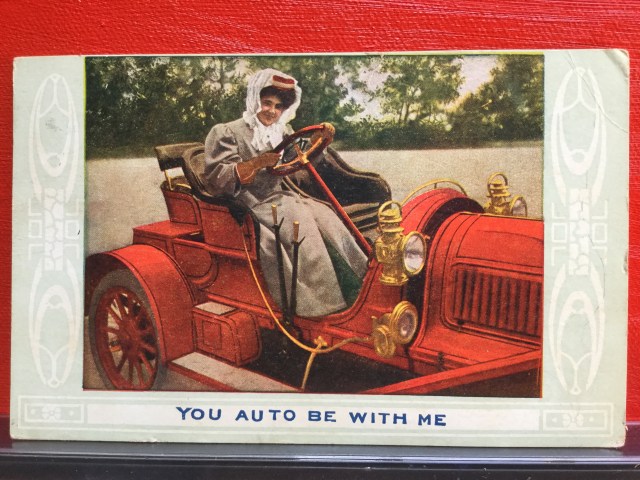
[Confession: I hesitate to register enjoyment of language that happens to come from a debate whose seriousness I readily acknowledge. Brexit is beyond my purview, but I hope whatever solution is reached benefits the UK and its citizens. With that proviso I proceed on a lighter note.]

A homely old saying where I’m from is that someone “is in high cotton” when he or she experiences a stroke of good fortune or finds himself or herself in a pleasing situation that works to his or her advantage. As a blogger who keeps an eye on language and style in daily readings I am in high cotton when I encounter passages such as the following:

Mr. Cox, who speaks in the clavicle-juddering bass of an Old Testament prophet, has achieved a degree of celebrity as Mrs. May’s surrogate and protector.

(Ellen Barry, “Theresa May Finds Herself Without a Voice, or a Friend,” NYTimes, 3-12-19)

The choices facing Parliament were “unenviable,” as Mrs. May said… but coming days promised more “squeaky bum time,” a phrase several British reporters borrowed from a soccer coach who once used it to describe the way fans squirm in their seats when the action gets tense.

(Editorial, “Britain Squirms After Another ‘No’ on Brexit,” NYTimes, 3-12-19)

The phrase describing Mr. Cox’s bass voice judders my clavicles. As for squeaky bum time, now is it, assuredly, on several fronts.

(c) 2019 JMN.

Posted in Anthology, Quotations | Tagged | 2 Comments

Sports

exclamation-mark

I’ve studied at every level of American education — elementary through graduate school and law school — and have taught without distinction at most levels as well — middle school, high school, community college, and university. None of this qualifies me to sound off about how the system should work because I’m clueless; however, my interest in the topic of education leads me to echo some points from an opinion piece in The Times stemming from the admissions bribery indictments that have surfaced. Points made in the article lend support to my sense that the outsize focus on sports that’s prevalent in our schools can siphon student energies, as well as key resources, away from the academic pursuits that might ought to be the bedrock of what schools are about.

[According to research into the college admissions process]: An athlete was about 30 percentage points more likely to be admitted than a nonathlete with the same academic record… Competitive sports occupy a ridiculously large place in the admissions process… “Athletic recruiting is the biggest form of affirmative action in American higher education…,” Philip Smith, a former dean of admissions at Williams College, has said. “Recruited athletes not only enter selective colleges with weaker academic records than their classmates as a whole but…, once in college, they ‘consistently underperform academically…,’” Edward Fiske wrote in a 2001 book review for The Times.

(David Leonhardt, “End Special Treatment for Sports,” NYTimes, 3-13-19)

(c) 2019 JMN.

Posted in Quotations | Tagged | Leave a comment

“Resolving Uncertainty”

music notation

I’m trying to make the musical intervals stick in my head through associated songs, a technique I’ve only just discovered. I’m painting each interval on canvas, first the minor second,  exemplified by the theme of the movie “Jaws.”

The article excerpted below  recommends drawing pictures of things you want to remember. Uncertain about the upshot of my experiment, I’m reminded of a joke involving someone at pains to remember the means by which he meant to remember the thing, while the thing itself is perfectly remembered.

… In an arts integrated curriculum, students would sketch their vocabulary words, or learn some of the material as songs, or act out molecular motion with their bodies… The children who had learned the material in the curriculum that made use of the arts remembered more, and the effect was largest among the children who were less strong academically, the ‘lower performers.’

“Working through some creative endeavor, we’re really resolving uncertainty,” [Ronald Beghetto, a professor of educational psychology] said. “We approach the blank canvas.”

(Perri Klass, “Using Arts Education to Help Other Lessons Stick,” NYTimes, 3-4-19)

(c) 2019 JMN.

Posted in Quotations | Tagged | 9 Comments