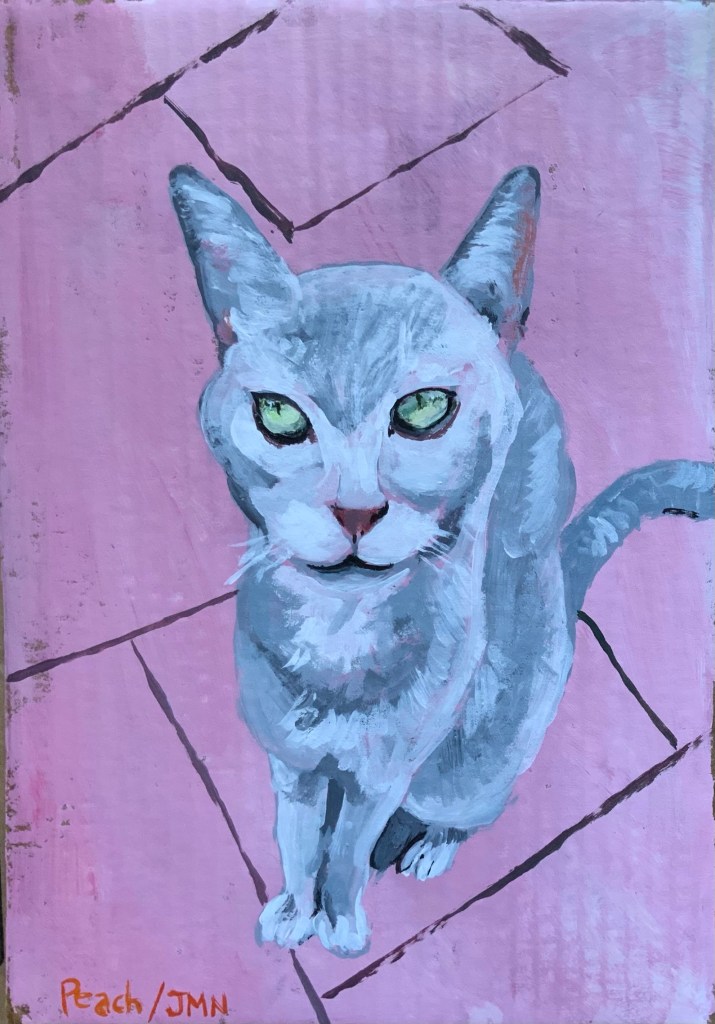
Greystoke, old dear, we hardly knew ya and you’ve broke our hearts. Purr in peace.
(c) 2022 JMN — EthicalDative. All rights reserved
Greystoke, old dear, we hardly knew ya and you’ve broke our hearts. Purr in peace.
(c) 2022 JMN — EthicalDative. All rights reserved

Vicky Phelan died of cervical cancer last month at age 48 in County Limerick, Ireland. She had been an advocate for fellow victims of botched Pap smears. Her ringing demand for freedom from callous, corrupt leadership has universal application.
“I don’t want your apologies. I don’t want your tributes,” she wrote. “I don’t want your aide-de-camp at my funeral. I don’t want your accolades or your broken promises. I want action. I want change. I want accountability.”
(Vicky Phelan, from her open letter to Ireland’s leaders in 2020, after the death of Ruth Morrissey, age 39)
Irish health authorities argued over who should inform 200 cancer victims of “negative” smear tests followed by cervical cancers that should have been flagged as likely positive. They took two years to notify doctors, and many women weren’t told of the error that had delayed their diagnoses. Some 30 have died. The CEO of the Irish Cancer Society faults a “patriarchal” health system that can be particularly harmful to women.
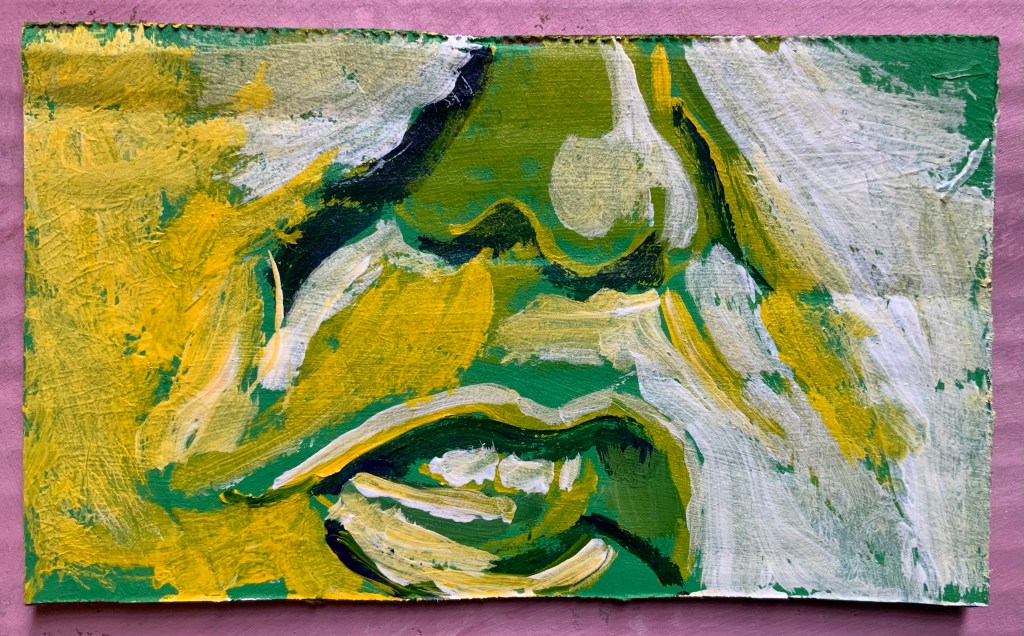
Politicians have paid tribute to Ms. Phelan for helping expose the scandal, but a law proposed four years ago granting patients the right to be told about their own cases has yet to be passed.
(Ed O’Loughlin, “A Botched Cancer Test, a National Scandal, and an Irish Hero,” New York Times, 11-16-22)
(c) 2022 JMN — EthicalDative. All rights reserved
A verse of classical Arabic can be tightly packed. Besides immersion in grammar, what’s most useful to this student of the language is a highly Congruent (1) translation. It amounts to what’s called a “trot,” and is the least likely kind of text to be published, which deprives the student of a valuable tool.
Making my own trots involves intensive bouncing between Hans Wehr (2) and Lane (3) as I mutter phrases from each verse aloud, lodging them ever more determinedly into my recall faculty. The great boon of Arabic’s conservatism is that vocabulary and structure encountered in a sixth-century poem are still current. The continuity is gobsmacking. For contrast in English culture, read Beowulf.
Arabic “roots” comprised of 3 (sometimes 4) consonants depart, theoretically, from a core meaning which can then be extended across a formidable drift of connotation and signification in the dictionaries. Settling on a choice of term for my poem-trots can be agonizing. I find myself hewing to core meanings, even when they yield weird resonance, as an expedient for cleaving the knot until context may dictate otherwise. What’s to remember is that a trot isn’t the destination, it’s a way-station on the journey to comprehension and retention.
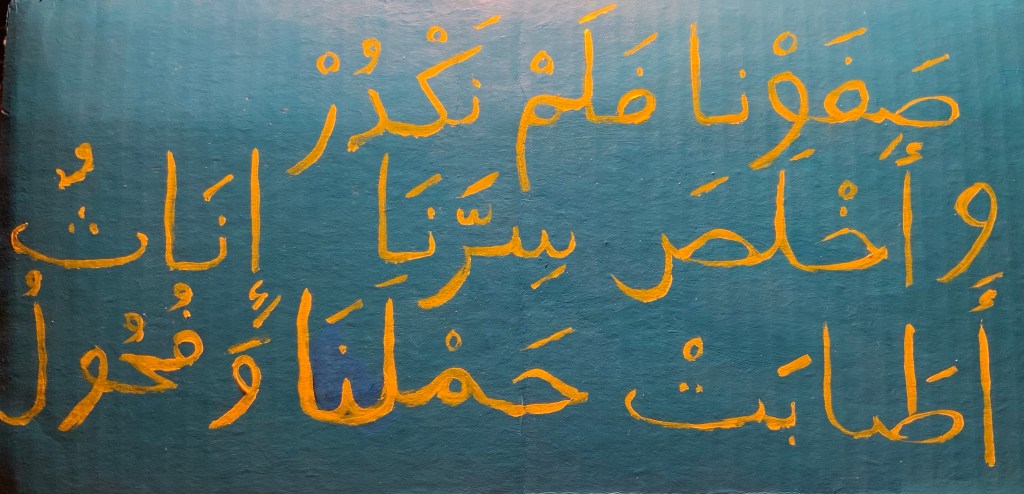
The first poem in Arberry’s anthology (4) is by As-Samaw’al ibn ^Adiyā’, who flourished in the mid-sixth century. Here’s verse 12 transliterated:
ṣafaw-nā fa-lam nakdur wa-‘aẖlaṣa sirra-nā | ‘ināṯ(un) ‘aṭāba-t ḥamla-nā wa-fuḥūl(u)
Here’s my trot: “We were limpid [ṣafaw-nā], so we were not turbid [fa-lam nakdur], and made pure [wa-‘aẖlaṣa] (5) our excellence of lineage [sirra-nā] (6) | females [‘ināṯ(un)] (who) made good [‘aṭāba-t] our carrying [ḥamla-nā] and males [wa-fuḥūl(u)].”
Here’s a version with subject-verb order more conventionally aligned: “We were limpid (or “clear”), for we were not turbid (or “muddy”), and females and males (or “stallions”) who made good our carrying (or “fetus”) made pure our excellence of lineage (or “race”).” (“Made pure” and “made good,” while unwieldy, mirror the factitive quality of the form 4 Arabic verbs.)
Here’s Arberry’s translation: We have remained pure and unsullied, and females and stallions who bore us in goodly fame kept intact our stock.
Skilled and dashing, also Expansive, which isn’t always helpful to the learner. Steering closer to trot-level can lend an oddly apt, modernist swerve to translated verse which makes a roistering 19th-century tone fall musty on the ear. What comes clear is that As-Samau’al’s archaic boast wafts a whiff of the “pure blood” tribalism that roils human affairs now, as then.
For the record, I’m not sure my trot of this verse is on the money; I must take on board what I’ve gleaned, however, and move on to the next verse.
Notes
(1) My labels are Congruent (matches the source text fairly closely, with minimal liberties taken for readability); Omissive (suppresses elements of the source text without obvious justification); Expansive (adds interpretive structure or content not discernible in the source text but plausibly deriving from it); Inventive (carries the “expansive” element to a level not obviously supported by the source text); Transgressive (departs from the source text in a way that seems to betray the poem’s letter or spirit).
(2) Hans Wehr, A Dictionary of Modern Written Arabic, Edited by J Milton Cowan, Cornell University Press, 1966.
(3) Edward William Lane, An Arabic–English Lexicon, vols 6–8 ed. by Stanley Lane-Poole, 8 vols (London: Williams and Norgate, 1863–93).
(4) A.J. Arberry, Arabic Poetry: A Primer for Students, Cambridge University Press, 1965, pp. 30-32.
(5) Lane: ẖallaṣa: “He made, or rendered, it clear or pure. [This is the first meaning of form 2 in Lane. He equates the first meaning of form 4 to it.] ‘aẖlaṣa: You say ‘aẖlaṣa-s-samn(a), He clarified the cooked butter by throwing into it somewhat of the meal of parched barley or wheat (sawīq), or dates, or globules of gazelles’ dung: or he took the ‘ẖulāṣaẗ [the dregs-free part] of the cooked or clarified butter.”
(6) Lane: sarāraẗ(un): see sirr(un). “It signifies also (assumed tropical:) The best of the productive parts of a meadow. And hence, (assumed tropical:) Pureness, choiceness, or excellence, of anything: pureness, and excellence, of race, or lineage.”
(c) 2022 JMN — EthicalDative. All rights reserved
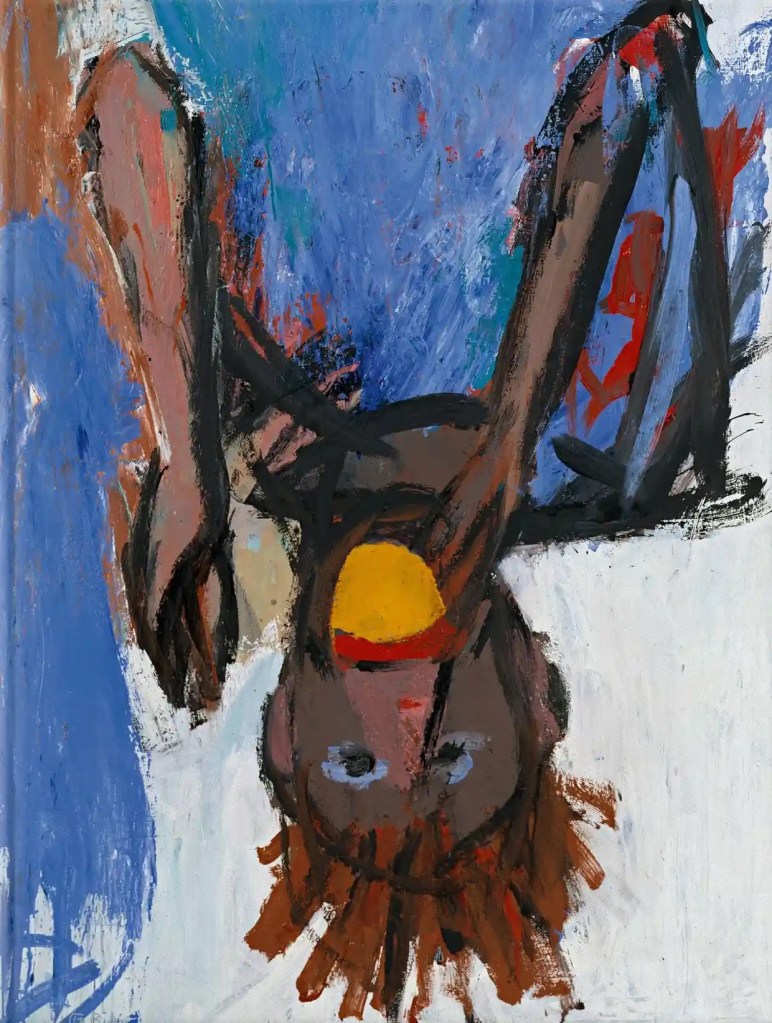
He talks about a narrow, closed view of the world in which a contempt for America – the home of “degenerate” jazz for the Nazis, the capitalist enemy for the GDR – was a constant. “Until I was about 20 years old I did not know there was something like culture in the United States. Based on the information I got from my father and the society around my parents, Americans were funny people. They had no culture and no art, only good weapons. Then I saw the New American Painting exhibition in 1958 from Pollock and his school, and it was like somebody beat me on the head with a big baseball bat. I suddenly learned that Americans did not only have the best weapons: they also had the best painters.”

(Jonathan Jones, “Like being beaten with a bat’: Georg Baselitz on eye-opening art — and his true feelings about female painters,” theguardian.com, 9-12-22)
(c) 2022 JMN — EthicalDative. All rights reserved

“We were flabbergasted. It has taken 100 years to rediscover Atlantic City.”
[Petulant style note: Equally flabbergasting is British journalism’s insufferable convention of not setting off titles with quotes or italics. What two researchers rediscovered was not the coastal city located in New Jersey, but a painting named “Atlantic City” by the artist Helen Saunders.]
Icily repellant, she’s fruit of the Tin Man’s dalliance with a galvanized hussy bucket. “Praxitella” of the ruby lips, faceted contours and catatonic gaze is a morose, Depression-era robot stitched in a tar paper frock with elephantine, copper-banded bloomers. She has the charm of a mud fence. It would take a hydraulic winch to hoist the lump of reductive figuration from her pharaonic chair.

Wyndham Lewis’s portrait of film critic Iris Barry is discovered to have been painted on top of a work called “Atlantic City” by fellow Vorticist Helen Saunders. He may have been irritated with Saunders.

(Harriet Sherwood, “‘Fit of pique’: lost vorticist masterpiece found under portrait by contemporary,” theguardian.com, 8-21-22)
(c) 2022 JMN — EthicalDative. All rights reserved
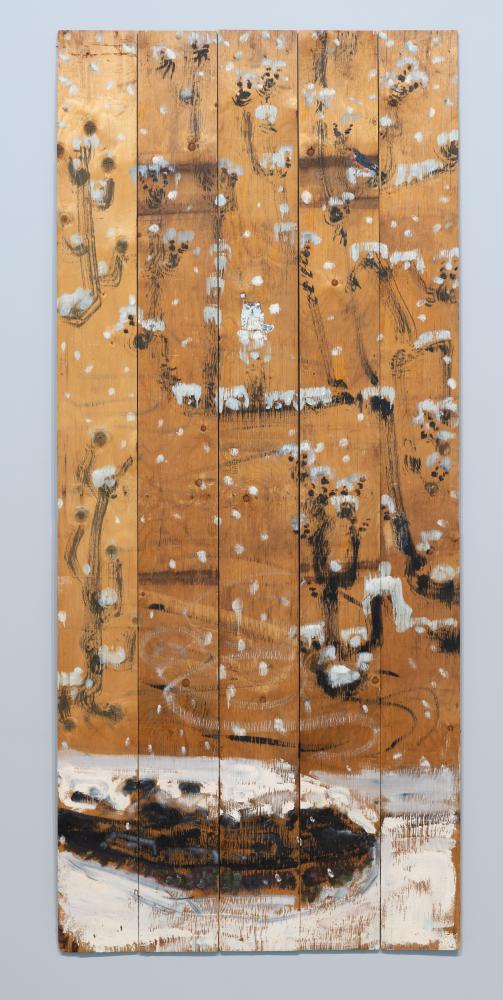
“I realised that the art of the 20th century is the fruit of personal revelation,” Lynch wrote, “while ancient art is the product of mystery initiation.”
I’ve no idea what Bill Lynch (1960 – 2013) meant by his incantation about the meaning of art, using words ending in -ation. The journalist isn’t helpful in contextualizing the comment, writing only that it’s “taken from a letter to a friend in the 1990s.” She adds, “It is surprisingly hard to discover very much about him… He died of cancer aged 53, but his inner life appears private, unknown even to the curator of this show.”
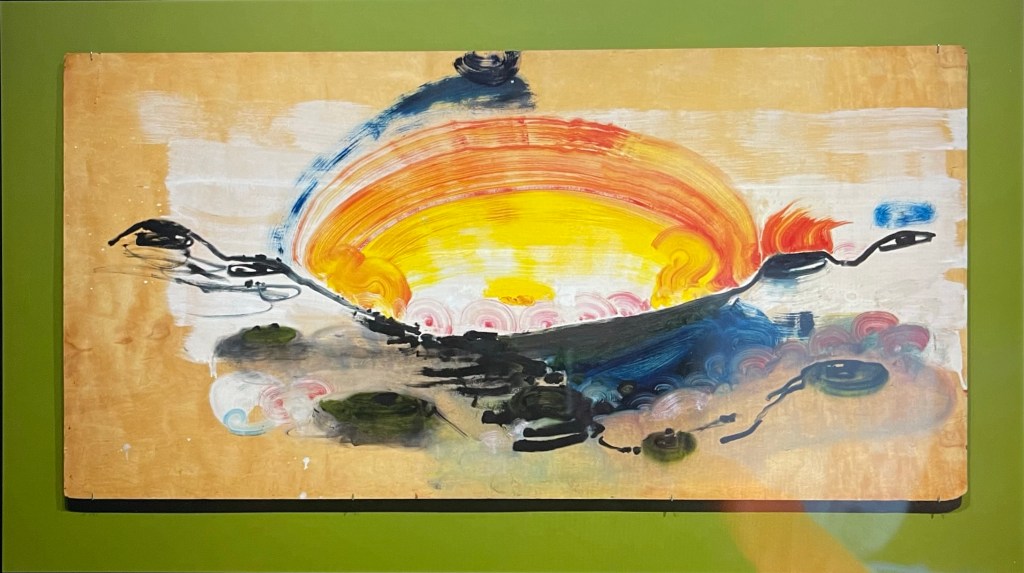
Born in Albuquerque, Lynch studied art at Cooper Union in New York, lived in California for a time, and ended up in Raleigh, North Carolina.
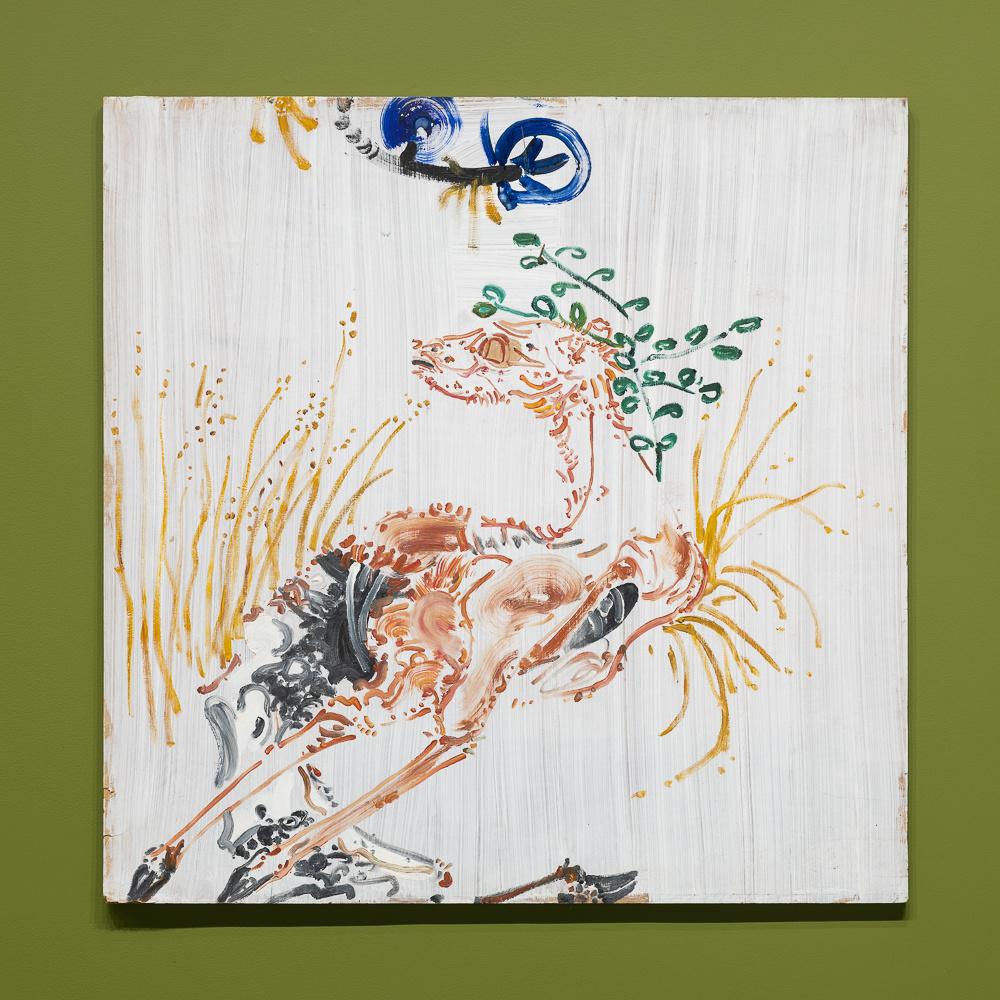
Old plywood, used planks, the top of a table pocked with woodworm: he found a way of painting on this hard and resistant substrate as if it were as light as parchment. And his brushwork, moreover, is rightly described as calligraphic. Owls, hawks, tangled blossoms, the pale discs of honesty seeds hanging like silver moons from skeletal black boughs: his art has all the delicacy of nature, combined with a swirling, stuttering, sometimes wayward abruptness.

(Laura Cumming, “Bill Lynch: The Exile of Dionysus review — the greatest American artist you’ve never heard of?” theguardian.com, 8-21-22)
(c) 2022 JMN — EthicalDative. All rights reserved
I painted it all tried to paint my thoughts / And caught so little / The world still grows it grows relentlessly / And yet there is always less of it
(From “The Old Painter on a Walk” by Adam Zagajewski, translated from the Polish by Clare Cavanagh, The New Yorker, 11-21-22)
Poetry! How do you translate it? I don’t know a word of Polish, but surely translator Clare Cavanagh has tapped transmissible gold from Adam Zagajewski’s poem? Look alone at how the transgressive run-on sentences evoke a perception of headlong welter!
Does winkeling out what a poem says shed light on what it’s “about”? A poet may say, “You’re asking the wrong question; the poem is about what it says. Just feel the burn, revel in the mystery!” Perhaps followed by tips on “how to read poetry.” My dinghy sails past these rodomontades with me lashed to the mast. Words that aren’t more than the sum of themselves are forgettable, and my project is to remember them.
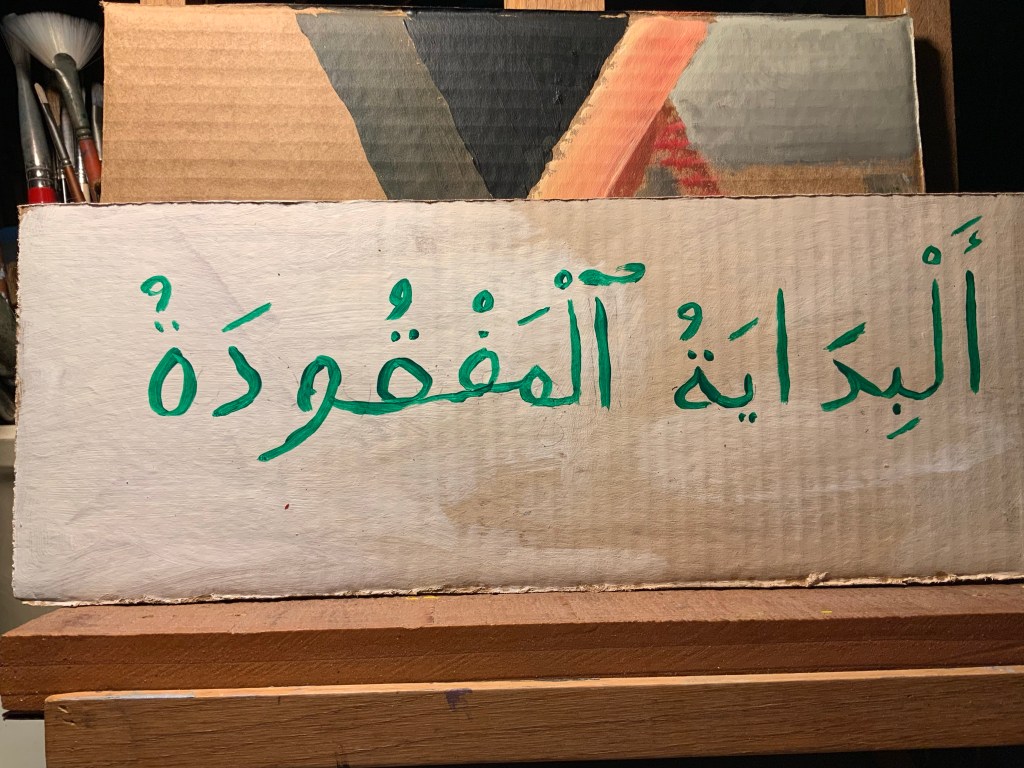
Part 2 of Gilgamesh’s Snake (1) is titled ‘al-bidāyaẗu-l-mafqūdaẗu: “the beginning the lost,” i.e., The Lost Beginning.
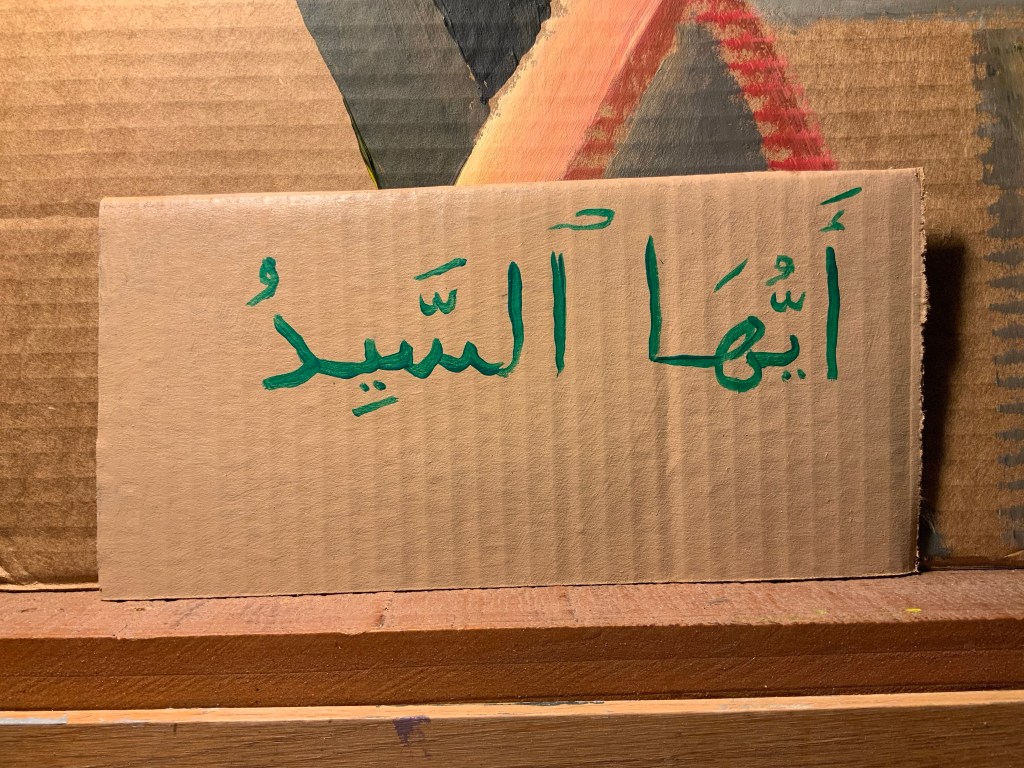
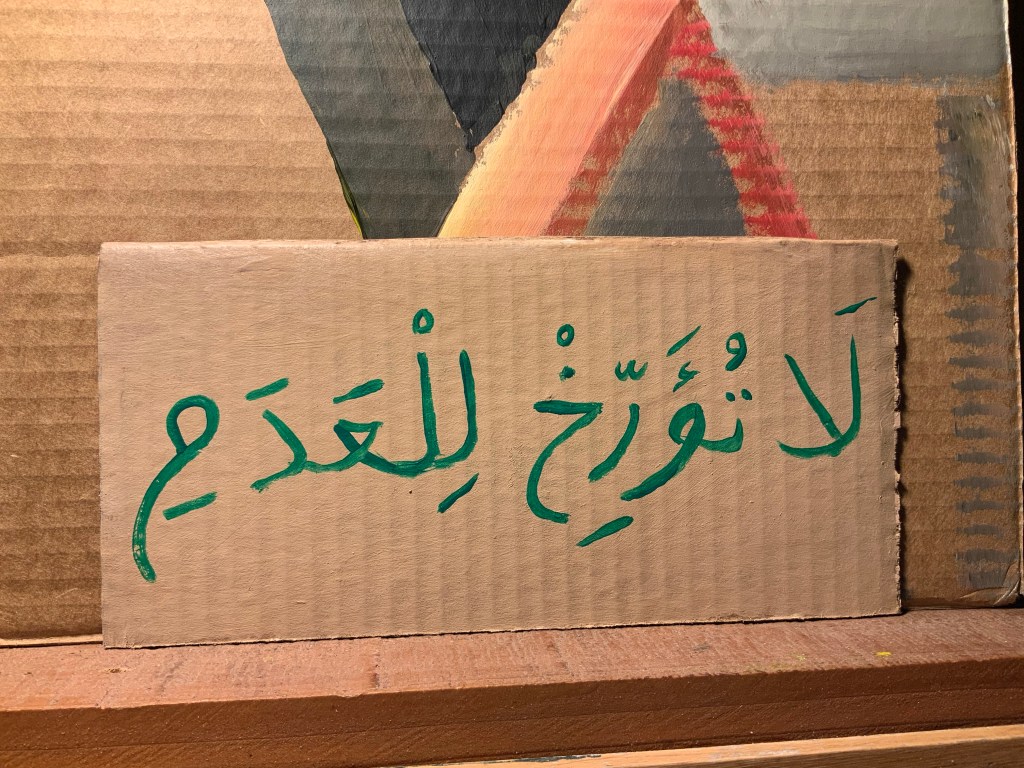
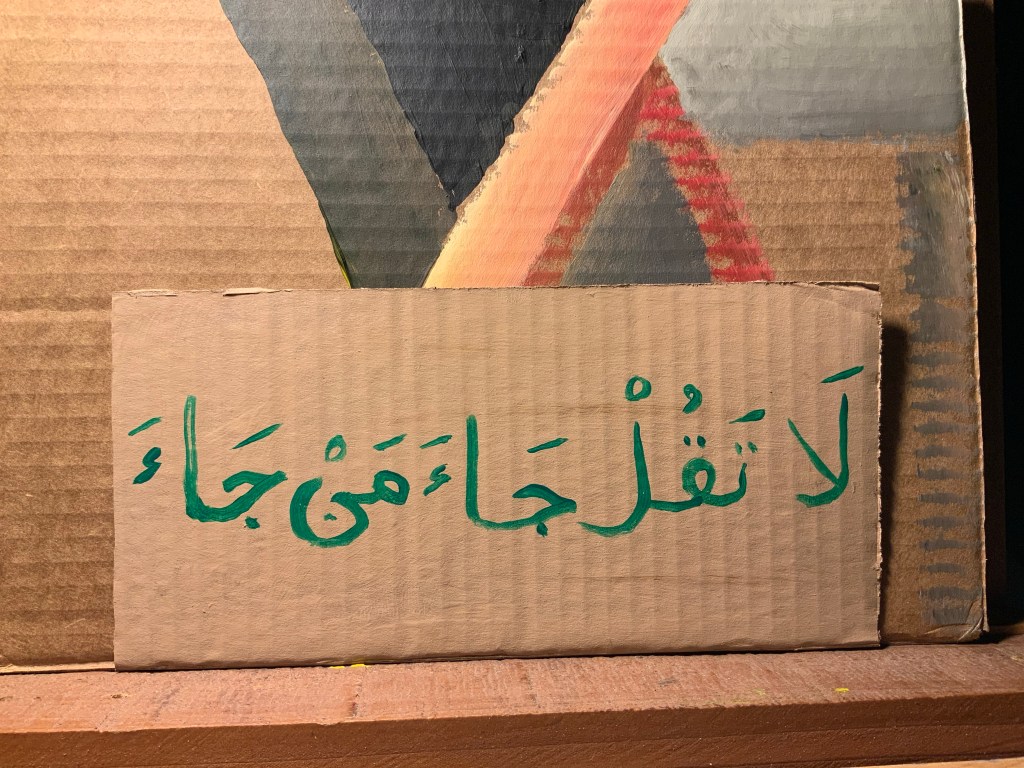
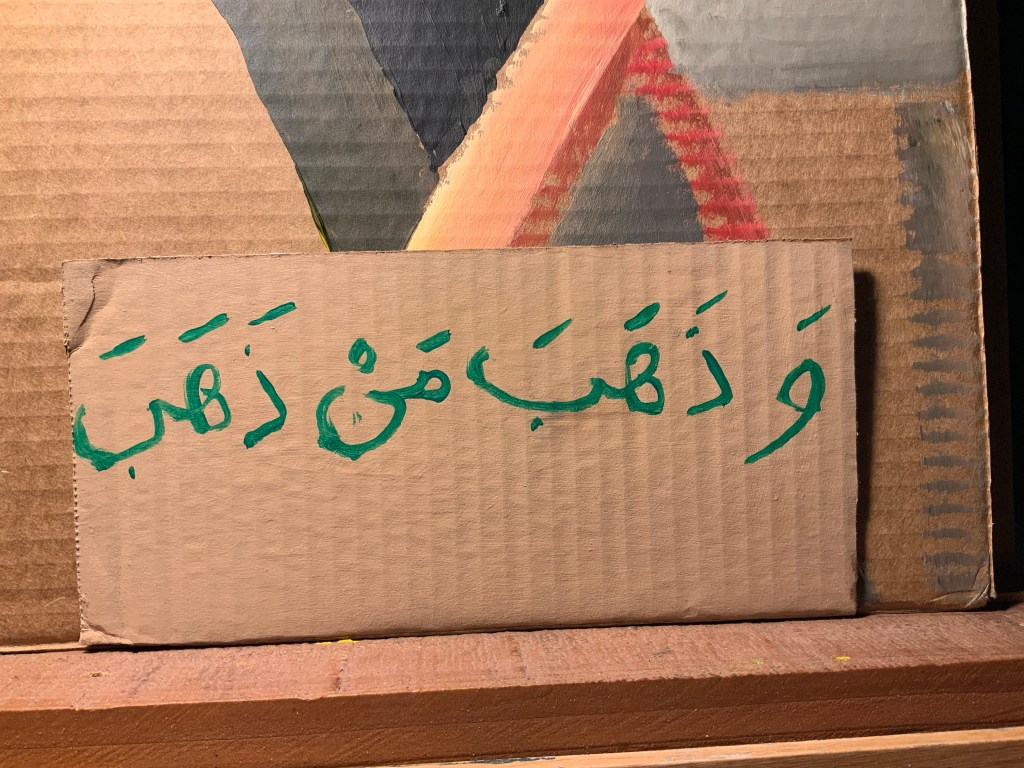


Verses 5 and 6 say, “Don’t draw back from eternity / your pale essence.” Verb kašafa with preposition ^an means to draw back something like a curtain or veil, thus laying bare what it conceals, which in this case is “eternity” — ‘al-ẖulūd. The “curtain” sought by the speaker not to be drawn back is the apostrophized master’s “pale essence.” He’s a historian. In the Glenday-Iskander version (italicized), the historian’s pallor colors eternity, which is the shadow he casts. This gussies up an obscure conceit with razzmatazz, which may fit Borges’ notion that “a translator should seek not to copy a text but to transform and enrich it.” (2) But it’s also Transgressive. (3)
Postscript: I can’t stop fidgeting over that odd comma casting its shadow in verse 6.
Post-Postscript: I need a good calligraphy brush. The paintbrushes I improvise with splay and fudge the script hideously. I’m discovering that a brush is like string: you can pull, but not push it.
Notes
(1) Gilgamesh’s Snake and Other Poems, Ghareeb Iskander, Bilingual Edition, Translated from the Arabic by John Glenday and Ghareeb Iskander, Syracuse University Press, 2015. In text citations, the published translation is in italics beneath my literal rendering and transliteration.
(2) Jiayang Fan, “Han Kang and the Complexity of Translation,” The New Yorker, 1-8-18.
(3) My invented labels are Congruent (matches the source text fairly closely, with minimal liberties taken for readability); Omissive (suppresses elements of the source text without obvious justification); Expansive (adds interpretive structure or content not discernible in the source text but plausibly deriving from it); Inventive (carries the “expansive” element to a level not obviously supported by the source text); Transgressive (departs from the source text in a way that seems to betray the poem’s letter or spirit).
(c) 2022 JMN — EthicalDative. All rights reserved

(A squalid detail to put behind us: “vichyssoise” is misspelled in the review as “vichysoisse.” Slipshod, to be sure, but my esteem for Pete Wells’s writing remains intact. Even Homer nodded.)
Pete Wells said once that when he became restaurant critic for The New York Times he resolved not to write about food in a hackneyed way. Wells doesn’t seek umpteen ways to say a dish tastes good or lousy. That would be all about him and his feelings. He skirts foodie raptures as resolutely as poets shun sunsets.
— … Two mini-slabs of monkfish-liver terrine… are impossibly soft for something that has edges and corners.
— … Karasumi, mullet roe that is salted, pressed and aged into something that tastes like fish-egg ham.
What telegraphs the passion is disdain for low-hanging ecstasies in favor of down-and-dirty detail. Close naming of ingredients, process, presentation and ambience serves to instantiate food in a gustatory headspace shared with the reader, who stands to attention as if summoned by bugle before mysteries such as monkfish liver and cod semen.
— In late fall and into the winter, there may be shirako, sacs of cod milt in loose white coils over ponzu sauce.
— The rice will be just sticky enough to hold together for a few seconds on its way to your mouth. It will be just tart enough that you can sense the presence of vinegar without quite tasting it.
(Pete Wells, “Restaurant Review: Four Stars for Yoshino, Where the Omakase Stands Alone,” New York Times, 11-15-22)
(c) 2022 JMN — EthicalDative. All rights reserved

“I will say something which is crazy, but less democracy is sometimes better for organizing a World Cup. When you have a very strong head of state, that is easier for us organizers.”
(FIFA secretary general Jérôme Valcke, 2013)
Nota Bene: The style of the benemérito presidente of the Fédération Internationale de Football Association (FIFA) is “His Excellency.”
(c) 2022 JMN — EthicalDative. All rights reserved
 EthicalDative
Can We Be Over ‘So’?
I think I’ll forfeit my fortitude when the next person who’s asked a question starts his answer with “So.” It’s like answering queries with “Therefore….”
— Where are you from? — Therefore I was born in Poughkeepsie, but grew up outside Memphis.
— Do you have an MFA? — Therefore I studied for two years at Vanderbilt, but dropped out before I got a degree.
— Can you see the letters on the bottom row? — Therefore they’re too blurry for me to make out.
The ornamental “so” from hell may be entrenched in our discourse now, parroted by legions of the influenced. How do these tics get started? The Kardashians?
(c) 2022 JMN — EthicalDative. All rights reserved