Asked and Answered

Pat Buchanan campaigns with a Winchester rifle in 1996. Credit… Eric Draper/Associated Press

“The American press is infatuated to the point of intoxication with ‘democracy,’ ” [Buchanan] wrote in 1991. To make his point, he compared the Marine Corps and corporations like IBM to the federal government. “Only the last is run on democratic, not autocratic, principles. Yet, who would choose the last as the superior institution?”

(Nicole Hemmer, “The Man Who Won the Republican Party Before Trump Did,” NYTimes, 9-8-22)

I would.

(This American)

(c) 2022 JMN — EthicalDative. All rights reserved

Posted in Commentary, Quotations | Tagged , , , | 1 Comment

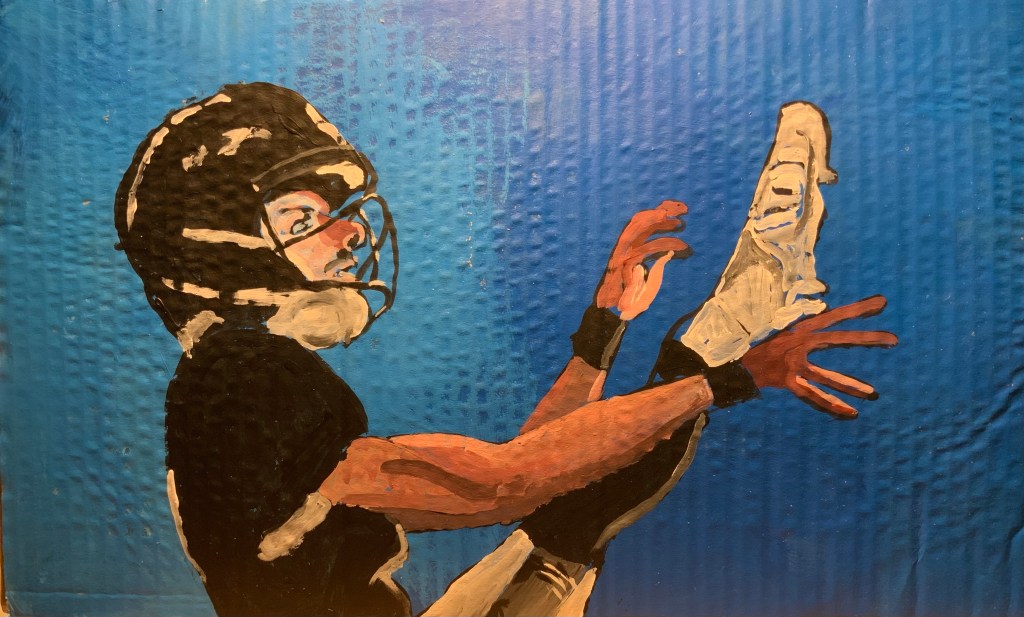
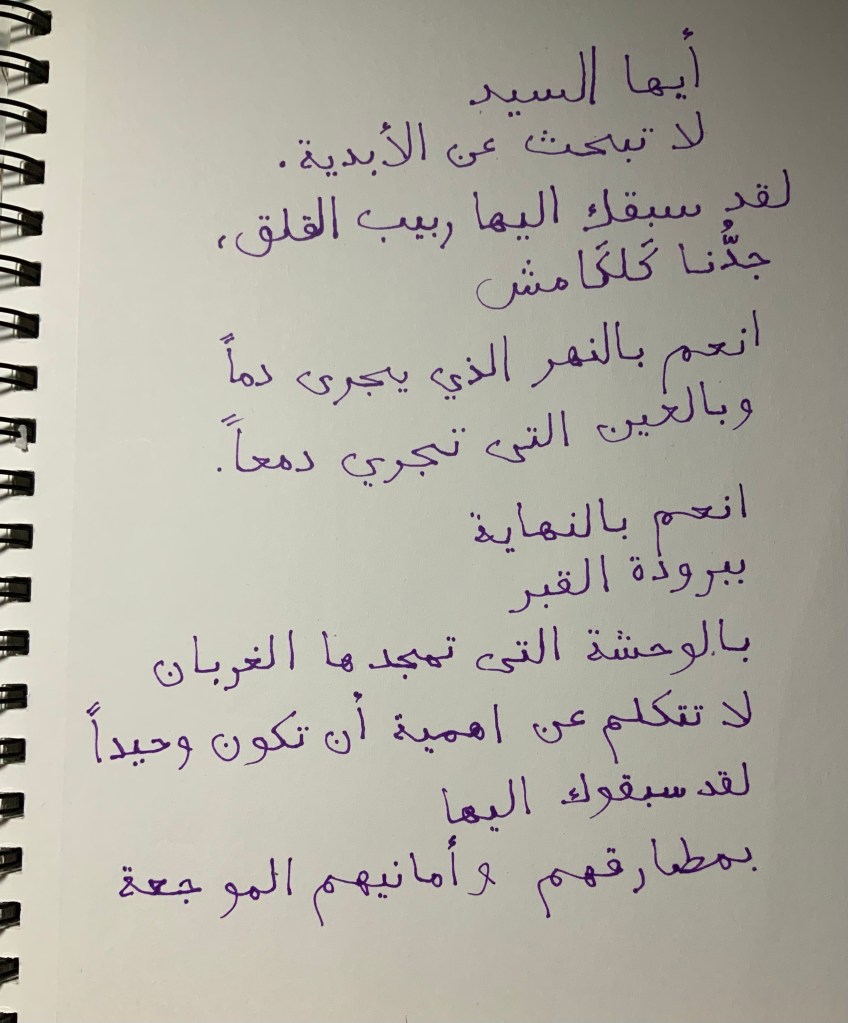
Chasing Command: The Kicker

Acrylic on cardboard.

Statistic: Forty-nine of the 50 highest-scoring players in American football history are kickers.

“And the first ball comes off my foot like a rocket, and then the next one and the next,” he says. “I just felt like I had command over the ball, something every kicker chases.”

(Wil S. Hylton, “How Justin Tucker Became the Greatest Kicker in N.F.L. History,” NYTimes, 9-1-22)

Sports journalism can be commanding and lucid, so replete with specificity and nuanced vigor that it encroaches on poetry. Wil S. Hylton’s profile of Baltimore Ravens kicker (and Austin, Texas native) Justin Tucker is a case in point. I’ve cherry-picked some of Hylton’s lyricism into “stanzas”:

Stanza 1
Kicking is the most consequential and least understood aspect of the sport… [The place-kicker’s job] is to enter a kind of trance, as if he were the last man on earth, and perform a complex choreography of his own.

Stanza 2
He has spent the bulk of his adult life… adjusting… tinkering… perfecting… making fractional changes… He has carefully calibrated the sequence of his proximal-to-distal movements to exploit the kinematic potential of his own proportions.

Stanza 3
There’s the setup… the approach… the plant… the backswing… the follow-through… Each of these movements has its own set of customs and conventions, but none are obligatory… Anybody who’s serious about kicking knows that nobody knows that much.

Stanza 4
… The shape of a football… can be formally described as a “prolate spheroid,” which is another way of saying that it looks like a regular ball getting sucked into a vacuum hose… “The reason not many people have looked into [the aerodynamics of tumbling footballs] is because it’s a very hard problem,” says Timothy Gay, a professor of physics….

Stanza 5
“All great kickers bring a certain amount of arrogance to the table.” And yet to perfect a kick requires an almost inexhaustible reserve of humility and patience as they subject themselves to an endless barrage of punctilious criticism and microscopic correction.

I say this: Respect to the few, the finicky, the inexplicable: poets, translators and kickers.

(c) 2022 JMN — EthicalDative. All rights reserved
Posted in Commentary, Quotations | Tagged , , , , , | Leave a comment

Romancing ‘Gilgamesh’s Snake’

Arabic text copied from page 10 of Gilgamesh’s Snake and Other Poems, Ghareeb Iskander, Bilingual Edition, Translated from the Arabic by John Glenday and Ghareeb Iskander, Syracuse University Press, 2015.

The transliterations bracketed below are mine. In them, tā’ marbūṭa is , and I show the lām of the article as assimilated to a following solar letter. For example: [‘ayyuhā-s-sayyidu] instead of [‘ayyuhā-l-sayyidu]. My character set, contrived to avoid digraphs, is the following:

‘ a ā i ī u ū ay aw b t ẗ ṯ j ḥ ẖ d ḏ r z s š ṣ ḍ ṭ ẓ ^ ḡ f q k l m n h w y

The text tagged “JMN” comprises my English and Spanish interpretation, and my transliteration, of the published Arabic text that’s copied in my illustration. I tag the published translation that follows it “GLENDAY” and add line numbering for ease of reference.

JMN
01 O master! (¡Maestro!)
[‘ayyuhā-s-sayyidu]

02 Don’t seek eternity. (No busques la eternidad.)
[lā tabḥaṯ ^ani-l-‘abadīyaẗi]

03 The stepson of unrest got there before you, (El hijastro de la inquietud te adelantó en ella,)
[laqad sabaqa-ka ‘ilay-hā rabību-l-qalaqi]`

04 our grandfather, Gilgamesh. (nuestro abuelo, Gilgamesh.)
[jaddu-nā kalkāmišu]

05 Take pleasure in the river that flows with blood (Recréate en el río que corre sangriento)
[‘un^um bi-n-nahri-l-laḏī yajrī daman]

06 and in the eye that flows with tears. (y en el ojo que corre con lágrimas.)
[wa bi-l-^ayni-l-latī tajrī dam^an]

07 Take pleasure in the end, (Recréate en el fin,)
[‘un^um bi-n-nihāyaẗi]

08 in the chill of the grave, (en el frío de la tumba,)
[bi-burūdaẗi-l-qabri]

09 in the gloom that the ravens glorify. (en la melancolía que los cuervos alaban.)
[bi-l-waḥšaẗi-l-latī tumjidu-hā-l-ḡirbānu]

10 Don’t speak of the importance of your being alone. (No hables de la importancia de quedarte solo.)
[la tatakallam ^an ‘ahammīyaẗi ‘an takūna waḥīdan]

11 They got there before you (Te adelantaron en ello)
[laqad sabaqū-ka ‘ilay-hā]

12 with their hurtful hammers and desires. (con sus martillos y sus deseos nocivos.)
[bi-maṭāriqi-him wa ‘amānī-himi-l-mūji^aẗi]

GLENDAY
01 Master!
02 Don’t search for everlasting life.
03 Our grandfather, Gilgamesh,
04 who was born in sadness, went there before you,
05 waded through the river flowing with blood
06 delighted in the eye that flows with tears.
07 Love the ending of things,
08 the chill of the grave
09 the strangeness the ravens sing of.
10 Don’t prattle on about needing to be alone.
11 They all went there long before you
12 following the ache and beat of their desires.

COMMENTS
Lines 05 and 06 of GLENDAY hold mystery. I read the verb formed from root n-^-m as a masculine singular imperative of Form 1, with the meaning “take pleasure in” or “delight in.” Is “waded” interpretive license? Line 06 does pick up on the sense of “delighted in,” but, as with “waded,” makes it into a past tense whose subject is “Gilgamesh,” and not a command in direct address to the “master” apostrophized earlier in the poem as the writer of history, which is how I read it. Line 07 of GLENDAY seems to corroborate a parsing of ‘un^um as an imperative, because it issues a command that encompasses the meaning of na^ama: Love the ending of things.

(c) 2022 JMN — EthicalDative. All rights reserved

Posted in Anthology | Tagged , , , , | 2 Comments

Soot, Spit and Paper

The artist often bundled his artworks and hid them in walls. Credit… Maris Hutchinson/David Zwirner.

James Castle (1899 – 1977) was born deaf in rural Idaho, and seems never to have learned to read and write. Formally untrained, he “dedicated his life to making art among the farms and ranches in and near Boise.”

His principle medium throughout was soot from the family stove mixed with his own saliva on the repurposed material he salvaged from his family home, which doubled as a post office and general store.

(John Vincler, “Soot, Spit and Paper: James Castle’s Transfixing Worlds,” NYTimes, 1-13-22)
“Untitled” shows a farmhouse, stairs, and figure. The mix of real and imagined feels starkly contemporary and conceptually rich. Credit… James Castle Collection and Archive LP.

Castle would bundle his works and hide them away in walls and outbuildings, and even in holes.

Untitled” (farmscape). Cut off from the art world, Castle incorporated into his landscapes sculptural elements, like power lines, that look surprisingly contemporary. Credit… James Castle Collection and Archive LP.

Not included in a Castle exhibition at the David Zwirner Gallery of Manhattan are “… his drawn reproductions of product packaging, his handmade books and calendar-like constructions, as well as his experiments with hand-drawn typography.”

Untitled (flamingo construction),” one of several bird constructions. Credit… James Castle Collection and Archive LP.

(c) 2022 JMN — EthicalDative. All rights reserved

Posted in Commentary, Quotations | Tagged | 5 Comments

(Not) Learning to Read

The most important thing schools can do is teach children how to read. If you can read, you can learn anything. If you can’t, almost everything in school is difficult. Word problems. Test directions. Biology homework. Everything comes back to reading.

(Emily Hanford, “School Is for Learning to Read,” NYTimes, 9-1-22)

It’s not about intelligence. Lots of very smart people have a tough time learning how to read. G. Reid Lyon, a former chief of child health and human development at the National Institutes of Health, told Congress in 1998 that learning to read is a “formidable challenge” for about 60 percent of children. They need direct and explicit instruction. Lots of children weren’t getting that kind of instruction in 1998. And they’re still not getting it. (Emily Hanford. My bolding)

“And they’re still not getting it” is the direst phrase in the article. Everything in this America is difficult.

(c) 2022 JMN — EthicalDative. All rights reserved

Posted in Commentary, Quotations | Tagged , , | Leave a comment

‘The Reader Effect’

[Photo July 19, 2015. Copyright 2015 The New York Times Company]. City of Asylum’s first exiled writer-in-residence was Huang Xiang. He wrote: “‘In China I was like a fossil… When I came to the United States and people discovered me, they dug me out of the earth and I became alive’… Mr. Huang painted calligraphy of his poetry on the facade of his City of Asylum rowhouse, which has become a neighborhood icon.”

… Like a scene from Mr. Rushdie’s novel “Shalimar the Clown,” a knife-wielding man rushed onto the stage and began to stab him. Immediately audience members ran to the stage to defend him. It was a remarkable response. That rush of people leaping from their seats was the opposite of the so-called “bystander effect,” when individuals do nothing, relying on others to help. I would call it “the reader effect.” Reading creates empathy… The intuitive response of an empathetic community is to help.

(Henry Reese, “I Was Onstage With Salman Rushdie That Day, and What I Saw Was Remarkable,” NYTimes, 9-2-22)

In 1997, Henry Reese and his wife, Diane Samuels, founded Pittsburgh: City of Asylum, which provides a safe haven for persecuted writers, artists and journalists. Their program includes: “a rent-free home for two years or more if necessary, a stipend, legal counsel, medical benefits and access to professional development opportunities.”

As Mr. Rushdie said in 1997, it’s not just about his right to write; it’s also about our right to read.

(Henry Reese)

(c) 2022 JMN — EthicalDative. All rights reserved

Posted in Quotations | Tagged , , | Leave a comment

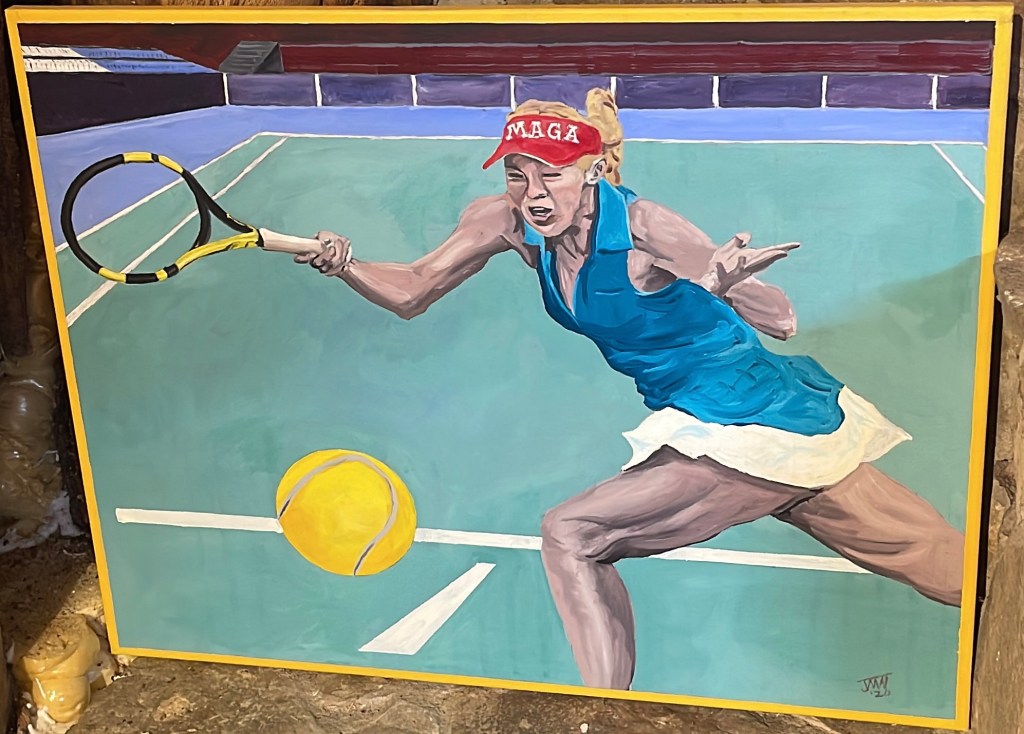
Fixing to Start Something With ‘Gilgamesh’s Snake’

Translated from the Arabic by John Glenday and Ghareeb Iskander.

Ghareeb Iskander is an Iraqi writer who lives in London. HIs book of poems in Arabic, “Gilgamesh’s Snake and Other Poems,” was published by Syracuse University Press in 2016. The English translations are the work of Scottish poet John Glenday and Iskander himself. Their versions command distinct authority, of course. Mine are dictionary-driven and meant to be literal for study purposes (akin to a trot).

Here’s a snippet reflecting the dialog I hope to have with the book. It’s from “Song,” the book’s first poem (my bolding):

My reading in English and Spanish: … He sang the spring — / the flowers that grow / after a long night. / Sang the streets, / did not sing the walls. [Cantaba la primavera — / las flores que crecen / después de una noche larga. / Cantaba las calles, / no cantaba las murallas.]

Published text: … He sang springtime — / the flowers that open themselves / after a long night. / He sang the streets / but he wouldn’t sing the hindering walls.

Amplification flows from the instincts and cultural grounding of the translators. It may capture a nuance of the Arabic that escapes me, or that’s missed by my dictionary. Is that the case with open themselves versus grow?

In other cases, certain phrasing may be deemed better suited to English cadence, or else to express what’s tacit in the Arabic. Consider “but he wouldn’t sing the hindering walls.” “Wouldn’t” injects a hint of willfulness into the Arabic’s unmodulated past tense. A wall can protect as well as hinder. Perhaps the connotation contributed by “hindering” foreshadows a context that lies ahead.

David Remnick has written that comparing two translations of The Brothers Karamazovis to alight on hundreds of subtle differences in tone, word choice, word order, and rhythm.” (“The Translation Wars,” The New Yorker, 10-30-05). What’s worthy of sharing here, now and in future, is the unexpected, where a tyro’s cluelessness collides with inborn savvy. When the poet collaborates in the translation, he serves as a native informant validating shadings and phrasings whose justification may not be immediately discernible, and which readily hold up to sturdy query.

(c) 2022 JMN — EthicalDative. All rights reserved
Posted in Anthology | Tagged , , | 2 Comments

‘Writing a Chrysanthemum’

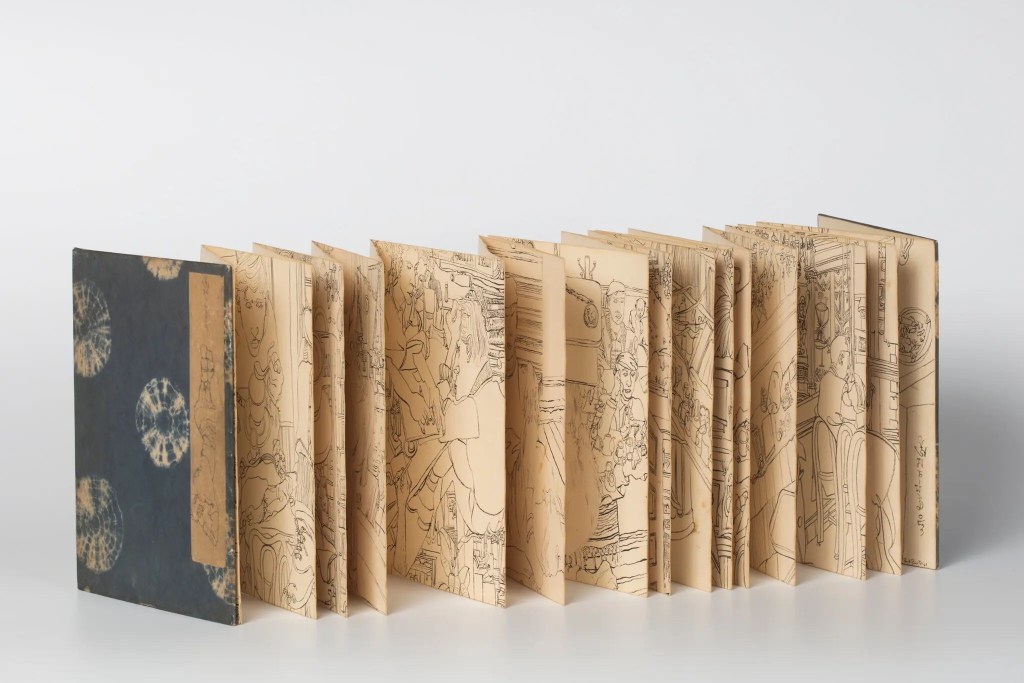
Rick Barton, “Untitled Sketchbook,” 1961. “… A workaday recluse who sought self-knowledge by way of a monastic and unquestioned creative ethic.” Credit… Northwestern University Libraries; Tom O’Connell.

On scrolls of Japanese paper each 19 feet in length, Barton documented the underbelly of San Francisco’s North Beach neighborhood before the hippies showed up… A friend and fellow artist recalled that Barton began a portrait with the sitter’s fingernail… (The show’s title comes from a boy who, as he passed Barton hard at work in Peking’s main square in 1960, observed to his father, “Look, he is writing a chrysanthemum.”) …

(Walker Mimms)
“Untitled [Facade of Barcelona Cathedral],” September 1962, pen and ink with graphite. Credit… UCLA Library Special Collections.

Classical music, not jazz, was Barton’s thing. When he briefly ran a gay nightclub near the Oakland Bay Bridge, he stocked its jukebox with Bach fugues… His clear devotion to the traditional line drawing of China (where the Navy brought him) and of Japan (he used the ultrafine yatate brush) explains his occasionally stunning compositional unity.

(Walker Mimms)
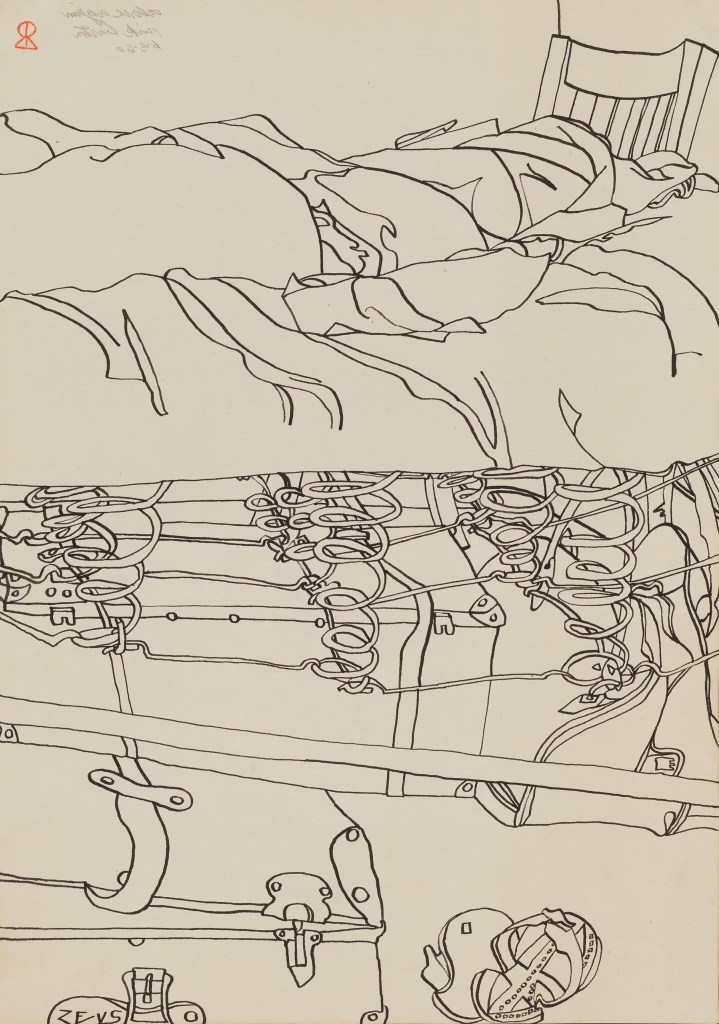
“Alone Again,” June 3, 1960, pen and ink. A bedspring as an unwieldy hunk of architecture. Credit… UCLA Library Special Collections.

“The artist is still alive,” Evans warned the curators in 1971, “but he is crazy as a bedbug and impossible to cope with.”

(Henry Evans, friend and patron who rescued Barton’s abandoned drawings and donated them to UCLA. Quoted by Walker Mimms.)

(Walker Mimms, “Unearthing Rick Barton, A Boho Bard of North Beach,” NYTimes, 8-22-22)

(c) 2022 JMN — EthicalDative. All rights reserved

Posted in Quotations | Tagged , , | 4 Comments

‘Because You See His Teeth, Don’t Assume the Lion Is Smiling’

(Acrylic brushed on wrinkled paper glued to cardboard scrap.) Joan Didion’s novel introduced me long ago to the reigning English solecism. I’m not a golfer, why am I attracted to Play it as it lies? Didion, a rigorous stylist, knew what she was doing. Her choice of the phrase’s version lends it the undermining force she needed. — JMN

The comment about the unsmiling lion is attributed to the 10th-century Arabic poet al-Mutanabbi (915 – 965). I heard it on a podcast called “Arabic Qahwa.” The line has a zesty zing to it that marks it as an old saying to be handed down indefinitely on the tongues of hoary elders, delivered with narrowed eyes and sagacious nods.

Old “Chinese” sayings abound in English. I’m not sure they’re all Chinese, or old, or even much said, but I have a favorite:

Wisdom consists in getting the names of things right.

Chinese Saying?

Whatever its origin, the saying bucks me up by validating a penchant for being ruled by grammar. The fewest words that are right can say enough barely, and leave the rest clearly understood. Excepting poetry, that’s good speech.

(c) 2022 JMN — EthicalDative. All rights reserved

Posted in Commentary, Quotations | Tagged , , , | Leave a comment

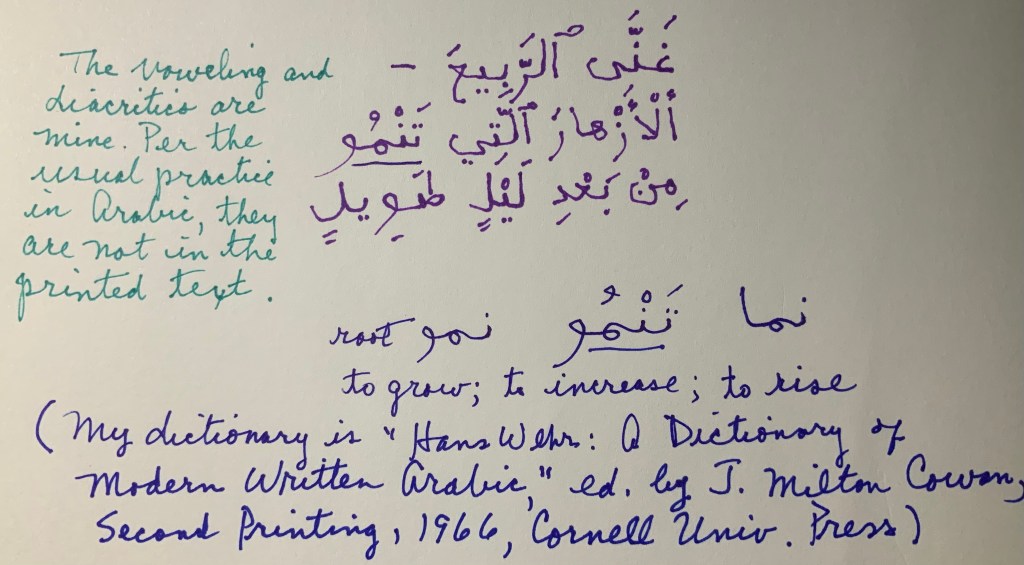
Translating Conceived as Sketching

I wonder if a translation of a poem can be compared to a sketch of a painting? The sketcher recreates aspects of an original art work in a different medium, say pencil. Words are the translator’s medium. She uses those of one language to depict an object made with those of a different language. Both sketcher and translator do something akin to copying. The outcome may do a certain justice to the original, or not, but won’t be confused with it. We’re not talking about forgery or plagiarism.

What’s the point of sketching another art work? Take your answer to that question, I’ll take mine, and let’s see if they apply to translation: What’s the point of it?

Suppose the sketches were made from a painting that has disappeared? Whatever inspired it, say the rape of the Sabine women, is known to us only via the exertions of a sketcher. Pursuing the analogy, a poem may as well not exist for the reader who doesn’t know the language it’s written in. When a translator says, It looks somewhat like this, the reader gains a modicum of access to it, an awareness of it.

Scrupulous fidelity isn’t in the cards in either case. Both actions, sketching and translating, are drenched in subjectivity, contingent on the eye, the tastes, the skill of the renderer. Each is a form of imitation; an homage, perhaps; or an exercise; or an exploration; even an idle amusement. Secondary and derivative, yes, but each possessing a life of its own.

(c) 2022 JMN — EthicalDative. All rights reserved
Posted in Commentary | Tagged , , | Leave a comment